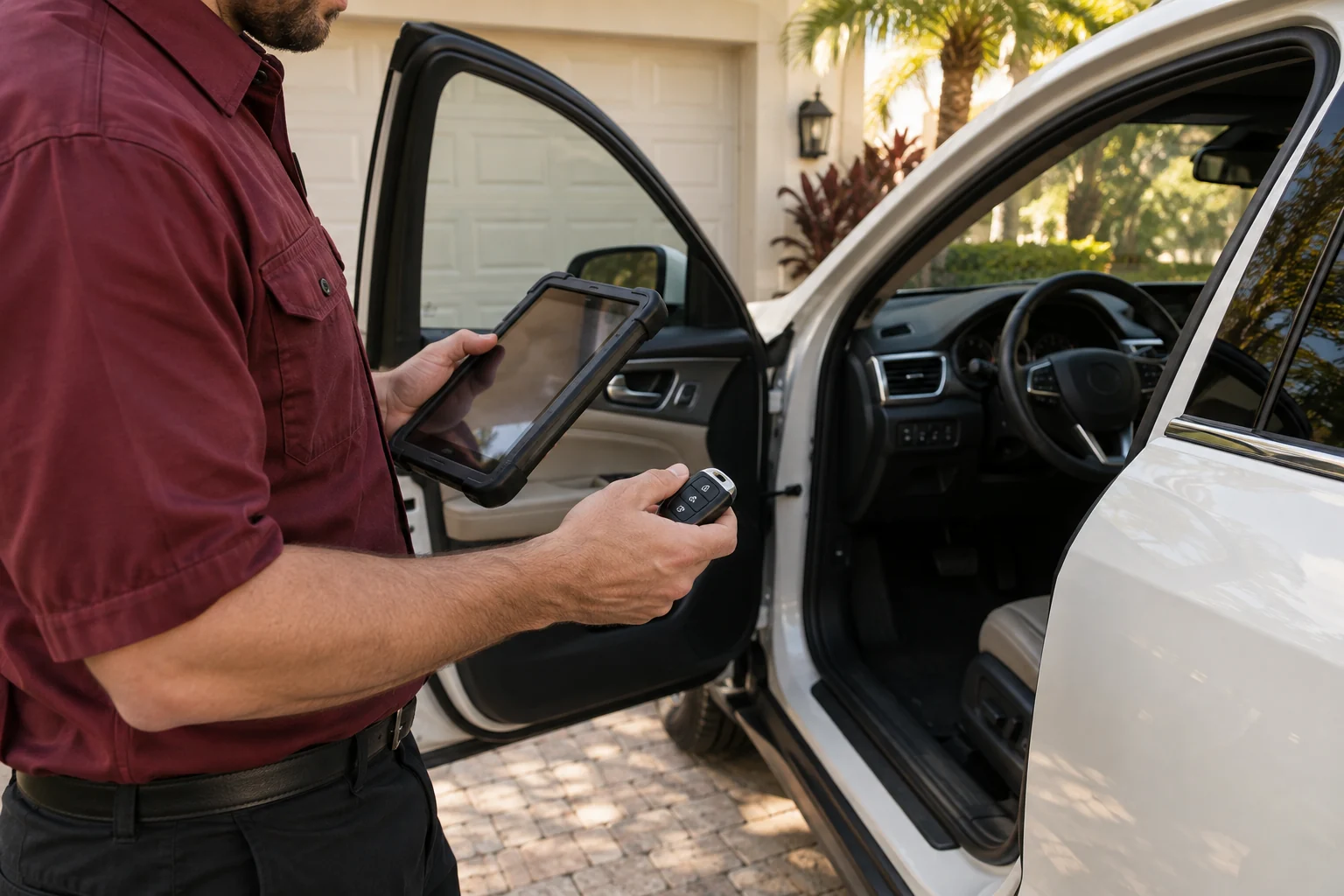
What car key replacement really involves
Replacing a car key used to mean cutting a piece of metal to match a pattern. For most vehicles on the road today, it means a lot more. The key carries an electronic identity that the car must recognize, and the metal blade, if there is one, is only half of the job. A key that turns the lock but is not recognized by the vehicle will not start the engine.
That is why car key work divides into two connected tasks: cutting and programming. Cutting shapes the blade so that it moves the ignition and door lock the way the factory key does. Programming teaches the car to accept the new key and, where possible, to ignore a lost one. A skilled automotive locksmith handles both, and explains which parts apply to your vehicle.
The details differ from one make and model to another, which is why the first step is always a conversation. Describing your car, your current keys and your situation helps the locksmith explain the work, give a clear price and set expectations before anything begins.
It also helps to know what an automotive locksmith does not do. A locksmith does not start vehicles without proper keys or ownership checks, and a responsible one will say no to requests that look wrong. That boundary protects every honest owner, because the same rules that slow down a stranger are the ones that keep your own car from being taken.
The kinds of keys you may be holding
Drivers often do not know which type of key they have, and the difference matters. Older vehicles may use a plain metal key with no electronics. Many cars from the late nineties onward use a transponder key, which looks like a metal blade attached to a plastic head with a small chip hidden inside. The chip sends a coded signal that the vehicle checks before allowing the engine to run.
Some keys have a thick, wavy blade cut along the side rather than the edge. These are laser cut, or sometimes called sidewinder keys, and they are harder to duplicate with ordinary equipment. Others are fobs with a built in blade that flips out, with buttons for locking, unlocking and opening a trunk. Still others are smart keys that never touch the lock, because the car senses them nearby and starts with a push of a button.
If you are not sure what you have, look for a chip symbol on the head, buttons, or a flip out blade. Our articles on laser cut versus standard car keys and transponder key programming explain these differences with examples.
Condition matters too. A key that has been through the wash, been left in a hot dashboard, or spent a summer at the beach may carry hidden damage. Heat can weaken the plastic housing and moisture can corrode the electronics. In South Florida's humidity and salt air, keys age differently than in dry climates, and an early replacement is often wise.
- Plain metal keys with no chip, found on older vehicles.
- Transponder keys with a chip in the plastic head.
- Laser cut keys with a cut along the side of the blade.
- Flip out and remote head keys with lock and unlock buttons.
- Smart keys and push to start fobs that work without being inserted.
When all keys are lost
Losing every key to a vehicle is the hardest version of this problem. There is nothing to copy, so the new key has to be built from information about the vehicle. The locksmith confirms who you are and that the vehicle is yours, determines the key type, creates a key that matches and then programs it so the car accepts it.
Ownership verification is part of responsible work, not an obstacle. A key to a vehicle is access to something valuable, and any professional will want to see identification and proof that the car belongs to you, such as the registration. Have those ready when you call so the process can go forward without delay.
When the car is parked where it cannot be moved, such as a lot, a garage or a roadside, a locksmith who works at the vehicle is often more practical than a tow. Describe where the car is and how it is parked when you call. Our guide on car key replacement cost explains what shapes the price in this situation.
Think about what else was on the key ring. House keys, a mailbox key and a gate fob may have disappeared along with the car key. If the missing set also holds your home keys, deal with the home first, since a lost car key combined with a registration in the glove box can point to your address. Ask about resetting those locks in the same conversation.
Broken keys, worn keys and keys that stopped working
Not all key problems are losses. A key can snap off in the lock or the ignition, leaving part of the blade inside. It can wear down until the cuts are rounded and the ignition no longer turns easily. A fob can survive years in a pocket and then stop working after a drop or a splash of water.
A snapped key should not be pushed, pried or forced. Doing so can wedge the broken piece deeper or damage the cylinder. The safer step is to stop and call someone who has the right tools and experience to remove it. Patience here usually saves the cylinder and the key.
Worn keys deserve attention before they fail. If your key turns stiffly, sticks, or needs to be wiggled, the key or the ignition may be wearing out. Having a fresh key cut from the code, or from a good original, can bring back smooth operation. Sometimes the ignition cylinder is the real culprit, which is covered in the next section.
If a key is worn but still works, resist waiting for the day it quits. A key that fails in the middle of a parking lot, at an airport or in the rain turns a small job into a stressful one. Make a fresh key while the old one still works and the car can be brought in calmly, and retire the worn one once the new key is tested.
Ignition trouble versus key trouble
Key and ignition are partners, and when something goes wrong it is not always obvious which is at fault. A key that will not turn might be worn, bent or the wrong one. It might also be that the steering wheel is locked against the key, or that the ignition cylinder has worn tumblers inside.
A simple test is to try a second key if you have one. If the spare turns freely, the first key is probably worn. If neither key turns smoothly, the ignition is more likely at fault. This is one more reason a spare is useful. A key that sticks or refuses to come out of the ignition points the same way, so stop and ask for help instead of forcing it.
Ignition repair and replacement is a related service, described on our ignition repair page. If the cylinder needs work, the locksmith will explain the options, including whether the existing cylinder can be repaired, whether a new one is needed and how keys will be matched afterward.
Warning signs of an ignition problem include a key that needs jiggling, a steering wheel that stays locked and resists the key, dash lights that flicker when you turn the key, and a starter that sometimes does not respond. Any of these can have causes beyond the ignition, such as a weak battery, so a short conversation about the symptoms helps decide who should look first.
Fobs, remotes and push to start systems
Many drivers think of the fob as a convenience, but on a lot of vehicles it is the key. Replacing a fob means more than matching a shape: the new unit must be compatible with the car and then programmed to it. Some fobs can be programmed by a locksmith, while others rely on specialized equipment or on steps only the maker supports.
Push to start vehicles have no ignition slot, and the car decides whether to start by detecting the fob nearby. When the only fob is lost, the process of making a new one can involve additional security steps. We explain the situation in what to do if you lose a push to start key.
If your fob has simply stopped responding, the cause may be as simple as a dead battery, or it may be a worn button or a failed circuit. Our guide on why a key fob stops working offers a few safe checks you can do before calling anyone.
Water is a frequent enemy of fobs. A fob that went through a pool, a wave or a heavy storm may work for a day and then fail. Do not rely on it. Dry it as well as you can, and plan on a replacement, because corrosion keeps spreading inside the case even when the buttons seem to respond.
Locked out of your car
Auto locksmith work includes lockouts, where the keys are inside the car or cannot be found. The goal is to open the vehicle without damaging it, using professional methods. Please do not try to force a door, pry a window or use a coat hanger style tool, since these approaches often scratch paint, bend door frames and damage weather seals.
Safety comes first. If a child or a pet is locked in a vehicle, especially in the heat of a Florida day, treat it as an emergency and call emergency services right away. A car interior heats rapidly, and nothing about a key is more important than a life. Our article on locked out with a pet or child inside explains what to do.
For ordinary lockouts, our guides on locked keys in the car and the trunk specific case give you options. Describe your location, the make and model, and the type of key, and the locksmith will explain how the car will be opened and what the work involves before it begins.
If the car is in a garage or parking structure with limited access, mention that as well. Gated lots, tight spaces and low ceilings affect how the work is done, and knowing about them in advance prevents delays. In a condo or apartment building, you may also need to tell the front desk or property manager that a locksmith is coming.
Dealer, locksmith or a mix of both
Dealerships can make keys for the vehicles they sell, and locksmiths can make keys for a broad range of makes. Each has strengths. A dealer typically needs the vehicle to come to them, which is a problem if the car cannot be driven. A locksmith can often come to the vehicle and work in the parking space where it sits.
Neither route is right for every vehicle. Some newer models or less common makes have restrictions that favor one path. Our comparison of locksmith versus dealership for car keys sets out the factors to consider, including convenience, timing, and what the process involves.
Whoever you use, ask them to explain before they start: what kind of key you are getting, whether it will be programmed, what the final price covers, and how the key will be tested. A professional answers plainly and does not pressure you into a decision.
Be wary of any company that will not explain the work, avoids giving a clear price, or asks for payment before telling you what you are getting. Those are signs to pause. A simple and honest explanation of the steps, the key and the cost is what you should expect from anyone you let near your vehicle.
Spare keys, and why to make one now
The simplest advice in this whole field is to make a spare while you still have a working key. Copying from a working original is generally simpler than building a key from scratch after everything is lost. A spare also protects against wear, failure and the ordinary chaos of life.
A spare should be kept somewhere safe at home, not in the car and not in an obvious hiding spot on the vehicle. If you share the car with family members, give each driver their own key. Our article is a spare car key worth it goes through the reasons in more detail.
Consider restricted and high security keys too. Some manufacturers limit who can copy their keys, and extra steps may apply. Ask the locksmith early whether your key falls into that group, so you can plan around any extra steps.
Another habit worth building is to keep a note of your vehicle details somewhere safe, such as the make, model, year and the type of key. That information makes any future call easier. Resist posting photos of your keys online, since some key patterns can be read from a clear picture and copied by someone you never met.
What to expect when you call
The process is straightforward. You call and describe the situation: the make, model and year, the kind of key if you know it, and where the vehicle is parked. You say whether you have any keys at all. The locksmith explains how the work would go and what it would cost before anything begins.
When the work is done, the finished key is tested with you. You watch it open the doors, start the vehicle and operate any remote buttons. You should leave knowing exactly what was made and how to take care of it. If anything is off, say so before the locksmith leaves.
Afterward, look after the new key. Keep it dry, keep the battery fresh in a fob, and avoid hanging a heavy bunch of keys from the ignition key, since the weight strains the cylinder over time. A light key ring and a tidy habit of putting the keys in the same place every day prevent most of the problems that bring people to a locksmith.
Half Off Locksmith serves cities throughout Broward County, including Coconut Creek, Plantation and Davie. Our broader list is on the services page. Call, describe your vehicle and your situation, and you will hear the plan before any work starts.
Common questions
Can a locksmith make a car key if I have lost all of them?
In many cases, yes. The locksmith confirms ownership, identifies the key type, creates a matching key and programs it to the car. The process depends on the make and model, and some vehicles have extra steps. Describe your car when you call, and the locksmith can explain what applies.
Will a new key start my car right away?
Only if it has been programmed to the car. A key that is merely cut to shape may open the door but fail to start the engine on modern vehicles. A good locksmith tests the finished key with you, including starting the car and trying any remote buttons.
What proof of ownership will I need?
Expect to show identification and proof that the vehicle is yours, such as registration or title. This protects you and the locksmith. Have these ready when you call so the process runs smoothly, and tell the locksmith if any documents are missing.
What if my key broke off in the ignition?
Stop and do not try to force it out. Pushing or prying can damage the cylinder. Call a locksmith who can remove the broken piece and check the ignition. Afterward, a new key can be made, and the ignition can be repaired or replaced if it was harmed.
Do you work on push to start and smart keys?
Many smart and push to start keys can be replaced, though the process depends on the vehicle. Some need extra security steps. Describe the make, model and year when you call, and the locksmith will explain whether and how a replacement can be made for your car.
Is it better to call a locksmith or the dealer?
It depends on the vehicle, its location and the key type. Locksmiths often come to the car, which helps when it cannot be driven. Dealers usually need the vehicle brought in. Ask each how they would handle your car, and compare what each explains about the work and the price.