The small chip inside the plastic head
Look closely at a car key made in the last few decades and you will usually find a plastic head wrapped around the metal blade. Inside that plastic sits a tiny chip, often smaller than a grain of rice. That chip is the transponder, and it is the reason a key can look perfect and still refuse to start the engine.
The chip does not need a battery in most designs. When you turn the key in the ignition, a ring antenna around the lock energizes the chip for a moment, and the chip answers with a coded message. The car's computer compares that answer with what it has stored. If the message matches, the engine is allowed to run. If it does not, the car may crank without firing or may not crank at all.
The whole point of this system is to make a simple copy of the metal blade useless on its own. In the past, anyone with a key blank and a grinder could duplicate a key in a minute. With a transponder, the blade only opens the door and turns the cylinder, while the electronic handshake decides whether the car actually runs. That is a real security improvement, and it is also why replacing a lost key is a more involved job than it used to be.
What programming actually means
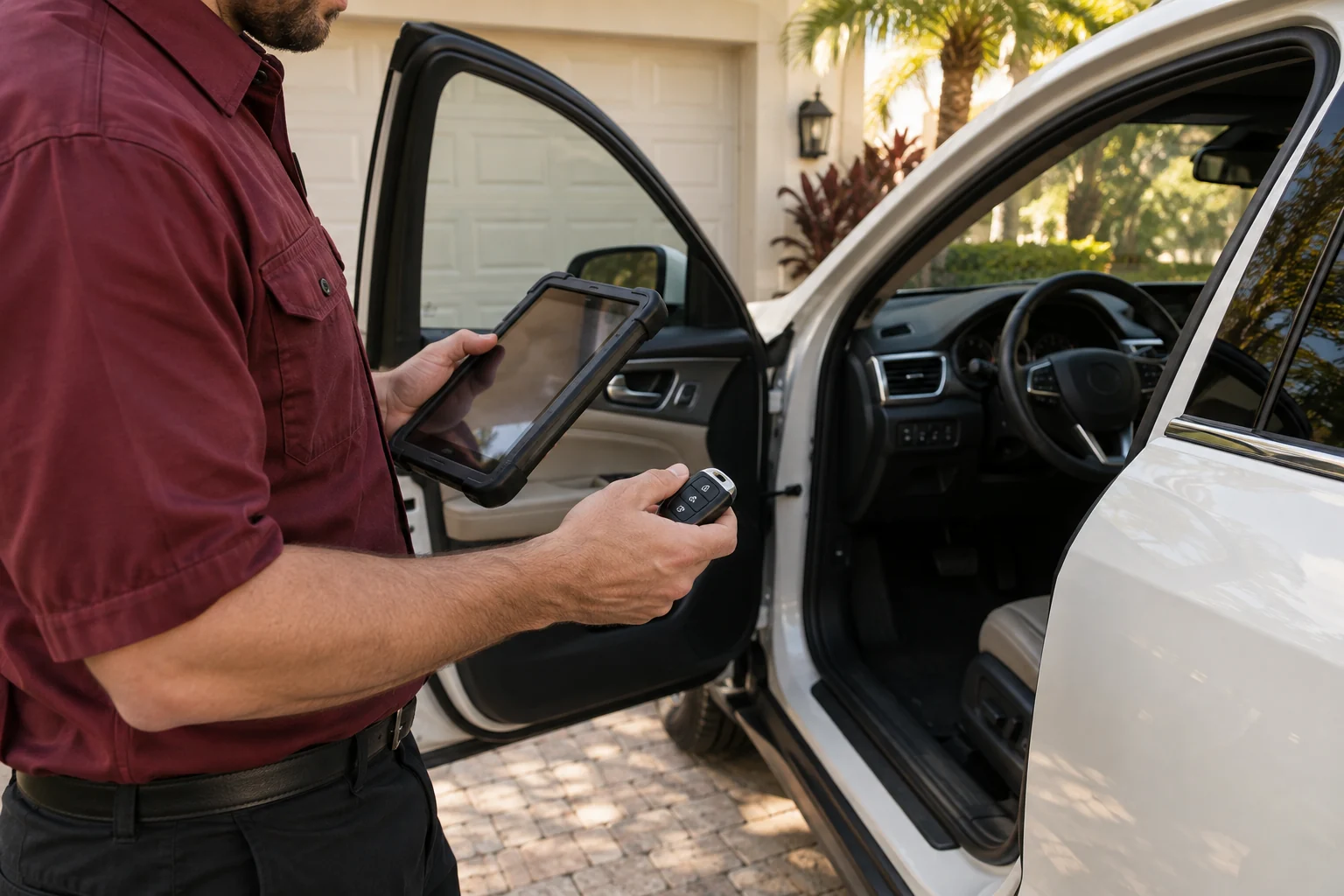
Programming is the step that teaches the car to accept a particular chip. Depending on the vehicle, this may mean writing a new key into the car's memory, copying certain data onto a blank chip, or both. A technician uses diagnostic equipment connected to the vehicle, plus software and sometimes security information tied to the car, to complete the process.
It is worth understanding that two keys can be cut identically and still behave differently. The blade controls the mechanical side. The chip controls the electronic side. A locksmith needs to make sure both parts are right: the blade must turn the cylinder smoothly, and the chip must be recognized by the car. Manufacturers also change their systems from one model year to the next, so a procedure that suits one trim level may not suit the one beside it on the lot. If either part is off, the key may unlock the doors but fail to start the vehicle, or the reverse.
Some systems let a new key be added while an existing key is present. Others require the car to be placed in a mode where all keys are rewritten together, which means every key you want to keep, including old spares, may need to be brought along. Mention how many keys you have, and where they are, when you call, since it changes how the visit is planned. The car key replacement page gives a broader view of the services involved.
Programming is not something you can judge by looking at the key afterward. A freshly made key can feel solid in the hand and still be incomplete. That is why testing matters as much as the work itself. A careful technician will start the car with the new key, turn it off, start it again, try each button, and lock and unlock the doors, rather than stopping after the first successful start.
Why a hardware store copy often fails
Many people discover transponder keys the hard way. They have a spare cut at a kiosk or a hardware store, walk to the car, and find that the door opens but the engine will not start. The blade is correct. The chip, if there is one, was never taught to the car, and a plain metal blank has no chip at all.
Some shops sell blank keys with a chip inside, and some can duplicate certain chips onto a new blank. That can work for some vehicles and not others. Even then, it is wise to test the key thoroughly before relying on it, including starting the car more than once, and doing so while someone can help if something is not right. A copy that works once in a parking lot and fails the next morning is no use as a spare.
If you are unsure what kind of key your vehicle uses, a locksmith can usually tell from the make, model and year, plus a look at the key you already have. Newer designs may use a different blade profile, which is covered in the laser cut versus standard car keys guide, and some use restricted blanks that are only available through controlled channels, discussed in the high security and restricted keys post.
Transponder keys, remotes and push button starts are not the same
The words key, fob and remote get used loosely, which causes confusion. A basic transponder key has a chip and a blade, and nothing else. A remote head key adds buttons for locking and unlocking, built into the same plastic head. A smart key or proximity fob may have no blade you use daily at all, and instead works when it is near the car and you press a start button.
Each of these has its own programming path. The chip that allows the engine to run and the remote buttons that operate the locks are often handled as two separate steps, even when they share one housing. It is common for a key to start the car but have dead buttons, and in that case the remote portion is the part that needs attention, not the chip.
If your car uses a push button start and the fob is missing, that is a different situation from a lost blade key, and the push to start key lost article covers what to expect. If the car starts but the buttons have stopped working, start with the key fob not working guide, since a battery or a simple reset is sometimes involved before reprogramming is needed.
What a locksmith needs from you
A good locksmith asks questions before touching anything. Expect to be asked for the make, model and year of the vehicle, the number of keys you have, whether you have any key at all, and whether the car is currently at home, at work or somewhere else. If you can describe the key, such as a metal blade with a rubber head or a flip key with buttons, that helps too.
You will also be asked to show that the car is yours. This is normal and protective, not a hurdle. A locksmith who makes keys for any car without asking questions would be a risk to every vehicle owner, including you. Having your identification and proof of ownership ready, such as registration, makes the visit smoother. The specific paperwork a technician requests can vary, so ask what to have on hand when you call.
The call is also the right time to ask how the work will go. You can describe the situation and the place, and the work and the price are explained before it begins. If anything is unclear, ask for it in plain words before agreeing. Once the key is made and programmed, the finished work is tested with you, including starting the car and checking all the functions of the key.
- Have the vehicle make, model and year ready.
- Locate every key you still have, even old or damaged ones.
- Keep proof of ownership and identification handy.
- Note whether the car has a push button start or a keyed ignition.
- Tell the locksmith where the vehicle is parked.
When all the keys are lost
Losing every key is stressful, but it is a situation locksmiths handle regularly. Without a working key to copy from, the technician typically uses the vehicle's identification information, together with the right equipment, to create a key from scratch. The result is a new blade cut to the lock and a chip taught to the car.
In this scenario, the process can involve more steps than adding a spare to a car that already has one working key. Some vehicles require additional security procedures, and the details differ by manufacturer. Being flexible about the details, and asking the technician to walk you through what applies to your car, saves frustration.
Once new keys are working, consider whether the old keys are a concern. A key that was lost may be in someone's hands, or it may be at the bottom of a lake. In most cases, a car can be set up so that the missing key no longer starts it. Ask whether that step is part of the work on your vehicle, because it can be an important part of feeling secure again. The locksmith versus dealership comparison explains how the two routes differ when you are choosing who to call.
The value of making a spare before you need one
Programming a second key while you still have a working one is usually the calmer path. You can plan a visit, choose a time that suits you, and avoid the tension that comes with being stranded. The existing key can often be used to add another, and there is no pressure about where the car is or what you are late for.
A spare also protects against a quieter problem: wear. Keys that have been used daily for a long time can develop rounded teeth, cracked housings and weak chips. The blade can begin to stick in the ignition or door, and a worn key can damage the cylinder it turns. A fresh spare gives you a baseline to compare against.
If you are weighing the idea of a spare, the spare car key guide lays out the reasoning in plain language. Keep the spare somewhere safe and away from the car, not in the glove box or under the bumper, since a key kept with the vehicle offers little protection if the vehicle is the problem.
Think about who else drives the car. Households with several drivers, or small businesses with shared vehicles, often end up with keys scattered across pockets, drawers and key hooks. When you plan a programming visit, gather everyone's keys at once and decide how many you really need. Fewer keys in circulation means fewer chances for one to go missing, and it keeps the programming session simpler.
Ignition trouble that looks like a key problem
Sometimes a key has nothing wrong with it and the real trouble is in the ignition. A worn ignition cylinder can make a good key stick, refuse to turn, or turn only with a jiggle. The transponder ring antenna around the cylinder can also fail, so the car never reads the chip even though the chip is healthy.
This is why a technician may test your existing key before programming a new one. If the old key starts the car without trouble, the system is working. If it does not, the new key may not fix anything, and putting time into programming a new chip would be a waste. Testing first saves effort and avoids a repeat visit.
If the ignition feels rough or the key seems to stick, the ignition cylinder problems article outlines the common causes, and the ignition repair page describes the work involved. Repairing a cylinder can change how keys are cut for it, so tell the technician about any ignition behavior when you first call.
Battery and wiring faults can imitate the same symptoms. A weak car battery can make the security light blink and the engine refuse to start even when the key is flawless, and a loose connection near the ignition can do the same. Before assuming the key is the culprit, a careful technician will look at the bigger picture, because replacing the wrong part wastes time and leaves the original trouble in place.
Coastal conditions, parking and key care
Cars in South Florida spend a lot of time outdoors, in heat, humidity and sometimes salt air. Key heads can crack, rubber coatings can peel, and moisture can find its way into the housing. A key that has been dropped or soaked may still unlock the door while the chip inside is damaged.
Small habits help. Avoid leaving keys on a hot dashboard, avoid heavy keychains that load the ignition, and replace a key with a cracked housing before the chip is exposed. If a key begins to work only sometimes, treat that as an early warning rather than a quirk. Intermittent behavior almost always gets worse.
If you live in or near Hollywood, Miramar or elsewhere in Broward County, this is general guidance for drivers rather than a claim about any one neighborhood. The conditions that wear out keys are shared across the whole region, and so are the solutions.
Parking habits matter as well. A vehicle left outdoors through long stretches of sun and rain exposes its keys to the same heat each time you stash them in a cup holder or on the dash. Condo and apartment residents who share a garage or lot with many other cars can also mix up fobs that look alike, so labeling your spare in a discreet way saves confusion. Small details like these rarely get mentioned at the counter, but they decide how long a key stays reliable.
Other vehicles, other keys
Not every vehicle uses a car style key. Motorcycles, scooters and some boats and utility vehicles use similar chip based systems, and some use simple mechanical keys with no chip at all. The principles are the same: the blade and the electronics must both be right, and the vehicle must be taught to accept the key.
If you ride, the motorcycle key replacement article covers how those keys differ. For cars, the details depend on the manufacturer and the model year, and it is normal for a technician to say that your car requires a particular approach after looking at it.
Before you agree to any programming, ask the technician to confirm that the work covers both the chip and any remote buttons you expect to use, and that the finished keys will be tested with you. A calm, step by step visit is the clearest sign that the work is being done carefully, and it leaves you with keys you can trust.
One more practical point concerns timing. Programming is rarely something to squeeze into the last minutes before you need the car. Give yourself room to test the new keys at home, in daylight, with the engine running and then off again. If something feels odd, you want to find out while the technician is still with you, not on a highway shoulder after the first long drive.