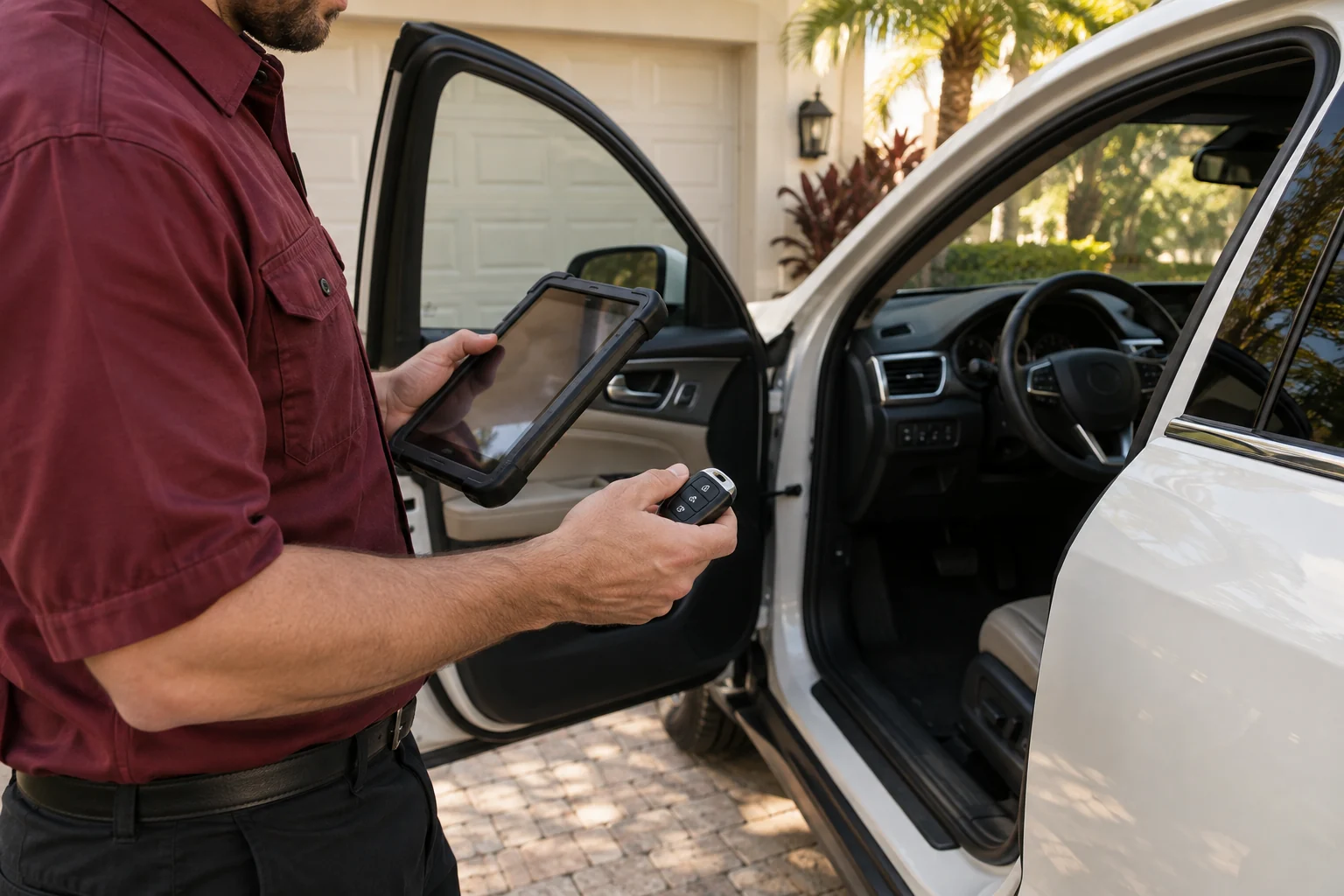
Half Off Locksmith technician and service van

Key Fob Not Working? Battery, Reset, or Replace

Key Fob Not Working? Battery, Reset, or Replace

What your fob is actually doing

A modern key fob is a small radio transmitter with a battery, a circuit board, a few buttons and, in most cases, a chip that identifies the key to the vehicle. When you press a button, the fob sends a coded signal. The car listens, checks the code against what it has stored, and only then unlocks, locks, opens the trunk or allows the engine to start. Nothing about that chain is magic, but every link in it can fail.

That is why a fob problem can look different from one car to the next. On some vehicles the remote buttons stop working but the key still starts the engine. On others the car refuses to start, shows a key warning on the dashboard, or fails to recognize the fob when you hold it near the start button. Describing exactly which of these you see is the single most useful thing you can do.

It also explains why guessing rarely helps. Pressing a button repeatedly, banging the fob against a palm, or leaving it in the sun to warm up will not repair a coded device. A calm, ordered check will, and the sections below follow the order in which problems most often turn out to be the cause.

Start with the symptoms, not the fix

Before touching anything, write down what is happening. Does the remote fail on every button, or only one? Does the vehicle respond when you stand very close but not from a distance? Did the trouble arrive suddenly, or did the range shrink slowly over weeks? A fob that works only when pressed against the door handle is telling a very different story from one that is completely dead.

Also note what the car says. Many vehicles display a message such as key not detected, low key battery, or no key found. Others show a small warning light shaped like a key or a lock. Take a photo of the dashboard if you can. That photo helps a technician narrow the cause before arriving, and it keeps you from relying on memory in a stressful moment.

Finally, remember when the trouble started and what happened around it. Did the fob get wet, get dropped, spend a day in a hot vehicle, or sit near a strong magnet or another device? South Florida summers, pool days and beach bags all put fobs through conditions their makers never promised they could handle. A little history often points straight at the culprit.

  • Which buttons fail: all of them, or only some?
  • Does the car respond at close range but not at a distance?
  • Is there a dashboard message or a warning light, and what does it say?
  • Did the fob recently get wet, hot, dropped or stored with other electronics?

The battery is the usual suspect

Most fobs run on a small flat coin cell, and those cells weaken gradually. The early signs are shrinking range, buttons that need a second press, or a fob that works in the morning and misbehaves after a hot afternoon. Heat and humidity shorten battery life, and a fob that rides in a parked car in the Florida sun lives a harder life than one kept in a pocket.

Replacing the cell is often something an owner can do safely. Your owner's manual usually shows how to open the case, which way the battery faces and what type to buy. Take a photo before you remove anything so you can put it back the same way, open the case gently with a thin plastic tool rather than a screwdriver blade, and handle the circuit board only by its edges.

A few cautions apply. Keep the old battery away from children and pets, since coin cells are dangerous if swallowed. Do not mix up the positive and negative sides. And if the case is sealed, or the manual says to have the work done by a technician, believe it. A cracked case or a bent contact can turn a simple battery change into a new problem.

A last point on batteries concerns buying them. Unbranded lookalike cells can be the wrong thickness or lose charge early, so buy the exact type named in the manual from a seller you trust. After changing it, test every button at a short distance first, then at a longer one. If the range is still poor with a fresh cell, stop swapping batteries and move to the other checks.

Cleaning, contacts and moisture

If a new battery does not help, look at the contacts. Over time the metal clips that touch the battery can loosen, corrode or collect a film of residue, especially in coastal air. A fob that fell in a pool or went through a wash may have moisture trapped under the board, which can cause intermittent behavior that comes and goes with the weather.

Gentle cleaning is reasonable. With the battery removed, let the case dry in a well ventilated place for a good while rather than applying heat. A soft, dry brush can lift loose dust. Avoid soaking, scraping or spraying anything into the case, and do not use a hair dryer, which can soften plastic and damage the chip. Patience protects a part that cannot be repaired once it is warped.

If the board shows green or white crust, or a button has lost its snap, the damage may be beyond a home fix. That does not mean the vehicle is stranded. It means the fob has reached the stage where a replacement is more realistic than another battery. Knowing that early saves several rounds of trial and error, and it keeps you from damaging the key blade or the case further.

What a reset can and cannot do

People often ask about resetting a fob, and the word covers several different things. On some vehicles, the owner's manual describes a simple resynchronization step, such as a particular sequence involving the door, the ignition position or the buttons. On others, no owner procedure exists at all, and the fob can only be introduced to the vehicle with diagnostic equipment.

If your manual describes a procedure, follow it exactly as written and only for your model. Do not rely on a sequence found in a forum post, because the steps differ widely between makes and years, and a wrong guess can sometimes make matters worse by triggering a lockout of the learning mode. When a manual says to see a dealer or a qualified technician, that is the honest answer for that vehicle.

It also helps to understand what a reset cannot do. It cannot revive a dead battery, repair a cracked circuit board, or replace a chip that has lost its identity. If the fob has never been programmed to this vehicle, or if the vehicle lost its stored key list during a battery disconnect or repair, a resynchronization will not work. In those cases, programming is the next step, and that is a different job from a reset.

Is it the fob or the vehicle?

Not every fob complaint is the fob's fault. The vehicle has its own receiver, antenna and body control electronics, and any of them can misbehave. A good test is to try a second key if you have one. If the spare works normally, the problem lives in the first fob. If neither key works, suspect the vehicle side, a weak car battery, or interference nearby.

Interference is more common than people expect. Strong radio sources, some charging equipment, and even a crowded key ring can reduce the range of a fob or confuse its signal. Try the fob in a different location, away from other electronics. If it works across the street and fails in one particular parking spot, the answer is the surroundings, not the key.

A weak car battery can also create strange behavior. Dashboards may flicker, locks may work slowly, and the vehicle may not recognize a perfectly healthy fob. If other electrical items are acting up, address that first. A technician who understands both keys and ignition systems can tell the difference with a few checks, and our pages on ignition repair and ignition cylinder problems explain the related issues.

Getting into the car when the fob is silent

Many fobs contain a hidden mechanical key, and many vehicles have a door lock that can be used with it. Check your manual for where the blade slides out and which door has the exposed keyhole, since some makes hide the cylinder behind a small cap. Using the physical key is a normal, intended backup, and it is the right first move if the remote locks will not respond.

Be aware that opening a door with the blade may set off the alarm on some vehicles. That is not a malfunction, and it usually quiets down once the vehicle recognizes the key or the ignition position changes according to the manual. Knowing this in advance prevents a flustered minute in a parking lot. If it happens, stay calm and follow the instructions printed for your model.

Push button vehicles often include a backup way to let the car read the fob when the battery is weak, such as holding it against a marked spot. Again, your manual is the authority. If you do not have a physical key at all and the vehicle will not let you in, our guide to locked out of the car solutions explains what to do and what to avoid. Never try to force a door or window.

When replacement and programming come next

Replacement is the right answer when the fob is physically damaged, repeatedly unreliable, or lost. A replacement has two parts: the physical key or fob, and the electronic introduction of that key to the vehicle. The second part is called programming, and it is where most of the mystery lives. Different makes need different equipment and different procedures, which is why a fob bought online may arrive and still refuse to work.

Our guide to transponder key programming explains the process in plain terms. If you drive a push button vehicle, what to do when a push to start key is lost covers that situation, and laser cut versus standard car keys helps you understand the blade side of the job. Our car key replacement service page describes how the work is handled.

When you call, have the make, model and year ready, and say whether you still have any working key. If you do, the work is often simpler, because the vehicle can learn from an existing key. If you do not, say so plainly. Either way, the work and the price are explained before it begins, and the finished key is tested with you at the vehicle so you know every function works.

Locksmith or dealership: choosing the route

Owners usually have two paths for replacement, and both are legitimate. A dealership has access to the maker's parts and procedures. A mobile locksmith comes to the vehicle, which matters when the car is not drivable or the fob is the only way to start it. Which route suits you depends on your situation, your schedule and how comfortable you are moving a car that cannot start.

Our article on locksmith versus dealership for car key replacement compares the two approaches in detail. The practical point is that you can ask questions of either one. Ask what is involved, whether the vehicle needs to be moved, what happens to the old fobs, and how the finished key will be checked. A clear answer is a good sign.

Whichever you choose, avoid buying a random fob from a marketplace and hoping it can be programmed. Some will work, some are locked to another vehicle, and some use the wrong frequency for your car. Ask the person who will program it what they recommend before you buy anything. That single question prevents a lot of wasted effort and a lot of frustration at the curb.

Think about where the fob lives between uses. A hook by the door is fine, but a gym bag, a beach tote or a cup holder in direct sun is not. Salt air creeps into everything near the coast, and a fob that spends its life in a damp pocket will fail sooner than one kept in a dry drawer. Small habits like these take almost no effort and make a real difference over the life of a key. If you ever notice a fob getting warm, swelling or leaking, stop using it and have it replaced.

Preventing the next fob failure

A few habits extend a fob's life. Keep it away from water, and take it out of a pocket before swimming or washing a vehicle. Avoid leaving it on a dashboard in the sun. Do not let it hang from a heavy ring, because the weight stresses the key blade and the case. A modest silicone cover can protect buttons from sweat and grit.

The strongest protection, though, is a working spare. If you have only one key, a failure puts you in a difficult spot, because the vehicle may be impossible to start and a lockout is only one dead battery away. Our article on whether a spare car key is worth it lays out the reasoning calmly. Keep the spare somewhere safe, not in the vehicle.

Finally, treat early warning signs seriously. If range shrinks or a button begins to stick, replace the battery now, in your driveway, instead of during a downpour at the grocery store. Residents of Hollywood, Pembroke Pines and other Broward cities deal with the same heat and humidity. This page is general guidance, and a call to a locksmith can sort out anything specific to your vehicle.

Frequently Asked Questions

Why did my key fob stop working all of a sudden?

A sudden stop is most often a depleted battery, though water exposure, a drop or a cracked case can also be responsible. Try the physical key blade to get in, then check the dashboard for a message. If a fresh battery does not restore function, the fob may need cleaning, replacement or programming by someone with the right equipment.

Can I replace the key fob battery myself?

Often yes. Your owner's manual usually shows how to open the case and which battery type it uses. Photograph the layout first, open the case gently with a thin plastic tool, and keep the old cell away from children and pets. If the case is sealed or the manual advises professional service, follow that advice.

Will a new battery fix a fob that has lost its programming?

No. A battery only supplies power. If the vehicle no longer recognizes the fob, because it was never programmed or the stored key list was disturbed, the fob must be introduced to the vehicle again. That requires the correct procedure and equipment for your make, model and year.

Is there a universal reset that works for every car?

No. Any resynchronization step is specific to the vehicle, and some vehicles have no owner procedure at all. Follow only the sequence printed in your own owner's manual. A sequence copied from the internet for a different model may do nothing, or it may interfere with the vehicle's learning mode.

Can I buy a fob online and have it programmed?

Sometimes, but it is a gamble. Fobs vary by frequency, chip type and vehicle, and some online units are locked to another car or are simply the wrong part. Before buying, ask the person who will program it what they recommend for your exact vehicle, and whether they can work with a fob you supplied.

What should I have ready when I call about a fob?

Have the make, model and approximate year, the type of key you have, such as a blade, a fob or a push button style, and what the dashboard says. Also say whether you still have any working key and where the vehicle is parked. Those details let the work be explained clearly before it begins.

Locked out or need a lock changed today?

Describe the problem by phone, and we go over the job and the price with you first.

What a key fob really is

A key fob is a small radio transmitter that talks to your vehicle. When you press a button, it sends a coded signal that the car recognizes, and the doors lock, unlock, or the trunk opens. On many vehicles the same device also holds a transponder chip that allows the engine to start, or it acts as a proximity key that the car detects when it is nearby. Different vehicles combine these functions in different ways.

Because the fob is electronic, it can fail in electronic ways. The battery can run down, the circuit board can be damaged by water or impact, the buttons can wear out, and the stored pairing with the car can be lost. Each of these has different symptoms and different solutions. Learning to tell them apart saves time and avoids paying for repairs you do not need.

It also helps to remember that fobs live hard lives. They ride in pockets, bags and cup holders, get dropped on pavement, sit in hot cars and travel to the beach. In South Florida, heat, humidity and salt air add stress that a fob in a cooler, drier place would never face. Small problems often start there.

Start with the symptoms

Pay attention to how the fob fails. If it works only when you stand right next to the car, the battery is probably weak. If it works sometimes and not others, it might be a loose contact or a failing battery. If some buttons work and others do not, the buttons themselves may be worn. If nothing works at all, the battery is dead or the fob has lost its pairing.

Notice whether the warning light on the fob, if it has one, still blinks when you press a button. A dim or absent light suggests a battery problem. Notice also whether the car behaves differently, such as showing a message about a key not detected on the dashboard. These messages give clues about where the trouble lies.

Try a second fob if you have one. If the spare works perfectly, the problem is with the first fob. If neither works, the cause may be on the car side, such as a weak vehicle battery or interference. This single test is among the most informative things you can do, and it costs nothing but a minute.

The battery: the most common cause

The most common reason a fob stops working is a worn out battery. Most fobs use a small coin cell, the flat round kind, and these slowly lose strength. Weakening often shows up as shorter range first, then as occasional failure, then as nothing at all. Heat shortens battery life, so a fob that lives in a hot car or a pocket against the body may tire sooner.

Replacing the battery is often simple. Many fobs have a small slot or seam along the edge, and a gentle twist with a flat tool or a coin opens the case. Note the battery type printed on the cell, usually a code on its face, and buy the matching one. Pay attention to which side faces up before removing the old cell. Be careful not to touch the circuit board more than needed, and avoid forcing the case.

If you do not feel comfortable opening the fob, a technician can do it. Take a photo of how the parts sit before disassembly, so you can restore them correctly. After replacing the battery, test every button near the car. Some fobs lose their pairing if power is interrupted for too long, though many keep it. If the fob still fails after a fresh battery, move on to the next possibilities.

Pairing, programming and what a reset means

People use the word reset loosely. For a fob, it may mean one of several things: syncing it again with the car after a battery change, reprogramming it so the vehicle recognizes it, or adding a new fob to the list of keys the car accepts. Each vehicle has its own method, and many require special equipment, access to the car's computer or a specific sequence of actions.

Some vehicles allow owners to pair certain remotes themselves, using a documented sequence found in the owner manual. If your manual describes such a procedure, following it carefully is reasonable. Do not try random sequences found online. Wrong steps can lock you out of the pairing process, or on some vehicles lead to a timed delay before you can try again.

For fobs that include a transponder chip or a smart key function, programming usually requires professional tools. Our article on transponder key programming describes how this works and why it requires care. If your fob has lost its pairing and the manual does not offer a method, a technician can often program it where the vehicle is parked.

Physical damage, water and wear

Fobs that have been dropped, crushed or soaked often fail for reasons that a battery cannot fix. Water leads to corrosion on the circuit board. You might see green or white residue on the contacts. In that case, replacing the battery will help only briefly, if at all. A damaged board usually means the fob must be replaced or its internals swapped into a new case.

Buttons wear over time. The rubber pads inside the case get thin, and the conductive coating can rub away. A fob where the lock button no longer works but others do is a classic example. Sometimes a new shell with new button pads fixes the issue, with the original circuit board transplanted into it. Whether this is practical depends on the fob.

Cracked cases and broken key rings are another failure. If the case is split, dust and moisture get in. If the metal emergency blade has snapped, you have lost an important backup. Do not ignore these signs. Repairing a damaged fob early may avoid the need for a full replacement later.

Interference and vehicle side problems

Sometimes the fob is fine and the surroundings are the problem. Strong radio signals, large metal structures, or certain electronics can interfere with the fob's signal. If it works away from a particular parking spot but fails at another, interference could be the cause. Try the fob in a different location before spending money.

The vehicle itself can also be to blame. A weak or failing vehicle battery may cause erratic behavior with locks and receivers. A faulty receiver in the car, a blown fuse or a damaged antenna can prevent the car from hearing the fob. If neither of your fobs works, these possibilities deserve attention.

If the car will not respond to either fob and also behaves oddly in other ways, such as dim lights or slow cranking, the vehicle battery is a likely suspect. Have it tested. If it is fine, a technician can use diagnostic tools to check whether the vehicle is receiving signals from the fob. Our article on ignition cylinder problems also helps separate key issues from ignition issues.

Getting into the car when the fob is dead

A dead fob does not always mean you are stuck outside. Most fobs include a hidden mechanical key, a small metal blade that slides out of the case. The driver door usually has a keyhole, often concealed behind a small cap or panel near the handle. Using the emergency blade in this way is the intended backup. Check your owner manual for the location of the keyhole and how to open the cover.

Push button vehicles are different, because the car expects the fob to be detected inside. Many makers include a backup arrangement for a weak fob, and your owner manual is the only reliable place to learn whether yours has one and how it works. Follow only what the manual says for your exact model.

If the blade is missing, or you are locked out with the fob inside, see our guide on keys locked in the car. Do not attempt to force a door or window. Damage to seals, wiring or glass can cost far more than a professional visit.

What a technician checks when you call

A technician starts with the same questions you can ask yourself. What vehicle is it, what type of key does it use, and what changed before the trouble began? From there they test the fob with a diagnostic tool that can show whether it is transmitting, whether the battery voltage is adequate and whether the signal is recognized. This moves the conversation from guessing to knowing.

Next they look at the vehicle side. A receiver, a fuse, or the way the car stores its list of accepted keys can all be involved. They also consider the age of the fob and the wear on the case, because a fob that has been through many seasons of heat and humidity may be near the end of its life regardless of the battery.

Finally, they explain what they found in plain words and lay out the choices. You might hear that a battery will solve it, that the fob needs reprogramming, that a new shell will restore the buttons, or that a replacement is the sensible path. The work and the price are explained before it begins, and you can ask why each step is needed. That is how a straightforward diagnosis should feel.

Repair, reprogram or replace

Once you know the cause, the choice becomes clearer. A dead battery calls for a new battery. A lost pairing calls for reprogramming. A worn case or buttons might call for a new shell. A water damaged or broken board usually calls for a replacement fob. A fob that is lost entirely calls for a replacement and often for removing the missing one from the car's memory.

Replacement fobs vary. Some are original equipment style, others are aftermarket. What matters is that the fob matches your vehicle and can be programmed to it. Ask the technician what they will supply, how it will be programmed and how it will be tested. Our guide to car key replacement cost explains what shapes the total.

If you have a push button vehicle and the fob is missing, read what to do when a push to start key is lost. For a broader overview, see our main page on car key replacement. The work and the price are explained before it begins, and the finished work is tested with you.

Preventing the next failure

A few habits keep fobs working longer. Replace the battery when you notice weakened range instead of waiting until it dies. Keep fobs out of the sun on the dashboard, and avoid leaving them in a hot parked car. Do not drop them in water; if they get wet, open the case, dry gently and replace the battery. Rinse salt residue after beach days and let everything dry fully.

Protect the fob physically. A silicone cover can reduce impact damage and keep dust out. Keep the key ring light. Do not hang the fob on a heavy bundle that pulls and flexes the case. If you share a vehicle with others, remind everyone about gentle handling.

Finally, keep a working spare. When the main fob fails, a spare turns an emergency into an inconvenience. Store it somewhere safe, away from the car. Our piece on whether a spare car key is worth it explains how people make that choice. Even a basic spare with a mechanical key can save the day.

Keep a small record for your household. Write down the vehicle make, model and year, the battery type your fob uses and the date you last changed it. When the next failure comes, that note turns a puzzle into a short call. If several people share the vehicle, tell them who holds each fob so a missing one is noticed early and can be dealt with before it causes trouble. A missing fob can be removed from the vehicle memory, which protects you if it was lost outside.

When to call a locksmith

Call a locksmith when the battery change does not help, when the fob has lost pairing, when it has been damaged, or when it has been lost. Describe the vehicle, the make, model and year, and what you have tried. Mention whether the car uses a blade key, a remote head key or a push button fob. This helps the technician bring the right parts and tools.

If you are in Broward County, a mobile visit can often take place where the vehicle is parked, avoiding a tow. Be ready to show identification and proof of ownership. The technician will explain the plan and the price before starting, program or replace the fob as needed, and test every function with you before the visit ends.

Motorcycles, scooters and other vehicles have their own key and remote setups. If yours is not a car, see our article on motorcycle key replacement. Whatever you ride or drive, the principle is the same: identify the cause, fix the simplest thing first, and ask for a clear explanation.

One caution about shopping for replacements on your own. Fobs that look identical can carry different frequencies, chips or software, and a mismatched fob may never pair with your vehicle. Buying a part online and hoping it works is a common source of disappointment. Before you buy, confirm the exact part with someone who can check it against your make, model and year, and ask how it will be programmed. Our article on laser cut versus standard car keys explains how the blade side of the key differs.

Common questions

Why did my key fob suddenly stop working?

The most common cause is a worn battery, which often shows up first as reduced range. Other causes include a dropped or wet fob, worn buttons, a lost pairing with the vehicle, interference or a weak vehicle battery. Try a spare fob to decide whether the problem is the fob or the car.

Can I replace the fob battery myself?

Often yes. Many fobs open with a small slot and a gentle twist. Note the battery type and the direction it faces, and avoid touching the circuit board. If the case is delicate or you are unsure, a technician can do it. Test every button near the car afterward.

Do I need to reprogram the fob after a battery change?

Many fobs keep their pairing, but some lose it if power is interrupted. If the fob does not respond after a fresh battery, check the owner manual for a documented procedure. Otherwise a technician can program it, using the right equipment for your vehicle.

What if the fob is wet or damaged?

Open the case, let it dry fully and look for corrosion on the board. If you see residue or the fob still fails, the board may be damaged. Repair or replacement may be needed. Do not use heat to dry it, since that can harm the electronics.

How can I get into my car if the fob is dead?

Most fobs hold a hidden metal key that fits a concealed keyhole near the driver door handle. Check your owner manual for its location. For push button vehicles, the manual may describe a backup spot for starting. Do not force doors or windows.

When should I replace the fob instead of repairing it?

Replace it when the circuit board is damaged, when water has corroded the contacts, when the fob is lost, or when repairs would cost nearly as much as a new one. A technician can explain the options and test the new fob with you before the visit ends.

Call Now