What commercial lock work really covers
The phrase commercial locksmith covers a wide span of jobs. At one end is a single repair, such as a sticking office door lock or a latch that has stopped catching. At the other end is a planned system for an entire building, with different levels of access for different people and a record of who holds what. Most businesses sit somewhere in the middle, with a handful of doors and a few recurring headaches.
What unites these jobs is scale and consequence. A commercial door is used by many people, often hundreds of times a week, and it protects things that matter: stock, equipment, records, cash, and the people who work there. A lock that fails at home is an annoyance. A lock that fails at a business can mean a closed shop or an exposed storeroom.
That is why the work starts with understanding the setting. How many doors? Who needs to get through them, and when? What happens if a key goes missing? Questions like these shape the plan more than any product catalog does. A restaurant, a medical office, a retail shop, a warehouse, and a small apartment building all ask different things of their doors. The restaurant worries about deliveries and closing routines, the office about confidential records, the shop about the display window and the stockroom, and the building about residents, guests, and shared entries.
We serve businesses throughout Broward County in South Florida. If you are in one of the cities, you may also like the local guidance for places such as Fort Lauderdale.
Master key systems, in plain words
A master key system lets different keys open different groups of locks in an organized hierarchy. Imagine an office with a front door, a storeroom, a manager's office, and a records room. A cashier might hold a key that opens only the front. A supervisor might hold one that opens the front and the storeroom. The owner holds a master that opens everything. Nobody carries more keys than they need.
The system works because each cylinder is built to respond to more than one key pattern. Extra pins inside allow both the individual key and the higher level key to line up at the shear line. The design has to be thought through with care, since the choices you make at the start determine how many levels you can add later.
A good master key plan begins on paper, not at the door. List every lock, list every role, and decide who should open what. Then consider growth: will you add a suite, a warehouse, or a new tenant? Leaving room for expansion avoids rebuilding the system in a year or two.
Our explanations of master key systems for business and of keyed alike and master key setups walk through the vocabulary if you want to read before you call.
Strengths and limits of a master system
Master systems offer real benefits. They cut down on key rings, make it simple to give a new employee the right access, and let a manager open any door in an emergency. They also make it easy to rekey a single level when someone leaves, without touching the rest.
There are tradeoffs to understand. Because more than one key opens each lock, a master system is somewhat less resistant to certain methods of attack than a single key lock. That makes the physical quality of the hardware and the discipline around the top level keys more important. The master key is the one that must never be casually copied.
Another limit is human. A system is only as good as the records behind it. If nobody knows who holds which key, the neat hierarchy turns into guesswork. Keep a log, and check it from time to time. Assign one person to be responsible for it, and make sure that person knows who to call when something changes. A system with no owner slowly drifts, and the first sign is usually a key that nobody can account for.
If these limits matter for your situation, restricted keyways add another layer by controlling who can order copies. The overview of restricted and high security keys explains how that works.
- A master system reduces key rings and speeds up access changes.
- Top level keys deserve the strictest handling.
- Records of who holds which key are part of the system.
- Restricted keyways can control who may order copies.
- Plan for growth before pinning the first cylinder.
Key control and rekeying after changes
Many commercial problems come down to key control. Keys are copied at hardware counters, handed around informally, left with former staff, or lost. Over time the number of working keys grows well past what the owner believes. The simplest cure is to rekey, which resets the locks to a known set of keys and retires every earlier copy.
Typical triggers include a departing employee who held a key, a lost key, a tenant change, a break in, or simply an audit that revealed more copies than expected. The practical guide on rekeying an office after an employee leaves shows how to handle it respectfully.
Rekeying a business is similar in principle to doing so at home, but it often involves more doors and tighter coordination. A technician can pin all locks to the new system in one visit, test each key, and hand over a clear set. You should leave with a record of which key does what. Many owners find it helpful to keep that record in two places, one with the business paperwork and one with a trusted manager, so that no single lost folder erases the plan. Stamping or tagging keys with a code instead of the door name, and keeping the code list separate, adds quiet protection if a ring is ever lost.
If you manage rental or office space, turnover rekeying for property managers describes a routine that scales across many doors.
Storefronts, offices, and back doors
Different parts of a business need different hardware. Storefront entrances are often aluminum framed glass, with a narrow edge that limits the lock options. These doors may use hook bolt locks, rim cylinders, or other devices designed for narrow stiles. They also get a lot of handling, so alignment and wear are common problems.
Office doors inside a suite tend to be wood or hollow metal and use mortise or cylindrical locks. Their job is to give privacy and limit access to specific rooms. Back doors and service entrances are usually heavier and need stronger hardware, since they face the least observation and the roughest treatment.
Each of these areas has its own repair patterns. A drooping door, a worn latch, a failing closer, or a sticking cylinder can all make a lock seem broken when the cause is elsewhere. A good diagnosis looks at the door, the frame, the closer, and the lock together. See storefront door lock repair for typical symptoms.
Glass doors raise questions that wood doors do not. Where the edge is narrow, hardware must be installed precisely, and a small shift in the frame can ruin the fit. Closers deserve attention as well, because a door that swings shut too gently may not latch, while one that slams will wear the lock and the frame. If you work with desks and cabinets, file cabinet and desk locks covers the small but important locks inside the office.
Exit devices and safe egress
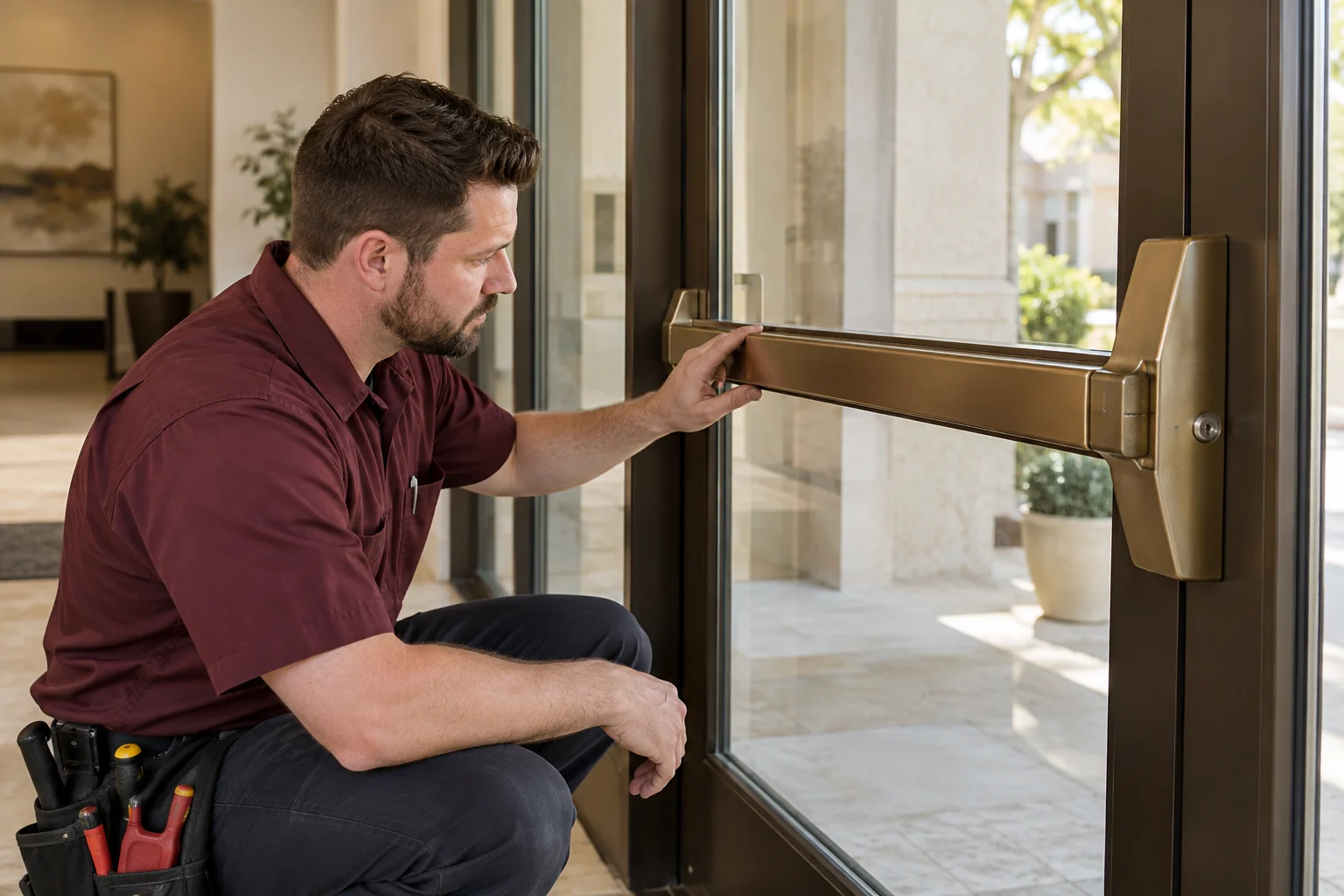
Doors that people use to leave a building in an emergency need to open easily from the inside. Panic bars and similar exit devices let a person push to open without a key or special knowledge. At the same time, the outside of the door can remain locked to keep unwanted entry out. It is a careful balance between safety and security.
Choosing and installing an exit device involves the door type, the traffic, and the rules that apply to your building. Those rules come from the authorities that govern your premises and vary from one property to another. Do not assume a general web page can tell you what your door requires. Ask your property manager, your insurer, or the local building and fire officials, then have hardware installed to match.
It also matters what the door opens onto. A rear exit that leads to an alley, a loading area, or a shared corridor has different risks from a front entry, and the device may need an alarm, a delayed release, or a cover, depending on what the authorities permit for your building. Ask before ordering rather than after. Exit hardware needs maintenance. Springs weaken, latches wear, and alignment shifts. A device that sticks or requires effort is a hazard in a crisis. Test your exit doors regularly and tell someone if they do not release freely.
Our guide on panic bars and exit devices explains the basics. For door questions about accessibility, see door accessibility audits for commercial properties and ask the proper authority for specifics.
Access control, keypads, and credentials
Some businesses move beyond metal keys. Keypads, card readers, and fob readers allow each person to have a unique credential, cancel it the moment they leave, and, in many systems, create a record of who entered. This suits sites with changing staff, shared spaces, or areas where a record of entry matters.
Electronic systems depend on power and on control equipment, so planning for failure is part of good design. What happens in an outage? Is there a mechanical override? Who holds it? A thoughtful installation answers these questions in advance rather than leaving them for a bad day.
The right mix depends on the situation. Many businesses use electronic access on the main entrance and mechanical keys on interior doors. Others keep to mechanical keys and rely on strong key control. Our article comparing access control and keys for a small business weighs the tradeoffs.
When you add electronic readers, ask who will manage the user list. Someone must add new staff, remove departed ones, and keep the list accurate. If that task is nobody in particular, credentials accumulate just as keys do, and the benefit of the system fades. Whichever you choose, treat credentials as seriously as keys. A card left at a front desk or a shared code written on a sticky note defeats the purpose.
Hardware grades and the cost of cutting corners
Commercial hardware comes in grades that reflect how strongly it is built and how much use it can take. A residential lock on a busy shop door might work for a short while, but it will loosen, stick, and eventually fail. The better choice is hardware built for the traffic it will receive.
Quality also affects security. A sturdier bolt, a thicker strike, and a better cylinder resist force and wear. That matters more on the doors that are least visible or most valuable. The article commercial lock grades explained describes what the categories mean.
Environment plays a role in South Florida. Salt air, humidity, and heat shorten the life of finishes and internal parts. For doors that face the weather, choose finishes and materials designed for it, and maintain them. It is usually less expensive to maintain a good lock than to replace a corroded one.
Cost deserves honest discussion. Heavier hardware costs more at the start, and it is reasonable to ask what each option will cost and what you gain for it before deciding. The work and the price are explained before it begins, so use that moment to compare choices calmly. Do not forget the frame and the door itself. A strong lock fitted to a weak door is only as secure as the door.
How a commercial job proceeds
It begins with a phone call. You describe the doors, the people, and the problem. The work and the price are explained before it begins, so that you know what is being done and why. If a visit is needed to assess, that is arranged and the plan is shared before any work starts.
On site, the technician looks at the doors, the frames, the existing locks, and how people use them. They may ask about your key situation, your staffing, and your plans. This conversation often reveals simple improvements that are not obvious from the phone. They will explain options and the reasons for each.
The work is carried out door by door. Cylinders are rekeyed or replaced, hardware is adjusted or installed, and each change is tested. When the job is complete, the finished work is tested with you, and you receive the keys or credentials along with a clear explanation of how the system works.
After hours work is its own category. Businesses often need doors opened, locks fixed, or keys cut when the building is closed, and they should say so when they call so the visit can be planned around people who are authorized to be there. If you need ongoing support, say so. A relationship with a locksmith who knows your building makes later changes easier and avoids starting from scratch each time.
Preparing before you call
You can make the process smoother with a bit of preparation. Walk through the premises and list every door that has a lock, noting whether it is a storefront, office, back door, or storeroom. Note the type of lock if you can tell, and mark any that are problematic. Count the keys you know about.
Think about who needs access and when. Write down roles and the doors each role must open. If you are a tenant, check your lease for who controls the locks and whether the landlord holds copies. If you manage a building, think about the common areas and who is responsible for them.
Be ready to show that you are authorized to request the work. A reputable provider will ask, and it protects you and the property. A lease, a business document, or a letter from the owner is usually enough.
It also helps to tell the technician about any past incidents, such as a forced door or missing stock, since they may point to a weak spot worth fixing during the same visit. Finally, ask about related services that might fit with your plans. The overview of all our locksmith services shows how commercial work connects with safes, smart locks, and other jobs, and the pages on safe opening may be useful if your business keeps a safe.
Common questions
What is the difference between rekeying and replacing commercial locks?
Rekeying changes the internal pins so old keys no longer work, keeping the same hardware. Replacing installs new hardware. Rekeying suits sturdy locks in good condition, while replacement suits worn, damaged, or underbuilt locks. A technician can look at each door and tell you which route fits.
How does a master key system work?
Each lock is built to respond to its own key and to a higher level master key. A tiered design lets staff hold only the keys they need while managers hold keys that open more doors. The structure should be planned on paper before any cylinders are pinned.
Can a business limit who copies its keys?
Yes. Restricted keyways allow copies only through an authorized process, which helps prevent casual duplication. They do not replace good habits, so keep a log of keys issued and recover or rekey when someone leaves.
Who decides what exit hardware my building needs?
The requirements come from the authorities that govern your building and from your lease and insurer, and they vary by property. Ask your property manager or the local building and fire officials, then have the hardware installed to match what they specify.
Is electronic access control right for a small business?
It can be, especially with changing staff or a need for entry records. Mechanical keys are simpler and need no power. Many small businesses combine the two. Consider outages and backups either way, and weigh the convenience against complexity.
What should I have ready when I call?
Know how many doors you have, what types of locks they use, and what problem you want solved. Count the keys you know about, list who needs access, and be ready to show you are authorized to request the work. Clear details lead to a smoother visit.