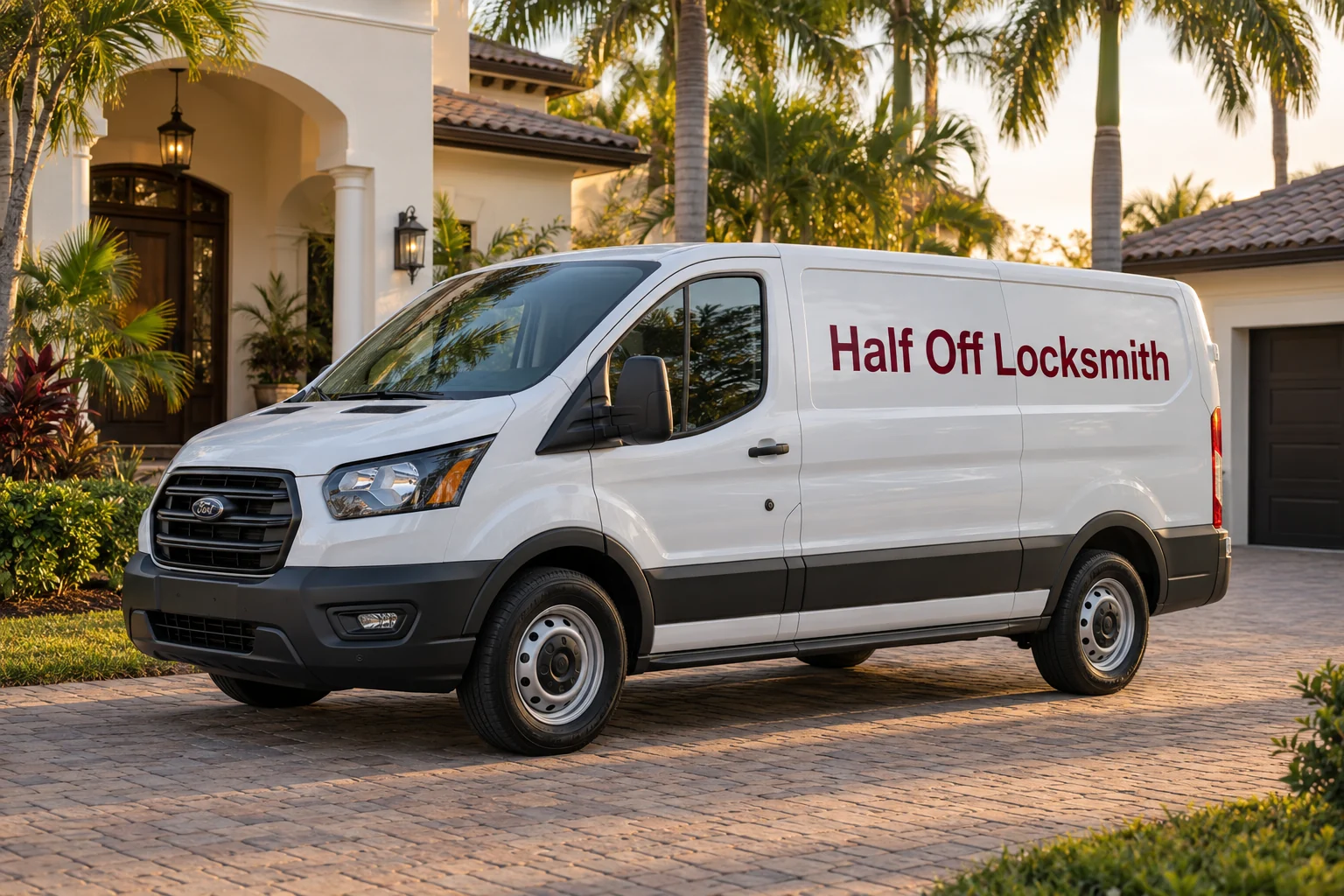
Locksmith Services in Coral Springs
Locks touch almost every part of daily life, from the front door to the car to the office. This page is general guidance for Coral Springs residents on the main kinds of locksmith work and how to choose between them.
Call (954) 888-8804Why one city page covers so many kinds of work
People search for a locksmith with very different problems in mind. One person is standing outside a locked house, another has a car key that stopped starting the engine, and a third is managing a small office where a former employee still has a key. They all use the same word, locksmith, yet the work involved is quite different.
This page is a map. It describes the main kinds of locksmith work, explains how to tell which one fits your problem and points you to pages with more detail. It is general guidance for people in Coral Springs and does not describe local history, rules or neighborhoods.
Half Off Locksmith serves Broward County, Florida, and the process is the same wherever you live in it. You call and describe the situation and the place. The work and the price are explained before anything begins, and the finished work is tested with you.
A good first step is to separate what you know from what you assume. You know the door will not open, or the car will not start, or a former colleague still has a key. You may assume the lock is broken, when it is only misaligned, or that you need a whole new system, when a small repair would do. Explaining facts and symptoms, and leaving the diagnosis to the person who will inspect the hardware, tends to lead to better decisions and clearer conversations on the phone.
Home locks: lockouts, rekeying and replacement
Home door work falls into three broad groups. A lockout is about getting back in without damage. A rekey changes the internal parts of a lock so that old keys stop working. A replacement or installation puts new hardware on the door when the old lock is worn, outdated or no longer suitable.
Because they sound similar, people often ask for the wrong one. If you simply left your keys inside, you need a lockout visit and nothing else. If you lost your keys, you may need the door opened and also a rekey. If the lock itself is damaged, installation is the more honest answer.
You can read more on each at our Coral Springs lockout page, the rekey page and the lock installation page.
Homes in this part of Florida range from older houses with original hardware to newer builds with modern fittings, plus townhomes and condos where several people share a building. Older locks may be perfectly serviceable but lack features people now expect, while newer hardware may be sturdier but still depend on a good installation. Neither age is automatically better. What matters is condition, fit and whether the keys in circulation are ones you can account for. A short inspection by someone who handles locks daily can clear up a lot of uncertainty.
- Lockout: you need to get in, and the lock should remain undamaged.
- Rekey: the lock is sound but the keys in circulation are not.
- Installation: the hardware is worn, broken or not what you need.
Car keys, fobs and ignitions
Vehicle keys have changed a great deal. Many cars now use a transponder chip in the key head, and the car will not start unless it recognizes that chip. Others use a proximity fob that you keep in a pocket, and a button starts the engine. Each type has its own method for making and programming a new key.
The usual problems are a lost key, a broken one, a fob that has stopped responding or an ignition that sticks or will not turn. They are not all the same repair. A worn key can look like an ignition fault, and a dead battery can look like a failed fob, so it helps to describe symptoms rather than guess at a cause.
Our car key replacement page explains the usual routes, and the Coral Springs automotive locksmith page speaks directly to drivers in the city.
A replacement key is not just a piece of metal cut to shape. The chip inside must be introduced to the car, which usually involves specialist equipment and the right information about the vehicle. That is why the make, model and year matter so much on the phone, and why a key bought online and cut elsewhere sometimes fails to start the engine. It is sensible to ask in advance whether a new key will need programming and what you need to bring, such as proof that the vehicle is yours. Keeping a working spare avoids most of the trouble.
Business doors and shared spaces
Commercial work is not just a bigger version of home work. Offices, storefronts and shared buildings have more people holding keys, more doors with different needs and more reasons to keep a record of who can enter where. Panic bars, door closers, master key systems and access control all come into play.
A small business often starts with a handful of keys and a simple lock, then grows without the hardware keeping pace. By the time an employee leaves, nobody is sure who still has what. A check of keys and doors before that happens is far less stressful than one afterward.
The Coral Springs commercial locksmith page goes into detail, and our overall commercial locksmith overview covers the wider topic.
In a shared building the question is rarely just who can open the door. It is also who is responsible for it, who must be told when something changes and how a record will be kept. A tenant may control the suite door while the building controls the entrance, the stairwell and the mailroom. Before changing anything, find out which doors are yours to alter and whom to inform. Requirements vary by building and lease, so ask your property contact, and make sure that any change leaves emergency exits working the way they were designed to.
Smart locks and keypads
Keypad and smart locks suit people who are tired of carrying keys, who share a home with several people or who manage a rental where guests come and go. They let you issue a separate code for each person and cancel it later without cutting a new key.
They are not magic. They depend on batteries, on how well they fit the door and on settings that someone must manage. A lock that is installed on a door that does not line up properly will give trouble no matter how clever its electronics are. Fit matters as much as features.
If this interests you, read our smart lock overview and the plain comparison in whether smart locks are worth it before deciding.
Think carefully about the door itself before you buy a lock with electronics. Thickness, bore size, the position of the latch and whether the door closes squarely all affect how well a new lock will work. A door that rubs the frame in humid weather will keep a motorized bolt from extending fully, and the lock will then report errors. It is often wiser to correct the door first and fit the lock afterward. Ask for a plan that covers what happens when the batteries run low, and keep a physical way in as well.
Safes and special items
Safes are a different corner of the trade. A home safe protects documents, jewelry, firearms or backup drives, and when the combination is forgotten, the electronics fail or a key goes missing, getting inside requires specialist skill. Forcing a safe usually destroys the very thing it was built to protect.
If you are thinking of buying one, consider fire rating, weight, how it is anchored and where it will sit. In a humid climate, moisture inside a safe can damage paper and electronics, so the details of the environment matter.
Our page on safe opening and the buying advice in the home safe buying guide explain what is involved.
People sometimes call about a safe only after something has gone wrong, but a few precautions help earlier. Record the combination and keep that record somewhere other than the safe. Replace batteries in electronic models on a schedule rather than waiting for a warning. Keep the spare key elsewhere, not taped to the back of a drawer nearby. If you move, plan how the safe will be transported, because a heavy safe that tips or drops can jam its own bolt work. These habits cost little and save a stressful afternoon.
How the local climate affects locks
Coastal humidity, salt in the air and strong sun are hard on hardware. Finishes pit, cylinders pick up deposits, screws loosen and door frames swell or shift with the seasons. A door that closed easily in winter can drag in summer, and a lock that turned smoothly may start to stick after a wet spell.
Vehicles parked outdoors suffer similarly. Keys and fobs live in pockets, are exposed to sweat and sunlight and get dropped. Door handles and trunk latches see weather for years. Small signs of wear are worth noticing before they turn into a failure at a bad moment.
Hurricane season brings its own habits. Shutters, impact windows and reinforced doors change how a home is secured, and evacuation or storm cleanup can scatter keys. Keep a spare outside the home with someone you trust, and check your locks after severe weather.
When a lock starts to feel rough, resist the urge to flood it with whatever is in the garage. Heavy oils and household sprays can collect dust and sand and turn into a paste that gums the pins. A clean, appropriate lubricant used sparingly is far better, and in many cases the better answer is to have the lock looked at. Notice also where the door sits when closed. If you see daylight along one edge or the latch only catches when you lift the handle, that is a sign the frame has moved and the lock is being asked to compensate.
Choosing who to call
Whoever you choose, a few signals tell you a lot. They should be willing to listen to your situation, ask sensible questions and explain what they plan to do. They should tell you the price before starting. They should be comfortable with you asking for identification and for the work to be tested in front of you.
Be cautious if someone cannot explain a plan, pushes to drill or replace a lock as a first resort or changes the price once they arrive. Those are not signs of a professional. Our guides on choosing a locksmith you can trust and red flags to watch for expand on this.
Having one number ready before you need it is a quiet kind of preparation. Searching in a panic, from a curb, is the situation in which bad choices get made.
Ask the plain questions: what exactly will you do, what will it cost, and what could change that? A trustworthy answer is specific, not evasive. Be wary of anyone who gives a very low figure on the phone and a very different one at the door. Notice whether they ask you to prove the property or vehicle is yours, because that is a good sign rather than an annoyance. After the work, ask to see the lock operate and keep a written note of what was done so you can refer to it later if something seems off.
Preparing before something goes wrong
A little planning prevents most locksmith emergencies. Keep a spare key with someone reliable. Know how many keys exist for each door and who holds them. Replace a key that is worn smooth, because worn keys eventually break off in the lock.
Check your doors once a season. Does the latch catch cleanly? Does the deadbolt reach all the way into the frame? Is the strike plate attached to the framing with long screws, or only to the trim? These are small details that matter during a break in attempt.
For vehicles, a second key is lighter in effort than a replacement made after the last one is lost. Our note on whether a spare car key is worth it sets out the reasoning.
Make a simple key record for your household. Write down each door and gate, how many keys exist for it and who holds them. Do not put the address on the list if it will be stored somewhere others can find it. Revisit it when people move in or out, when a contractor finishes a job and when you lose track of a key. A record like that turns an anxious guess into a simple check and makes decisions about rekeying easy to justify and easy to explain to the people involved.
Nearby cities and where to go next
Coral Springs shares its edges with other Broward communities, and the same guidance applies across them. If you are comparing, see the pages for nearby Parkland services or Tamarac lockouts, written for readers there.
If you are still unsure which kind of help you need, start with the symptom. Locked out means one page, keys no longer trusted means another, a car that will not start means a third. Pick the one that fits and read on from there. If two of them apply at once, for example a lost key and a door that no longer latches well, say both on the phone so the plan can cover them together instead of in separate visits. And if you are only planning ahead, with nothing broken, that is the calmest moment of all to ask questions, because nobody is waiting on the other side of a locked door.
Remember that a general page cannot know your exact door, car or building, and it makes no claim about any specific street or development. What it can do is help you describe your situation well. Bring the facts, ask for the plan and price first and insist on seeing the result tested. That sequence works for a lockout in the evening, a key replacement for a family car or a set of locks for a small office, and it works the same whichever part of Broward you are in.
Common questions
What kinds of problems does a locksmith handle?
Common ones are lockouts from homes and vehicles, rekeying after lost keys or a move, lock installation and replacement, car key and ignition problems, safe opening, smart locks and commercial door hardware. If you are unsure which category fits, describe the symptom on the phone and the right approach can usually be sorted out.
How do I know whether I need a rekey or new locks?
If the lock is in good shape and turns smoothly, a rekey usually solves a key control problem at a modest scope. If it is worn, corroded, loose or outdated, replacement is more honest. A technician can inspect and show you the difference, then explain the plan and price before any work starts.
Can a locksmith make car keys on site?
Many vehicle keys can be made and programmed at the vehicle, though it depends on the make, model, year and key type. Describe your car and what has happened when you call, including whether you have any working key. Some situations need extra steps, and the plan should be explained before work begins.
Is a keypad lock safer than a key?
Not automatically. A keypad removes the risk of a lost key but adds batteries, codes and settings to manage. A well fitted lock with sensible habits is safer than a poor one of either type. Choose based on how you live, who needs access and how reliably you maintain it.
What should I have ready when I call?
Know where you are, which door or vehicle is involved, what kind of lock or key it has if you can tell, and what happened. Have identification and something linking you to the property or vehicle. This helps the visit go smoothly and protects you and the owner.
Does this page describe local rules?
No. This is general guidance for people in Coral Springs. Rules about buildings, associations, rentals and vehicles vary, and I do not state them here. If a rule might apply to you, ask your property manager, association or the relevant local office whom to inform before work begins.
Talk through the job before work begins
Tell us what happened, which doors or keys are involved and who needs to get in. The price and the plan are agreed with you before any work starts.
Call (954) 888-8804Locksmith services in Coral Springs
Each service has its own page for Coral Springs, so you can read what it covers before you call.