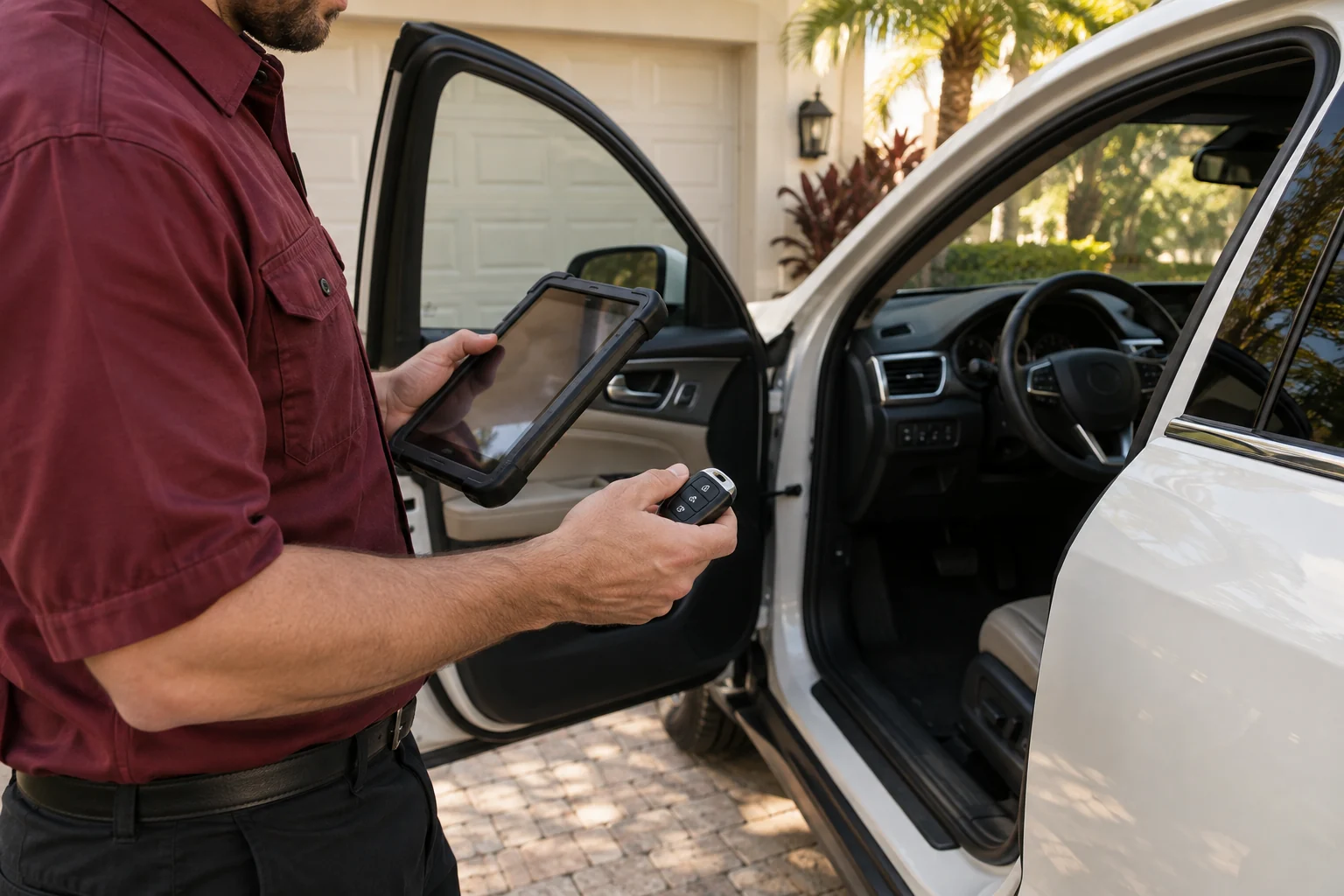
Rekey Service in Coral Springs
Every key in circulation is a small piece of access that you may no longer control. This page is general guidance for Coral Springs households, landlords and renters on resetting that access through rekeying.
Call (954) 888-8804The question behind every rekey
People rarely wake up wanting a rekey. They want an answer to a quieter question: who can get into my home? A new owner wonders about the previous one. A parent wonders about the babysitter who moved away. A landlord wonders about the tenant who left. In each case, the honest answer is that nobody knows, and rekeying is the practical way to change that.
The reason it works is that a key is only a physical shape that matches a pattern inside the lock. If the pattern changes, the old shape stops working. The door, the handle and the bolt stay as they were. Only the hidden part that recognizes keys is reset.
This page is general guidance for people in Coral Springs and says nothing about local rules or the history of any company. If a requirement might apply to your building, ask your property contact whom to inform.
It is worth saying what rekeying does not do. It does not make a weak door strong, it does not repair a worn lock and it does not erase every risk. What it does is reset one specific kind of trust, the trust placed in physical keys that left your sight. Seen that way, it is a modest and sensible step, similar to changing a password after a shared account has been used by too many people.
A good habit is to treat the first answer as a draft. Describe what you know, then add what you suspect, and let the person you speak with ask follow up questions. How old are the locks? Do the keys stick? Has anyone mentioned a problem with the door? These details turn a general plan into one that fits your actual doors, and they help avoid a second trip for a part that was not on hand.
Thinking through who actually has keys
Before booking anything, sit down and count. Write each door and gate on a sheet, and next to it every person who might have a copy. Include the obvious, such as family members, and the less obvious, such as former partners, a house cleaner, a pool service, a contractor who finished a job months ago and the neighbor who once watered your plants.
The exercise often reveals gaps. You may find that three people have copies you did not know about, or that you have no idea who made a certain copy. It also helps you decide how many new keys to order and who really needs one. A rekey is a good time to shrink the group.
If the count surprises you, our page on lost house keys and the choice between rekeying and replacing helps you decide what to do next.
Do not forget gates and shared areas. Pool gates, community mailrooms, storage cages and garage fobs are often outside your control, and their keys are managed by an association or building. For those, speak to the manager about how to replace a lost key or card. For the locks that are yours, the list on your sheet is a good guide to what should be reset, and in which order.
A fresh start in a home you just bought or rented
Moving day is the easiest time to rekey. The house is often empty, nobody is using the doors constantly and you can have every lock reset before you move in. Previous owners, agents, inspectors, contractors and neighbors may all have held keys during the sale, and you have no record of any of them.
This applies to newly built homes as well. Builders and their crews often use construction keys or sets that were handed around during the project. A rekey after closing removes that history. It is a small step that gives a large sense of ownership.
Our guide on rekeying locks after moving sets out a sensible sequence, and the short note on how often to rekey a home explains when to repeat it.
Humid weather is worth noting at this stage. A house that has stood empty for weeks can have swollen doors and stiff locks, and a rekey is a good chance to notice a cylinder that is starting to struggle. If a lock turns roughly even before work starts, mention it, so the technician can judge whether fresh pins will help or whether the lock itself should be replaced instead.
Landlords, tenants and turnover
Rental properties see more keys than almost any other kind of home. Tenants make copies for partners, friends and relatives. Property managers hold sets. Maintenance workers and cleaners may use keys on a rotating basis. When a tenant leaves, the number of copies still in the world is unknown.
For landlords, resetting the lock between tenants is a basic duty of care to the next occupant. It also protects your property. Doing it consistently, as a routine step in turnover, avoids any question later about whether the previous tenant could have entered. Our article on rekeying rental properties for landlords describes a workable routine.
For tenants, ask before you change anything. Your lease may restrict alterations or require copies for the owner. Many landlords agree to a rekey, particularly after a loss, and it is better to have their agreement in writing.
Keep a simple log for each unit. Note the date of each rekey, who received keys and whether any were returned. If you manage many units, a consistent system of key tags and a locked cabinet makes the difference between control and chaos. The point is not paperwork for its own sake. It is being able to answer, calmly, a question like who could have entered this unit last month.
Condo and townhome owners who rent out their unit face a further layer. The association may keep a master key for emergencies, and the building rules may say how a lock can be changed and who gets a copy. Ask the association whom to inform before work begins, so that fire and emergency access is never accidentally lost when the key pattern is reset.
One key for many doors
A household often carries a ring that looks like a janitor's: front door, back door, garage entry, side gate, mailbox, storage room. Each uses a different key because each lock arrived from a different source. Rekeying several locks to the same pattern means a single key handles them all.
This convenience has a tradeoff. If one key opens everything and it is lost, everything is exposed. Many people accept this for exterior doors but keep a separate key for a safe, an office or a storage unit that holds valuables. Decide which doors share a pattern and which stand apart.
Our explanation of keyed alike and master key choices sets out the terms. Not every lock can be matched to another brand, so ask about your specific doors when you describe them on the phone.
There is a practical limit to matching. Locks from different makers often use different key shapes, called keyways, and some cannot be combined. In those cases the choice is to replace one lock so that it matches, or to accept two keys. A technician can tell you which doors can share a pattern once they see the locks, and what the simplest path to a single key would be.
Shared homes, family changes and hard conversations
Sometimes a rekey follows a change in a relationship. A roommate moves out, a couple separates, an adult child leaves or a caregiver finishes. These are delicate moments, and the practical side is straightforward: if someone no longer lives in the home, their key should no longer open it.
If you share ownership or a lease, think about who has the right to change the lock. In some situations, changing locks affects someone else's legal right to enter, and I cannot say what applies to you. Ask the right local office or a qualified adviser whom to inform before acting in a disputed situation.
Where the situation is simple and everyone agrees, a rekey is simple to arrange and removes a worry. Many people find that the peace of mind is worth far more than the effort. Give new keys to those who need them, and keep a short list of who has one.
Communicate before you act. A short, honest message such as the locks are being changed on this date, and here is how to arrange a new key avoids hurt feelings and misunderstandings. If someone left on good terms, they will usually understand. If emotions are high, give yourself a day to calm down and consider whether the change is for security or for point scoring. The first is sensible, and the second tends to backfire.
What the visit looks like
The process is simple. You call and describe the situation and the place, including how many locks and what kinds. The work and the price are explained before it begins. When the locks have been rekeyed, the finished work is tested with you, including each new key in each lock and an old key to show that it no longer works.
On site, the technician examines each lock to confirm it can be rekeyed. A healthy lock is opened up, its internal pins are exchanged for a new set that matches the new key and the lock is put back together and tested. If a lock is damaged or worn, you will be told, and the plan can change before further work.
It helps to gather your existing keys and any spare sets so they can be tested and then retired. If you have no key at all for a lock, mention it, because that affects the approach.
Clear a path to each door before the technician arrives, and keep pets secured. If you live in a building with a gate or a front desk, let the staff know someone is coming. If doors are shared between units, tell your neighbors. Small preparations like these keep the visit smooth and let the work proceed without interruptions, and they let you ask questions rather than answer the intercom.
When rekeying is not the right answer
A rekey leaves the lock in place, so it cannot fix a lock that is worn, broken or poorly made. If a cylinder is sticky, a latch is loose or a deadbolt barely extends, new pins will not cure it. In a humid, salty climate, hardware ages sooner, and some locks reach the end of their useful life.
Likewise, rekeying does nothing for a weak door or frame. If the door is cracked, the strike plate is held by short screws or the jamb is soft, the lock is not the weak point. Those can be corrected during the same visit, and a short fix there can matter more than the key change.
Our article on rekeying versus replacing locks goes through how to decide, and our page on lock installation in Coral Springs covers the replacement side.
Smart and keypad locks have a separate rule. The mechanical cylinder can be rekeyed, but the codes and app access are managed on the lock itself. If a former tenant knew the code, rekeying alone does not help, and you must change the code too. Treat the two as separate access routes and close both. Our page on a smart lock with a dead battery explains why a backup key is wise.
After the rekey: keeping control
The work is not complete until the old keys are dealt with. Collect those you can and discard or destroy them, so no one mistakes them for current ones. Tell the people who need new keys, and make a note of who received them. If you rent, share the update with your landlord if the lease requires it.
Label your new keys in a way that makes sense to you but not to a stranger. Avoid writing the address on a tag. Keep spares in a place that is not a flowerpot or a doormat. If you hand a key to someone temporarily, such as a contractor, write down when you did and collect it afterward.
Finally, remember the electronic side. If a door has a keypad or app, the codes need the same attention as the metal keys. Remove codes for people who no longer need them. See smart locks if you would like to move toward codes and away from keys.
Plan a yearly habit. Once a year, count your keys, check that the people who hold them still need to, and test each lock. A yearly look takes a few minutes, and it catches wear, loose screws and lost keys before they cause a lockout. It also gives you a natural moment to decide whether another rekey is needed, for instance after a long stay by guests or a renovation with many workers.
Short term guests, caregivers and temporary access
Not everyone who needs access needs a permanent key. A guest who stays a week, a caregiver who visits for a season and a contractor on a three day job are all temporary. Handing out a standard key to each person creates a trail of copies that is hard to follow. Better options include a keypad with a code you can cancel, a key you collect on the day or a lockbox arrangement.
If you do give a key, write down who has it and when it is due back. If it does not return, treat the lock as compromised and plan a rekey. Guests who stay in rental homes often leave with keys by accident. A simple return routine, with a box or a handover, prevents most of those losses and saves you from resetting the lock every few weeks.
For homes used as short term rentals, consider the options carefully. Our article on smart locks for short term rentals explains how codes can be issued and cancelled, and what to plan for when the power or the connection fails. If you prefer to keep metal keys, rekey between guests when a key has not been returned, and keep a stock of spare keys you can trust.
Common questions
How do I know whether rekeying is enough?
If your lock is in good condition and the only concern is who holds keys, rekeying is usually enough. If the lock is worn, damaged or weak, or the door and frame are poor, other work may be needed. A technician can inspect and explain the difference before anything is done.
Will rekeying stop my old keys from working?
Yes, that is its purpose. The inside of the lock is reset so only the new key turns it. Ask to see an old key tested at the end of the job. Then discard old keys so they are never confused with current ones.
How many locks can I rekey at once?
There is no fixed limit. Many households do every exterior door in one visit, which also lets one key serve several locks. Mention how many locks and what types when you call so the plan covers them all and the work is explained in advance.
Do I need my landlord's agreement to rekey?
Often yes. Your lease may restrict changes, and the owner or manager may need copies. Ask before work and keep the reply in writing. Requirements vary, so ask your property contact whom to inform. Doing so protects you and keeps access available for emergencies.
Can a rekey help after a break in?
It addresses key control, which is a common worry after an incident. It does not repair a damaged door, frame or latch. Check for physical damage first. Our guide to recovering after a break in explains what to look at and what to ask a locksmith to examine.
Can a lock be rekeyed if I have no key for it?
Often yes, though the approach differs and depends on the lock. Tell the technician honestly that you have no key. They will explain the plan and price before starting. If the lock is worn or unusual, replacement may be a more sensible choice.
Talk through the job before work begins
Explain the problem, what has to work again and who needs access afterward. We talk through the scope and the price first, and work begins after you agree.
Call (954) 888-8804