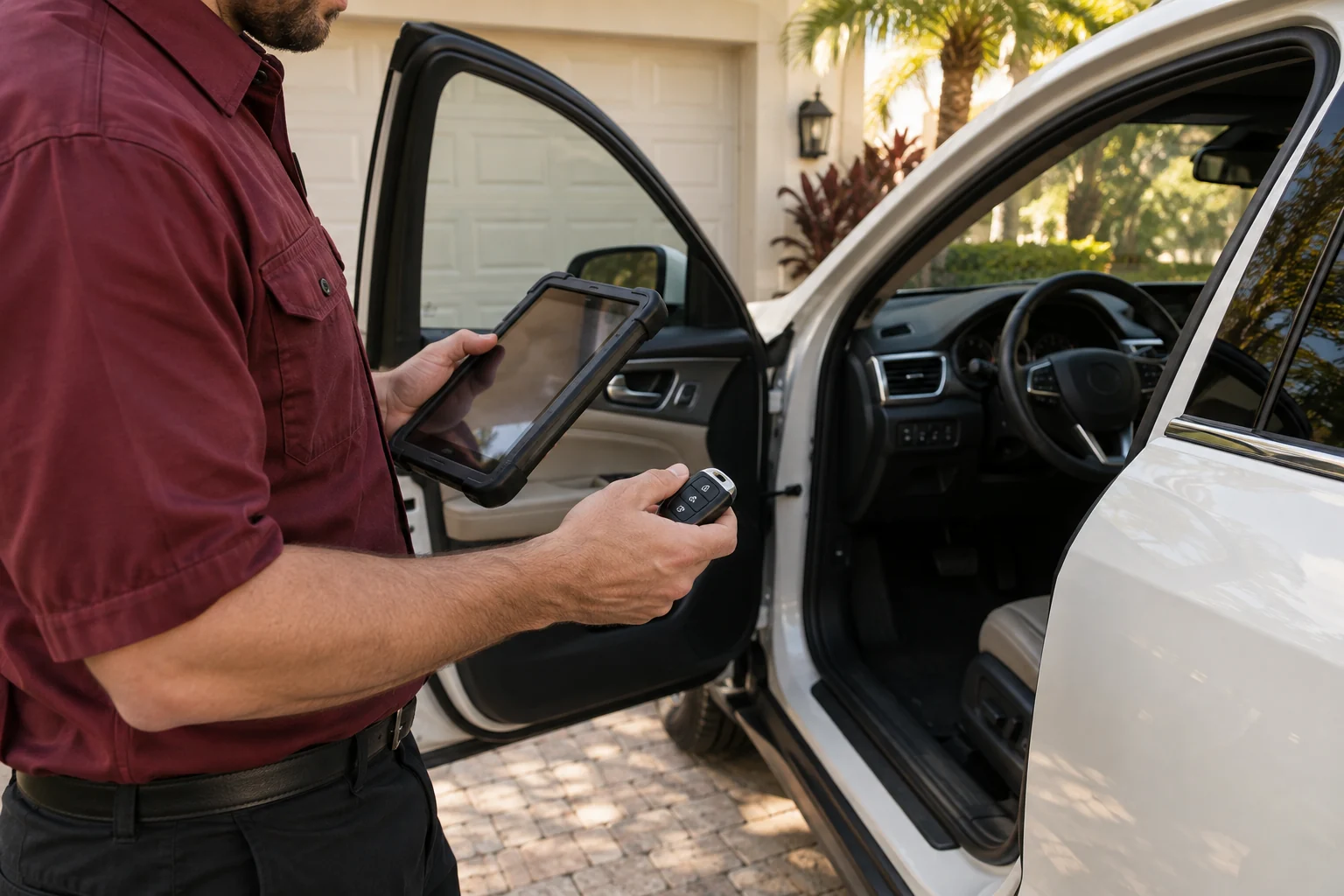
Rekey Service in Cooper City
Rekeying changes which key fits a lock without replacing the lock itself. This page is general guidance for Cooper City homes, condos and small properties about when it helps, how it works and what to decide beforehand.
Call (954) 888-8804What rekeying actually changes
A rekey leaves your lock hardware in place and changes the small internal parts that decide which key will turn it. After the work, the old keys no longer operate the lock, and a new key does. The door looks the same, the handle feels the same and the deadbolt sits where it always did.
Inside a typical house lock there is a cylinder holding a row of tiny spring loaded pins. Each pin stack has to line up at exactly the right height for the cylinder to rotate. A key is a set of cuts that lifts every stack to that height. Rekeying swaps the pins so that a different pattern of cuts is required.
That is why it is a sensible answer when the lock is healthy but the list of people holding keys is no longer one you trust. It is general guidance here, not a description of local rules, and the page applies to Cooper City the same way it would to any Broward community.
One more point is worth stating early. Rekeying is about who can enter, not about how strong the door is. A rekeyed lock on a weak frame, a loose strike plate or a thin door is still weak. Think of the key change as one step in a short list that also includes the condition of the door, the hardware around it and the habits of the people who live behind it. Our overview of house lockout and rekey work places this step in that wider picture.
Moments when rekeying makes sense
Most people think about it only after a bad moment, but there are plenty of calmer reasons. You moved into a house and have no idea how many keys the previous owner handed out. A tenant left and a new one is arriving. A contractor, cleaner or relative once had a key and no longer needs one. You lost a key and cannot be sure where it went.
Another common reason is tidiness. Many homes have a front door, a back door, a garage entry and a side gate that all take different keys, so you carry a bundle. Rekeying several locks to one pattern lets you use one key throughout, which simplifies daily life.
If you recently bought a home, our guide to rekeying after you move covers the sequence I would suggest, and our page on lost house keys speaks to the other common trigger.
- You moved into a home and do not know who holds old keys.
- A tenant, roommate or employee has left.
- A key was lost or stolen and you cannot confirm where it ended up.
- You want several doors to open with a single key.
- A former partner, contractor or caretaker once had access.
Rekey or replace: choosing honestly
Rekeying is not always the answer, and a thoughtful technician will tell you when it is not. If a lock is worn out, corroded or sticky, new pins in a tired cylinder will give you a tired lock with new keys. South Florida air is hard on hardware. Salt, humidity and sun can pit the finish, seize the mechanism and loosen the moving parts, especially on doors that face the weather.
The reverse also holds. Replacing a perfectly sound lock only because the key was lost is often more work than needed. A good deadbolt can serve for many years, and rekeying it keeps that value while fixing the actual problem.
Our article on rekeying versus replacing sets out the questions to ask about condition, grade and features. In short, if the lock turns smoothly, latches properly and has a solid build, rekeying is usually reasonable. If it grinds, sticks or wobbles, replacing deserves a look.
How the visit usually unfolds
The process here is simple. You call and describe the situation and the place, including how many doors and what kind of locks you have. The work and the price are explained before it begins, so there are no surprises at the door. When the job is done, the finished work is tested with you.
On site, the technician examines each lock, confirms that it can be rekeyed and removes the cylinder or opens it to access the pins. The old pin pattern is replaced with a new one cut for the new key. The lock is reassembled and tested with the new key several times and with an old key to confirm that it no longer works.
Have your old keys ready if you can. They are not always required, but they make some jobs smoother. If you have lost every key, say so, because that changes the approach and affects what can be done without disturbing the lock.
Expect the technician to look at a few other things while they are there. A deadbolt that does not fully extend, a latch that rubs the frame or a cylinder that spins loosely are all visible once the lock is in hand. You may be shown the problem and offered a choice. You are entitled to decline extra work, take time to think and ask for the plan and price to be repeated clearly before agreeing to anything beyond the rekey you asked for.
Think about timing around your own day as well. Rekeying means the lock is briefly apart, so make sure someone can be home, that pets are kept calm and that the doors involved can be reached. Clearing the space around the door also helps, since the technician will need room to lay out small parts and work without stepping around boxes or furniture.
Deciding how many doors to include
The decision is usually between doing only the door in question and doing every exterior door. If one key was lost from a set that works on all doors, then leaving any door unchanged leaves a working path in for whoever finds the key. Rekeying all exterior locks to the same new key closes that gap and gives you one key to carry.
Interior locks matter less for security but may matter for privacy. A home office, a closet that holds valuables or a bedroom in a shared house might deserve attention if there is a conflict at home. Garage entry doors are often forgotten, and they connect directly to the house, so they deserve the same treatment as the front door. See also garage entry door security.
Do not forget the secondary points: a mailbox, a storage cage in a condo building, a side gate padlock or a patio slider with its own keyed lock. They are small, but they are on the same ring as your front door key.
Keys that cannot be copied casually
Not every key is a plain brass blank. Some locks use restricted key systems, where copies can be made only with authorization from the person who holds the registration. They are more secure against casual duplication because a stranger at a hardware kiosk cannot copy them. The tradeoff is that you should plan ahead for spares.
If you have a restricted key, tell the technician. It affects what is possible and how new keys are made. You can read more about how they work in our explanation of high security restricted keys.
For ordinary keys, think about who copies them and where. A key cut at a convenience counter may be a poor copy of a copy, and the error compounds. A new key made carefully from a sound original works smoothly. A bad copy can stick, wear the lock and eventually break off inside it. If a key has already snapped, our page on broken key extraction explains what is involved.
When you order new keys, check each one against the lock before you leave. A key that feels slightly stiff when new tends to get worse, not better. Ask for it to be corrected on the spot. A few extra minutes at the beginning can save years of irritation, and it protects the lock you have just refreshed.
Condos, townhomes and rentals
In shared buildings, the lock on your unit door may not be entirely yours to change. An association might keep a master key, a manager might hold copies, or a lease may restrict alterations. Before rekeying, find out what is allowed and who needs to be informed. Rules vary from building to building, so ask the property contact whom to inform.
For landlords, rekeying between tenants is a basic safety habit. A former tenant who still has a key is a risk to the next tenant, and a risk to the owner. It is also a good moment to inspect the door, strike plate and latch. Our guide to tenant turnover and rekeying for property managers lays out a workable routine.
For renters, a rekey can bring real peace of mind, but only with permission. If your lease does not mention it, ask. Many landlords agree, especially when the alternative is that you replace hardware yourself.
Roommates deserve a mention. In a shared rental, one person leaving can change the sense of safety for those who stay. Agree among yourselves who gets a new key, who is responsible for a lost one and what happens when someone moves out. Written down briefly, those agreements prevent most arguments that otherwise come later and all at once, usually when somebody is standing outside in the rain.
After the work is done
Test everything before the technician leaves. Turn the new key in each lock from the outside, and use the thumb turn from the inside. Open and close the door a few times to confirm that the latch and bolt line up with the strike plate. If a door drags or the bolt hits the frame edge, the problem existed before and is worth fixing now.
Label your keys once, in a way that makes sense only to you. A small colored cap, a tag with a code you understand or a simple convention such as front on the left works well. Avoid writing the address on a key tag, because a lost ring becomes a map to your door.
Collect the old keys and destroy or discard them so no one confuses them with working ones. Hand out new keys only to people who need them, and note who has one.
If your doors also have keypads or app controlled locks, remember that the mechanical key is only one way in. Codes should be changed when people leave your circle, and our pages on smart locks and keypad versus smart lock choices explain how to think about both sides. A physical key remains a sensible backup, since batteries run down and electronics fail at inconvenient moments.
Hardware that ages in a humid climate
Coastal humidity does slow, steady damage that you may not notice until a key starts to stick. Moisture gets into cylinders, carries salt with it and leaves deposits on the pins. Over seasons the key drags a little more, then a lot more. Doors that face the sun add heat cycles that expand and contract the metal, loosening screws and shifting the alignment of bolt and strike.
If your key has felt rough for months, mention that before a rekey. A cylinder that is already struggling may not be a good candidate for fresh pins, and a technician can show you the wear. Spraying heavy oil into a lock is a common reflex, but it can attract grit and gum up the pins. Ask what suits your lock instead of guessing.
Hurricane season adds another habit worth building. Before a storm, make sure every exterior door latches and locks without force. After a storm, check again, because swollen frames and shifted doors can cause bolts to rub. Catching that early is less costly than fixing a lock that has been forced for weeks.
Questions to settle before the visit
A few decisions are easier to make at the kitchen table than on the porch. Which doors are included? Who needs a key, and how many copies? Do you want one key for everything, or separate keys for the main house and the garage? Is there a restricted key you need to keep? Having answers ready makes the visit calmer and the plan clearer.
Think about spare keys, too. A rekey is a good time to cut a small number of extra keys for people you trust, rather than waiting until a crisis. More copies means more risk, but a spare with a relative can save a long wait later. Keep the number modest and write down where each one lives.
Finally, be clear about what you expect from the work. You are paying for a lock that works smoothly with the new key and for old keys that no longer open it. You are not paying for a surprise. If the plan changes on site, because a lock is worn or a part will not fit, the new plan and price should be explained before anything more is done.
Mistakes people make with rekeying
The first mistake is waiting. People who lose a key often decide to see if it turns up, and weeks later it still has not. In the meantime the lock has been working for someone else. If the key could have been found by a stranger, treat the situation as an open door and change the lock sooner.
The second mistake is changing only one door. The remaining locks share the old key, so a lost key still works there. Another common error is giving a new key to everyone who had an old one, without thinking about who truly needs access. A rekey is a chance to reduce the circle, not just refresh it.
The third is skipping the test. Check each lock yourself, from both sides, with the new key. A lock that works only when you hold the door a certain way is telling you something. Better to find out with the technician beside you than at night with your arms full of groceries.
If your concern is getting into a locked door rather than changing it, the Cooper City lockout page covers that situation. If you are adding hardware instead, lock installation in Cooper City is the place to start.
People in neighboring communities ask the same questions. The rekey pages for Davie and Pembroke Pines follow the same logic, written for their own readers. Whichever page fits you, the approach holds: describe the situation, hear the plan and price first and test the result together.
Common questions
Does rekeying change the lock itself?
No. The lock stays on the door. Only the small internal parts that match a key are changed, so the old keys stop working and a new key fits. The finish, handle and deadbolt remain the same. If the lock is worn or damaged, a technician may recommend replacing it instead.
Will my old keys still work afterward?
They should not. That is the point of rekeying. The technician can test an old key in the lock to show that it no longer turns. Keep or destroy the old keys so no one mistakes them for current ones, and hand the new key only to people who need it.
Can all my doors use the same key?
Often yes. Locks of compatible types can be set to one key pattern, so a single key opens the front, back and garage entry. Some locks cannot be matched, such as certain restricted or unusual models. Ask about your specific doors when you call and describe what you have.
Is rekeying enough after a break in?
It addresses the key side, but a break in may have damaged doors, frames or strike plates. Check for splintered wood, bent latches or loose hardware. Rekeying does not repair physical damage. Our guide on recovering after a break in suggests what to inspect and what to ask a locksmith to look at.
Do I need my old key to rekey a lock?
Not always. Having an old key can make some jobs smoother, but a technician can often work without one. Tell them honestly if every key is lost. That helps them choose the right approach and decide whether the lock should be rekeyed or replaced.
What if I rent my home?
Check your lease and ask the owner or property manager before changing a lock. Many agree, especially after a key is lost. The building may also hold its own copies or have rules about who can alter locks. Requirements vary, so ask the property contact whom to inform.
Talk through the job before work begins
Explain the problem, what has to work again and who needs access afterward. We talk through the scope and the price first, and work begins after you agree.
Call (954) 888-8804