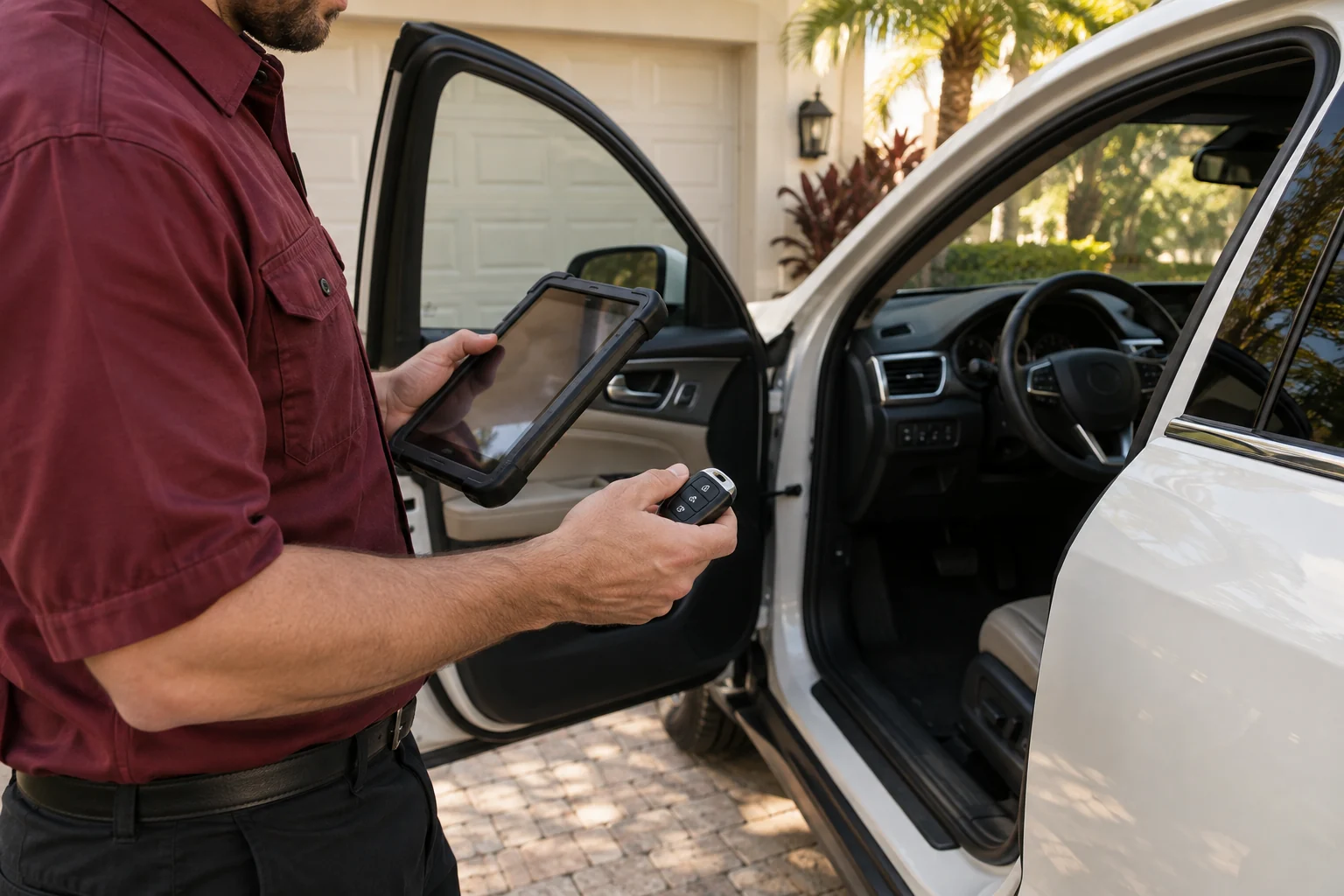
Automotive Locksmith in Cooper City
A car that will not open or start disrupts the whole day. This page is general guidance for Cooper City drivers on lost keys, fobs, ignitions and lockouts, and how to describe your situation clearly before you call.
Call (954) 888-8804Why car keys are more than a piece of metal
A key from thirty years ago was a cut piece of brass or steel, and any key shop could copy it in a minute. Most cars on the road today use something more elaborate. Inside the plastic head of the key is a tiny chip that sends a coded signal to the car. If the code does not match what the vehicle expects, the engine will not start, even if the metal blade turns the ignition freely.
Others skip the blade entirely and use a fob that the car senses nearby, then a push button to start. These proximity systems add convenience but also add parts that can fail: batteries, antennas, buttons and circuit boards. Each has its own ways of going wrong, from a worn rubber button to a fob that took a swim in a pocket during a rainstorm.
This page is general guidance for drivers in and around Cooper City. It does not describe any particular vehicle, because every make and year behaves differently. The more you know about your key type, the easier it is to explain the problem. The page on car key replacement gives the wider overview.
Transponder, laser cut and fob keys in plain words
A transponder key has a chip in the head that talks to the car. A laser cut key has a thicker blade with a wavy groove cut along the side, rather than teeth on the edge, and needs a special machine. Many modern keys are both. A fob may include a blade you can use as a backup, tucked inside the casing.
Knowing which type you own helps explain why replacement costs and procedures differ. A simple metal key is easy to copy. A chipped key must be cut and then programmed to the car. A push to start fob must be introduced to the vehicle so it recognizes the signal. The explainer on laser cut versus standard car keys shows the differences.
The programming side is covered in the guide to transponder key programming. If you are unsure what you have, look at the key head for a thick plastic section, check for a button, and read the owner's manual. A photo of the key sent or described over the phone helps a technician plan.
It also helps to remember that two keys that look alike can behave differently. Two fobs from the same maker may belong to different systems depending on the model year, and a blade that fits the door may not carry the right chip to start the engine. That is why a technician asks for the make, model and year rather than guessing from a picture, and why buying a random key online can end in disappointment.
- A plain metal key with no plastic head is usually the simplest type.
- A thick plastic head often hides a transponder chip.
- A key with a wavy groove along the blade is usually laser cut.
- A fob with buttons may include a hidden backup blade.
- A push to start fob may have no visible blade at all.
When you have lost the only key
Losing the only key to a car is stressful, but it is a common problem with a clear path. The vehicle owner needs to prove ownership, usually with registration and identification that match. The technician needs the make, model and year, and sometimes the vehicle identification number, so the correct key blank and code can be prepared.
Some vehicles are simpler than others. Certain makes allow a new key to be created on site, while others require extra steps. The result is the same: a key that opens the door and starts the engine. After the new key works, any lost key can be removed from the car's memory on many vehicles, so the old one no longer starts it.
That last point is worth asking about. If your lost key could be found by someone who knows your car, you want it disabled. The article on losing a push to start key covers the specific case of fobs, and the comparison of locksmith versus dealership replacement helps you weigh your options.
Whichever path you take, ask what is included. Does the price cover cutting, programming and testing? Will the technician work where the car is parked, or must it be moved? Are extra keys possible during the same visit? Clear answers up front avoid confusion later. A calm, specific conversation is a good sign that the work will proceed in an orderly way.
Why a spare key is worth having before you need it
Making a spare while you still have a working key is much simpler than replacing everything after the last one disappears. The existing key can be copied or used to help program a new one, and you avoid the stress of being stranded. A spare also gives you a second chance when one key is lost, damaged or locked inside the car.
Store the spare at home, not in the vehicle. A spare hidden under the bumper or in a magnetic box is something thieves know to look for. A drawer at home, a trusted family member or a secure place at work is a better choice. The case for planning ahead is laid out in the article on whether a spare car key is worth it.
Test the spare once it has been made. Lock and unlock the doors, start the engine and use the buttons on the fob. If anything is off, you want to learn that now, not on the morning you need it. Replace the battery in the fob when range starts to fade, since a weak battery is a common cause of a remote that seems broken.
Consider keeping the spare somewhere that matches how you live. A household with two drivers might keep one spare each, labeled so nobody confuses them. A family member who lives nearby can hold a copy for emergencies. Whoever holds it should know to keep it dry and away from heat, and to tell you if it ever goes missing.
Locked out of the car
A car lockout usually happens when keys are left inside, the door closes after the remote locks it, or the key is lost somewhere else. The immediate question is safety. If a child, a pet or anyone vulnerable is inside the vehicle, call emergency services first. Cars parked outdoors in South Florida can become dangerously hot in a short time.
If nobody is in danger, stay calm and avoid attempts that can scratch paint, damage weather seals or set off an alarm. Coat hangers and wedges can harm door components, and modern doors contain wiring, airbags and electronics that do not like prodding. A trained technician opens the door with tools designed for the job.
Explain exactly where the keys are, whether the engine is running and whether a spare exists. The overview in keys locked in the car covers the choices. A key locked in the trunk is a different case, since the cabin may still be reachable but the boot is not, and you should say so on the call. Wait somewhere safe and shaded while help is on the way.
Parking location matters too. A car in a dark corner of a lot, on a busy road shoulder or in a tight garage poses different challenges, and the technician needs to know what the space allows. If you can move to a safer, brighter spot nearby without leaving the car unattended, say so. Tell the technician about any alarm system, because opening a door may set it off.
Ignition trouble: when the key will not turn or will not come out
Sometimes the key is fine and the ignition is the problem. A worn cylinder, dirt, a bent key or a steering lock that has engaged can all make the key stiff. The first rule is not to force it. Excess force can snap a key inside the cylinder, which creates a bigger job than the original problem.
A common cause of a stuck steering wheel lock is the wheel resting against a curb or the tires turned when the car was parked. A gentle, steady wiggle of the wheel while turning the key is a standard owner technique, but if it does not work, stop and call. Repeated force damages the parts further.
Ignition cylinders wear over years of use, especially when the key ring carries a heavy bundle of keys. The article on ignition cylinder problems explains the causes, including a key that sticks or will not come out. For repair and replacement of the cylinder itself, see the overview of ignition repair.
Fob problems and dead batteries
A fob that stops working is often nothing more than a tired battery. Symptoms include shorter range, buttons that need several presses and a dashboard message about the key. Replacing a small coin cell is a simple fix on many models, and the owner's manual usually shows how to open the casing.
If a new battery does not help, the cause may lie elsewhere: a damaged circuit board, a worn button pad, water damage or a fob that has lost its programming. Dropping a fob repeatedly or leaving it in a hot car can shorten its life. Knowing the history helps a technician decide whether to repair, reprogram or replace.
Most fobs include a backup method to unlock the door, often through a hidden blade. The guide on a key fob that is not working explains what to check before you call, and what details to mention. Always keep the hidden blade accessible, because you never know when the remote will let you down.
Motorcycles, trucks and other vehicles
Cars get most of the attention, but locksmith work extends to motorcycles, work trucks, vans and similar vehicles. Motorcycle keys, especially on newer models, can have chips and unusual blanks. The ignition and the fork lock are often separate, which matters when explaining a problem.
Work vehicles raise practical issues for businesses. If a delivery van is out of service because a key has snapped or been lost, the cost is not just the repair but lost work. A business with several vehicles benefits from a spare key plan and a record of which key belongs to which vehicle. The page on commercial locksmith help in Cooper City covers fleet and building concerns.
For two wheelers, the process is similar in principle, with its own blanks and its own programming steps for newer models. Whatever the vehicle, give the technician the make, model and year, and describe the key type if you can.
Heat, humidity and the life of your keys
South Florida's climate is rough on vehicles and on keys. Heat softens plastic heads and shortens battery life in fobs. Humidity creeps into buttons and circuit boards. Salt air, especially near the coast, encourages corrosion in the ignition cylinder and door locks.
Small habits make a difference. Do not leave the fob on the dashboard in direct sun. Keep it away from water, and if it gets wet, remove the battery, let it dry and have it checked. Use a light ring, since heavy bundles wear the ignition. Clean the key now and then if it picks up grit.
If a door lock on the car feels gritty or stiff, mention it early. A lock that sticks is often cleaned or serviced more easily than a lock that has seized. Do not spray heavy oil into a lock, because it can attract dirt over time. A technician can recommend a suitable approach for the type of lock involved.
If you have a home as well as a car, consider that the same habits protect both. Check the locks when you notice something unusual, keep a short written list of spare keys and their locations, and tell trusted family members how to reach a locksmith when you are away. For help with the doors at home, the page on lockout help in Cooper City covers that side.
What to prepare before you call
Have the basics ready. The make, model and year of the car are the starting point. If you can, find the vehicle identification number, which is usually visible through the windshield near the dashboard or printed on the registration. Have proof that you own the vehicle, such as registration and matching identification.
Describe what happened clearly. Say whether you lost all keys, broke a key, locked it inside or have a key that no longer starts the car. Mention whether the vehicle is parked at home, at work or somewhere unfamiliar. Tell the technician about any special features such as push button start or an aftermarket alarm.
The process is simple. You call and describe the situation and the place. The work and the price are explained before it begins. When the work is done, it is tested with you, so you can start the car and use the key in the way you expect. For the broader list of work, see the services page.
Keeping control of your keys afterward
Once the new key works, think about how you manage them. Know how many keys exist for the car and where each one lives. If a key went missing for good, ask whether it can be removed from the car's memory so it can no longer start the engine. This is a standard consideration on many vehicles.
Keep the car's paperwork, key code information and any receipts in a safe place at home, not in the glove box. If you ever sell the vehicle, you will want to hand over every key and note any programming that was done. A buyer will appreciate it, and you will not be left wondering where a stray key might be.
Finally, treat a car key like any valuable item. Avoid leaving it visible on a counter or a bar, and keep it away from water and heat. A little care extends its life and reduces the chance of a stressful call. If you live in a shared parking situation, such as a condo garage, take extra care of keys and fobs.
Common questions
Can a locksmith make a new car key if I have lost all of them?
In many cases yes, though the process depends on the vehicle. You will be asked to prove ownership and provide the make, model and year. The new key is cut or programmed to match the car. It is simpler and less stressful to make a spare while you still have a working key.
Why won't my car start even though the key turns?
If the key turns but the engine does not start, the car may not recognize the chip in the key. That can happen with a damaged transponder or a key that was never properly programmed. A weak car battery can also be the cause. Describe exactly what the dashboard shows to help a technician narrow it down.
What should I do if my key is stuck in the ignition?
Do not force it. Check that the gearshift is in park and that the steering wheel is not locked against a turn. A gentle wiggle of the wheel while turning the key sometimes helps. If it does not release, stop and call, since forcing can break the key inside the cylinder.
Is it safe to use a coat hanger on my car door?
It is not a good idea. Modern doors contain wiring, airbags and electronics, and poking inside can damage weather seals, paint and components. A trained technician opens the door with tools designed for the job. If someone is trapped inside the vehicle, contact emergency services right away instead of trying to open it yourself.
Do I need proof of ownership to get a key made?
Yes, a responsible technician will ask for proof that the vehicle is yours, usually registration and matching identification. This protects owners from someone trying to get a key to a car that is not theirs. Have the documents ready when you call, along with the make, model and year.
How can I make my car keys last longer?
Keep fobs out of direct sun and away from water. Use a light key ring so the ignition does not carry a heavy bundle. Replace the fob battery when range begins to fade, and keep a tested spare at home. If a lock or key starts to feel rough, address it early.
Talk through the job before work begins
Explain the problem, what has to work again and who needs access afterward. We talk through the scope and the price first, and work begins after you agree.
Call (954) 888-8804