First, take a breath and confirm it is really gone
The sinking feeling when you pat your pocket and find nothing is familiar to every driver. Before you assume the worst, give the situation five honest minutes. Smart keys are small, they slip into odd places, and they are often not where you remember leaving them.
Retrace your last stop out loud. Where did you park, what did you carry, which pocket or bag did you use, and who else touched your things. Check the cup holders, door pockets, the gap beside the seats, the floor mats and the cargo area. Look under the seat with a flashlight rather than just feeling around.
Also check the places that have nothing to do with the car. Coat pockets, a gym bag, a beach tote, a stroller basket, the kitchen counter and the laundry basket are classic hiding spots. In South Florida, a key can also travel in a swimsuit pocket or a cooler bag and surface a day later.
If you share the car with a spouse, a teenager or a coworker, ask them directly. A fob that looks lost is surprisingly often sitting on someone else's key ring. Only after this short search does it make sense to treat the key as truly missing and start planning a replacement.
Why a smart key is different from an ordinary key
A traditional metal key works by shape alone. A push to start fob works by conversation. It carries a small radio chip that answers when the car asks who is nearby, and the car only unlocks, wakes up and allows the engine to start when it hears the right answer.
Because that answer is stored in the car's computer, a fob cannot simply be copied by tracing its outline. A new fob has to be introduced to the vehicle through a programming step, using equipment that talks to the car's electronics. That is why replacement involves more than cutting something.
Most smart keys also contain a hidden mechanical key blade tucked inside the fob. It exists as a backup for opening the driver door when the battery dies. On many cars this emergency blade is a laser cut style, and our piece on laser cut versus standard car keys explains why those are cut differently.
Some cars also use a proximity antenna system that senses the fob from inside the cabin and near the door handles. That is why the car can unlock as you approach and why the engine can start with the fob sitting in a bag. The same convenience means a lost fob is a bigger deal than a lost house key, since it can start the car and open it from a distance. Understanding this difference helps you ask better questions. You are not buying a piece of metal. You are arranging for a new electronic credential to be recognized by your car, with hardware that matches your exact make, model and model year.
Do not leave the car in a risky spot while you decide
Once you suspect the fob is gone, think about where the car is. If you parked at home in your own driveway, you have time. If it is in a public lot, a beach garage or on the street, treat the situation with a bit more care.
Some vehicles allow the engine to keep running even after the fob leaves, which means a car can be driven away from a stop and then fail to restart. If you realize the fob is missing while someone else is driving, plan where the car will end up before you switch it off.
If the key was stolen rather than misplaced, such as from a bag or a gym locker, the stakes are different. The person holding it may be able to find your car and use it. Consider telling local authorities and keep the car in a secure place until the key situation is resolved.
A locksmith can also help here by programming a new key and removing the old one from the car's memory, so a missing fob stops working. Ask about this specifically when you call, because it matters most when you suspect the key is in the wrong hands.
What to gather before you make the call
Having a few facts ready makes the conversation much smoother. You will want the make, model and model year of the car, and the vehicle identification number, which appears on the lower corner of the windshield and on the driver door jamb. The VIN lets the technician look up the correct key hardware.
Be ready to show proof that the car is yours. A registration or title along with a photo ID is typical, since a reputable locksmith will not create keys for a vehicle without confirming who is asking. If the car is leased or financed, bring whatever paperwork you have.
Count how many keys you had originally. If one is still in your hands, tell the locksmith. A working key can sometimes make the process simpler, and having one gives you a second option for a duplicate, as we describe in the notes on whether a spare car key is worth it.
Finally, think about where the car is and whether it can be reached by someone else. Tell the locksmith the exact spot and whether the car is locked, since that changes how the visit unfolds. You can read what a good first call sounds like in our guide to questions to ask a locksmith on the phone.
- The make, model and model year of the vehicle.
- The VIN from the windshield corner or the driver door jamb.
- Your photo ID and the registration or title.
- The number of working keys you still have.
- The exact place the car is parked and whether it is locked.
Comparing your replacement options
You generally have two paths for a new smart key: the dealership and a mobile automotive locksmith. Both can produce a working fob, and the right choice depends on your situation, the vehicle brand and how soon you need to be moving again. We lay out the comparison in more detail in our page on locksmith versus dealership.
A dealership usually requires the car to be brought to them. If you have no working key, that can mean arranging transport, which adds a step and a day to the plan. They have access to manufacturer systems and original parts for their own brand.
A mobile locksmith comes to where the car is. For many popular makes, the technician carries programming equipment and fob hardware, and can create a new key on site. For some brands or newer models, programming may require special access, and a good technician will tell you honestly if the job is better handled elsewhere.
Whichever path you choose, ask what kind of fob you are getting. Original manufacturer parts and quality aftermarket parts are both common. What matters is that the fob is correct for your vehicle, tested with the car, and explained clearly before work begins. For a rough sense of what shapes the quote, see what affects a locksmith quote.
What a mobile visit looks like from start to finish
The visit starts with the technician confirming your identity and ownership. That can feel formal, but it protects you. The same step that slows down a thief is the one that keeps your car yours.
Next comes identification of the exact key type. The VIN, the dashboard and a look at your remaining key, if any, help narrow down the hardware. The technician explains the plan and the price before any work begins, so you can decide with full information.
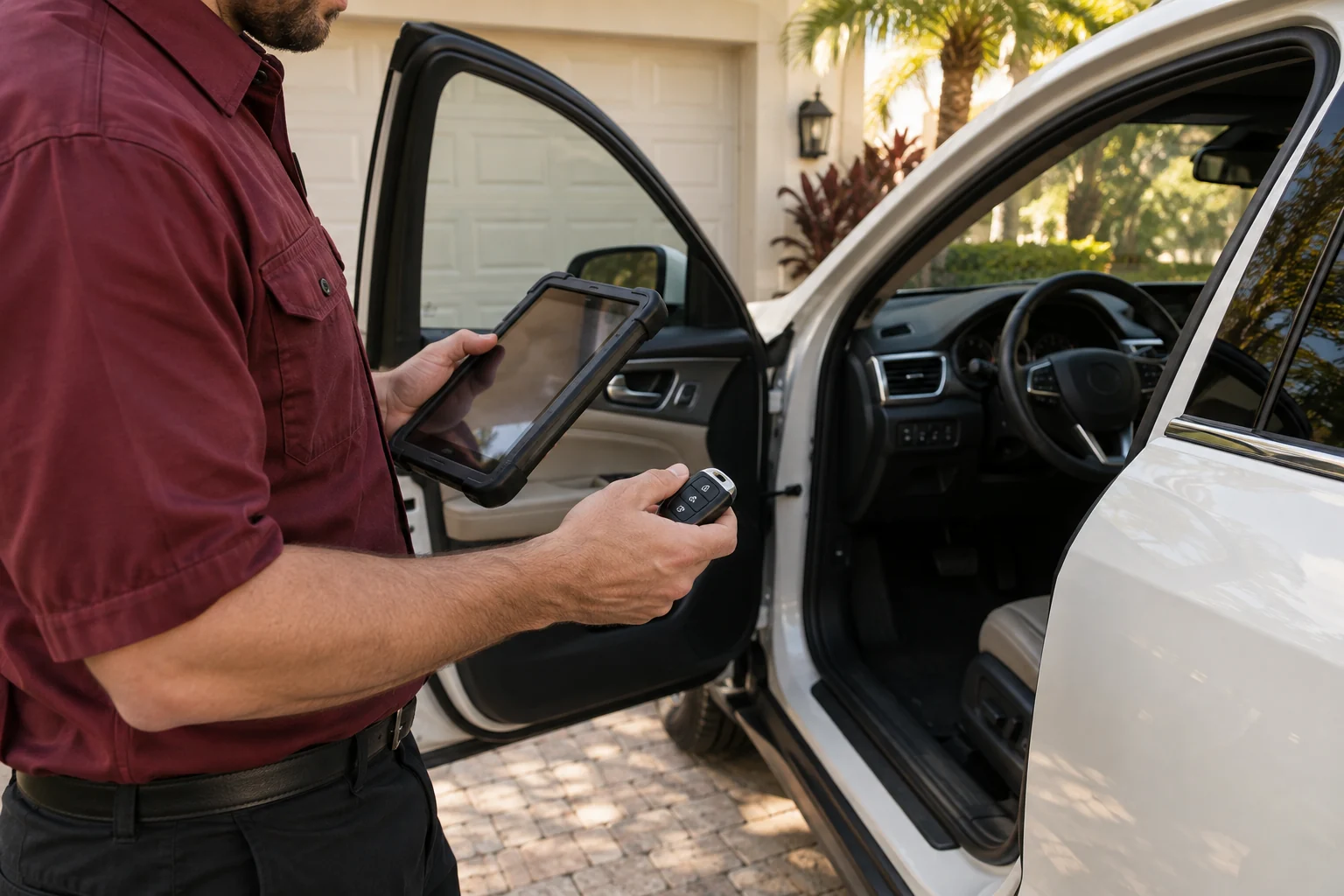
Then the new fob is prepared and introduced to the car. Depending on the vehicle, this can involve connecting equipment to the diagnostic port under the dashboard and following a sequence that registers the key in the car's memory. If the emergency blade also needs cutting, that is done too.
The finishing step is testing. The technician checks that the fob locks and unlocks the doors, wakes the dash, starts the car with the button, and opens the trunk if applicable. You should also watch for any warning lights. Ask them to remove the lost fob from the car's memory, and never accept a job until everything works while you stand beside the vehicle.
It is also reasonable to ask the technician to show you how the emergency blade releases from the fob and where the hidden keyhole sits on the driver door handle. Many drivers never learn this, and it is the one thing that gets you into the car when the battery in the fob runs out. A minute of showing and telling at the end of the visit pays off for as long as you own the car.
The all keys lost situation
If the missing fob was your only key, the job is called an all keys lost situation. It sounds dramatic, but it is routine for automotive locksmiths. The difference is that there is no working key to learn from, so the technician must create the first credential entirely through the car's computer.
This can take more steps than adding a spare, and it varies by make and model year. Some cars make the process fairly direct. Others restrict it, requiring security codes or longer sessions. The technician should tell you before starting which category your car falls into.
If the car is locked and the fob is lost, the first need may be simply getting inside. We explain that kind of call in our lockout solutions guide. Entry should be done without damaging the paint, seals or window, and a careful technician will talk about the approach before beginning.
Once inside, the work moves on to the new key. This is also a good time to ask for a second fob. With the car and technician already there, adding a spare tends to be far simpler than starting over later, and it protects you from the next loss.
Common mistakes that make the problem bigger
The first mistake is ordering a random fob online and hoping it works. Many online listings are the wrong frequency, the wrong chip, or locked to another vehicle after first use. A fob that cannot be programmed to your car is simply an expensive keychain.
The second is calling the first number that appears in search results without asking basic questions. Some companies advertise a low opening quote and then add charges after arrival. Our notes on locksmith red flags describe the warning signs, and a few minutes of asking about the full process prevents most trouble. Ask for the business name, ask how the final price is determined, and ask whether the person arriving will identify themselves and the company before touching the car.
The third is trying to force the situation. Prying a door, smashing a small window or poking at the ignition or dash can create damage far more irritating than the missing key. If something is wrong with the ignition itself, a separate problem altogether, see our page on ignition repair.
The fourth is delaying the decision about the lost key indefinitely. A missing fob that sits unaddressed means no spare, no backup, and a car that depends on a single thing you do not own. Replacing it promptly gives you control again.
The fifth is assuming that a spare key at home solves everything. If the lost fob was not removed from the car's memory, it remains a working credential. Having the missing one erased during the visit is a small step that closes a real gap.
Preventing the next loss
Once you have a working key again, consider small habits that make another loss less likely. Choose one place at home for the fob, such as a hook or a bowl by the door, and return it there every time. Habit beats memory. It sounds simple, and it is the single most effective step, because most lost fobs are simply put down in a new place on a busy day.
Add a tracker if you like. Small bluetooth locators attach to a key ring and help you find a key at home or nearby. They are not a replacement for a spare, but they turn a long search into a short one.
Consider keeping the second fob in a safe location that is not inside the car. A spare locked in the glovebox is useless if you are locked out, and a spare hidden outside the car can be found by someone who wants it. A trusted family member or a home safe is a better spot.
Also keep an eye on battery health. A dying fob battery can look like a lost or broken key. Our guide on a key fob that is not working explains how to tell the difference, and a battery change can save an unnecessary replacement.
Planning for the South Florida driving life
Vehicles in Broward County live outdoors much of the time. Salt air, humidity, sun and sudden storms are hard on electronics. A fob that spends time in a damp beach bag can short out, and a fob left on a dashboard in summer heat may wear out sooner than one kept in the shade. Even the rubber buttons and the small battery contacts suffer when they are exposed to sweat, sunscreen and sand day after day.
Keep the fob out of saltwater and sand. If it gets wet, power it down right away by removing the battery if possible, dry it thoroughly and give it time before trying again. Water exposure is one of the most common reasons a fob suddenly stops working.
Hurricane season adds its own planning point. If you evacuate or store a car elsewhere, make sure every key is accounted for and carry the spare with you. A missing key on a day when roads are full and offices are closed is the worst time to discover the problem.
For a broader view of how we approach vehicle keys, visit our car key replacement page, and our explanation of transponder key programming goes through how the car and the key learn to recognize each other.