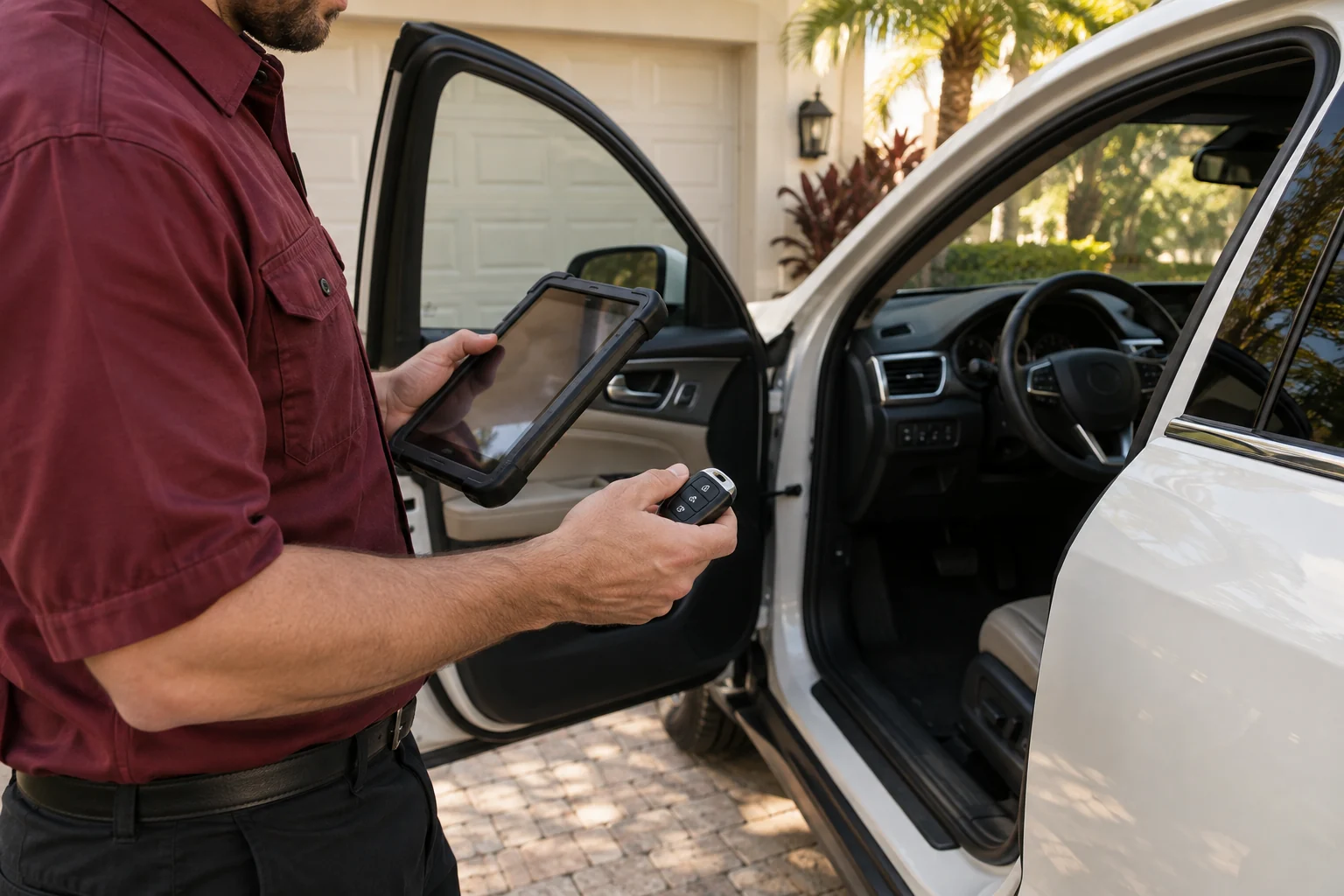
Automotive Locksmith in Coral Springs
Modern car keys are small computers wrapped in plastic, which makes losing one more complicated than it used to be. This page is general guidance for Coral Springs drivers on what to expect and what to ask.
Call (954) 888-8804A car key is more than a cut piece of metal
Older cars used a plain metal key that turned a lock. If you lost it, a copy cut from the same code worked. That world is mostly gone. Today a typical key carries a transponder chip that talks to the vehicle, and the engine will not run unless the car recognizes the chip. The metal blade is only half of the system.
That is why replacing a key now involves two separate jobs: cutting the blade so it fits the door and ignition, and introducing the electronic part so the car accepts it. Sometimes these happen together and sometimes the chip and the blade come from different places. When someone says they can make a key, ask which of those two jobs they mean.
This page is general guidance for drivers in Coral Springs and says nothing about local rules, dealers or specific roads. It simply explains how the work tends to go and how to talk about your problem so the right help arrives.
The four situations drivers actually face
Nearly every call falls into one of four groups. You have lost every key and need one made from scratch. You have one key and want a spare before the last one disappears. A key has broken, stopped working or lost its fob buttons. Or you are locked out with the keys inside, which is a door problem rather than a key problem.
Each calls for something different. Making a key when none exists is the most involved, because the system must be told to accept a new one. Duplicating from a working key is simpler. A broken key may leave part of itself in the ignition or door, which is a retrieval task. And a lockout needs the door opened without harming the paint, seals or electronics.
Say clearly which of these you have. If it is more than one, say that too. A driver who has lost a key and also has a door that will not unlock needs a plan that covers both.
If you are unsure about any of this, say so. Nobody expects a driver to know the difference between a transponder and a proximity fob, and a patient explanation is part of the job. Describe what you see, read out any numbers or markings on the key if you have one, and mention whether the vehicle is a family car, a work truck or something older. The more concrete the picture, the less guesswork stands between you and a working key, and the fewer surprises appear once someone is standing next to the car with their tools.
- No working key at all, and the car is parked somewhere.
- One working key and a wish to cut a spare before it is lost.
- A key or fob that is broken, worn out or no longer responding.
- Keys visible or known to be inside the locked vehicle.
Transponder keys and why programming matters
A transponder chip holds a code. When you turn the key, the car sends a small signal and the chip answers. If the answer is right, the engine management system lets the car start. If it is wrong or missing, the car may crank without firing, or the dashboard may show a security light and refuse to run.
A new key therefore has to carry a chip that the car can be taught to trust. This is called programming. The method depends on the make, model and year. In some vehicles an existing working key is used to add another. In others, specialist equipment connects to the car and writes the new key into its memory.
If you have read about it, you may have heard of laser cut keys, which have a milled track along the blade instead of edge cuts. Our page on laser cut versus standard car keys explains the difference, and transponder key programming goes deeper into the electronic side.
A point that surprises people is that the physical copy and the electronic copy are independent. A key can turn the lock perfectly and still not start the car, and a programmed chip in a badly cut blade will start nothing, because the blade will not turn the ignition. Both halves have to be right. Ask whoever is making the key how they will check each half, and expect them to demonstrate both before you pay.
Push button start and proximity fobs
Many newer cars have no key slot at all. You carry a fob, press a button on the dash and the engine starts, provided the fob is inside the vehicle. These systems are convenient and add their own failure points. A fob battery runs out, the fob is dropped or soaked, or the car forgets the fob after a battery change.
If you lose a proximity fob, the replacement must be programmed to the car, and some systems limit how many fobs they accept. Having a second fob can matter more than people expect, because losing the only one can mean the car cannot be moved without specialist help.
If your fob has simply stopped responding, check the obvious before assuming the worst. Try the small physical key hidden inside many fobs to open the door, and look in the owner manual for how to start the car with a weak fob. Our guides on a key fob that is not working and losing a push to start key walk through the symptoms.
Ignition trouble that looks like a key problem
Sometimes the key is fine and the ignition is not. Signs of an ignition cylinder problem include a key that goes in but will not turn, a key that turns only after much wiggling, a key that sticks and will not come out, or a steering column that stays locked. The mechanism has parts that wear with years of turning.
It helps to compare keys. If a spare key works smoothly where the main key does not, the main key is probably worn. If every key behaves the same, the cylinder is the likely suspect. Worn keys can also damage a cylinder over time, so replacing a worn key before it fails is more sensible than waiting.
The steering wheel lock sometimes causes the same symptom. If the wheel is pressed against its lock pin, the key will refuse to turn until you ease the wheel gently from side to side. We explain more in a key stuck in the ignition and our ignition repair page, and ignition cylinder problems describes what wears.
Locked out of the car
Car lockouts are different from home lockouts in one important way: the doors are full of wiring, airbag components, side impact bars and linkages. Prying, wedging and inserting tools without understanding what is inside can bend panels, tear seals and trigger alarms. A trained technician uses methods designed to avoid damage.
If a child or an animal is inside, do not wait for any locksmith. Contact emergency services at once, because a closed car in South Florida sun becomes dangerous within minutes. Once everyone is safe, the rest of the problem can be handled calmly.
For ordinary lockouts, your most useful help may be a spare key brought by someone you trust. If not, describe the vehicle and the location. See also solutions for keys locked in a car and the shorter note on keys locked in the trunk.
What to have ready when you call
The make, model and year of the vehicle matter more than anything else, because they determine the key type and the method. The vehicle identification number, usually visible on the dashboard near the windshield and on the registration, can help confirm details. Have your identification and proof that the vehicle is yours ready too.
Explain the story briefly. When was the key last seen? Does the car show any lights? Has the battery been changed recently? Did the fob get wet? These small details often point to the real fault and save wasted effort.
The working process here is simple. You call and describe the situation and the place. The work and the price are explained before it begins, and the finished work is tested with you. Testing a key means starting the car, locking and unlocking with the buttons and turning off the engine and starting again.
Keep a note on your phone with the vehicle details, such as the make, model, year and the type of key, so you are never searching for them while standing in a parking lot. It takes two minutes and makes every future call simpler.
Cost, dealers and doing it yourself
People often wonder whether to go to a dealership or a locksmith. There is no single answer. Some vehicles are simple for a locksmith to handle, while a few need dealer involvement for certain parts. A thoughtful provider will tell you honestly when something is outside what they can do instead of pretending otherwise.
Prices vary with the vehicle, the key type and the circumstances, and I will not quote any here. What you can do is ask what the total will be, what it includes and whether anything could change it. Our articles on locksmith versus dealership and what shapes the cost of a replacement key explain the factors.
Buying a key online and hoping it works is a gamble. Blank fobs from unknown sources may carry the wrong chip, a locked chip that cannot be programmed or the wrong frequency. If you do buy one, check it with the person who will program it before you pay anything.
There are practical considerations beyond price. A dealership may need the vehicle brought to them, which is a problem if you have no working key and the car cannot be driven. A mobile service comes to the vehicle, which matters when the car is stuck in a parking lot or at your home. Think about where the car is, what paperwork you have and how soon you need to be moving, and let those facts guide your choice rather than assumptions about one route or another.
Motorcycles, trunks and other odd cases
Not every vehicle is a sedan. Motorcycles, scooters and some boats and trailers have their own key systems, and a motorcycle key often has a chip, a steering lock and a separate seat or storage lock. If you ride, read about motorcycle key replacement before you assume it will work like a car.
Vehicles parked outdoors take a beating. Sun cracks key heads, rain gets into fobs and heat warps plastic. The key that has lived on a crowded ring for years has probably worn its teeth, which is when it begins to snap. A spare made while the original still works is the sturdiest protection.
If your needs are about a house instead, the Coral Springs lockout page and the main Coral Springs guide cover that ground.
Rental cars and company vehicles add one more layer. If the vehicle belongs to someone else, contact the owner or the rental company before calling anyone, because they may have a service arrangement and may need to authorize the work. A locksmith will rightly ask for proof of authority, and without it, the safest course is to wait for the owner to confirm. This protects the vehicle and keeps you out of an awkward misunderstanding.
After the key is made
Before you accept the finished work, test everything. Start the car from cold, turn it off and start it again. Try each button on the fob: lock, unlock, trunk, panic and remote start if fitted. Use the physical key blade in the door and the ignition, not just the buttons. A new key that works for one task and not another is not finished, and it is far easier to say so while the technician is still with you.
Count your keys and decide where each will live. A spare belongs outside the car and outside your daily bag. If the old key was lost, ask whether the car can be set to stop recognizing it. That step matters because a lost key in a stranger's hands, with the car parked in a known place, is a real risk. Some vehicles allow lost keys to be removed from memory, and some do not, so ask what is possible for yours.
Finally, think about the wear that caused the trouble. A heavy key ring hanging from the ignition wears the cylinder over the years, because the weight pulls on the mechanism with every bump. Keep only the car key and fob on the ring you use while driving, and the ignition will thank you. These small changes make the new key last, and they keep the next problem a long way off.
Habits that save a key
Most key trouble starts with ordinary habits. A key left on the roof of the car while you load groceries, a fob dropped into a bag with loose change, a spare kept in the same pocket as the original and a ring so heavy it bends the blade are all common. None of them is dramatic, and all of them end in a phone call. Choose one place for your keys at home and one pocket for them outside, and stick to it every time.
Water is a particular enemy in this climate. Fobs that go through the wash, get soaked at the beach or sit in a damp pocket can fail even when the battery is fine. If a fob gets wet, remove the battery if you can, let it dry fully in a ventilated spot and do not use heat to speed it along. Many fobs recover, but corrosion on the contacts may remain, and a replacement could be wiser than a repeated repair.
Finally, think of the vehicle as part of a household security plan. A car key often sits beside the house key, and the garage door opener is usually clipped to the visor. If a vehicle is broken into and the opener is taken, someone now has a link to your home. Keep the opener with you or hidden, and if the car key is lost, consider whether your home locks need attention as well. Our pages on house lockout and rekey work explain that side.
Common questions
Can a new car key be made if I lost every key?
Often yes, though the method depends on the vehicle. A new key has to be cut and the car must be taught to accept it. Tell the person on the phone the make, model, year and where the car is. Some situations need additional steps, and the plan should be explained before work starts.
Why won't my car start with a new key?
Usually the chip in the key has not been programmed to the car, or the chip type is wrong. A key that opens the door can still fail to start the engine. Programming is a separate step. If a key was bought elsewhere, have it checked before assuming the car is at fault.
My key turns but the car does not start. What could be wrong?
It may be the chip not being recognized, a weak car battery, a worn ignition or a fuel or starter issue unrelated to the key. A security light on the dash is a useful clue. Describe exactly what happens when you turn the key, so the cause can be narrowed.
Is it worth having a spare key made?
Generally yes, because copying from a working key is simpler than creating one when none exists. A spare also protects you if the first key breaks, is lost or has its fob damaged. Keep it somewhere other than the car, with someone you trust.
Will opening my car door damage it?
It should not when done by someone trained, who uses methods that avoid paint, seals and wiring. Damage tends to come from improvised tools or force. Ask what method will be used, and check the door, seals and locks together when the job is complete.
What proof do I need to show the car is mine?
Expect to be asked for photo identification and something that links you to the vehicle, such as a registration or other paperwork. Requirements differ by company, so ask on the phone what to have. This protects owners and prevents the wrong person from getting a working key.
Talk through the job before work begins
Explain the problem, what has to work again and who needs access afterward. We talk through the scope and the price first, and work begins after you agree.
Call (954) 888-8804