Commercial Locksmith in Coral Springs
A business door has to do more than keep people out. It has to let the right people in, let everyone leave safely and keep a record of who holds what. This page is general guidance for Coral Springs businesses.
Call (954) 888-8804How business locks differ from home locks
A house usually has a handful of doors and a handful of keys, all held by people who know each other. A business has staff who come and go, customers who walk in, deliveries, cleaners, landlords and sometimes several shifts. The same lock that is fine for a family can become a source of confusion when thirty people need different levels of access.
Business doors are also built to a heavier standard. They are opened hundreds of times a day, slammed by carts and pushed by crowds. Hardware that is made for light residential use will loosen and fail under that treatment, and a failed lock on a busy door always seems to happen at the worst time.
This page is general guidance for businesses in Coral Springs. It does not describe local codes or any particular building. If a requirement might apply to your door, ask the property manager, the landlord or the relevant local office whom to inform before changing anything.
Another difference is who is responsible when something goes wrong. At home, a lost key is your own problem. In a business, a lost key may be an insurance question, a lease question and a staff question all at once. Decisions about locks therefore benefit from being written down and agreed with whoever owns the building or manages the business. A brief note of what was changed, when and why will save arguments later, and it helps the next person who has to make a decision about the same door.
Hardware grades in plain language
Commercial hardware is sorted into grades that describe how much punishment it is built to survive. A higher grade generally means thicker metal, stronger internal parts and a longer working life, while a lower grade is made for lighter use. Choosing a grade is a balance between the door, the traffic and how important the door is to protect.
A back storeroom door that is opened twice a day does not need the same hardware as the main entrance to a clinic. On the other hand, installing a light duty lock on a busy front door often means replacing it again within a short time, which ends up being more trouble than buying the right item once.
We go through the idea in more detail in our article on commercial lock grades, and the companion piece on deadbolt grades shows how the same thinking applies to the bolt itself.
Frames and doors matter as much as the lock. A strong bolt set into a thin hollow frame, or a latch that barely reaches into a worn strike, is only as strong as its weakest part. Commercial doors are often metal or heavy wood, and the frames may be hollow steel that can be bent by a determined shove. Part of a good assessment is looking at the whole assembly: hinges, frame, strike, closer and lock together, and deciding which part is limiting the door.
Panic bars and exit devices
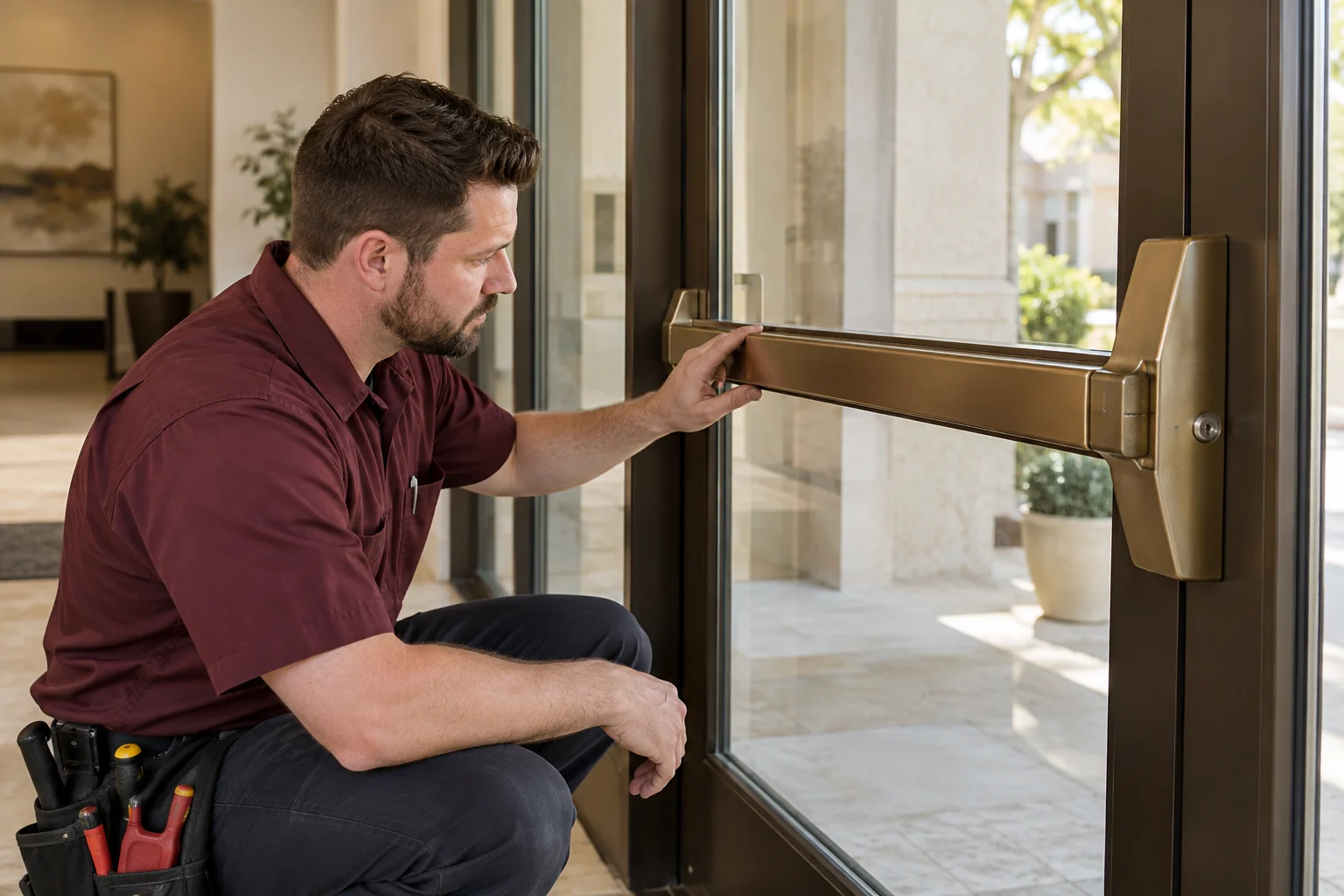
Many business doors must let people leave without any key, tool or special knowledge, even when the door is locked from the outside. Exit devices, often called panic bars, serve this purpose. Pushing the bar retracts the latch, and the door opens in the direction of travel. They are a safety feature first and a security feature second.
Because they matter for safe exits, they should never be chained, blocked or disabled to prevent theft. A door that cannot be opened in an emergency is a danger, and tampering can create serious problems. If a panic bar is sticking, loose or not latching, have it examined by someone who understands both the hardware and its purpose.
Rules about which doors need which devices vary and depend on the building and its use, so I will not state them. Ask your property manager or the relevant authority whom to inform. Our plain guide to panic bars and exit devices explains how they work.
Maintenance deserves attention because these devices work hard. Bars loosen, springs tire and latches wear against strikes. A device that needs two tries to open, or that is slow to latch behind a person, should be looked at. In a humid, salty climate, corrosion on the latch and the trim can seize moving parts. If a door has an alarm, check that it still behaves as intended after any repair, and never leave an exit device out of service for longer than necessary.
Keys: who holds what
The most common business security problem is not a clever break in. It is a long list of keys nobody has tracked. An employee leaves with a key, a contractor keeps one after the job, a manager makes a copy for a family member, and over time the number of working keys exceeds the number of people who need them.
A simple record helps. Write down each door, each key stamped or tagged with a code and the person who holds it, with a signature or date when it was handed out. When someone leaves, collect the key and note it. This is dull paperwork, and it is the foundation of every other measure.
If the record is already a mess, a rekey is a clean way to start again. Our guide on rekeying an office after an employee leaves sets out a sensible order of work.
Stamped keys can be a weakness and a strength. Keys marked do not duplicate discourage casual copying but do not stop it, because the stamp is only a request. Restricted key systems, where copies need authorization, offer more real control. For a business with many staff or sensitive areas, it can be worth discussing them. Our explanation of high security restricted keys covers how they work and what tradeoffs they involve.
Master key systems
A master key system lets different keys open different groups of locks, with one master that opens everything. A manager might hold the master, a department head might hold a key that opens all the doors in their area and each employee might carry a key for just their own office. It is a neat answer for buildings with many doors.
It also needs careful planning. More levels of access mean more complexity and more potential for mistakes. A system designed well from the start can last for decades, while one expanded carelessly can leave overlaps that nobody can untangle. Decide the hierarchy on paper before any hardware changes.
Our articles on master key systems for business and keyed alike and master key choices explain the vocabulary so you can ask good questions.
Think also about what happens when a key in the system is lost. In a simple lock, you rekey one door. In a master system, a lost master key can affect every door it opens, and fixing it may mean changing a large number of cylinders. That is why masters should be few, carefully stored and signed for. A good rule is to keep the highest level of key in the smallest possible number of hands, with a clear note of who they are.
Access control and when keys are not enough
Keypads, cards and fobs replace or supplement metal keys. They let you give each person their own credential, cancel it without touching the lock and in some systems record when it was used. For a business with many employees or high turnover, that can be easier to manage than a drawer of keys.
They are also more complicated, with power supplies, controllers and software behind the door. Think about what happens during a power failure, whether the door still opens safely from inside and who administers the system. A system that nobody understands becomes a hazard when the one person who set it up leaves.
Our guide on access control versus keys for small businesses compares the two so you can match the choice to your size and habits.
Whatever system you choose, plan for failure. What happens when the power goes out, when the network is down or when a credential reader is damaged? Doors that must stay secure need a fallback that does not weaken the building. Doors that must allow exit need a safe path out regardless of the electronics. A sensible installation answers these questions in advance and records them, so a person who arrives after the system was set up can understand what was intended.
Storefronts, glass doors and humidity
Many shops use glass doors with a narrow frame, which limits the hardware that can be fitted. The lock often sits in a small rail at the bottom or the side of the door, and it takes a lot of abuse. Rattling, sagging and difficulty locking are common complaints, and they usually trace to alignment or worn parts.
South Florida weather adds to the problem. Humidity, salt air and heat shorten the life of finishes and mechanisms, and doors facing the sun or sea breeze suffer most. A cylinder that sticks every morning is telling you something, and ignoring it leads to a lockout at opening time.
See our notes on storefront door lock repair and think about your own door as you read. If you notice daylight at the edge of a closed door, or a latch that catches only when you lift or pull, mention it.
Opening and closing routines matter too. Many shops lose their lock to a daily habit, such as forcing the door shut with a shoulder, kicking a stuck bottom latch or propping the door open with a wedge that scrapes the frame. If staff do any of these, the hardware will wear much sooner than it should. A word with the team and a small adjustment to the door may do more good than replacing the lock again and again.
Compliance, accessibility and doing it right
Business doors come with expectations about accessibility. Handles that can be used without tight gripping, thresholds that can be crossed with a wheelchair and operating forces that most people can manage all matter. These requirements vary and depend on the building, so I will not state specifics. Ask the right local office whom to inform.
What you can do is think about the people who use the door. A lever handle is easier than a round knob for someone with limited hand strength. A door that is hard to open because of a stiff closer is a problem for many people. A walk through your doors with real users in mind often reveals simple improvements.
Our piece on door compliance checks for commercial properties offers a starting point for the conversation.
Insurance and lease documents sometimes mention locks, and it is worth reading them before you buy anything. A requirement may call for a certain kind of deadbolt or for a record of who holds keys. I will not state what yours says, because it varies, but your insurance contact and your landlord can tell you. Knowing in advance prevents the frustration of installing hardware that later turns out not to meet an agreement you had already signed.
Planning a visit and working with a landlord
If you rent your space, find out who owns the lock. A landlord may hold master keys, may require copies of any new keys and may need to give permission before you change a lock. Sorting this out first prevents conflict and avoids a locked out landlord, which is its own kind of problem.
When you call, describe the business type, the number of doors, the kind of lock and what is wrong. The work and the price are explained before it begins, and the finished work is tested with you. For several doors, ask for a plan that covers them in a sensible order and leaves the business secure at the end of each stage.
If you need other services or have a home to think about too, the commercial locksmith overview and the Coral Springs main page are good places to continue.
Think about timing from the business side. Locks usually need to be worked on when the door is not in use, which may mean after closing or during a quiet period. Tell the technician about busy times, deliveries and any days when the door cannot be out of service. A sensible plan keeps the business running, leaves the premises secure at the end of each day and avoids the situation where a door is left half finished because someone needed it open.
When something has already gone wrong
Sometimes a business calls after an incident: a break in, an attempted entry or a door that was found open in the morning. The first priority is safety and, where appropriate, reporting it to the proper authorities. After that, look at the door before anyone touches it. Splintered frames, bent latches, scratched cylinders and missing screws tell a story, and a technician can read the damage and suggest repairs.
A secure temporary measure may be needed so the premises are protected while a permanent fix is arranged. Our checklist for recovering after a break in explains what to look at, and it applies to businesses as well as homes. Rekeying is usually part of the response, because you cannot be sure who has copied or kept a key.
Do not hurry into replacing everything in a panic. Decide what truly failed. Was it the lock, the door, the frame or the habit of leaving a door unlatched? A careful assessment often finds one or two weak points that, once corrected, make the whole entrance stronger. Spend the money where the weakness is, and the building will be better protected than it was before the incident.
Afterward, speak to your staff. Explain what happened, what has changed and what you expect of them, such as returning keys, locking up in a set order and reporting a door that does not latch. People follow routines they understand. A short, calm conversation turns a stressful event into a better set of habits and gives you a team that notices small problems before they become large ones.
Common questions
What is the difference between a commercial and a residential lock?
Commercial hardware is built for heavier use, with stronger parts and higher grades for thousands of operations. Residential locks are designed for lighter daily traffic. Using the wrong type on a busy door tends to cause early wear and failures. A technician can recommend a grade that suits the door and how it is used.
How do I stop former employees from having access?
Keep a record of every key and collect it when someone leaves. If you cannot be sure all keys came back, rekeying the affected locks is a clean fix. For larger staffs, a system with individual credentials lets you cancel one person without touching the hardware.
Can a panic bar be locked so no one can use it?
It should not be disabled in a way that stops people from leaving in an emergency. Exit devices exist for safety. If the door needs to be secure from outside, there are proper ways to do that without blocking the exit. Ask the property manager or relevant local office whom to inform.
What is a master key system?
It is a set of locks arranged so that different keys open different groups of doors, with a top level master opening all. It suits buildings with many doors and people. It needs careful design, because each additional level adds complexity. Plan the hierarchy on paper before changing any hardware.
Should I choose keys or a keypad system?
It depends on the number of people, how often they change and how you manage records. Keys are simple and need no power. Credentials are easy to cancel and track but need setup and maintenance. A small team with few changes may be fine with keys, while high turnover favors credentials.
Do I need my landlord's permission to change a lock?
Often yes, and the landlord may hold master keys or need copies. Read your lease and ask before work begins. Requirements differ by property, so ask your property contact whom to inform. Settling this first prevents disputes and makes sure emergency access is not accidentally lost.
Talk through the job before work begins
Tell us what happened, which doors or keys are involved and who needs to get in. The price and the plan are agreed with you before any work starts.
Call (954) 888-8804