Commercial Locksmith in Cooper City
Running a business means trusting many people with a way in. This page offers general guidance for Cooper City owners, tenants and property managers on organizing keys, keeping doors in good order and handling change.
Call (954) 888-8804Different kinds of workplaces need different kinds of doors
A dental office, a corner shop, a small warehouse and a professional suite all lock their doors, but the way each one uses a door is quite different. A shop opens its front door hundreds of times a day. A warehouse may rely on a heavy rear door that moves only when a delivery arrives. An office may keep its front door unlocked during business hours and secure it hard at night.
Those habits decide what hardware makes sense. Heavy daily traffic wears out light duty parts. Rarely used doors still need to be reliable, because a stuck lock on a seldom used door tends to fail when it matters most. A medical or records heavy office may need interior doors that lock for privacy as well.
This page is general guidance for businesses in and around Cooper City. It does not describe any particular building. For a broader look at the range of work available, the page on commercial locksmith services is a good starting point, and the first step is always to describe how your doors are actually used.
Think about the people who walk through those doors as well. Customers expect an entrance that opens easily and looks cared for. Staff expect keys that work the first time. Delivery drivers expect a door that stays open while they carry boxes and closes behind them. A good lock plan serves all three groups, and it is easier to design when you picture a normal day from each person's point of view.
Tenants, landlords and who controls the door
In a multi tenant building, the answer to who may change a lock depends on the lease. The landlord often controls the exterior doors, the shared lobby and the common areas. The tenant usually controls the suite door and interior doors. Some leases require the landlord to hold a key to every suite, and some forbid lock changes without approval.
Before you call anyone, read your lease or ask the property manager. A locksmith should ask whether you have the right to authorize the work, and you will save time and awkwardness if you already know. Requirements differ from one building to the next, so this page does not state what applies to you.
For owners, the situation is simpler but the responsibility is larger. You decide who holds keys, you pay for changes and you live with the consequences of a lost master. If you manage several units, the guide on turnover rekeying for property managers shows how others handle the cycle.
Disputes about doors are common and mostly avoidable. A tenant who changes a lock without telling the landlord can end up locked out of a building they pay for. A landlord who rekeys a suite without notice can interrupt a business. A simple written note between the two, stating who keeps which keys and who pays for changes, heads off most of these problems before they begin.
Opening a new location: a first week checklist for locks
The first week in a new space is the ideal moment to deal with keys. You have no idea who held keys to the previous tenant, and a rekey at the start resets that to zero. Do this before you bring in inventory, equipment or records, not after.
Walk every door with the technician. Check that each one latches, that the frame is sound, that closers work and that any exit hardware retracts cleanly. Make a note of the doors that stick or drag. Fixing alignment early prevents wear on the lock itself, and it prevents the strange problem of a lock that seems broken but is only fighting a crooked door.
Decide who gets which keys and write it down. Then think about what you want next: a master system, a keypad on the main entrance or a restricted key that cannot be copied freely. The article on access control versus keys for a small business helps you weigh the options.
Do not forget the less obvious entry points. A window that opens, a roof hatch, a gate to a rear lot and a service door beside the dumpster are all doors in the eyes of a stranger. Include them in your walk through, and ask whether each needs a lock, a better latch or simply a reminder to staff to keep it closed.
- Rekey every exterior door before moving in.
- Test each latch, closer and exit device.
- Note any door that drags or fails to catch.
- Write down who receives each key.
- Decide whether you want a master or restricted key setup.
Staff changes and the key that never came back
Employees come and go, and keys do not always come back with them. Even a friendly departure leaves an open question about a copy made years ago. The surest way to answer that question is to rekey the doors that person could open. It resets the situation without drama and without accusing anyone.
The timing matters. Doing it within a reasonable window after someone leaves is better than waiting until something goes wrong. For a person who held a master or opened the cash room, treat it with more urgency than for someone who only had the front door. The article on rekeying an office after an employee leaves describes the typical approach.
Prevention helps too. Issue keys against a signed form, limit who can authorize copies, and consider restricted keys for sensitive doors. The page on restricted and high security keys explains how control over duplication works.
When a key does go missing, resist the urge to wait and hope. Think about what the key opened and what is behind that door. If the answer is a back storage room with low value items, you may reasonably decide to monitor the situation. If the answer is the cash office or the main entrance, rekeying is the sensible response. Write down the date and what you decided, so the record is clear later.
Cleaners, vendors and after hours access
Many businesses have people who need to get in when no one else is there: cleaning crews, delivery drivers, repair technicians and security guards. Each needs a way in, and each is a potential source of lost keys. The goal is to give enough access to do the job and no more.
One approach is a separate key that opens only the doors a vendor needs, kept off the main ring. Another is a keypad with codes that can be changed or turned off for one person. A third is a lockbox that holds a key for a specific visit. Which fits depends on how often the person comes and how much you trust the arrangement.
Whatever you pick, keep a record of who holds what. Ask vendors to tell you if a key is lost. If a vendor changes, rekey or change the code. A small amount of discipline here prevents the situation where a former contractor can still enter your building months later.
Consider the practical details of handing over a key. Give it in person where possible, note the date, and tell the person what it opens and what it does not. Ask them to keep it separate from personal keys and to report a loss at once. People who understand why the rules exist tend to follow them, and people who feel trusted tend to take extra care.
Doors that must always open from inside
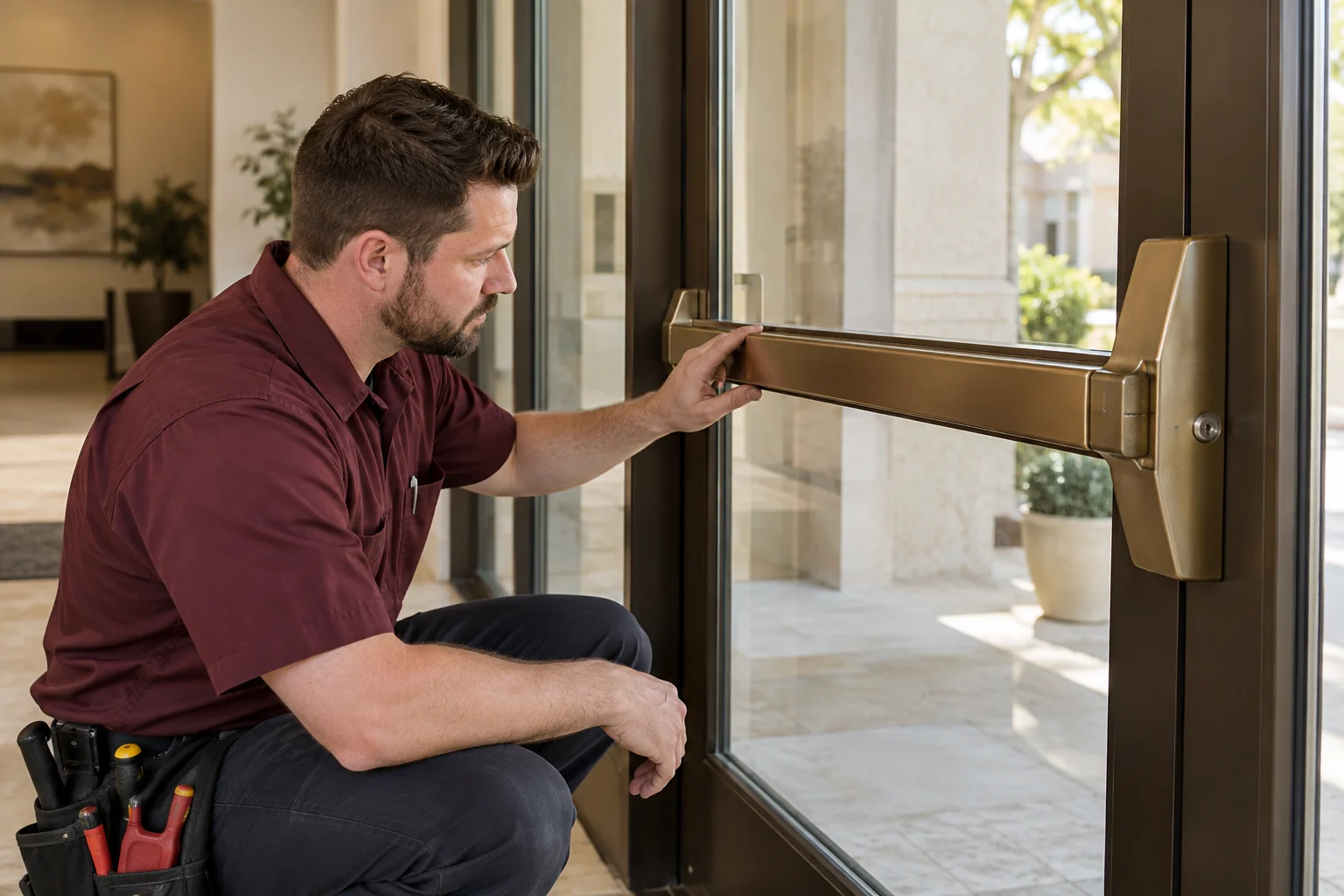
Some doors in a business exist to get people out. Rear exits, stockroom doors and doors off a busy room often use panic bars or similar exit devices, which open from inside with a push even when locked from outside. They are a safety feature, and a sensible owner keeps them working and unblocked.
These devices take punishment. A bar that sticks, a latch that no longer catches or a door that does not close fully needs attention. Never chain, wedge or disable an exit device to prevent misuse. If people are propping a door open, talk to a technician about alternatives such as an alarm or a different layout. The article on panic bars and exit devices explains how they operate.
Requirements for exits, fire safety and accessibility vary by building and use. This page does not state what applies. Ask your landlord, property manager or the local authority that handles building and fire matters, and share what you learn with the technician so the hardware matches.
Train staff on how the door is meant to be used. A new employee may not know that the rear door has to stay closed, or that a bar must never be chained. A short note in an orientation checklist, together with a monthly walk past each exit to see that it opens freely, builds the habit of treating these doors with respect and keeps small faults from turning into large ones.
Storefront glass, hinges and the doors customers touch
Customer facing doors take the most abuse. Glass storefront doors have narrow frames and small lock parts, and they flex when pushed hard. Hinges wear and sag, and closers lose their adjustment so the door swings too freely or slams. A door that does not close properly is a security risk and an annoyance.
Small fixes often help a lot. Tightening loose screws, adjusting a closer or realigning a strike can bring a tired door back into shape. When the lock itself is the problem, a technician can often replace the cylinder or repair the latch without replacing the whole door. See the overview of storefront door lock repair for typical symptoms.
Salt air, rain and cleaning products all work on the finish and the internal parts. A weekly wipe of the lock face and an occasional check of the screws costs little and extends life. If a customer sees a door with peeling finish and a sagging frame, it quietly shapes how they see the business.
Closers deserve special mention. A closer is the hydraulic arm near the top of the door that controls how it swings shut. If it is set too strong, it slams and strains the latch. If it is too weak, the door hangs open or fails to engage the lock. Adjusting it is a modest job for a trained person, and it often cures a door that seemed to have a lock problem.
Keys, codes or cards: choosing a system that fits
A single owner with two employees can manage ordinary keys. A business with twenty staff, shift changes and several departments will find them hard to control. Keypads and cards move the control to a list that can be edited, so removing access for one person does not require changing every lock.
The tradeoffs are real. Electronic systems need power, setup and a manager who knows how to use them. They can fail in a storm, and a door that stays locked during an outage is a serious problem. Always ask what happens to a door without power, and whether a mechanical backup exists.
Many businesses combine the two, using ordinary keys on interior doors and electronic control on the main entrance. For hardware choices, the reference on commercial lock grades explains how strength levels are described, so you can match the lock to the traffic it will see.
Think about growth. A system that suits ten people may become unmanageable at forty. If you expect to hire, add a second location or share space with a partner, ask the technician whether the setup you choose can expand without starting over. Planning for that now is less costly than reworking a whole building later.
Storms, outages and securing a building
Hurricane season turns lock planning into an annual task. Before a storm, owners secure windows, protect inventory and often leave in a hurry. After a storm, doors may swell or shift, and electronic systems may be down. A mechanical key that works without power is worth its weight in these moments.
Have a plan for who can enter the building if you cannot. Decide in advance who holds a key, where a spare is kept and what to do if power or the network is out. Make sure at least one person can reach every exit device and every lock that matters. Keep a short written plan in a place that does not depend on a computer.
After any storm, walk the doors. Check for sticking, misaligned latches and water in the hardware. Salt and moisture do damage that is not obvious right away. Catching a problem early is far easier than waiting for a lock to seize at an inconvenient time.
Shared offices, rooms and records that need privacy
Inside a business, not every door is about the outside world. A records room, an owner's office, a supply closet or a medical exam room may need to be locked for privacy or inventory control. These interior locks are often simple, but they are heavily used and often forgotten.
Cabinets and desks matter too. A file cabinet that holds payroll or client records should have a lock that works and a key that is accounted for. The guide on file cabinet and desk locks covers these smaller pieces, which are often overlooked until something goes missing.
Think about who needs access and who does not, and then match keys to roles. A short written list of rooms, locks and key holders gives you a map of your building. It also makes a future audit or change far easier.
How the work is arranged and what to have ready
The process is plain. You call and describe the situation and the place. For a business, say what kind of space it is, how many doors are involved and what you want to change or fix. The work and the price are explained before it begins, and the finished work is tested with you.
Have a list ready, with the doors, the current hardware and who has keys. If you rent, bring the lease details about lock changes. If you want a plan across several doors, say so, since a planned approach is often more organized than a series of single repairs.
Nearby communities have their own pages as well, such as commercial locksmith help in Davie, and the full set of work appears on the services page. If you are installing new hardware, the page on lock installation in Cooper City covers fit and finish.
Common questions
Can a tenant change the locks on a leased commercial space?
That depends on the lease. Many landlords control exterior doors and may require a copy of any key. Others allow tenants to rekey suite doors with notice. Check your lease or ask the property manager before work begins, and tell the technician what you learn so the plan stays within your agreement.
How do I handle keys when an employee leaves?
Collect any keys they hold and consider rekeying the doors they could open, especially if they had a master or access to a sensitive room. Rekeying changes the inside of the lock so old keys stop working. Keep a written record of who holds each key so you can tell what is missing.
Is a master key system a good idea for a small business?
It can be, when different people need different levels of access. A master lets an owner open everything while staff carry keys for only their doors. It also adds complexity and a bigger risk if a master is lost. For a very small team, keyed alike locks may be enough.
What should I do if an exit device sticks?
Treat it seriously, because exit devices are part of safe egress. Do not leave a sticking bar in use or defeat it to keep a door shut. Describe the symptom when you call, such as a bar that will not return or a latch that fails to catch, so the technician can plan the repair.
Should I use electronic access control instead of keys?
It depends on how many people need access and how often they change. Electronic control makes it easy to remove one person, but it needs power, setup and someone to manage the list. Ask how the door behaves in an outage. Many businesses use both keys and electronics.
What should I prepare before calling a locksmith for my business?
Make a list of the doors involved, the hardware on each and who holds keys. Note which doors stick or fail to latch. If you rent, find out who owns the door and whether approval is needed. Clear information helps the technician plan the work and explain the price before it starts.
Talk through the job before work begins
Tell us what happened, which doors or keys are involved and who needs to get in. The price and the plan are agreed with you before any work starts.
Call (954) 888-8804