Commercial Locksmith in Davie
Running a business means opening and closing it every day, and every lock along the way either helps or gets in the way. This is general guidance for Davie owners and managers on planning doors, keys and access.
Call (954) 888-8804Start with a walk around your own building
Before calling anyone, take ten unhurried minutes and walk the building as if you were seeing it for the first time. Start outside and move in. Note every door that can be opened, from the main entrance to the back exit, the storage room, the roof hatch, the electrical closet and the little door by the dumpster. Write each one down.
For each door, ask four plain questions. What kind of lock is on it? Who has a key? Does it close and latch properly without being pushed? Would you know how to get out through it in an emergency? The answers often reveal surprises, such as a door nobody remembers locking or a lock that has not worked in years.
This page is general guidance for businesses in Davie, written without claims about particular buildings or neighbors. The list you just made is the right preparation for a useful conversation with a technician, and for the broader overview, see the main page on commercial locksmith work.
Take photographs while you walk. A picture of each door, its lock and its frame costs nothing and answers many of the questions a technician would otherwise ask. If you manage more than one location, label the photos by address and door, and keep them in a folder where your team can find them without calling you.
The daily routine of opening and closing
Most of a business's contact with its locks happens twice a day, at opening and closing. These moments are where small problems show first. A key that needs a wiggle, a door that must be lifted to latch, a bolt that does not fully extend: each is a warning that arrives when somebody is in a hurry and not paying attention.
Write a short closing routine and share it with whoever closes. Check that the back door latched, that the front lock turned fully, that the gate is secured and that nobody propped a door for a delivery and forgot it. A routine that takes a minute can prevent a loss that takes weeks to fix.
Tell your staff that reporting a sticky lock is helpful, not a nuisance. Many people work around a misbehaving door out of politeness, and by the time the manager hears about it, the lock has failed. A culture that treats a small report as useful saves money and keeps the doors dependable.
Deliveries deserve a mention. Doors propped open for a few minutes of loading are a common cause of both theft and damaged closers. Where deliveries are frequent, a proper arrangement, such as a monitored door or a hold open device designed for the purpose, is better than a brick or a wedge. Ask your technician what suits your door.
Retail doors and shared plazas
Shops in a plaza or a mixed building often share walls, service corridors and sometimes entire doors with neighbors. This affects who is responsible for what. The glass front of your unit may be yours, while the rear corridor belongs to the landlord, and the roof belongs to somebody else entirely.
Find out in writing which doors are yours to change. Your lease, or the landlord, can tell you. Changing a lock on a door that is not yours can cause trouble, even if your intentions are sound, and may require approval or the delivery of a key copy to the owner.
When the doors are yours, think about the pattern of use. A busy shop front takes heavy daily cycling, and hardware should reflect it. The notes on storefront door lock repair describe typical signs of wear and what a technician looks for when a glass door begins to misbehave.
A storefront also faces the street, which means its condition speaks for the whole business. A door that sags, a handle that hangs loose or a lock that sticks can make a customer wonder about everything else. Keeping the entrance in good working order is a quiet form of marketing, and it is usually a modest job compared with the impression it creates.
Offices, files and the doors inside
Not every lock in a business faces the street. Interior doors protect payroll, records, equipment and private conversations, and desks and cabinets hold items that people assume are safe. These inner locks are often the weakest, since they were chosen casually and are rarely checked.
Take stock of what lives behind them. Client files, personnel records, cash drawers, spare keys and sensitive devices all deserve thoughtful protection. A cabinet lock that opens with any similar key, or one that has been lost for years, offers little. Replacing or rekeying these locks is a modest job with a real benefit.
The article on file cabinet and desk locks discusses the choices and the common weak points. For doors with many users, consider the question of who needs which key, and read about master key systems for businesses to see how access can be layered.
Do not overlook the small keys. A cash box, a supply cabinet, a mail slot and a server closet each have a key that tends to live in somebody's drawer. Include them in the same log as your door keys. When one of these goes missing it is often discovered only when something else has gone wrong, and by then the question of who had access cannot be answered.
When someone leaves the team
Staff changes are normal, and so is the uneasy feeling that a former employee may still hold a key. Departures are usually friendly, and nothing happens. But it takes only one case where a key goes unreturned, or a copy exists, for the cost of ignoring the issue to become obvious.
The firmest remedy is simple: when you cannot account for every key held by the departing person, change the cylinders they could open. Rekeying does exactly that without replacing the doors. Everyone who still needs access receives a new key, and the old ones stop working.
The guide to rekeying an office after an employee leaves explains the thinking. A written key log, with names and dates, makes the whole task easier, because you know exactly whose keys to collect and which doors are affected.
Handle the conversation with care. Most departing staff are honest, and a change of keys is routine, not an accusation. Explain that the business changes keys whenever someone leaves, and apply the policy to everyone alike. That keeps relationships calm and makes the habit part of ordinary management.
Exit doors and life safety
The doors people use to leave in an emergency are a different category. They must open easily from the inside, without keys or special knowledge, and they must work every time. Chaining, blocking or disabling such a door, even to stop theft, can create real danger for the people inside.
If you worry about security on an exit door, talk to a trained technician about options that preserve the exit function. Alarms, monitoring, better lighting and proper hardware can raise security without compromising safety. Requirements vary by building type and by local authority, and this page cannot state them as facts, so ask your landlord, your insurer or the local building office.
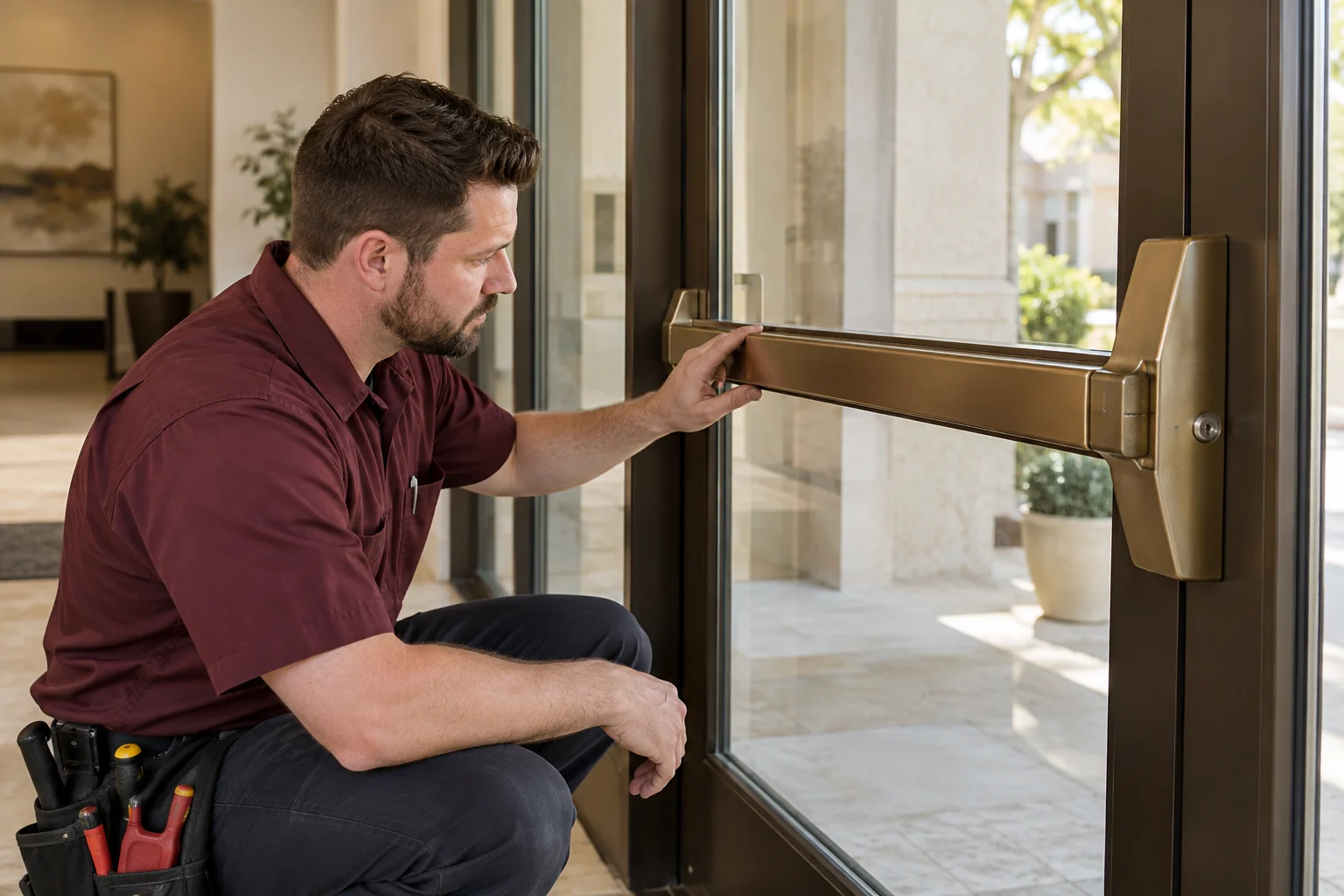
For a plain introduction to the hardware, read panic bars and exit devices explained for business owners. If a bar sticks, sags, drags or fails to latch, treat it as a priority repair and get it examined.
Staff should know how the exit works, too. A new employee who has never pushed the bar may hesitate in a real emergency, and that hesitation is avoidable. Include the exit doors in your orientation, point out where they lead and keep the path outside clear of boxes, carts and parked vehicles.
Keys, codes and cards compared
Businesses today can choose among keys, keypads and cards. Each solves a different problem. A key is simple and needs no power. A keypad lets you change a code when someone leaves, with no key to return. A card or fob system can allow different access for different people and record entries, though it relies on electronics and upkeep.
The mistake is choosing by novelty. Start with your actual needs: how many people, how often they change, how sensitive the space, and what happens when the power or the network fails. Also decide who will manage the system day to day, since any lock system that nobody maintains becomes a weakness.
A balanced comparison appears in access control versus keys for a small business. Many businesses end up with a mix, using electronic access at a busy entrance and ordinary keys on quiet interior doors.
Ask what the door does when power fails. Some electronic locks stay locked and some release, and the right behavior depends on the door. An exit must always allow people out. A stockroom might be better held shut. Have the installer explain each setting in plain words and write the answer down, so the next manager understands the plan.
After hours trouble and what to prepare
Business problems rarely arrive during a convenient hour. A lock fails at closing time, a door is found damaged in the morning, a key is lost on a night when the shop must be secured. In those moments, having a few facts ready makes the phone call shorter and the response better.
Keep a simple card with the address, a description of each door, the lock brand if you know it and the name of the person who may authorize work. Someone with that authority must be reachable, since a locksmith should take direction from the owner or manager and not a passerby.
If a door cannot be secured, think about interim steps that do not harm anyone. Move valuables to a safer place, keep someone present if you can, and let your landlord or insurer know what happened. Do not tamper with exit hardware to keep the door shut, since that can create danger for people inside.
When the technician arrives, expect the plan and the price to be explained before the work begins, and expect the finished repair to be tested with you. Keep a note of what was done, and arrange a follow up if the repair was temporary.
Landlords and turnover between tenants
Owners of commercial space meet a recurring question each time a tenant leaves: whose keys are still out there? Previous tenants, their staff, cleaners, contractors and brokers may all hold copies. Rekeying before a new tenant moves in gives them a clean start and protects you from disputes.
Keep the process consistent. Record the date, the doors changed, the keys cut and who received them. Agree who holds the master, if there is one, and how copies are requested. Spreading keys around informally defeats the purpose of the work.
The article on tenant turnover and rekeying for property managers carries the topic further. Leases and local rules may affect notice and access, so check with your attorney or the relevant authority for requirements that apply to you.
Think of the rekey as a reset button for the building. It is also a chance to simplify. Count the keys in circulation and ask whether that many are needed. Trimming the number of holders, and giving each person only what they use, shrinks the risk for the next tenancy and makes the system easier to run.
Accessibility and public doors
A door open to the public should be usable by people of different abilities. This touches the handle shape, the force needed to open the door, the threshold and the clear approach. A lever is easier than a round knob for many people, and a door that is hard to pull can keep customers out.
Owners often hear about accessibility only after a complaint. A calmer path is to look at your entrance with a customer's eyes. Try opening the door with an elbow, a full hand or a stroller. See whether a closer slams or drifts. Look at the floor in front of the door.
What is required in your building depends on its type and the authorities that apply, and this page does not state it. A broader introduction is available in door compliance audits for commercial properties, and the people to ask are your landlord, property manager and the local office.
Keep notes of anything you change. If you replace a handle, adjust a closer or swap a threshold, write down the date and the reason. These notes show good faith if a question arises, and they help the next person who works on the door. A short entry in a shared log is enough.
Heat, humidity and the maintenance calendar
Commercial hardware in South Florida works against the weather. Salt air corrodes metal finishes, humidity swells wooden and composite doors, and strong sun bakes plastic parts and fades finishes. Doors at the back of a building, near drains and dumpsters, often suffer worst, because they are neglected and wet.
Make a simple maintenance calendar. Twice a year, walk the building and test every lock, closer and exit device. Look for rust, loose screws, doors that rub, gaps at the frame and keys that stick. Fix small things in the dry months before storm season. A short list of items now beats an emergency list in a hurricane watch.
Do not forget the gates, shutters and roll down doors that many businesses rely on at night. Their locks and tracks see rain and grit, and a shutter that jams halfway is both a security gap and a safety concern. Test them as part of the same walk, and note any that need attention before the weather turns.
When you are ready for help, call and describe the doors involved and your concern. The work and the price are explained before it begins, and the finished work is tested with you. You can also compare the guidance for Plantation businesses and read about lock installation in Davie if you are replacing hardware.
Common questions
How do I know which of my doors a locksmith should look at?
Walk the building and list every door, including the back, the roof hatch and storage rooms. Note the lock type, who holds keys and whether it latches smoothly. Bring the list when you call. It helps the technician plan the work and explain the price before beginning.
What should I do when a key is not returned by a departing employee?
If you cannot account for every key, the firm remedy is to change the cylinders that person could open, which a locksmith does by rekeying. Doors and hardware stay in place, old keys stop working, and current staff receive new keys. Keep a written key log to make this easier.
Can I lock an emergency exit to stop theft?
You should not disable or block an exit door, because people must be able to leave safely. If theft is a worry, ask a trained technician about alarms, monitoring and proper hardware that keep the exit working. Rules vary, so ask your landlord, insurer or local building office.
Are electronic locks better than keys for a small business?
Not always. Keys are simple and need no power, while keypads and cards are easy to update and can record entries but need maintenance. Staff turnover, the value of what you protect and what happens in a power cut should guide the choice. Many places use both.
Who is responsible for the locks in a shared plaza?
It depends on the lease and the building. The front of your unit may be yours, while rear corridors, roofs and shared doors may belong to the landlord. Ask in writing before changing any lock you are not sure about, because the owner may need approval or a key copy.
How often should business locks be checked?
A walk through twice a year is sensible, with a look at every lock, closer and exit device, and again whenever a door starts to stick or drag. Fix small problems before storm season. A lock that is hard to operate is warning you that it may fail soon.
Talk through the job before work begins
Start by describing the situation, the lock or key involved and who must have access. You hear the price and the plan before anything is done.
Call (954) 888-8804