Commercial Locksmith in Oakland Park
A business lives or dies by its doors opening and closing correctly. This guide helps Oakland Park owners and managers plan sturdy hardware, tidy key control and sensible responses when something breaks or someone leaves.
Call (954) 888-8804Doors are part of how a business runs
Owners tend to think of locks as security equipment, but they are also operating equipment. A door that sticks in the morning delays opening. A back door that will not latch worries the closing manager. A key that nobody can find halts a delivery. When hardware works quietly, nobody notices. When it fails, everyone does.
That is why commercial locksmith work covers more than emergency openings. It includes choosing hardware that suits how a door is really used, setting up a key plan that people can follow, and keeping the whole set of doors in good order before problems appear. Small maintenance is almost always easier than big repair.
Consider the cost of a failure, too, in a way that has nothing to do with the price of a lock. A shop that cannot lock its front door at closing time must pay someone to stand guard, or leave stock exposed overnight. A clinic that cannot secure records faces obligations far beyond a broken latch. Thinking in those terms helps you decide how much attention each door deserves.
This page is general guidance for businesses in and around Oakland Park, not a description of any specific building or street. Every property has different doors, tenants and rules, so use these notes to prepare good questions for whoever you hire.
One more framing idea is useful before the details. Security is made of layers: the door and frame, the lock, the key control, the lighting outside and the habits of the people inside. A strong lock on a weak door, or a strong door with keys scattered across a dozen hands, leaves gaps that have nothing to do with the hardware. Look at all the layers together.
Different businesses, different door problems
A restaurant opens its back door constantly for deliveries and trash, often with wet hands and loaded arms. That door needs tough hardware, a closer that works and a lock that can be operated with one hand by tired staff. A salon or clinic has clients coming and going, with private rooms that need to be secured, and a front entrance that should feel welcoming and still lock properly at night.
A warehouse or workshop may have overhead doors, side doors and a gate, with high value tools and stock inside. An office suite might have a shared hallway, a reception area and a few interior rooms that hold records. Retail shops have glass storefronts, stockrooms and cash handling spots, each with its own risk.
Rental units that are leased to different tenants add another layer. The owner wants control of the building, each tenant wants control of their suite and everybody wants things to work. Thinking through each type of door separately, instead of treating the whole property as one problem, gives you better decisions and a more useful conversation with a locksmith. Group doors into public, staff only, restricted and exit, then decide which group each one belongs to. The groups tell you what kind of hardware and key rules each door should have.
Taking inventory before spending anything
A simple walk around the property is the strongest first step. Count every door, gate, cabinet, drawer and closet that locks, including the ones you rarely open. Write down what kind of lock it has, which key opens it and who holds a key. Most owners are surprised by the length of the list and by the number of doors with no record at all. Add the gate padlock, the meter room, the roof hatch and the mailbox so nothing important is left out.
Look at how each door behaves. Does it close without a push? Does the key turn smoothly? Does the latch catch without slamming? Is the frame solid around the strike? These observations separate doors that need maintenance from doors that need replacement, and they help you rank work by importance.
Photograph what you find. Photos of hardware, door types and frames make phone conversations easier and give you a record for insurance or property transfers. A photo of the edge of the door, showing the latch and any markings on the faceplate, tells a technician more than a long description. Keep the inventory in a safe place, and update it when anything changes. Share it only with people who truly need it, since a complete list of your doors and keys is itself sensitive information. This one document will save you time on every lock job that follows.
Hardware built for heavy use
Locks and door hardware are graded by how much use and abuse they can take. Light residential parts will loosen and fail on a busy business door, often within months. Heavier commercial grades are made with thicker metal, stronger springs and better finishes, and they hold alignment for much longer. The extra cost up front is usually repaid in fewer repairs and fewer awkward moments at opening and closing.
Hinges, closers and strike plates matter as much as the lock. A sagging door will wear a good lock out because the bolt scrapes against the frame. A weak closer leaves the door ajar or lets it slam, and a thin strike plate bends under force. Hinges with loose screws let a heavy door drop, and a door that drops even a little will drag across its threshold and chew up both the latch and the floor. The entire door assembly works as one system. When one part is weak, the rest carry its load, and that is how a modest problem shortens the life of an expensive lock.
Finish and corrosion resistance are practical concerns near the coast. Salt air attacks plated parts, and outdoor locks that look fine in spring may be stiff and pitted by autumn. Hardware designed for harsh conditions, with sealed or coated parts, tends to outlast lighter duty alternatives and keeps looking presentable at the entrance your customers see.
Ask the locksmith to explain why a certain grade is suggested for each door, and to show you the difference when possible. Our guide to commercial lock grades explains the vocabulary, and the commercial locksmith page describes how the work is arranged.
Keys, copies and who really has access
Uncontrolled key copies are the quietest security hole in many businesses. Keys get duplicated at hardware counters, lent to a cousin or lost in a gym bag, and the owner never knows. A restricted key system closes this gap, because blanks are controlled and copies require authorization. Ask the locksmith how copies are requested, who can approve them and how long it takes, so the process is practical for your staff.
Not every business needs that level, but every business needs a record. A basic sign out sheet for spare keys, a list of holders and a rule about who may make copies prevents most trouble. When staff understand that key handling is routine and not personal, it becomes easy to enforce. A short note in the staff handbook that keys are never copied and are returned on the last day is usually all that is needed, and it sets the expectation from the first week.
Think about electronic access too, and about the batteries and backup keys that go with it. Cards, fobs or codes can be added and removed without chasing physical keys, and many systems log entries. They are not right for every door or budget, but they can fit places with many users, such as a building where several tenants share a common entrance and each needs a different level of access. For a comparison, read access control versus keys for a small business, and for restricted systems, see restricted high security keys.
One key for many doors: master systems
A master key system allows a hierarchy. The owner has a key that opens everything, a manager's key opens a group of doors, and employees hold keys only for what they need. Each door still has its own individual key, so ordinary users cannot open each other's spaces.
This design suits offices with many rooms, buildings with several suites and property managers who handle multiple units. It reduces the number of keys people carry and cuts down on mix ups. It also centralizes risk, because a lost master key affects every door it opens.
Planning matters. Tell the locksmith how many doors you have, how you want access to be layered and how the setup might grow. Keep careful records and decide ahead of time what happens if a master key is lost. The article on master key systems for business covers these considerations in more depth.
Test the system before you sign off. Walk the property with a sample set of keys, trying each level against doors it should and should not open. Mistakes in the original chart show up early this way, and fixing them while the locksmith is still there is far easier than finding them months later.
Storefront entrances and glass doors
Glass doors are common in retail and office fronts. Their hardware sits in narrow metal frames, and it takes constant use. Over time, the latch may stop catching, the cylinder may feel rough and the door may sag, so the bolt no longer lines up with the strike.
Treat these symptoms early. A glass door that does not lock reliably is a security gap, and forcing it risks cracking glass or bending a frame. Describe how the door behaves, whether it is worse in humid weather and whether it was recently bumped by a delivery cart or a vehicle. Mention the type of frame if you know it, and whether the door has a closer, a panic bar or a pull handle, since those parts affect the repair.
Many problems can be solved with adjustment or part replacement, not an entirely new door. The guide to storefront door lock repair describes what a technician usually checks, and it can help you decide whether a repair or replacement fits.
Daily habits protect these doors. Teach staff not to hold the door open with a wedge that levers against the latch, not to slam it shut and not to hang heavy bags on the handle. Cleaning crews should avoid spraying liquids into the keyway. Gentle routines add up to far fewer service calls, and they keep doors looking professional for customers who notice more than you think.
Staff changes, vendors and cleaning crews
People come and go in every business, and every one of them may have been given access. The usual schedule is simple: when someone with a key leaves, rekey the doors they could open. This is a routine step and does not need to feel like an accusation.
Vendors and cleaning services need thought as well. Some businesses give a trusted contractor a key, others issue a code that can be changed, and some assign an employee to open and close. Whatever you choose, write it down and revisit it when the arrangement changes.
The article on rekeying an office after an employee leaves gives practical steps, and the notes on file cabinet and desk locks remind you not to forget internal storage. For rental properties, rekeying between tenants covers a similar routine.
Alarm and camera systems deserve a place in this plan. Whoever gets a new key or code should also know the alarm procedure, and when someone leaves, the alarm code should change along with the lock. Many a false alarm or missed alert starts with an out of date list of who knows what.
Exit routes, life safety and rules you should not guess
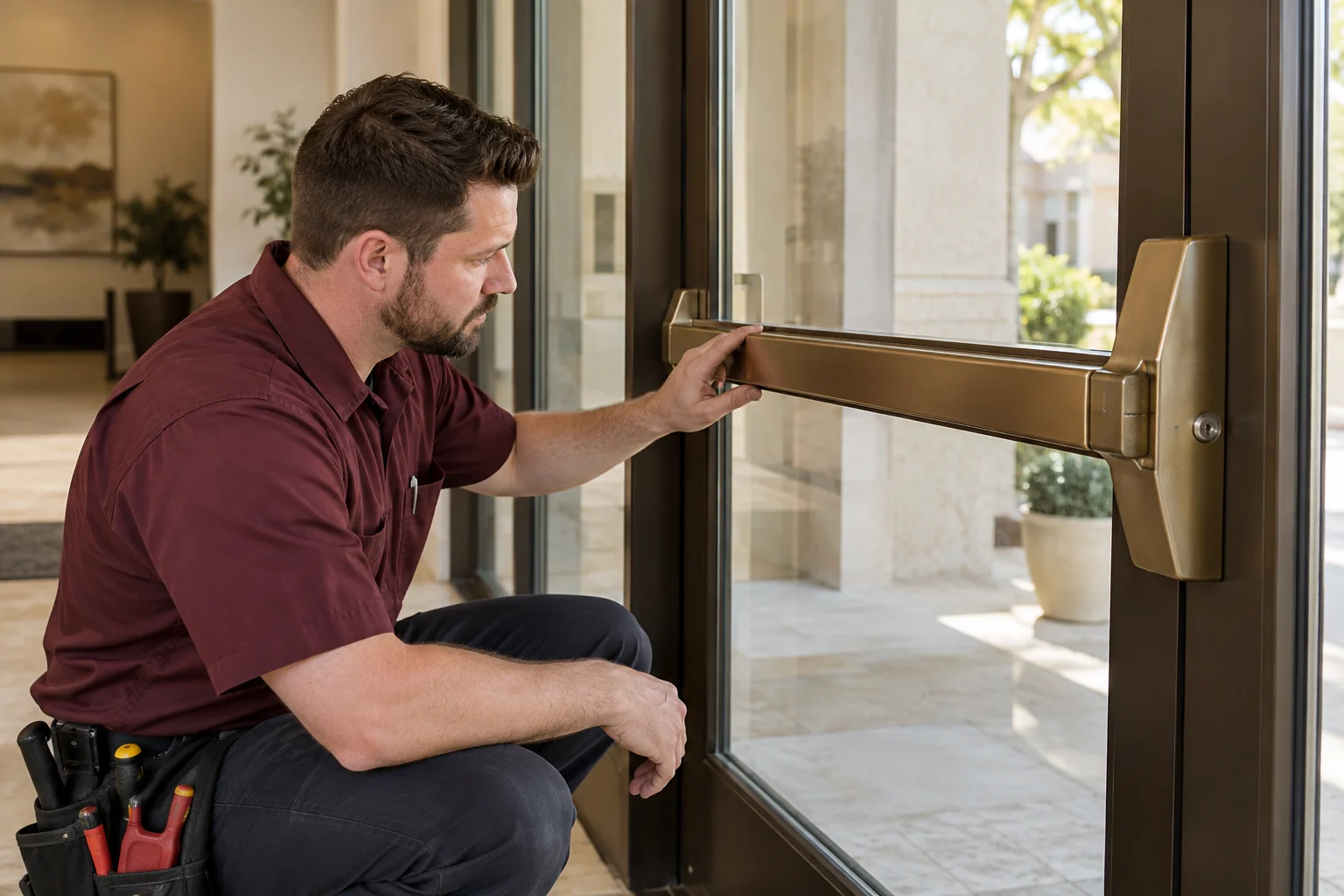
Doors that people use to leave a building in an emergency have special requirements. Hardware that is easy to open from the inside, such as a push bar, exists for a reason, and it must keep working. Blocking, chaining or disabling an exit device to prevent theft creates a serious risk.
Which devices your doors need depends on how your space is used and on local requirements, which vary. Ask your building authority, fire marshal's office or property manager instead of guessing. A locksmith can install and maintain the hardware, but the decision about what is required belongs to the people who set the standards.
For an overview of how these devices work, see panic bars and exit devices. Test your exit doors regularly and report any that stick, rattle or fail to close fully, because those are the ones you will depend on in an emergency. Keep the area around each exit clear of stock, boxes and furniture, and make sure signs and lighting remain visible. When a delivery or a seasonal display tempts you to block a path, move the item instead of the rule.
Weather, aging and getting ready to call
Coastal air and summer heat are hard on hardware. Humidity swells wooden frames, salt corrodes metal, and storms push water into places it should not be. Before storm season, check that every door closes and latches smoothly. Afterward, test again and look for damage. Water can get into card readers, keypads and door controllers, and debris can jam latches and tracks. If a door will not lock after a storm, arrange a temporary solution that actually secures the opening, and have the permanent repair done as soon as conditions allow.
Contact with Half Off Locksmith is by phone. Say what kind of business you run, which doors are involved, what the problem is and whether you are the owner or a manager. The work and the price are explained before it begins, and the finished work is tested with you.
Have a few facts ready: the number and type of doors, the current locks if you know them and any recent staff or tenant changes. If you rent, check who is responsible for locks. Also decide whether this is a single repair or a chance to organize the whole property, since a planned visit usually costs less effort than several emergency ones. Nearby pages for Fort Lauderdale and Pompano Beach cover the same service for those areas, and the services overview shows the wider range of work.
Common questions
How do I know which doors need heavier hardware?
Look at how often and how roughly each door is used. Entrances, delivery doors and anything used by many people need heavier grades. A locksmith can examine each door and explain which hardware suits its use, so you spend where it counts and save where it does not.
Should I rekey when an employee leaves?
It is a sensible routine, especially if the person had access to sensitive areas. Rekeying changes the cylinders so their key no longer works, without replacing the hardware. Do it as standard practice, not as a reaction, and keep a record of who holds the new keys.
What is a restricted key system?
It uses key blanks that are not sold freely, so copies require authorization from the owner. That makes unauthorized duplication much harder. It suits businesses and landlords who want firm control over who holds working keys, and a locksmith can explain how to set it up.
Can I change the hardware on a rented suite?
Check your lease first. Landlords and property managers often have rules about locks, especially for exit doors or doors that serve a shared hallway. Requirements vary, so ask in writing before making changes and keep a copy of the answer.
What should I do when a glass door sticks or drags?
Do not force it. Note when it happens, whether the weather matters and whether anything struck the door. A technician can check the door, frame, closer and lock together. Early attention often saves the glass and avoids a larger repair.
Who decides what exit hardware my doors need?
The rules depend on how the building is used and on local requirements, which vary. Ask the building authority, the fire marshal's office or your property manager. A locksmith can install and service the devices, but should not be asked to guess which ones are required.
Talk through the job before work begins
Start by describing the situation, the lock or key involved and who must have access. You hear the price and the plan before anything is done.
Call (954) 888-8804