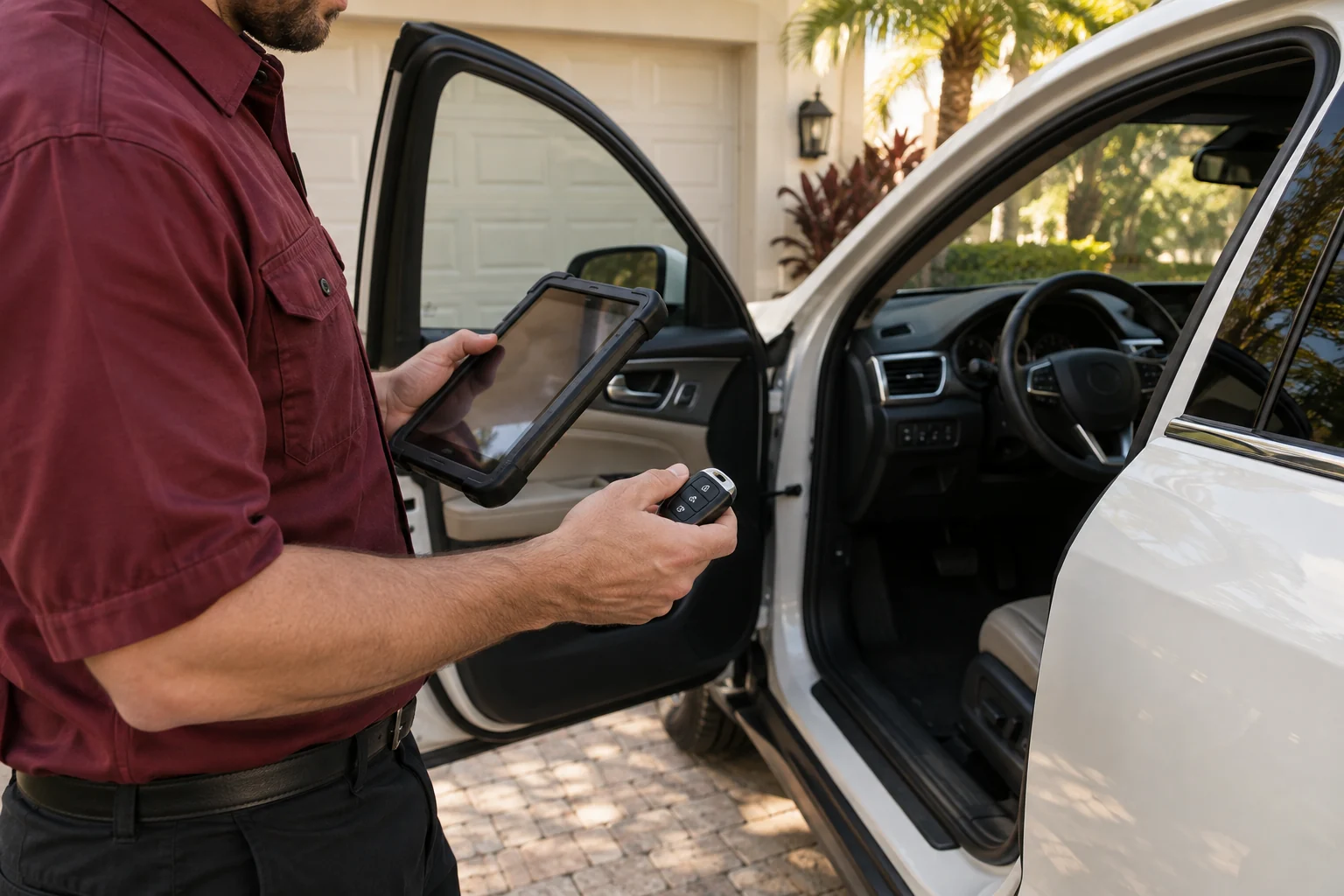
Automotive Locksmith in Oakland Park
Car key trouble tends to arrive at the worst moment. This guide gives Oakland Park drivers a clear way to sort out what went wrong, what a locksmith can do and what to have in hand before calling.
Call (954) 888-8804Sorting out what actually went wrong
When a car will not start or open, people often blame the battery, the key or the door lock, and they are not always right. The first useful step is separating three different failures: the key is missing or broken, the key or fob works on the door but the car will not start, or the key goes in but the ignition will not turn. Each has a different cause and a different fix.
If the doors respond to the remote but the engine stays silent, the problem might be the chip in the key, the car battery or the ignition. If the dashboard lights up but nothing cranks, that points away from the key. If you hear nothing at all and the lights are dim, the battery deserves a look before anyone blames the key.
This page is general guidance for drivers in Oakland Park and nearby areas, and it does not describe any particular street, shop or neighborhood. Take your time describing the symptoms to the person you call, because a precise description leads to a better first answer.
Write down the sequence if you can. Did the problem begin after a wash, after heavy rain, after the key was dropped or after the car sat for days? Small clues like these let a technician narrow the cause before arriving. A person who says the car clicks once and goes dark gives a very different picture from one who says the key will not enter the slot.
A short tour of modern key designs
Cars on the road today use several key designs, and knowing yours helps. A basic metal key has no electronics and is cut to match. A transponder key hides a small chip in its plastic head, and the car refuses to start unless the chip answers correctly. Remote head keys combine that chip with lock and unlock buttons. Smart keys, used with push button ignition, never touch the car and are detected by proximity.
What differs is the way each is replaced. Cutting a plain key is a mechanical job. A chipped key must also be introduced to the vehicle, which is a programming step done with specialized equipment. A smart key often needs both programming and a case or battery that fits the original design.
The vehicle's make, model and year narrow all of this, so have them ready. The explainer on transponder key programming goes into the electronic side without jargon, and it is helpful reading if you have never had a chipped key replaced.
A related detail is the keyway itself. Some keys have a single cut edge, others cut on both edges, and some have a track milled into the middle of the blade. These shapes need different machines, so a locksmith who knows which one you have can bring the correct blank on the first visit instead of making a second trip.
If you lost your only key
Losing the only key is stressful, but it is a normal job for an automotive locksmith. Stay calm, retrace your steps, and check obvious places before assuming the worst: coat pockets, bags, the last place you parked, and under the seat if you can reach the car. If you are sure it is gone, think about where it was lost and whether anyone could find the car.
If there is a risk someone could connect the key to your vehicle, mention it. In some cases, the old key can be erased from the car's memory when the new one is added, so the lost one can no longer start it. Ask whether that is possible for your model.
Be ready to show who you are and that the vehicle is yours, with a registration or title and photo identification. If the car is not where you are, say how far it is and whether it can be reached. Have the vehicle identification number if you can find it on paperwork or an insurance card. The page about car key replacement explains how the process runs from the first call to the final test.
If you are away from home when the key disappears, you still have options. Arrange a safe place to leave the car if it is stranded, do not leave it unlocked, and ask a locksmith whether the work can be done where the car sits. Parking garages, apartment lots and workplace lots each have their own access rules, so mention which one it is.
When the key breaks in your hand
Keys fatigue over time. A key that has been bent, twisted or used as a tool for opening boxes may crack at the shoulder, leaving a piece in the lock. People often try to pull the fragment with tweezers or push it in, but this can wedge it further.
If the broken piece is still in the door or ignition, stop. Do not use glue or force. A locksmith has extractors made for this task, and the fragment can often be removed without harming the cylinder. The work is delicate, which is exactly why it is better left to someone with the right tools than attempted with a pin or a blade from a pocket knife. Keep the pieces you do have, because they help with matching a new key.
If the blade snapped but the head, with its chip, is intact, there may be an easier path than starting over. The chip can sometimes be moved to a new blade, which keeps programming simpler. Describe exactly what remains when you call, and mention whether the car will still start with the damaged key, since that affects the plan. Do not keep driving with a cracked key, because the break may happen at a bad time, such as when you turn off the engine and cannot restart it.
A habit worth building is checking your key head for hairline cracks now and then. A small split near the ring or at the base of the blade is an early warning. Making a spare while the key still works costs far less in trouble than waiting for the break, and it gives you a perfect reference for matching the new key to the original.
Fobs that fade, crack or get wet
A key fob lives a hard life. It rides in pockets, drops onto concrete, goes into pools and sits on dashboards in the sun. Plastic cracks, button pads wear away, and moisture finds its way to the circuit board. When a fob starts to act up, battery replacement is the simplest first step, but it does not fix everything.
Signs to watch include needing several presses to unlock, shorter range, and a dash warning that the key is not detected. If the key was fine yesterday and dead today after a swim, assume moisture and keep it dry rather than pressing buttons repeatedly. Dry gently, away from direct heat. Leaving a wet fob in rice is a popular idea that does little, so a locksmith test is a better use of your time.
If battery and drying do not help, the board or the programming may be at fault. A locksmith can test the fob and tell you what is wrong. The step by step article on what to do when a key fob is not working lists checks in sensible order, and the notes on a lost push to start key cover the harder case.
The ignition that fights back
Some drivers find that the key goes in but will not turn, or that it turns only after jiggling. Others discover the key will not come out. These problems usually point to wear inside the ignition cylinder, a bent key or a steering lock that has engaged. Each deserves a different response.
If the steering wheel has locked, try turning it gently left and right while turning the key. If that does not help, do not force. Repeated hard turning can break a key or damage internal parts, turning a small repair into a larger one. If the key is clearly worn, consider a fresh copy cut from a better source.
Weight on the key ring matters. A big bundle of keys, charms and tags hanging from the ignition pulls on the cylinder every time you hit a bump, and over months that leverage wears the pins and tumblers. Removing the extras and carrying just the car key on the ring in the ignition costs nothing and protects the part.
When the cylinder itself is worn, only repair or replacement will solve it. The write up on ignition cylinder problems and the entry on a key stuck in the ignition give more detail, and the ignition repair page describes how the work is handled.
Locked out with the engine off or running
Lockouts come in two kinds. In the first, the car is off, the keys are inside and the doors are locked. In the second, the engine is running and the keys are inside, which adds the worry of fuel and heat. In either case, avoid forcing the door, because damaged seals and wiring cost more than the lockout.
When a child or animal is inside, call emergency services first. Heat in a closed vehicle climbs to a dangerous level during a Florida afternoon. A locksmith can help afterward, but emergency help is the right first call when a life is at risk.
For ordinary lockouts, tell the person on the phone where the car is, the make and model, and whether the keys are visible. The article on solutions when keys are locked in the car describes what a careful opening looks like, which is quiet, unhurried and designed to leave paint, seals and windows intact.
Think also about a locked trunk or hatch. If the keys are inside and the interior is accessible, the rear seat may fold down. If a push button start is involved and the fob is inside, the car may refuse to lock in some models, so you may find that the car locks only after the fob leaves the cabin.
Planning ahead with a spare
The easiest key to deal with is the one you make before you need it. When you still have a working key, copying it is simpler than creating a key from nothing, and you avoid the stress of a stranded vehicle. A spare kept at home is also a safety net for lockouts.
Think about who else drives your car. Partners, teenagers and relatives each need access, and each additional key is one more thing to track. Decide how many you really need, label them without revealing your address and keep one in a safe place away from the vehicle.
The decision is personal, and the article on whether a spare car key is worth it lays out the reasons. If you want an idea of the factors behind the cost of replacement, the car key replacement cost guide explains why different vehicles vary so widely.
Where you keep spares matters. A spare in the glove box defeats the purpose, since the lockout or theft takes both. Good places are a home drawer that everyone in the household knows about, or with a trusted relative. Avoid magnetic boxes under the bumper, which collect rust and are the first place anyone looks.
Heat, humidity and cars that live outdoors
Vehicles in this part of Florida bake in the sun, soak in storms and breathe salt air. Dashboards reach high temperatures, which can warp plastic housings and weaken batteries. Rubber button covers crack, and door lock cylinders that rarely get used can corrode.
Some simple habits go a long way. Keep the fob out of the sun on the dash, avoid tossing it into wet bags, and use the physical key now and then so the door cylinder does not seize. If the key feels rough in the lock, address it before it turns into a lockout.
Storm season adds another factor. Keep a spare key and a copy of your registration and insurance in a safe place at home, so you can handle a lost key even if you are away from your car. If your car has been flooded, do not try to start it. Keys and electronics may be damaged, and starting could make it worse. Have the car dried and inspected by a qualified shop first, and tell the locksmith about the flooding if keys need to be made later, since water damage can affect programming and the equipment used to do it.
If you travel, remember that rental cars and borrowed cars have keys too. Losing a rental key can lead to fees that dwarf the cost of a careful search, so keep it in a zipped pocket rather than loose in a bag. For your own vehicle, take a photo of the key and the dash display so you can describe them later, and keep that photo somewhere you can reach from your phone.
How to prepare for the call
Contact with Half Off Locksmith is by phone. Describe what happened in a few clear sentences, then give the make, model, year and location of the car. Say whether you have any working key, whether the car is in a garage or on the street and whether it can be moved.
Have your identification and proof of ownership ready. Expect to be asked about it, and be patient, because it protects you. The same check would stop a stranger from getting a key to your car, which is the whole point. The work and the price are explained before it begins, and the finished work is tested with you.
Once the key is made, test everything: unlock, lock, trunk, remote start if you have it and, of course, the ignition. Ask how many keys are now programmed, and whether any old ones were removed. Keep the paperwork with the vehicle documents at home, not inside the car. Nearby pages for Fort Lauderdale and Wilton Manors cover the same service for those areas.
Common questions
Why will my car not start even though the key turns?
If the key turns but the engine stays silent, the chip in the key may not be recognized, or the battery or another part could be at fault. A locksmith can test the key and the ignition. Describe the dash lights and sounds you notice for a better diagnosis.
Can a locksmith remove a lost key from my car's memory?
In many vehicles, yes. When a new key is programmed, older keys can be erased so a lost one will no longer start the car. It depends on the model, so ask at the beginning of the call whether that is possible for your vehicle.
What should I do with a broken key?
Keep every piece and stop trying to remove the fragment yourself. Glue and force make it worse. A locksmith can extract a piece left in the lock or ignition and may be able to reuse the chip from the head in a new blade.
Is a dead fob always a battery problem?
Not always. A weak battery is the most common reason, but moisture damage, worn buttons or lost programming can also be responsible. Replace the battery first, keep the fob dry, and if the problem returns, have it tested rather than guessing.
Do I need proof of ownership for a new key?
Yes. Expect to show registration or title and a photo identification. This protects you and prevents a stranger from obtaining a key to your car. If you do not have the paperwork with you, ask what alternatives can be accepted.
What details speed up a car key call?
Give the make, model and year, your exact location, what happened to the key and whether any working key remains. Mention if the car is in a garage or gated lot, and whether it can be moved. The more precise you are, the smoother the visit.
Talk through the job before work begins
Tell us what happened, which doors or keys are involved and who needs to get in. The price and the plan are agreed with you before any work starts.
Call (954) 888-8804