Home | Cities | Fort Lauderdale
Commercial Locksmith in Fort Lauderdale
This page is general guidance for Fort Lauderdale shop owners, office managers and property teams. It explains how business locks differ from home locks and how to plan key control, door repair and upgrades sensibly.
Call (954) 888-8804How a business lock differs from a house lock
A front door at home opens a few times a day. A front door at a shop, clinic or office may open hundreds of times, and each one asks the latch, hinges and closer to do their work again. Commercial hardware is built with that load in mind, with heavier parts, stronger springs and mounting that stands up to constant use. That difference explains why residential grade hardware on a busy business door often wears out sooner than anyone expects.
The people using the door are different too. A house has a handful of key holders. A business may have owners, managers, staff on different shifts, cleaners, delivery drivers, landlords and vendors, all needing some form of access. The question shifts from "who has a key" to "who has which key, and what can it open." That is a management problem as much as a hardware problem, and it is where a locksmith can help you think clearly.
This page is general guidance for businesses in Fort Lauderdale and does not describe particular buildings, streets or local rules. Requirements for fire exits, accessibility, leases and permits vary by property and by authority, so confirm them with your landlord, building management, fire inspector or the city office that handles your situation. A locksmith can then carry out the hardware work within those limits.
Taking stock of every door you own or manage
The most useful first step is a walk around the property with a notepad. List every door that locks: front, back, storage rooms, offices, server closets, gates, roll up doors and the quiet side door nobody remembers. Beside each one note the type of lock, whether it sticks, how many keys you believe exist, and who uses it. This is boring work, but it reveals things. Many owners discover a door nobody can account for.
Next, test each door the way a user would. Close it gently and see if it latches without help. Turn the key and listen for grinding. Push and pull on the handle to feel for looseness. Check the frame for cracks and the strike plate for wear. Salt air and humidity attack hinges and latches over time, and a door that drags on the threshold in the wet months may need adjustment before it fails completely.
Bring that list to your locksmith when you call. It speeds up the conversation and helps the work and price to be explained clearly before it starts. A property that has been documented well is also easier to maintain, because you can see at a glance which doors are due for attention. The overview on the commercial locksmith page shows the kinds of services that grow out of such a survey.
A short written record is worth the effort even for a small business. Put the list on one page, date it, and keep a copy offsite or in a shared folder so it survives a bad day. Each time a lock is changed, a key is lost or a person joins or leaves, update the page. Over time this becomes the memory of your property, and it makes every later decision about repairs, upgrades and budgets calmer because you are working from facts instead of guesses.
Grades of hardware and why they matter
Lock hardware comes in grades that reflect how much abuse it is designed to take. Lighter grades suit a quiet bedroom door. Heavier grades are built for a door that gets slammed, pulled, leaned on and pushed open by carts. When a business buys light hardware, the lock may work on day one and then loosen, stick or break after months of heavy use. Paying attention to grade at the start saves repeated repairs.
Grade is not the only thing to consider. A strong lock on a weak door or frame offers little protection, and a heavy door with a poor latch still lets in drafts, noise and trouble. The parts work as a system: door, frame, hinges, latch, strike, lock cylinder and closer. When a locksmith looks at a door, a good one looks at the whole assembly rather than just the lock face.
If you want to learn the vocabulary before buying anything, read about commercial lock grades. Ask your locksmith which grade they recommend for each door and why. A thoughtful answer will refer to how the door is used, how many people use it and what is behind it. Be wary of an answer that is only a brand name with no reasoning attached.
- Front customer doors need hardware built for constant daily cycling.
- Back and delivery doors face carts, pushing and weather.
- Office and storage doors need key control more than raw strength.
- Gates and outdoor doors need parts that resist moisture and salt.
Master keys and key systems
As a business grows, carrying a ring of twenty keys becomes silly. A master key system solves this by designing locks so that a manager's key opens many doors, while a staff member's key opens only a few. Each lock still has its own key, but a higher level key can open a group of them. It is a clever arrangement, and it works well when planned in advance with clear records.
The risk is that a master key is powerful, so losing one is more serious than losing a standard key. If a master key goes missing, many doors may be exposed at once. For that reason, a system should be designed with thought about who really needs top level access and how those keys will be tracked. A short written log, with names, dates and signatures when a key changes hands, is worth the small effort.
Our guide on master key systems for business explains how the levels work in plain language. Ask a locksmith to sketch the plan before any lock is changed, so you can see which doors fall into which group. Some owners also ask about restricted key blanks, which are harder to copy without authorization; you can read about restricted and high security keys to see whether that fits your needs.
After an employee leaves or a tenant moves out
Every departure raises an uncomfortable question. Did the person return all their keys? Did they make a copy? Even a perfectly honest former employee might have a duplicate in a drawer at home. The sensible approach is not to accuse anyone but to treat key control as routine. When someone with key access leaves, you rekey the affected locks so old keys no longer work.
Rekeying is usually the practical choice because it changes the inside of the lock rather than the whole hardware. The doors stay as they are, new keys are cut, and old ones become useless. You decide which doors are involved depending on what that person could reach. For a manager with master access, that may be many doors. For a part time helper with one back door key, it may be one.
We cover the reasoning in rekeying an office after an employee leaves. If you are a landlord or property manager, the same logic applies each time a commercial tenant moves out. Treat the handover as a chance to reset access, record who holds new keys and test every door before the next occupant takes over.
Storefront doors and the problems they develop
Storefront doors take punishment. Glass doors with narrow metal frames often rely on small hardware that holds a lot of weight. Over time, pivots loosen, closers leak or lose their adjustment, and locks that once turned smoothly begin to drag. A door that does not close fully, or that slams, is both a security issue and a safety issue for customers.
Some warning signs are easy to spot. The door needs a push or lift to latch. The key requires force to turn. There is a gap at the edge when the door is closed. The closer hisses or drips fluid. Each of these suggests that attention is overdue, and fixing it early usually costs less than waiting for a failure at opening time. Do not try to adjust heavy door closers yourself, because stored spring force can injure you. Customers also notice these details. A door that sticks or squeals signals neglect, while a door that glides shut and clicks into place quietly suggests a business that pays attention.
For more on typical issues, read about storefront door lock repair. If you are unsure whether the problem is the lock, the door or the frame, explain what you observe and let the technician diagnose it. A thorough diagnosis is more valuable than a hasty swap, since replacing the wrong part wastes money and leaves the actual fault in place.
Exit devices, fire safety and accessible entry
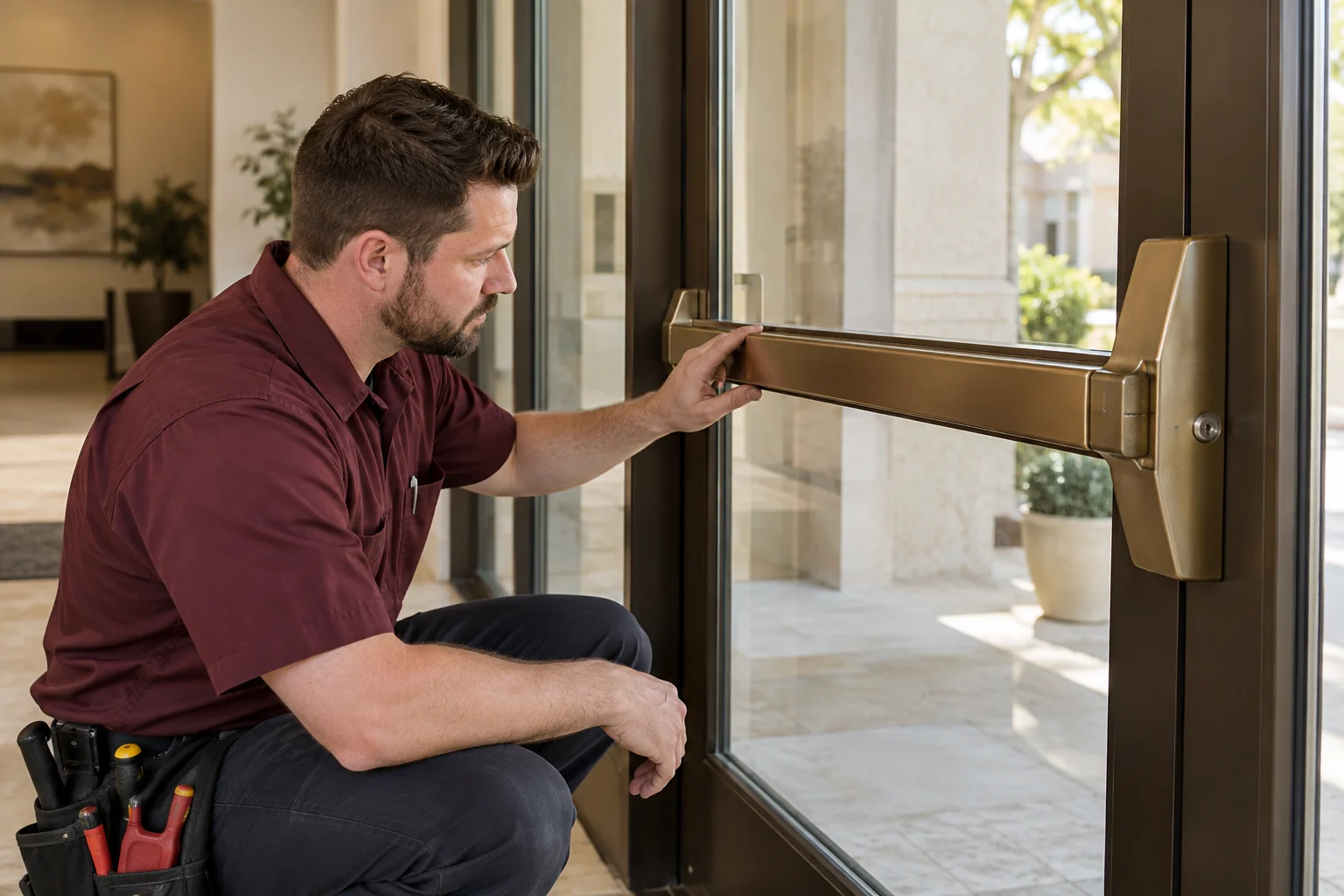
Many businesses have doors fitted with exit devices, often called panic bars. They let people leave promptly by pushing a bar, even while the door remains secure from the outside. These devices matter for safety, and they are not the place for improvisation. A blocked, chained or altered exit can turn an emergency into a disaster, so never disable or obstruct one to save a little trouble.
Requirements for exits, door hardware and accessibility depend on the type of building, its use and the authority that governs it. This page does not state what applies to your situation. Ask your fire marshal, building department or landlord what your property requires, then bring that information to the locksmith so the hardware work matches it. A responsible locksmith will not ask you to compromise an exit.
If you want an overview of how these devices work, our business guide to panic bars and exit devices is a good place to start. Another useful read is the article on accessibility focused door walk throughs, which explains why a periodic walk through of your doors is worthwhile, covering force to open, reach and hardware shape.
Keys versus access control
Some businesses outgrow metal keys. An access control system uses cards, fobs, codes or phone credentials, and it lets you add and remove people without cutting anything. If an employee leaves, you disable their credential rather than rekey a lock. You can also set schedules and look back at who entered, which is attractive for places with many staff or frequent turnover.
That flexibility has trade offs. Electronic systems depend on power, software and network connections, and they need proper installation and maintenance. A door must still be sound mechanically, and a plan must exist for what happens if power fails or the reader stops working. Many owners keep a mechanical key override at critical doors. The right mix depends on the size of the team and how sensitive the area is.
Our comparison of access control versus keys for small businesses sets out the questions to ask. A locksmith can talk through options, explain the work and the price before it begins, and install hardware that suits your doors. Do not feel pushed toward the most complex system; the goal is a setup your team will actually use consistently.
Offices, cabinets and the small locks that get forgotten
When people think about business security they picture the front door, but a great deal of sensitive material sits behind smaller locks. Desk drawers hold checks and petty cash. File cabinets hold employee and customer records. A storage room holds inventory, tools or equipment. These locks are often basic hardware installed years ago, with keys copied freely and a spare taped under a drawer.
Look at them with the same attention as exterior doors. Ask who needs access, whether the locks still work smoothly, and whether keys are labeled and tracked. If a cabinet lock is loose or the key has been lost, a locksmith can often service or replace the cylinder without replacing the furniture. Our article on file cabinet and desk locks explains the common types.
Small locks also deserve a policy. Decide who keeps spares, where they are stored and how often keys are accounted for. A short checklist at the end of each quarter keeps things from drifting. Because rooms in a business change use over time, a lock that once guarded a closet may now guard sensitive records, and its level of protection should keep pace with that change.
Weather, upkeep and working with a locksmith
South Florida conditions are tough on commercial doors. Humidity makes wood swell and metal corrode. Salt air creeps into hinges and latches. Storm season brings wind pressure on large doors and gates, and flooding in some situations. A preventive routine, with a simple check of every door twice a year and again after a major storm, catches small problems before they stop your business from opening.
When you contact a locksmith, expect a clear exchange. You describe the doors and the problem, and ask about the plan. The work and the price are explained before it begins. When the job is finished, the hardware is tested with you, including every key you intend to use. If you manage multiple sites, ask for notes that you can store, listing what was done at each door.
Half Off Locksmith serves businesses across Broward County by phone. For a wider view of the city, see our general page on locksmith services in Fort Lauderdale, or read how the same approach applies in Pompano Beach. Whatever the size of your business, a steady relationship with one reliable locksmith makes every later job simpler.
Finally, plan for the unexpected. Decide in advance who in your company is allowed to call for lock work, who may approve changes, and who keeps the records. When a door fails on a busy morning, that clarity prevents confusion. Keep a note near the office phone describing the problem door, the type of lock and any other details a locksmith will ask about, so whoever answers can describe the situation calmly and accurately.
Common questions
How do I know which doors in my business need attention first?
Start with the doors that carry the most traffic or protect the most valuable things: the customer entrance, the back door, any storage or records room, and cash handling areas. Look for doors that stick, drag, fail to latch or have loose hardware. A locksmith can help rank them once you describe what you see.
Should I rekey the locks when an employee quits?
It is a common and sensible practice, especially if that person held keys to sensitive areas. Rekeying makes old keys stop working without replacing all the hardware. The scope depends on what the person could access. Ask a locksmith to explain which doors are affected and what the work and price involve before approving anything.
What is a master key system?
It is a keying plan where each lock has its own key but a higher level key can open a group of locks. Managers might carry one key for many doors while staff carry keys for only a few. Because a master key is powerful, a system works well only with clear records and careful control over who holds the top keys.
Can I change my own exit device or panic bar?
Exit devices are safety equipment, and changes to them can affect how people leave a building in an emergency. Requirements vary by building and authority, so ask your landlord, fire inspector or building department what applies, then have a qualified professional carry out the work. Never block, chain or disable an exit.
Is an electronic access system better than keys for a small business?
Not automatically. Electronic systems make it easy to add or remove people and can track entry, but they rely on power, software and maintenance. Keys are simple and dependable but harder to control as staff change. Many businesses use a mix. A locksmith can explain the trade offs for your doors.
Does this page describe rules for Fort Lauderdale businesses?
No. It is general guidance for business owners in Fort Lauderdale and does not state local codes, lease terms or permit rules. Those vary by building and use. Ask your landlord, property manager, fire inspector or the city office that handles your situation to confirm anything that applies, then share it with your locksmith.
Talk through the job before work begins
Start by describing the situation, the lock or key involved and who must have access. You hear the price and the plan before anything is done.
Call (954) 888-8804