Home | Cities | Lauderdale-by-the-Sea
Commercial Locksmith in Lauderdale-by-the-Sea
A business door has to do more than a house door: open easily for staff, hold up to constant use, and protect stock and cash. This page is general guidance for owners in Lauderdale by the Sea.
Call (954) 888-8804Why business locks are a different job
A house front door opens a few times a day. A shop door may open hundreds of times, often with a hand full of boxes and a customer waiting behind it. That volume wears hardware in ways that residential locks are never designed to survive. Latches loosen, springs tire, strikes shift, and the first sign is usually a door that sticks on a busy morning.
The second difference is the number of people involved. At home, everyone with a key is a family member or a trusted friend. In a business, keys end up with employees, delivery people, cleaners, a landlord, a manager, an alarm company and sometimes a former employee who never handed theirs back. Managing who can enter and when becomes a real task, not a one time choice.
The third difference is consequence. A failed lock at home is an inconvenience. A failed lock at a business can stop sales, expose stock, or leave a space unprotected overnight. This is general guidance for owners in Lauderdale by the Sea, and the overview of commercial locksmith work sets out the full range of services in one place.
Taking stock of the doors you have
A useful first step, and one you can do yourself, is to walk the building and list every door. Count the front entrance, the back door, any storeroom, the office, a rear gate, a roll up or sliding door, and any interior doors that hold stock or paperwork. Note what kind of lock each one has, which key opens it, and who currently holds that key.
Most owners are surprised by what the list shows. A door that nobody remembers locking, a storage cabinet whose key is lost, a side entrance with a lock that has not been changed since the previous tenant, or two doors that share a key by accident. A simple sheet of paper with one row per door becomes the foundation for every later decision.
Take a few photographs while you are there, including the lock faces, the edge of the door where the latch sits, and the frame. They help when you describe your needs to a locksmith on the phone, and they are useful later as a record of what was installed. If you rent the space, check your lease for what you are allowed to change before you plan anything.
- List every door, gate and cabinet that holds stock, cash or records.
- Write down who holds a key to each one.
- Note which doors stick, rattle or fail to latch.
- Photograph the lock faces and the frame at each door.
- Check the lease for limits on changing hardware.
Grades of hardware and why they matter
Commercial hardware is sorted into grades, and the grade tells you how much use and abuse a lock is designed to take. Lower grades suit light residential use. Higher grades are built for heavy daily traffic, with thicker metal, stronger springs and more robust latches. A shop that installs a light duty lockset on a busy door will find it loosening and failing far sooner than expected.
The lowest priced route is rarely the sensible one for a door that is used constantly, and a locksmith can help you match the grade to the job. A back door used twice a day by a stock clerk is a different case from a front entrance opened by every customer. The article on commercial lock grades explains the grading in plain words.
Beyond grade, think about the type of lock. A cylindrical knob lock is common in light use, but a mortise lock, which sits in a pocket cut into the edge of the door, is traditional in commercial settings and holds up well. A deadbolt adds a separate throw that is harder to force. The right combination depends on the door, the frame and what you are protecting, and a locksmith should look at all three before recommending anything.
Storefront doors and the problems they develop
Glass storefront doors have narrow stiles, the vertical frame pieces on either side of the glass, and the locks are fitted into very little metal. That makes them a distinctive repair category. Common problems include a latch that no longer catches the strike, a thumb turn that spins freely, a lock cylinder that has worn out, or a closer that slams or hangs open.
In a coastal setting, salt and humidity are hard on aluminum frames and exposed hardware. Corrosion on screws and hinge pins can freeze moving parts, and a lock that is stiff in the morning and loose by afternoon may be responding to the weather. Regular attention to a door, including wiping the hardware and noting any change in how it feels, can catch a problem before it becomes an emergency.
If a storefront door is damaged after an attempted break in, avoid leaving it unsecured while you wait for repair. Take photographs, contact the right authorities if needed, and arrange for a locksmith to assess the hardware and the frame together. The guide to storefront door lock repair describes what is usually involved.
Door closers deserve a mention because they are easy to ignore. A closer that is set too hard makes the door slam and wears the latch, while one set too soft leaves the door hanging a little open so the lock never engages. Many a shop has been left unlocked overnight because the door looked shut but had not quite caught. Closing the door and then pulling on it from outside as a last step is a simple habit that avoids that mistake, and it is worth teaching to whoever locks up.
Keys, copies and what happens when staff leave
Every key that leaves the building is a risk that grows with time. When an employee leaves, you cannot be sure every copy has come back, and even a trusted person may have given a copy to someone else without thinking. Rekeying the affected locks is the standard way to make old keys useless without replacing hardware, and it is worth doing whenever there is any doubt.
A key control habit helps. Keep a log of who holds which key, give each person only the keys they need, and ask for keys back in writing when someone leaves. Some businesses stamp keys with a code rather than a name, so a lost key cannot be matched to a location by whoever finds it. Another useful habit is to avoid unrestricted keys that any shop can copy.
Restricted key systems are designed for this, and they limit duplication to authorized sources. The piece on high security and restricted keys explains how they work, and the article on rekeying an office after an employee leaves describes the practical steps. Both are good reading before you decide how tightly to control your keys.
Master key systems for several doors
A master key system lets each door have its own key while a higher level key opens many doors. It is common in offices, small retail strips and buildings with different tenants. A manager may carry one key that opens every door, while a staff member carries a key that opens only the doors they need.
These systems are flexible but also need planning. Every additional level adds complexity, and a poorly designed system can leave unintended overlap, where a key opens a door it was never meant to. A locksmith will usually ask how many doors, how many people, and who needs to enter where, then sketch a plan for you to approve before cutting anything.
They also need discipline. A master key is a high value item, and its loss means rekeying many doors rather than one. Treat it with care, restrict who holds it, and keep a record. The article about a master key system for a business explains design and management, and is worth reading if you manage more than a handful of doors.
Keys, codes or cards: access control
Electronic access control replaces or supplements metal keys with codes, cards, fobs or phone credentials. The attraction is clear: you can add or remove access without cutting a physical key, set times when a person may enter, and in many systems keep a record of who came in. For a business with changing staff, that flexibility is a real advantage.
Electronic systems come with their own considerations. They depend on power, so you need to know what happens during an outage, and whether the door fails open or fails locked. They depend on software and on the person who manages it, so someone must be responsible for adding and removing users. And they sit alongside a mechanical backup in many installations, which still needs its own key control.
Whether a small business benefits depends on size, staffing and budget. Some owners find that mechanical keys with good control are enough, while others want the audit trail and the ability to cancel electronic access. The comparison is laid out in the guide to access control versus keys for a small business.
Exit hardware, safety and what to ask
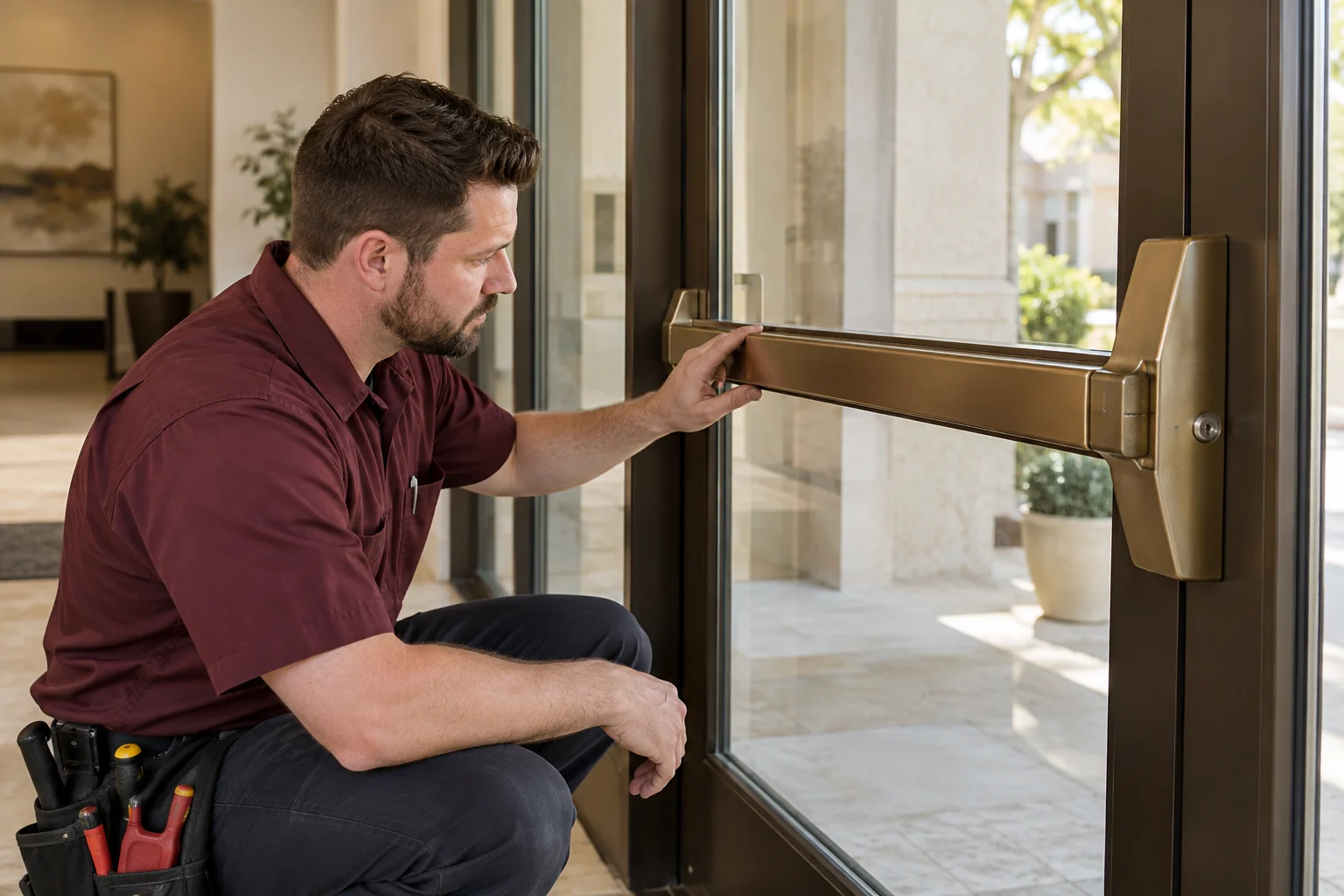
Doors that people use to leave a building in an emergency need hardware that allows easy exit without special knowledge. Panic bars and similar exit devices are designed for this. The rules about where such hardware is required, what type, and how a door must operate, vary by location and by building use, and they are not something a general web page can state for you.
What a business owner can do is ask. Your local fire authority and building department can tell you what applies to your space, and a locksmith can explain how a given device works and what installing it involves. Never fit a lock that stops people leaving in an emergency, and never chain or block an exit. If a door is meant to be an exit, it needs to open from inside.
The article on panic bars and exit devices explains the basic types, and the piece on door accessibility audits covers how doors are looked over for people with different abilities. Use both as background for your own questions to the authorities who decide what applies to you.
Hurricane season deserves a line here. Businesses that close ahead of a storm should think about which doors will be locked, who holds the keys while the building is shut, and how the owner or manager will get back in afterward if roads or power are disrupted. Written notes on where spare keys are kept, shared with a second trusted person, can save a lot of trouble once the weather clears. Afterward, check that doors still latch, since swollen frames and shifted hinges are common after a wet, windy week.
Interior locks: offices, cabinets and desks
Not all business security is about the front door. Offices hold paperwork, cash boxes, computers and personal items, and a lock on an interior door or a filing cabinet adds a layer. Filing cabinets and desks use small cylinder locks that are easy to overlook, but they can be rekeyed, replaced or supplied with new keys when the originals are lost.
If you have inherited a desk or cabinet with no key, a locksmith may be able to supply a key or a replacement cylinder without damaging the furniture. Describe the piece, mention any markings on the lock face, and be ready to explain that it belongs to you. Many such locks are low security and are meant to deter casual access, not stop a determined person, so use them accordingly.
Think about layers. A locked cash drawer inside a locked office inside a locked building is far harder to get into than any one of them alone. The article on file cabinet and desk locks covers the small hardware that people often forget, and a short read of it may reveal an easy improvement.
Mailboxes, key cabinets and lockboxes belong in this same category. A wall mounted key cabinet that holds spare keys for the whole building is itself a target, so its own lock deserves the same care as any door. If it uses a basic cam lock that opens with a common key, that is worth replacing with something less widely duplicated. Ask about it while someone is already on site for another task.
Working with a locksmith for your business
The process is plain. You call and describe the property, the doors and the problem. The work and the price are explained before it begins, you decide, and the finished work is tested with you. For a business, testing means trying every door and every key, with the door open and closed, and confirming that the door closer, the latch and the strike work together.
Before you call, have your door list and any photographs ready, and know who has authority to approve work. If you rent, ask your landlord what is permitted, since some leases require keys to be shared with the property owner or manager. Keep a copy of any agreement you reach.
If your business is near other parts of Broward, you may also want to read the town pages on Pompano Beach and Fort Lauderdale, which offer similar general guidance for their areas, and the page on lock installation in Lauderdale by the Sea if you are adding new hardware.
Think about timing from the business side as well. A lock change on a front entrance is easiest to plan around a quiet part of your week, with a note on the door for customers, and with someone present who can approve the work and receive the new keys. If the job involves a door that cannot be left unsecured, say so when you call, so the plan includes a way to leave the building locked when the work is finished.
It also pays to ask what happens afterward. Who holds the extra keys? Are the keys marked in a way that stops them being copied freely? Will the locksmith note which cylinders were changed, so you have a record next time? These are ordinary questions, and a thoughtful answer is a good sign that the work will be done with care.
Common questions
How do I know if my business doors need a higher grade lock?
Look at how often the door is used and how it is behaving. A door that opens many times a day, or one whose latch has started to loosen or stick, probably needs commercial grade hardware. A locksmith can look at the door and frame and suggest a grade that fits the job.
Should I rekey after an employee leaves?
If there is any doubt that every key was returned, rekeying the affected locks is a sensible step. It makes old keys useless without replacing the hardware. For a business with several staff, keeping a key log and limiting who holds each key makes this easier and less often necessary.
What is a master key system?
It is a set of locks where each door has its own key and a higher level key opens many or all of them. It suits offices and small buildings with several doors or tenants. It needs careful planning so no key opens a door it should not, and the master key must be tightly controlled.
Is electronic access control better than keys?
It depends on your size and staffing. Electronic systems let you add or remove access without cutting keys and can record entries, but they rely on power, software and someone to manage users. Many businesses keep mechanical keys as a backup, so key control still matters.
Who decides what exit hardware my business needs?
Requirements vary by location and by how a building is used, so ask your local fire authority or building department. A locksmith can explain how exit devices work and install what you are told is needed, but should not be the one to decide what the rules require.
What should I have ready before calling?
A list of the doors involved, a short description of each problem, a note of who holds keys, and photographs of the locks and frames if you can take them. If you rent, know what your lease allows and who can approve work. That makes the conversation shorter and the plan clearer.
Talk through the job before work begins
Explain the problem, what has to work again and who needs access afterward. We talk through the scope and the price first, and work begins after you agree.
Call (954) 888-8804