Commercial Locksmith in Parkland
A business door has to do more than a home door: it serves staff, customers, deliveries and emergency exits all at once. This page offers general guidance for Parkland owners and managers thinking about commercial locks.
Call (954) 888-8804How business locks differ from home locks
A house has a handful of people who need a key, a modest number of daily openings and a clear owner. A business has employees, managers, cleaners, vendors, delivery drivers and sometimes a landlord, all with different reasons to come and go. The doors open hundreds of times a week rather than a dozen times a day, and every opening wears the hardware. Locks that suit a bedroom or a garage entry may fail early on a storefront or a stockroom.
Commercial hardware is built for this heavier use. It tends to have stronger springs, thicker metal, larger bolts and parts that can be serviced rather than thrown away. It is also made to fit doors that are different from residential ones, including aluminum storefront doors with narrow stiles, glass doors with pivot fittings, steel doors in metal frames and wooden office doors with heavy closers.
The work behind the door matters as well. A business must think about who may enter at which times, how a lost key is handled without chaos, and how people leave safely in an emergency. Those questions turn a lock choice into a small system, and a good plan begins by asking them rather than by picking a brand.
Starting with a key plan
Before you buy any hardware, sketch a key plan. List the doors, and next to each, write who needs to open it. The front door may be used by every employee, while the cash room or server closet may be used by two people. A plan on paper shows the shape of the system you need and prevents the common pattern of a drawer full of unmarked keys.
From the plan, you can decide what kind of key structure fits. A single key for each door is simple but leads to key rings that grow without limit. A master key system lets a manager open every door with one key while each employee carries a key that opens only their areas. The article on master key systems for a business explains the idea and its limits clearly.
Keep the plan alive. When a person is hired or leaves, when a door is added or a room changes use, update the sheet. A key plan that was accurate three years ago but is never updated does not protect the business. Make one person responsible, and keep the record somewhere safe, with a second copy that someone else can reach if the first person is away.
- List every door and who must open it.
- Decide which areas need extra limits, such as cash rooms or records.
- Note who holds each key and when it was issued.
- Plan what happens when an employee leaves.
- Update the plan whenever doors, staff or tenants change.
Understanding commercial hardware grades
Lock hardware is commonly sorted into grades that describe how well it stands up to repeated use and to force. A residential grade lock can be perfectly good in a home but may not survive years on a busy shop door. Commercial grade locks are designed for heavier cycles, and they are usually the sensible choice for a front entrance, a back door or an employee entrance.
Grade is not the only measure. The cylinder, the strike, the frame and the way the lock is mounted all matter. A strong lock on a weak door fails at the door. Look at the whole assembly, including the closer, the hinges and the glass, rather than concentrating on a single part. The guide to commercial lock grades helps you understand what the labels mean.
Do not be pushed into more hardware than you need. A small office with low foot traffic does not require the same equipment as a busy store. Ask the person advising you why each item is recommended and what would happen without it. A clear, practical explanation is a good sign, while pressure and jargon are not.
Exit devices and safe ways out
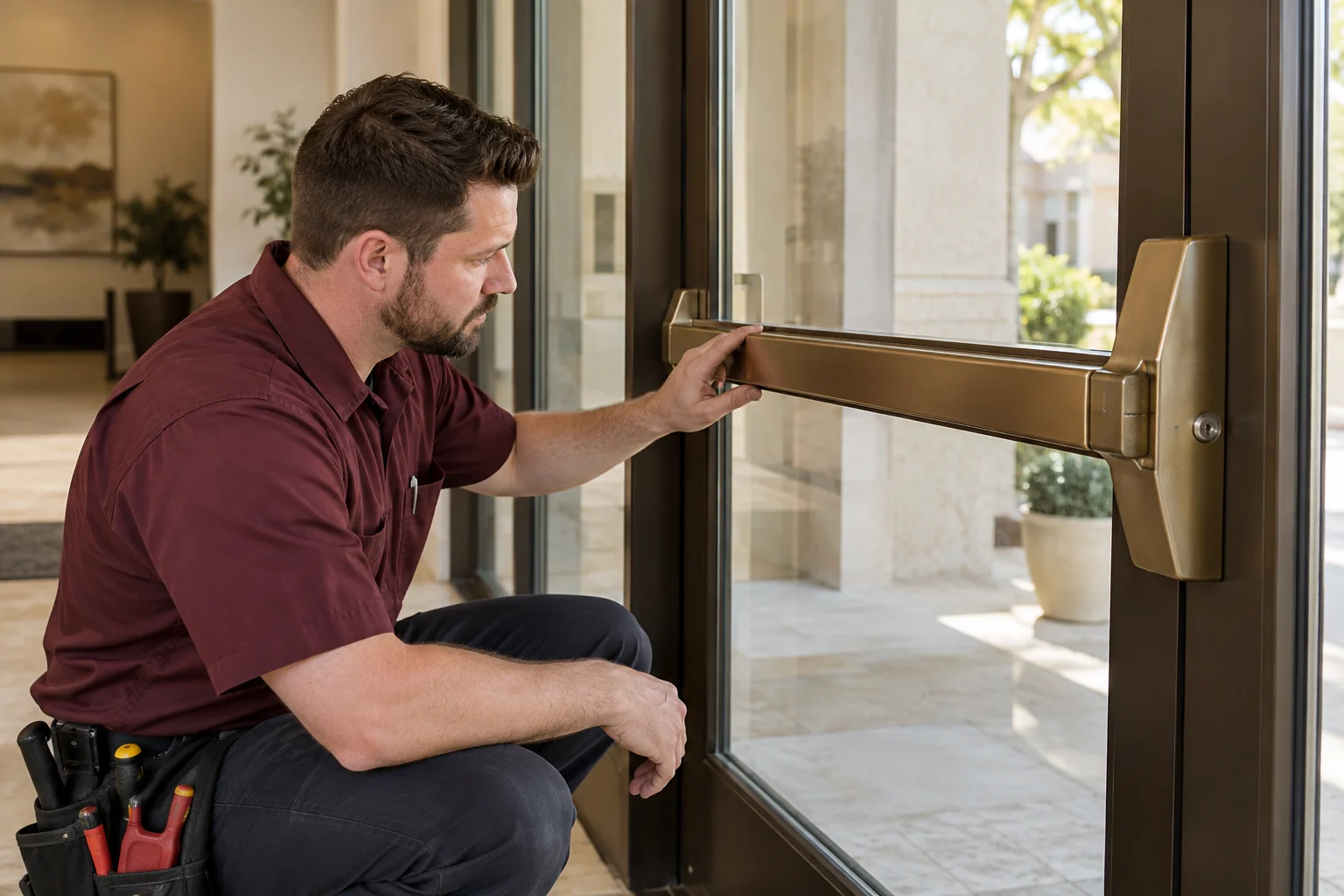
Every business door has a second job, which is to let people leave in an emergency. Doors that serve as exits often need hardware such as a panic bar or a push pad that lets someone exit with a single motion and without a key. This is a safety feature, and it is not something to disable or chain shut. Locking people in, even by accident, is dangerous.
The rules that govern exits depend on the type of building, its use and the number of people who occupy it. Requirements vary, so ask your local building or fire authority, your landlord or your insurance contact what applies to your space. Do not rely on guesses or on what a neighboring shop does. A locksmith can install and adjust hardware, but you should confirm the requirement with the right authority.
For a general introduction, read the business guide to panic bars and exit devices. It explains the common types and the kind of maintenance they need so that they work on the day you rely on them.
Storefront doors and everyday wear
Storefront doors take a beating. They are opened by hundreds of hands, bumped by carts and deliveries, and slammed by wind. In Parkland and the rest of South Florida, humidity, rain and salt air add corrosion to the list. Hardware that was smooth when it was installed can become stiff, loose or misaligned within a year or two.
Typical problems include a lock that sticks, a latch that will not catch, a door that drags on the floor, and a pivot or hinge that wears. Many of these can be repaired rather than replaced if they are caught early. Ignoring a stiff lock until it fails can leave the door unable to lock at all, which turns a small repair into a security problem for the night.
If your door is showing these signs, read storefront door lock repair for common causes and what can often be done. Report wear promptly to whoever maintains the building, and keep notes on what you reported and when.
A simple habit helps: once a month, open and close each public door slowly and listen. Note any scraping, clicking or resistance. Check that the closer brings the door fully shut and that the latch catches without a push. Try the lock from both sides. Five minutes of attention catches problems while they are still small, and it gives you something concrete to describe when you call for help.
Keys, cards and codes for small businesses
Mechanical keys are not the only way to control access. Keypads, card readers, fobs and app based systems let you give each person a separate credential and remove it without changing any lock. For a business with frequent staff changes, that can be easier than collecting keys, and it creates a record of who entered and when.
Electronic access has its own costs and demands. It needs power, a network or a controller, software, and someone who will manage the list. It can fail during an outage or when a battery runs flat. Many businesses combine the two, using electronic access for daily use and a mechanical key as a backup. The comparison in access control versus keys for a small business sets out the trade offs.
Choose the system that matches the way your staff actually works. A technology that people find irritating will be propped open or bypassed. Speak to the people who use the doors every day before settling on a plan, and test any new system with a few of them first.
When an employee leaves
Staff turnover is a normal part of business, but each departure raises a question about keys. If an employee held a key to the front, the stockroom or the office, you cannot be certain that every copy was returned. Changing the cylinders on the affected doors, or rekeying them, ends the old access in a clean and consistent way.
Doing it as a routine rather than as a reaction to a dispute also removes drama from the process. If every departing key holder triggers the same simple steps, nobody feels singled out. Collect keys, cards and fobs on the last day, update your record, and decide whether a rekey is needed for any door that person could open. The guide to rekeying an office after an employee leaves outlines a calm approach.
Do not forget digital credentials. Cancel codes and cards, change shared passcodes on keypads, and remove any access from apps. A key plan covers every kind of entry, and one overlooked code can undo the careful work done on the locks.
Inside the office: cabinets, desks and storage
Not every lock is on an outside door. Filing cabinets, desks, cash drawers and storage cupboards hold records, payroll papers, small valuables and supplies. These locks are often ignored until a key is lost. They are usually simple, but they still deserve a plan, because the contents may be more sensitive than the building.
Many furniture locks come in a small number of common keys, which means a key from one desk might open another. If you handle confidential records, replace or rekey those locks so that they are unique to your office. The article on file cabinet and desk locks explains the usual options and how they can be changed.
Also think about where the keys to these locks are stored. A key taped under the desk defeats the purpose. Keep spares in a locked place with limited access, and write down who has them. A tidy habit protects sensitive contents more than an expensive lock that no one uses properly.
Doors, accessibility and shared buildings
Public facing businesses must consider whether customers of all abilities can use the door. Hardware such as lever handles, the force needed to open a door, and the height of controls may be covered by accessibility rules. Requirements vary by building and use, so ask your local authority, your landlord or a qualified consultant what applies, and do not rely on a general article, including this one.
If you rent space in a building with other tenants, your landlord may control the exterior doors, the common areas and the master key. Clarify who may change locks and who must be informed. A change made without approval can create disputes, and in some leases it can breach the agreement. Put approvals in writing, and keep copies.
If you want a general introduction to door audits and accessibility issues, read door compliance audits for commercial spaces. It will help you ask better questions of the people who set the requirements in your area.
Weather, storms and after hours security
A business building in South Florida has to survive the same weather as a home, with the added problem that nobody may be there when it arrives. Before hurricane season, walk your doors and check that each one closes, latches and locks without being forced. Swollen frames, loose hinges and worn closers often show up only when conditions turn wet or windy, and a door that fails to latch during a storm is an open invitation.
After a storm, check again. Doors can shift, glass can crack and hardware can fill with debris or moisture. If a lock feels different, do not assume it will recover on its own. A stiff cylinder that was fine last week might be corroding, and early attention is easier than an emergency repair at night. Keep a record of any damage in case you need it for your property manager.
Think about lighting and visibility as well. A well lit entrance and a clear view of the door from the street discourage trouble more than many people expect. Locks do their job well when they are part of a sensible whole, including lighting, tidy surroundings and routines for opening and closing.
Finally, plan how the building is opened and closed each day. Who unlocks in the morning, who checks the back door at night, and who is called if an alarm or a lock issue appears? Writing these steps down turns a vague habit into a routine that can be handed to a new employee without confusion. Locks protect a business only when people use them the same way every day.
What a commercial visit involves, and nearby pages
Start with a phone call. Describe the type of business, the number of doors, the problem and any deadline you face. The work and the price are explained before it begins, and you should know which doors will be affected. Ask whether any part of the building will be unusable during the work, so that you can plan around staff and customers.
On site, the locksmith examines the doors, frames and existing hardware, then installs or adjusts the agreed items. The finished work is tested with you, including exit devices, closers and any keys or credentials. Ask for a clear list of keys issued, and keep it with your key plan.
This page is general guidance for Parkland and does not claim any history with local businesses. Owners just beyond the city line may find the same advice in the pages for Coral Springs and Coconut Creek, and the main page on commercial locksmith work covers the broader range of services.
Common questions
What is a master key system?
It is a key plan in which each lock has its own key, and one or more higher level keys can open groups of locks. A manager might carry a key that opens every door, while a staff member carries one that opens only their area. It needs careful planning and records to work well. Because one key can reach many doors, the master key itself should be kept under tight control and issued to very few people.
Should my business use keys or electronic access?
It depends on the number of people, how often staff change and how much you value an entry record. Keys are simple and need no power, while electronic access is easier to change and track. Many businesses use both, with a mechanical key as a backup. Whichever you choose, plan for outages and lost credentials so that a dead battery or a missing card never leaves staff standing outside.
How do I know my exit doors are acceptable?
Requirements depend on the building, its use and local rules, so confirm with your local building or fire authority, your landlord or your insurance contact. A locksmith can install and adjust exit hardware, but the authority decides what is required. Do not lock or chain an exit door under any circumstances.
Can the locks be changed without disturbing the business?
Often yes, with planning. Tell the person you call which doors are used most and when the business is quiet. Work can sometimes be arranged door by door so that customers and staff can still enter. Agree the plan in advance so that nobody is surprised. It also helps to tell your staff beforehand which doors will be out of use and for how long, so that deliveries and customers are directed sensibly.
What should I do about keys no one can account for?
Treat them as a risk. Rekeying the affected doors makes the unknown keys useless and gives you a clean starting point. Then record who receives each new key, and keep the sheet current. It is a modest step that solves a common problem. If the unaccounted keys were issued many years ago, the case for rekeying is even stronger, because you cannot know where those copies have traveled since.
Do I need permission from my landlord to change locks?
Often you do. Leases vary, and many require approval for changes to exterior doors or shared areas. Check your lease and ask your landlord or property manager in writing before work begins. Keep their reply on file, and ask whether they need a copy of the new key. Some landlords keep a key for emergencies, and agreeing on that arrangement early avoids disagreement later.
Talk through the job before work begins
Explain the problem, what has to work again and who needs access afterward. We talk through the scope and the price first, and work begins after you agree.
Call (954) 888-8804