Commercial Locksmith in Pompano Beach
Shops, restaurants, offices and storage buildings all depend on doors that open smoothly for the right people and stay shut for everyone else. This page is general guidance for Pompano Beach business owners and managers.
Call (954) 888-8804Doors are part of how a business runs
A business owner thinks about customers, staff, suppliers and stock. Doors rarely make the list until one fails. Yet every opening of the day depends on a key turning, a latch catching and a closer behaving. When the back door sticks during a delivery or the front lock jams during closing, the day stops, and everyone notices the lock.
The most useful shift in thinking is to treat locks as equipment, like a refrigerator or a register. They wear, they need occasional attention, and they cost less to maintain than to replace in a hurry. A short routine of looking at the doors every so often can catch most problems while they are still small. Put it on the calendar with the other tasks you do not want to forget, such as checking smoke detectors and replacing light bulbs. Ten minutes with a notebook at the start of each season is usually enough, and the notes you gather become a useful history if you ever need to explain a repeating problem to someone.
This page is general guidance for businesses in Pompano Beach. It does not describe local rules, specific buildings or any past work. Its aim is to give you the vocabulary and the questions you need for a clear conversation with a locksmith.
It also helps to remember that your lease may affect what you are allowed to change. Many tenants in shopping centers and office buildings share a building entrance, a hallway or a gate with other businesses, and the landlord may control those. Your own suite door is usually yours to manage, but read the lease or ask the property manager before you change anything.
Different businesses, different doors
A restaurant faces heat, grease, steam and constant traffic through the kitchen and the back door. A retail shop relies on a glass front door that must lock securely and look good. An office suite may have a shared hallway, a reception area and a few private rooms. A warehouse has large doors, small side doors and often a mix of old and new hardware.
Each setting calls for different thinking. A restaurant might need hardware that withstands moisture and frequent cleaning. A shop might focus on the storefront lock and a reliable closer. An office might care most about who can reach the supply room or the file cabinets. A warehouse may need a plan for several employees to share a small set of keys without losing track.
Before calling, think about what is unusual about your building. A door that opens onto an alley, a gate that is opened by many different drivers, or a room with expensive stock all affect the plan, and mentioning them at the start saves back and forth later.
Seasonal patterns matter in a coastal city. Some businesses are busy through winter and quiet through summer, and a locked storeroom may sit untouched for weeks, which is when hardware seizes. If you have doors that are rarely used, try them regularly. A lock that is exercised keeps moving smoothly, while one that sits untouched in damp air can stiffen and fail at the first real use.
Walk the building with a notebook
The most useful preparation is a slow walk around your property with a notebook or phone. Visit every exterior door, then every interior door that carries a lock. Write down the type of lock, what the door does when closed, whether it needs a push or a lift, and who uses it. Take a photograph of each lock so you can describe it later, and add a note about anything odd, such as a door that is hard to close in wet weather.
As you walk, look for the signs of age. White powder on metal, rust stains, loose handles, gaps around the frame and keys that need wiggling all tell you something. A door that has been repaired several times is a candidate for replacement rather than another patch.
Bring the notes to the phone call. A technician who hears that there are six doors, two of them glass and one a metal rear door with a hold open habit, can give you a clearer picture of the work and the price before anyone travels anywhere.
A good call also mentions urgency honestly. If the front door will not lock tonight and valuable stock is inside, say so, because it changes how the problem should be approached. If it is a nuisance that can wait, say that too. Being honest about the situation helps you get the right kind of help, instead of overpaying for a hurried solution to a calm problem.
- List every door with a lock, interior and exterior.
- Note which doors are used by customers and which by staff only.
- Photograph each lock and any markings on it.
- Mark doors that stick, drag or fail to latch by themselves.
- Write down who currently holds keys for each door.
Who has a key, really
Key control is the part of business security that people neglect most. Over the years, keys go to staff, managers, cleaners, contractors, relatives of the owner and former tenants, and nobody keeps a clean list. The result is that no one can say with confidence who can open the building.
The fix starts with a list. Write the name of every person who holds a key beside the key number or description. If you find holes, such as keys nobody can account for, rekeying the affected locks is a straightforward way to start fresh. The article on rekeying an office after an employee leaves explains how owners usually approach it.
From then on, handle keys like cash. Hand them out deliberately, record who has them, and collect them when people leave. Stamped notes that say do not duplicate are only polite requests, so if copies are a real concern, ask about restricted key systems that limit who can have them made.
Think about vendors and contractors, too. Cleaners, security staff, delivery drivers and maintenance people often need access, but not permanent keys. A lockbox with a changing code, or a key that is signed out and in each time, can give them access without leaving copies around town. The right method depends on your building, and a locksmith can help you weigh the options.
Designing a key plan
A key plan decides who can open what. At its simplest, everybody has a key to the front door. At its most careful, each person holds only the keys their job needs, and a manager holds a master key that opens several doors. The idea is to avoid the situation in which one lost key exposes the whole building.
Our guide on master key systems for a business explains the options in plain terms, and the article on restricted and high security keys shows how to limit copying. Neither is necessary for every business, but both are worth understanding before you decide.
It is better to build the plan once than to improve it piece by piece. If you know you are likely to grow or add staff, say so when you call. A key system with room for growth costs less to extend than one that must be replaced when you outgrow it.
Consider seasonal staff as well. If you hire extra people for busy periods, a plan that makes it easy to collect keys at the end of the season saves worry. Number the keys, record who has which, and check them in at the end. A simple routine of this sort costs almost nothing and makes the next rekeying decision much clearer.
Storefront glass and the front entrance
The front door is the face of the business, and it is also usually a glass door in an aluminum frame. These doors have their own types of lock that fit into a narrow stile, and they rely on pivots at the top and bottom to hang properly. Over time, the pivots wear, the door drops slightly and the latch no longer lines up.
The signs are familiar: a door that scrapes the floor, a key that turns but does not throw the bolt, or a door that must be lifted to lock. The article on storefront door lock repair describes these symptoms and what a visit usually involves.
Humidity and salt air make the aluminum and the moving parts age sooner. A routine cleaning of the track and a light dry lubricant on the pivots, as the technician recommends, extends life. Do not tie the door shut with a chain or wire at closing if the lock fails. Describe the symptom and have it looked at.
Also pay attention to the threshold and the weatherstripping. A gap at the bottom of a glass door lets in water and insects, and a worn sweep can drag on the floor and make the door harder to latch. These small parts are often replaced at the same visit, and fixing them improves how the door closes, which is what helps the lock do its job.
Back doors, delivery doors and loading areas
The back of a business is where deliveries arrive, staff take breaks and trash leaves. It is also where many security problems begin, because the door is often propped open, left unlocked for convenience or fitted with older hardware. A door that is unwatched needs better hardware, not worse.
Consider whether a closer, a door position alarm or a stronger strike would help. If staff prop the door because it locks behind them, a keypad or a simple pull handle on the outside could solve the habit without making the door unsafe. These choices depend on the building and its use, so describe how the door is actually used.
Exit rules matter at the back as much as the front. A door that serves as a way out must open easily from inside. Do not chain it shut, even overnight. Requirements vary by building, so ask your landlord or the authority that oversees the property before changing any exit door.
Lighting plays a role in back door security as well. A well lit rear entrance makes it harder for anyone to approach unseen and easier for staff to see what they are doing when they take out the trash at night. It is not a lock issue, strictly speaking, but it is part of the same picture, and it costs little compared with the benefit.
Exit devices and safety
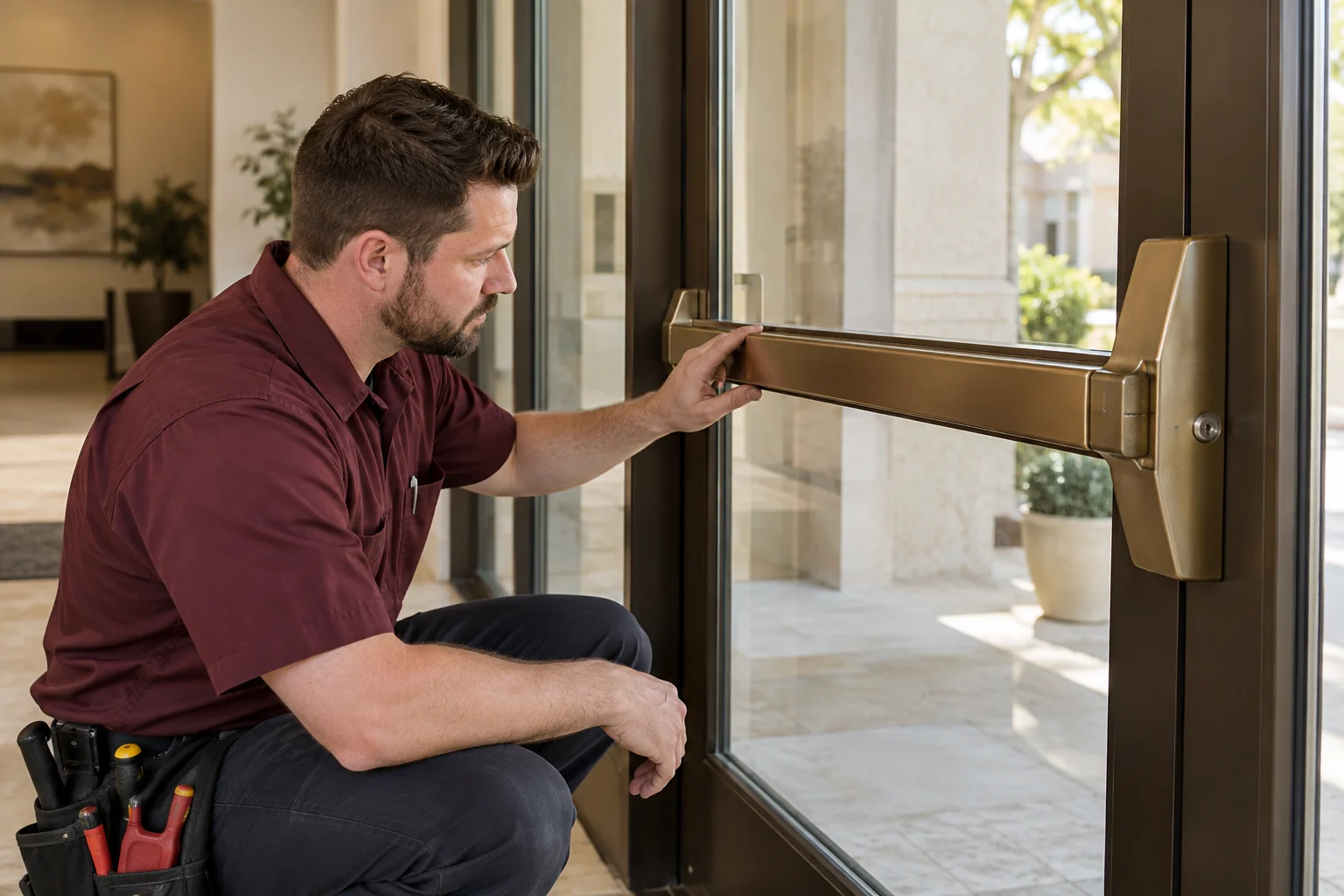
Exit devices, often called panic bars, let people leave safely by pushing a bar. They exist for safety, and they must not be disabled or blocked. A business with a public space often has them on at least one door, and they need occasional checking to be sure the bar moves freely and the latch retracts.
The article on panic bars and exit devices covers how they work and what maintenance involves. If yours sticks, squeaks or no longer latches fully, have it looked at by a trained technician rather than adjusting it yourself, because a wrong adjustment can create a hazard.
Rules about exits, fire safety and accessibility vary by building and by use. Ask your landlord, property manager or the authority that oversees your property what applies to your doors, and do not treat any general page, including this one, as a substitute for that answer.
Desks, cabinets and mailboxes
Not every lock in a business is on a door. Desk drawers, file cabinets, cash drawers and tool cabinets all use small locks that are easy to forget. Keys for these often get lost or mixed up, and some are shared among many people. When one goes missing, the contents can be exposed quietly.
Our guide on file cabinet and desk locks explains how they work and what can be done when the key is lost. Business mailboxes, whether in a building lobby or at the curb, are another small lock with a big impact on privacy, and the article on mailbox lock replacement covers that case.
Treat these small locks as part of your key plan. Write down which keys open them, who holds them, and where the spare is kept. A short list prevents a lot of frustration.
Keys, codes and cards
Many owners are drawn to keypads, cards and phone controlled locks because they avoid copied keys and let you remove a person without changing a lock. These systems have real advantages, especially where staff change often. They also bring new tasks: batteries, power, software settings and the discipline of removing users promptly.
The comparison in access control versus keys for a small business helps you think through which doors benefit. A mix is common, with electronics at the main entrance and mechanical keys on storerooms.
Whatever you choose, plan for the day the power is out or the battery runs low. A door that cannot be opened by anyone is as much a problem as one that opens for the wrong person, and your plan should include a safe backup.
Calling, and what happens next
Call and describe the business, the number of doors and what each one does. Say whether anyone is locked out or whether the building is exposed right now. The work and the price are explained before it begins, and you should expect to hear what will be done and why.
When the work is finished, the doors are tested with you. Open and close each one, turn every key and check the exit hardware from inside. If something feels wrong, say so before the technician leaves, when a small adjustment is easy.
For broader background, see the Pompano Beach locksmith overview, the page on lock installation in Pompano Beach, and the main commercial locksmith page. Nearby places such as Deerfield Beach follow similar ideas.
You may also want to look at the page for commercial locksmith help in Oakland Park if your business has more than one location, because many of the same questions arise. In every case, the central idea is the same: know your doors, know your keys, and ask a clear question before work begins.
Common questions
How do I know if my storefront door needs repair or replacement?
Signs include dragging on the floor, a latch that no longer lines up, a key that turns without throwing the bolt, or corrosion on the pivots. Often the door is repaired rather than replaced. A technician can look at the frame, pivots and lock and explain which parts are worn before the work begins.
Should every employee have a key to the front door?
Not necessarily. Many owners limit keys to people who need them and use a plan in which each person holds only certain doors. Think about who opens, who closes and who works alone. A written key list makes it easy to see who has access and to change it when staff leave.
Can my business use keypads instead of keys?
Often yes. Keypads and card systems suit places with frequent staff changes, but they require batteries or power and someone to manage users. Many businesses mix electronic locks on main entrances with ordinary keys on storerooms. Describe your doors and staff, and options are explained before work starts.
What should I do if a lock fails at closing time?
Do not tie the door shut with wire or a chain, and do not block an exit. Note exactly what the lock does and call to describe it. If the building cannot be secured, you may need to arrange for someone to watch it until the work is done. The plan is explained before it begins.
Can desk and cabinet locks be dealt with at the same visit as door work?
Often they can, if you mention them when you call. Small locks on drawers, cabinets and mailboxes use different cylinders from doors, and the technician can plan accordingly. Make a list of every lock, including small ones, so that nothing is forgotten and you are not surprised later.
Does this page describe rules for Pompano Beach businesses?
No. It is general guidance and does not state local rules or describe any particular business, building or past job. Requirements for exits, accessibility and fire safety vary, so ask your landlord, property manager or the authority that oversees your property before changing hardware on any door.
Talk through the job before work begins
Tell us what happened, which doors or keys are involved and who needs to get in. The price and the plan are agreed with you before any work starts.
Call (954) 888-8804