Commercial Locksmith in Dania Beach
A business door has to do more than a house door: serve staff and customers all day, stay secure overnight, and let people out safely in an emergency. This is general guidance for Dania Beach business owners on how commercial locksmith work fits together.
Call (954) 888-8804How a business door differs from a home door
A front door at home is opened by a handful of people. A business door may be opened by dozens, sometimes with a deliveryman, a cleaning crew and a landlord's representative all holding keys. That traffic changes what the hardware must endure and what the owner must keep track of. Commercial locks are built heavier, they are expected to cycle thousands of times, and they usually come in standardized sizes so parts can be swapped without remaking the door.
There is also a safety side that homes mostly escape. In a public or work space, people must be able to leave without delay and without special knowledge, even while the door stays secure from the outside. That need shapes which locks are allowed on which doors, and it is one reason business hardware looks different from the kind sold for houses.
This page is general guidance written for businesses in Dania Beach, without claims about specific buildings or neighbors. For the wider service overview, see the main page on commercial locksmith work, which describes the kinds of jobs a locksmith takes on for shops, offices and rental properties.
Business space in a coastal county also faces the weather. Doors near the water see damp air and salt that eat at metal finishes, and the storm season means hardware is tested by pressure and flying debris. None of this changes the basic logic of choosing sound hardware, but it is a reason to inspect doors on a schedule rather than only when they fail.
Understanding lock grades
Lock quality is not just a matter of price or brand. Commercial and residential hardware is sorted into grades that describe how much abuse a lock is built to take, from light use up to heavy daily traffic. A higher grade generally means thicker metal, tougher internal parts and a cylinder that resists wear for longer. A door that sees constant use from staff and customers deserves hardware that was designed for that pattern.
The mistake many small business owners make is buying a household lock from a home store because it fits the hole. It may look the same and work well for a few months, yet it was never meant to be cycled hundreds of times a day. Loose handles, sticking latches and failing cylinders follow, usually at an inconvenient moment.
If you want the details, the guide to commercial lock grades explains the categories in everyday terms. Reading it before you replace anything will help you ask better questions and understand what a technician is recommending and why.
Keys, who has them, and who should not
The weakest point of many business security setups is not a lock but a list. Who has a key? Who had one last year? Over time, spare keys pile up with former employees, previous tenants, old contractors and relatives of people who once worked there. If nobody can answer the question with confidence, the lock is only as private as the least careful holder.
A practical habit is to keep a written record of every key issued, with names and dates, and to collect keys when someone leaves. When that is not possible, or when you simply cannot be sure where all the keys went, the cleaner answer is to change what the key opens. A locksmith can rekey the cylinders so that old keys stop working and a new set takes over, without replacing the doors or the hardware.
Do not overlook the quiet keys. Safe deposit style cabinets, file drawers, a desk lock and the small padlock on a supply cage all tend to get forgotten when keys are reviewed. They often hold the items that matter most, such as cash drawers, records and stock, so include them in your inventory when you count who holds what.
The article on rekeying an office after an employee leaves walks through the reasoning, and it applies to any workplace where a key has gone out of your control.
Master key systems for multiple doors
When a business has many doors and many people, a single key for every door becomes a security problem, while a separate key for every door becomes a nuisance. A master key system solves this by building a hierarchy. Each employee holds a key that opens only the doors they need, while a manager holds a key that opens more, and the owner holds a top key that opens everything.
Think of it like the layers of an organization chart drawn onto your doors. The people at the bottom need the least reach, and each level above them adds to what they can open. If you can sketch your own staff structure on a page, you already have the starting point for a master key plan.
The design of such a system is detailed work. It involves planning the levels of access in advance, deciding how many changes will be needed in the future, and keeping the records that make later additions possible. A poorly planned system can lose its security as it grows, since too many keys may end up opening too many doors.
Before deciding, read about master key systems for a business and think about how your own staff move through the space. A brief floor plan with rooms marked by who needs access is a useful thing to bring to the conversation.
Keys or access control
Modern business owners often face a choice between traditional keys and electronic access control, such as keypads, cards or fobs. Each has strengths. Keys are simple, need no power and can be understood by anyone. Electronic systems can be changed without collecting hardware, can record who entered and when, and can cancel one person's access without affecting anyone else.
The tradeoff is that electronic systems depend on power, software and sometimes a network. They need maintenance, and a failure can leave a door in an awkward state. For some businesses a mix works well:electronic access on the main entry where turnover is high, and traditional keys on interior doors and storage rooms.
A balanced discussion appears in access control versus keys for a small business. It helps to consider how often your staff changes, how sensitive your stock or records are, and whether you want a log of entries before choosing a direction.
Do not forget the failure plan. If a keypad loses power, or a card reader stops responding, what happens to the door? Some devices lock when power fails and others unlock, and the right choice depends on the door. An exit door must always let people out, while a stockroom might be better staying locked. Ask the installer to explain what each door does when something goes wrong, and write the answer down.
Exit hardware and life safety
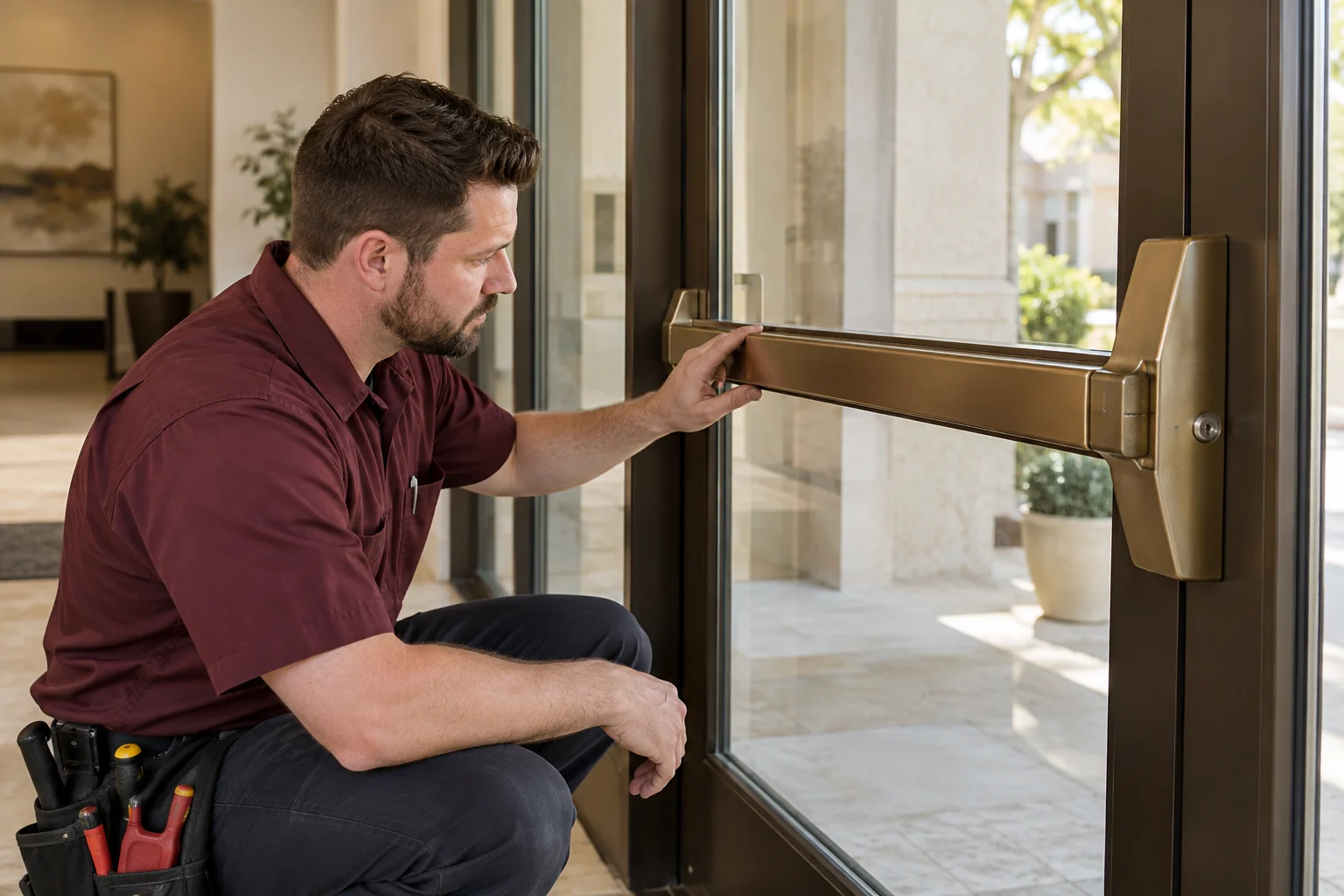
Doors that people use to leave a building in an emergency need special handling. Panic bars and similar exit devices let a person push their way out without twisting a knob or using a key, and they are installed on many doors in public and work settings. They are part of how a building keeps occupants safe, so they should never be disabled, chained or blocked for convenience.
A common problem is a door that is hard to push open from inside because the device is worn or misadjusted, or one that does not latch properly, leaving the building less secure at night. Both problems deserve attention from a trained technician, since exit hardware has a safety purpose and tampering with it can create risks.
Requirements for which doors need what vary by building type and by local authority, and this page cannot state them as facts. If you are unsure, ask your landlord, your insurer or the local building department, and read the overview in panic bars and exit devices for business owners.
Storefront doors and daily wear
Glass storefront doors take a beating. They swing all day, they are pushed, pulled and sometimes slammed, and their locks are mounted in narrow frames with little room for error. Early signs of trouble include a latch that does not catch unless the door is lifted, a key that turns with effort, a closer that no longer controls the swing, and a gap between the door and its frame that was not there before.
Humidity and salt air in South Florida add to the wear. Moisture reaches the internal parts of cylinders, and metal fittings may corrode earlier than owners expect. Cleaning crews that spray liquids near locks can also push moisture into places it should not go. Regular attention, rather than waiting for failure, tends to keep these doors working.
When a storefront lock begins to misbehave, it is worth acting before it fails completely, because a lock that will not secure at closing is a bigger problem than one that needs attention at midday. More detail on this topic appears in storefront door lock repair.
Try a simple daily habit. When you lock up, push on the door after turning the key and watch whether the bolt fully extends. Listen for a grinding sound in the cylinder. If you ever need to lift, shove or kick a door to make it lock, report it that day. Staff who close the shop should know to mention these oddities rather than quietly working around them, because a workaround today is often a failure next week.
Accessibility and door hardware
Doors in places open to the public are expected to be usable by people with different abilities. That affects handles, thresholds, the force needed to open a door and the height at which hardware is mounted. A lever handle can be used with a closed fist or an elbow, while a round knob requires a tight grip and a twist, which is why levers are common in commercial settings.
Business owners sometimes learn about accessibility requirements only after a complaint or an inspection. A better approach is to look at your doors with fresh eyes before anyone else does. Is the handle easy to operate? Does the door close too sharply? Is there a clear approach to the entrance?
Specific requirements depend on the building and the authorities involved, and this page does not state them. A broader introduction is available in door compliance audits for commercial properties, and the people to ask about your own obligations are your landlord, your property manager and the relevant local office.
If an inspection or a complaint has already raised the issue, tell the locksmith exactly what was said. A technician can then focus on the doors in question and explain what changes to the handle, closer or threshold might help, so you can take a clear plan back to whoever raised the concern.
When tenants change and doors need new keys
Commercial tenancies turn over, and each change creates a key question. A new tenant moves into a unit where former occupants, brokers, contractors and cleaning staff may have held copies. Rekeying at the start of a new tenancy is a common and sensible step, since it costs far less than the trouble that follows an unauthorized entry.
Landlords and property managers often handle many units at once. A coordinated approach, with a record of which cylinders were changed and when, helps avoid confusion later. It also helps to agree who holds the master key and how copies are requested, so the system does not slowly drift.
If you manage rental space as well as commercial units, the same thinking applies. A comparison to residential practice is in tenant turnover and rekeying for property managers.
Closing time, break ins and what to check afterward
Every business owner eventually faces the morning when a door looks wrong. Maybe the frame is bent, the glass is cracked near the lock, or a window was forced. The first rule is to avoid touching anything that may matter to the police, and to call them before you begin any repair. Once they have finished, the building still needs to be made secure, and that is where a locksmith becomes useful.
A forced door often looks worse than it is, but the damage can hide in places you cannot see. A latch may be bent, a strike plate loosened from the frame, or a cylinder cracked inside. Repairing only the visible damage can leave a door that closes but no longer resists a second attempt. A technician can examine the whole assembly, explain what was affected and recommend what to replace.
After a break in, think about the keys as well. If a key was taken, or if you cannot be sure none were, the safer answer is to change what the cylinders respond to. The recovery steps in the break in recovery checklist apply to a business just as much as to a home, and they help you decide what to do first when you are rattled.
Preparing for a locksmith visit to your business
A few simple steps make a business visit go smoothly. Know which doors are involved and how many. Note the type of door, whether wood, metal or glass, and whether there is exit hardware. Have someone available who has authority to approve the work, since a locksmith should be directed by the owner or manager, not a passerby.
Think about how the business will operate while the work is under way. A rear door can often be addressed while the front stays open, but if the main entry is involved, you may need to plan staff access and customer flow. Tell the technician about any alarm sensors or electronic strikes near the door so they are not disturbed unexpectedly.
Expect the usual process: you call and describe your doors and your goal, the work and the price are explained before it starts, and the finished work is tested with you. For neighboring areas, see the guidance for Hollywood and Fort Lauderdale businesses, which share much of the same advice.
Common questions
What should I tell a locksmith about my business doors?
Describe how many doors are involved, what each is made of, and what problem you see. Mention exit devices, glass frames, alarm sensors and any electronic locks nearby. Say whether the door must stay usable during the work. A clear description helps the technician prepare and explain the plan and price before the job begins.
Is rekeying enough when an employee leaves?
Often it is, if the concern is simply that a former employee might still hold a working key. Rekeying changes the cylinders so old keys no longer operate them, while the doors and hardware stay in place. If the hardware itself is worn or unsuitable, replacing it may make more sense, and a technician can explain which applies.
What is the difference between a master key system and ordinary keys?
Ordinary keys each open one lock or a matched set. A master key system builds levels of access so that staff keys open only certain doors, supervisors open more, and a top key opens all. The design takes planning, and good records matter as the system grows.
Can I remove or lock an emergency exit bar to improve security?
No, you should not disable or block exit hardware, since it exists so people can leave a building safely. If you worry about the security of such a door, ask a trained technician about solutions that keep the exit function intact. Rules vary, so check with your landlord or local authority.
Why does my storefront door lock keep sticking?
Common causes include worn cylinders, moisture and salt air, a door that has shifted so the latch no longer lines up, and a closer that slams the door against the frame. A technician can look at the door, find the cause and recommend repair or replacement rather than guessing.
Should a small business use keys or electronic access control?
It depends on staff turnover, the value of what you protect, and whether you want a record of entries. Keys are simple and need no power. Electronic systems are easier to update and can log access, but they need maintenance. Many businesses use both in different places.
Talk through the job before work begins
Explain the problem, what has to work again and who needs access afterward. We talk through the scope and the price first, and work begins after you agree.
Call (954) 888-8804