Home | Cities | Hallandale Beach
Commercial Locksmith in Hallandale Beach
This page is general guidance for owners and managers of small businesses in Hallandale Beach. It explains how to think about keys, doors and upgrades, and how to work with a locksmith without losing control of your property.
Call (954) 888-8804Small businesses, big dependence on a few doors
A small business often depends on very few doors. A boutique has one entrance and one stockroom door. A restaurant has a front entrance, a kitchen door and a delivery door that opens onto an alley. A medical or professional office has a suite door, a records room and perhaps a shared hallway. When one of those doors fails, the day stops. That is why a thoughtful approach to locks matters even for modest operations.
Owners are usually focused on customers, staff and suppliers, so lock maintenance slides down the list until something goes wrong. A better approach is to treat doors as part of your equipment, like a register or an oven. They have a working life, they need periodic attention, and a small repair today can prevent a closed sign tomorrow. Setting aside a few minutes each season to test every door pays off.
It also helps to remember that customers judge a business partly by its doors. A door that opens smoothly and locks with a clean click gives a calm impression, while one that sticks or rattles suggests a place where things are not cared for. Good hardware that works quietly is a small piece of your reputation, and it costs little attention when it is maintained.
This page is general guidance for businesses in Hallandale Beach. It does not describe particular buildings or local requirements, and it makes no claim about any neighborhood. Leases, landlords, associations and city offices set their own rules for doors, exits and signage, so confirm what applies to your space and share it with your locksmith before work begins.
Who holds the keys to your business
The simplest security question in any business is also one of the hardest to answer: who has a key? Owners are sure of themselves, managers think they know, and long serving employees remember handing a key to someone years ago. Landlords may keep a copy. Cleaners, security companies and maintenance workers may hold others. Over time, the number of key holders grows quietly, and the records, if any, lag behind.
Start by writing everything down. For each door, record how many keys exist and who holds them. Include landlords, vendors and former staff whose keys may not have been returned. If the picture is murky, that is a signal to rekey and begin again with a clean list. From that point on, keep a short log of changes: who received a key, when, and who signed for it.
Policy supports practice. Decide who may copy keys and how. A key stamped with a warning is not a barrier, because many shops will copy it anyway. Restricted key systems control copying more tightly, and our article on restricted and high security keys explains the idea. Used with a simple log, they put you back in charge of your own access.
A practical example shows the value. Imagine a seasonal worker who is given a key for the summer and leaves in the autumn. Without a log, nobody remembers whether the key came back. With a log, you can see the gap in seconds and decide whether to rekey that one door. The record turns a vague worry into a specific, manageable decision, and it takes only a minute to maintain each time a key changes hands.
- Record every door, every key holder and the date of the last change.
- Collect keys from staff who leave, and rekey if any are missing.
- Do not leave a spare in a hiding place near the door.
- Ask your landlord which doors, if any, they hold keys to.
- Keep the log somewhere you can update and reach.
Restaurants, retail and the doors that take abuse
Customer doors work harder than almost anything else on a property. Restaurants swing doors open for guests, servers and deliveries throughout service. Retail shops invite constant foot traffic and the occasional shove. Salt air from the coast adds corrosion to hinges, pivots and latches. These doors tend to develop slow faults: a latch that needs a push, a closer that slams, a lock that grabs.
Early signs are easy to miss because staff adapt. Someone learns to lift the handle just so. Someone starts propping the door with a mat. Those workarounds hide a growing problem and also create security gaps, since a door that does not latch is not locked. Ask your team to tell you when a door behaves oddly, and make it clear that reports are welcome rather than a bother.
Storefront glass doors in particular rely on small hardware to hold a lot of weight. Our article on storefront door lock repair describes common faults and what a locksmith examines. Do not adjust heavy closers or pivot hardware yourself. Stored force in springs can injure you, and a wrong adjustment may leave the door hanging unevenly or failing to close.
Back doors, alleys and deliveries
The back of a business is a different world from the front. It has plain doors, poor lighting, trash bins and deliveries. It is also where many security lapses live, because staff open the door to carry things out, prop it for convenience and forget to close it. A back door left slightly ajar for a cigarette break or a cooling breeze is an invitation.
Good habits help more than expensive hardware. Make a rule that the back door is closed and latched when not in active use. Consider a door that closes itself, with a latch that engages reliably. Add a viewer or a camera if your layout calls for it. Keep the area lit and clear of clutter that could hide someone. Talk with the locksmith about hardware that suits your delivery pattern without leaving the door unsecured.
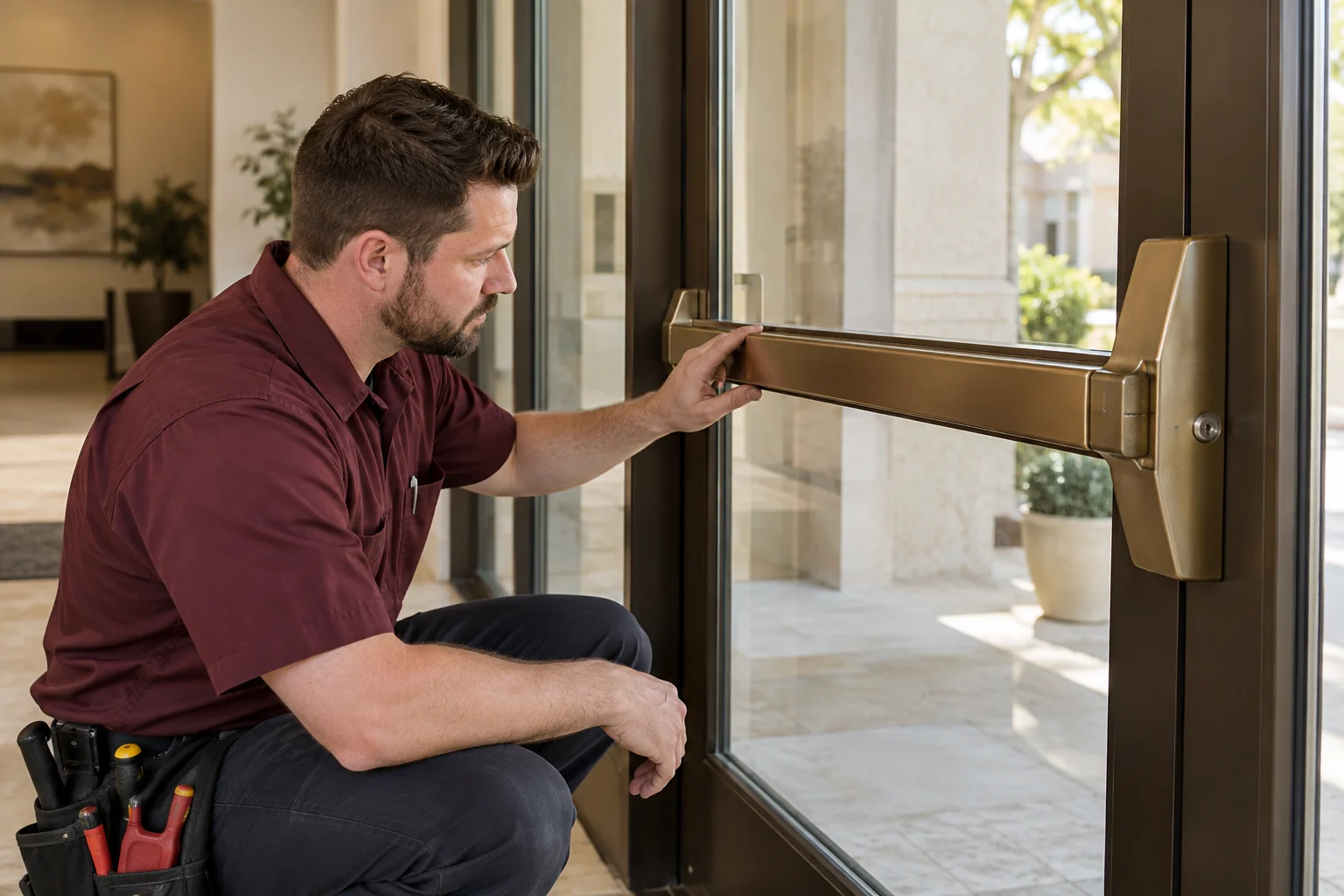
Remember fire safety. Back doors are often exits, and exits must work from the inside when people need them. Never chain, block or disable an exit to solve a security worry. Requirements for exit devices vary by building and use, so check with your landlord, fire inspector or building department. Our overview of panic bars and exit devices explains how the hardware works.
Master keys and areas of different sensitivity
Most businesses have areas of different sensitivity. A public floor is open to everyone. A back office is for staff. A cash room or records room is for a few people only. If everyone carries the same key, the most sensitive area is only as safe as the least careful key holder. A master key system lets you create levels, so that people receive only the access they need.
Planning is the key. Before any lock is changed, sketch who needs to reach which doors, and which doors should remain tightly limited. A locksmith can then design the keying so a manager's key reaches several doors, while a part time worker's key opens just one or two. Keep the top level keys few, and record where each lives. Losing one of those is more serious than losing a normal key.
Our article on master key systems for business sets out the principles without jargon. If you are not ready for a full system, even a modest step helps: separate keys for the cash room and the front door, for instance. Start with the area where a loss would hurt most and widen the plan as your budget and staff grow.
After a break in or attempted entry
No one wants to open the door and find it damaged. If you arrive to signs of forced entry, do not walk in. Stay outside, move to a safe place and contact the police. Do not touch or move anything that may be evidence. Once authorities have finished, you can think about repairs, and your priority will be to secure the property so that you can operate and rest easy.
A locksmith can assess damage to locks, doors and frames, and explain what needs repair or replacement. Often the lock is not the only casualty. The frame may be split, the strike plate torn out or the door skin crushed. Securing the opening may mean a temporary measure first and a proper repair afterward. Ask the locksmith to explain both, along with the work and the price, before anything is done.
Also think about the keys. If an intruder had access to keys, or if a break in suggests inside knowledge, rekeying makes sense. Our checklist on recovering after a break in lays out the order of steps. Check with your insurer about what they require, since policies differ, and keep notes and photographs of the damage for your own records.
Once the immediate repair is done, use the event to look at the bigger picture. Was the door the easiest way in because it sits out of sight? Was lighting poor? Was a key left in an obvious place? Small changes in habits and layout can matter as much as the hardware itself. A locksmith can talk through what the damage suggests about the way the building was approached, and recommend sensible reinforcements for the doors involved.
Lockboxes, mailboxes and shared building hardware
Many small businesses share a building, and with sharing come shared hardware: a common entrance, a mailbox bank, a utility closet, a shared storage room. Who controls those locks matters. A tenant cannot normally rekey a building entrance, and trying to do so can cause serious trouble with the landlord or association. Find out who owns each lock before you ask for any change.
Mailboxes deserve a special mention because they hold checks, statements and customer correspondence. Some are controlled by the postal service or building management, which affects who may change the lock. Our guide to mailbox lock replacement explains the usual situations. Always ask the property manager first, and then bring that answer to the locksmith.
Lockboxes for keys are popular among contractors and cleaning crews, and they can be useful if they are placed and managed sensibly. Choose a model suited to outdoor conditions, change the code when the people who know it change, and avoid leaving valuable keys in a place that is easy to find. A code that never changes is just a long term hiding spot with a number on it.
Planning upgrades without overspending
Upgrading all the locks in a business at once is rarely necessary and often unwise. A better method is to rank the doors by risk and use. Start with the doors that guard cash, records or valuable stock, and the doors that take the hardest daily wear. Then move outward. Spreading the work over a sensible schedule keeps cash flow steady and lets you learn what works before you commit to more.
Match the hardware to the door. A strong lock on a hollow door or a split frame protects very little. If the door itself is weak, reinforcing the frame, strike and hinges may do more than a new cylinder. Ask your locksmith to look at the whole assembly and explain which element is the weak link. A plain answer, backed by what the technician can show you, is a good sign.
Pricing questions are fair. Our article on what a fair locksmith price looks like in Broward helps you compare quotes without being guided by a single figure. Ask what is included, what is not and what could change the plan. If a locksmith is evasive about this, move on. Clear conversations about money are part of honest service.
Storm season, humidity and the calendar of door checks
Hallandale Beach businesses plan for storm season, and doors belong in that plan. Before a forecast storm, make sure every exterior door closes fully and latches without a shove. After it passes, walk the property and look at frames, thresholds and weatherstripping. Wind pressure can shift a door in its frame, and water can swell wood and corrode steel. Catching a shift early is far easier than discovering it on opening morning.
Humidity works more slowly but just as surely. Hinges squeak, latches grow sticky and keys start to feel gritty. A light, regular routine helps: wipe exterior hardware, tighten loose screws and use a lubricant made for locks, applied sparingly. Avoid heavy oils that attract dust. If a key turns with effort even after cleaning, that is the time to ask a locksmith to look, before the key snaps or the cylinder seizes.
Put these checks on a calendar. A short walk twice a year, plus one after any major storm, is enough for most small businesses. Assign it to a specific person so it does not depend on memory. Write down what you find, even if it is only that everything worked. Those notes make your next conversation with a locksmith shorter and more useful, and they show patterns that point to a door in decline.
Choosing and working with a locksmith
A business relationship with a locksmith is worth building. When someone knows your doors and your habits, repairs go more smoothly and advice becomes more useful. Look for clear communication, a calm manner and a willingness to explain. Be cautious if someone insists on a decision before they have described the plan or if they discourage you from asking questions. Our guide on choosing a locksmith you can trust lists the signals to look for.
Half Off Locksmith serves Broward County by phone. You call, describe the doors and the problem, and the work and the price are explained before it begins. When the job is finished, the work is tested with you. For a business, add one more habit: ask for a note of what was done at each door, and file it with your key log.
If you also need hardware added to new doors, the page on lock installation in Hallandale Beach covers that work, and the page on commercial locksmith services lists the wider range. Neighboring business owners may find the page for commercial locksmith help in Hollywood useful as well, because the same principles apply across Broward County.
Common questions
How can I tell how many keys to my business exist?
You often cannot, which is why many owners rekey and start a record from that point. List each door, who holds keys and when they were issued. Include landlords, vendors and past staff. If the list has gaps you cannot fill, rekeying gives you a clean starting point.
Should I change the locks after a break in?
It depends on what happened. Damaged locks, doors or frames need repair or replacement, and rekeying makes sense if keys may have been taken or copied. Contact the police first, avoid touching evidence, then ask a locksmith to assess the damage and explain the work and the price before it begins.
What is a restricted key system?
It is a keying system where key blanks and copying are controlled more tightly than with ordinary keys, so duplicates are harder to make without authorization. It can help a business keep track of who holds keys. A locksmith can explain whether it suits your doors and how copies would be requested.
Can I change the lock on a shared building entrance?
Usually not without permission. Shared entrances, mailboxes and utility rooms are typically controlled by the landlord or an association. Ask who owns the lock and what the process is before requesting any work. A locksmith can then carry out approved changes in a way that matches the building's requirements.
Why does my storefront door keep sticking or slamming?
Possible causes include a worn or misadjusted closer, loose pivots, a shifted frame or a latch that no longer lines up with the strike. Salt air and constant use speed up wear. Because closers hold strong springs, do not adjust them yourself. A locksmith can examine the whole door and explain the fault.
Does this page set out local rules for Hallandale Beach businesses?
No. It is general guidance for business owners in Hallandale Beach and does not state local codes, lease terms or association policies. Requirements for exits, signage and alterations vary by property and use, so confirm them with your landlord, property manager or the relevant city office.
Talk through the job before work begins
Say what went wrong and what you need to work when we leave. Scope and price are settled with you ahead of the work.
Call (954) 888-8804