Home | Cities | Deerfield Beach
Commercial Locksmith in Deerfield Beach
A business door has to do more than a house door: stay secure, let staff and customers move easily and, above all, let everyone out in an emergency. This page gives general guidance for Deerfield Beach business owners.
Call (954) 888-8804How business locks differ from home locks
A home front door is opened by a handful of people. A shop door may be opened and closed hundreds of times a week by staff, delivery drivers, cleaners and customers. That constant use wears hardware down sooner, and a lock that would last for years on a house can loosen or jam in a few seasons on a busy storefront. Commercial hardware is built heavier for exactly this reason. Hinges are thicker, latches are larger, and the internal parts are made to survive a long run of daily cycles without losing their shape.
The other difference is the question of who holds keys. A household might have four keys in circulation. A business may have a dozen or more, held by people who come and go. When a key goes missing or an employee leaves, the owner has to decide whether the risk is acceptable. That is why key control gets so much attention in a commercial setting.
This page is general guidance for business owners in Deerfield Beach and is not a description of any particular local job. It is meant to help you think through your doors and describe your situation clearly, so that the work and the price can be explained to you before any work begins.
Know your doors before you plan anything
Walk your building as if you were a visitor and then as if you were a stranger. Count the doors: front entrance, rear service door, loading door, side exit, office doors inside, storage rooms, a back gate. Note what each is made of, what hardware it carries and how often it is used. A glass storefront door with a narrow aluminum frame behaves very differently from a solid steel rear door.
Next, write down what each door needs to do. The front door must be easy for customers to use during business hours and secure after closing. A rear exit may need to open from inside at all times but stay locked from outside. A supply closet may need only a basic privacy latch, while a room holding cash or records needs more.
Once you have that list, the conversation with a tradesperson becomes much clearer. You can say which doors are the priority and what problem each one has. For a broader overview of business services, see the commercial locksmith page, which lists the kinds of work involved.
Understanding commercial lock grades
Lock hardware is graded by how much cycling, force and abuse it is designed to take. Lower grades are lighter and meant for light duty, while higher grades are heavier and built for heavy traffic and attack resistance. A business door typically deserves more than a residential grade, though the right level depends on the use of the door and the building.
Grades are only part of the story. A strong lock in a weak door or a thin frame still gives way at the weakest point. When you consider an upgrade, think about the door, the frame, the hinges and the strike as a system. A good lock cannot compensate for hinges held by short screws or a frame that is cracked.
The article on commercial lock grades explains the labels in plain language. Reading it before you call will help you ask good questions, such as what level is being suggested for each door and why.
- Heavier duty locks are built for frequent use and stronger resistance to force.
- Door, frame, hinges and strike all matter as much as the lock itself.
- Choose the level of hardware to match how each door is used.
- Ask for the reason behind each suggestion before the work begins.
Storefront doors and their special problems
Storefront doors are a world of their own. Many are glass in aluminum frames, with a narrow stile that leaves little room for a large lock. They often use specialized hardware such as a pivot hinge at the top and bottom, a floor closer, and a lock designed to fit a thin frame. When any of these parts wears or loosens, the door may drag, fail to latch or become hard to lock.
Alignment is critical. A door that sags even a little can leave the bolt unable to reach its keeper, and then the shop cannot be secured at night. Staff sometimes learn to lift or shove the door to make it latch, which hides a problem that gets worse. It is better to address a drooping door before it fails completely.
The guide on storefront door lock repair explains typical problems and what causes them. Salt air and humidity add to the wear on metal parts near the coast, so hardware that looks fine may be stiffer inside than you think.
Closers deserve a special mention. A door closer is the cylinder arm near the top that pulls the door shut. If it is set too strong, customers struggle to open the door. If it is too weak, the door may not latch, which leaves the shop open overnight without anyone noticing. Closers also leak fluid with age, and an oily streak on the door is a sign that one needs attention. Adjusting closers is a routine part of keeping storefront doors working properly.
Exit hardware and life safety
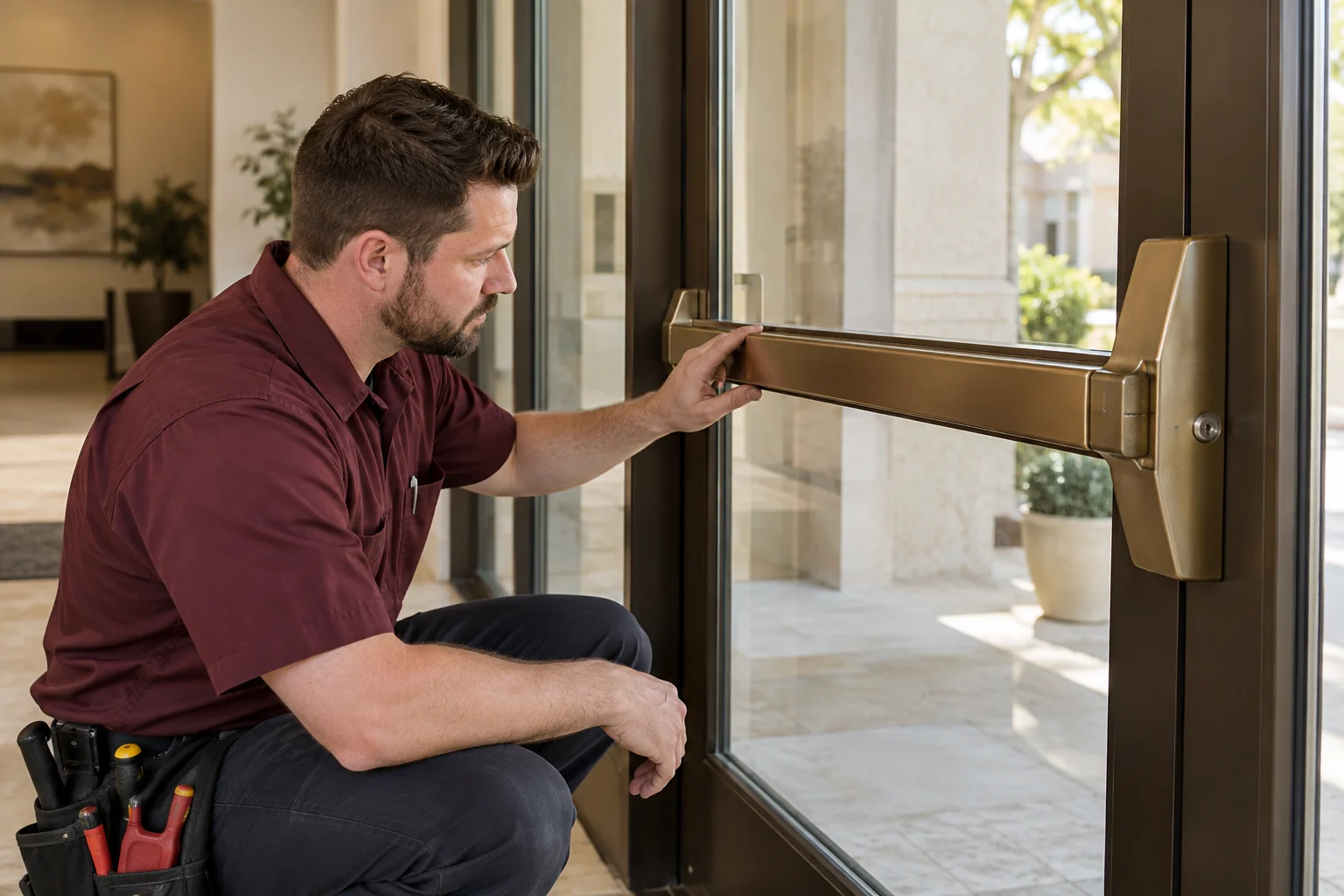
Any door that people use to leave a business must let them out easily, even in an emergency. That is the purpose of panic bars and other exit devices: a person pushes the bar and the door opens, with no key and no special knowledge. Locking such a door in a way that traps people inside is dangerous, and any change to this hardware deserves care and the right professional input.
Exit device requirements depend on the building, its use and its occupancy. They are set by codes and by the local authority, and they differ from place to place. Do not assume that what works in one building applies in another. Ask the fire marshal, the building department or your landlord what applies, and make sure any work respects those requirements.
The article on panic bars and exit devices gives an overview in plain language. If you are unsure whether your current setup is right, raise that question when you call, and ask for guidance on what to confirm with the authorities.
Never chain, bar or block an exit door to save effort during off hours. It may seem harmless when the shop is empty, but a forgotten chain on a busy day can have serious consequences. If you need more security on a door at night, ask for a solution that releases from the inside whenever someone pushes the bar, and that is clearly allowed for your type of building. Safe exits and a secure building are goals that can both be met.
Key control when staff changes
Employees come and go, and every departure leaves a question about keys. Did the person return all of them? Did they make copies? Did they share a code or a key with someone else? You rarely know for sure, and the cost of finding out the hard way can be large. Many owners decide to rekey the affected locks whenever someone with broad access leaves.
Rekeying is usually simpler than replacing a lock, because the hardware stays and only the internal pins change. For an office with several doors, it can be done on all of them at once, with a fresh set of keys issued only to those who need them. Keep a simple log of who holds which key so the next change is easier to manage.
The article on rekeying an office after an employee leaves goes through the steps. For the basics of how the process works on a single door, the page on rekey service in Deerfield Beach gives general guidance.
Master key systems and levels of access
When a business has many doors and many people, a single key for everything is rarely wise, but a ring of twenty keys is no better. A master key system solves this by letting each door have its own key while a master key opens a group of doors. A manager might hold a master for a floor, while staff hold keys only for the rooms they use.
Setting up such a system requires planning. The tradesperson needs to know which doors belong in which group and who should have what level of access. Once the system is built, adding doors or changing keys follows the same plan, which is why it is worth thinking carefully at the start. A badly planned system can be hard to extend.
The article on master key systems for business explains the concept and the trade offs. Bring a rough sketch of your layout, a list of who needs access to what, and a sense of how likely it is to grow.
Keys or electronic access
Some businesses outgrow keys altogether. Keypads, card readers and app based systems let you grant and remove access without chasing down physical keys. When someone leaves, you disable their credential instead of rekeying a door. For a business with high turnover, that can be a real convenience.
Electronic access has its own concerns. It depends on power, software and sometimes a network connection, and it needs a plan for outages. In a hurricane prone region, think about what happens when the power goes out or when equipment gets wet. A door that cannot open during an outage is a serious problem, so ask how the system behaves if power fails.
The article on access control versus keys for a small business compares the two approaches. Many businesses end up using a mix, with electronic control on the main entrance and mechanical keys on interior or backup doors.
Hurricane season adds a practical angle for any business near the coast. Before a storm, think about whether the building will be closed, who will return afterward, and how they will get in if the power is out. A mechanical backup, such as a keyed cylinder on the main door, can be a sensible fallback. Moisture after a storm can also affect electronics, so inspect keypads and readers once the weather clears.
Accessibility and the details people forget
Doors must work for everyone who uses them, including people with limited strength or mobility. Handle shapes, opening force, thresholds and the height of controls all matter. Rules about accessibility exist, and they vary by building and use, so do not assume you know the answer from general reading. Ask the building department, your landlord or a qualified professional what applies to your property.
Small details can cause problems. A closer that is too strong makes a door hard to open. A lever set at the wrong height frustrates customers. A threshold that has lifted can trip someone. These issues are often easy to correct once they are noticed, and fixing them reduces risk for both customers and owners.
The article on door accessibility checks for commercial properties explains the kinds of things to look at. It is general information, not a legal opinion, so confirm specifics with the right authority.
Interior locks, files and cash
A business has valuable items beyond the front door. Files, desks, cabinets, cash drawers, storage rooms and server closets may all deserve a lock. These interior locks are usually lighter than door locks, and they exist to keep honest people honest and to slow down casual access. Match the level of protection to what is being protected, and avoid putting expensive hardware on a closet that holds nothing of value while leaving the cash room with a flimsy latch.
Cabinet and desk locks are often forgotten until a key is lost. Many use small cylinders that can be replaced or rekeyed without much trouble. If you find that keys for these locks are scattered or missing, it may be time to pull them together into a system and decide who needs access to what.
The article on file cabinet and desk locks explains options for these smaller items. For anything holding money or sensitive records, think also about a safe, which is a topic of its own.
Getting ready to call about a business job
A little preparation turns a vague call into a useful one. Know the address type, the number of doors involved, the kind of door each is, and what problem you are trying to solve. Say whether you own the building or lease it, since a tenant may need the landlord's consent for changes to exterior doors or locks.
Think about timing and disruption, because a shop that cannot lock up at night or cannot open in the morning loses far more than the cost of the hardware. A busy shop cannot always close, so say what hours the doors must remain usable. Mention whether any door is part of an exit route. If hardware is shared with a neighbor or managed by the property owner, mention that as well so the work can be planned properly.
When you call, describe the situation and the place, and ask that the work and the price be explained before it begins. When the work is done, expect it to be tested with you present: every key, every door and every closer. For a neighboring area, the same general guidance appears on the commercial locksmith page for Pompano Beach.
Finally, plan for the long term. Doors, closers and locks wear, and a short walk through the building every few months, with a note of anything that sticks, rubs or feels loose, catches problems early. Staff are often the first to notice a door that behaves oddly, so invite them to tell you. A small repair made early is usually simpler than an emergency made later.
Common questions
How often should a business change its locks?
There is no fixed schedule. Change or rekey locks when keys go missing, when someone with broad access leaves, when a tenant moves in, or when keys have spread further than you can track. Regular checks of who holds keys help you decide when a change is needed. A short written list, updated whenever someone joins or leaves, makes that decision much easier and keeps the answer from living only in one person's memory.
Can a locksmith work on a glass storefront door?
Yes, though these doors use specialized hardware and narrow frames, so the exact lock and parts matter. Describe the door, its frame and any problems such as dragging or poor latching. The work and the price should be explained before it begins, with the finished door tested with you. Mention the door type, whether it swings in or out, and whether it has a closer, since each detail affects what hardware will fit.
What is a master key system?
It is a setup where each door has its own key, while a master key opens a chosen group of doors. A manager might carry a master, and staff carry only the keys they need. It needs careful planning at the start, because extending it later follows the same plan. Ask how new keys will be made, who will hold the records, and how a lost master key would be handled, since that is the question owners worry about most.
Are panic bars required on my business doors?
Requirements depend on the building, its use and the local authority, and they differ from place to place. Do not guess. Ask the building department, the fire marshal or your landlord what applies, and make sure any work on exit hardware follows what they say.
Should I use keypads or card readers instead of keys?
It depends on your business. Electronic access makes it easy to add and remove people without rekeying, but it needs power, software and a plan for outages. Many businesses mix both, using electronic control on a main entrance and mechanical keys elsewhere. Whichever way you lean, ask what happens during a power cut and how a user would be locked out or let in.
Do I need my landlord's permission to change business locks?
Often yes, especially for exterior doors or shared areas. Leases vary, and some require the landlord to hold a key or approve hardware. Check your lease and ask the property manager before work is scheduled, so you do not have to undo anything later. A written note of approval from the landlord is a simple way to protect everyone involved.
Talk through the job before work begins
Tell us what happened, which doors or keys are involved and who needs to get in. The price and the plan are agreed with you before any work starts.
Call (954) 888-8804