Commercial Locksmith in Hollywood
Business doors work harder than home doors and carry more responsibility. This general guide for Hollywood owners and managers covers storefronts, offices, key control, exit hardware and what to do when staff or tenants change.
Call (954) 888-8804How business locks differ from home locks
A front door at home opens a few times a day. A storefront door can open hundreds of times, often with tired hands, heavy deliveries and a line of customers behind. That constant cycling wears hinges, latches and cylinders in ways a residential lock was never meant to handle. Hardware for business use is built heavier for exactly this reason.
Business doors also carry obligations that houses do not. People must be able to get out without delay in an emergency, which affects the kind of hardware allowed on certain doors, and the relevant requirements are set by authorities who differ from place to place. Customers, staff, vendors and cleaners may all need different levels of access. And the contents of the building, from stock to records to cash, make the stakes higher if something fails.
None of this means business owners must become experts. It means they should ask better questions of whoever services their doors. Our explanation of commercial lock grades shows how to read the labels on hardware, and the page on commercial locksmith services describes the kinds of work available.
Storefront doors and the problems they develop
Glass storefront doors usually have narrow aluminum frames, and the lock sits in a thin stile with little room to spare. Over time the door can sag, the latch stops lining up with the strike, and the key starts to need a push or a lift to turn. These are the early signs of wear, and they are worth fixing before the door refuses to lock at closing time.
Weather plays a part too. Humidity and salt air corrode hardware, and an entrance exposed to rain and sun ages sooner than an interior door. A door that is slightly out of alignment in the morning may be impossible to lock by evening, after a day of heat has moved the frame.
Our article on storefront door lock repair covers the common faults. Do not try to adjust closers or heavy hardware yourself if you are unsure, since these parts are under tension and can injure you or damage the door. Describe the symptoms and let a locksmith inspect the door.
Keep a simple note of when the problem seems to happen. If the door sticks only in the afternoon, heat is probably moving the frame. If it fails after rain, moisture is a likely cause. If the key turns hard only at closing time, the cylinder may be dirty from a day of use. These patterns give the locksmith clues, and they often shorten the diagnosis considerably.
Offices, suites and shared buildings
Office doors face a different problem: many people, few visitors, and keys that wander. Staff come and go, contractors borrow keys, and the same key may be used for years without anyone noticing that copies have multiplied. A casual lending habit, where a friendly colleague hands a key to a visitor for a few minutes, can create copies nobody records. A modest office can end up with far more working keys than its manager realizes.
In multi tenant buildings, the question of who controls the lock is important. The landlord or property manager may hold a master key, and tenants may need approval before changing a cylinder. Requirements vary from building to building, so ask your lease, your manager or the building office before you modify any lock.
A clear plan makes a big difference. Decide who needs access to what, record who holds which key, and agree on what happens when someone leaves. Our guide to rekeying an office after an employee leaves follows that logic, and the same thinking applies to the smaller locks inside the office, such as file cabinets and desks.
Think about the contents as well as the doors. Payroll records, client files, keys to company vehicles and petty cash all deserve their own protection, often inside a locked drawer or a small safe that only one or two people can open. A well locked front door does little for you if the most sensitive papers sit on an open desk. Layering protection, from the outer door to the inner cabinet, is more sensible than relying on any single lock.
Master key systems explained simply
A master key system lets different keys open different doors in a defined pattern. An individual employee's key opens their own office, a department key opens a group of rooms, and a master key opens everything. The structure is built into the cylinders, so it has to be designed carefully before the locks are set.
The benefits are clear: fewer keys to carry, easy control over who can go where, and a way for managers to reach any space when needed. The risks are also real. Because a master key opens many doors, losing one has bigger consequences, and a poorly planned system can create unexpected overlaps in access.
If you are considering a system, think about future growth. Adding rooms or departments later is much simpler if the original plan left room for them. We explain the structure in master key systems for business.
A short worked example helps. Imagine a small medical office with a waiting room, four treatment rooms, a records room and a supply closet. Each clinician might hold a key to their own room, a front desk employee might hold keys to the waiting room and supply closet, and the manager holds a master. The records room might sit outside the master pattern altogether, with its own restricted key. Sketching a table like this before ordering cylinders makes the plan clear.
Exit devices, panic bars and doors that must open from inside
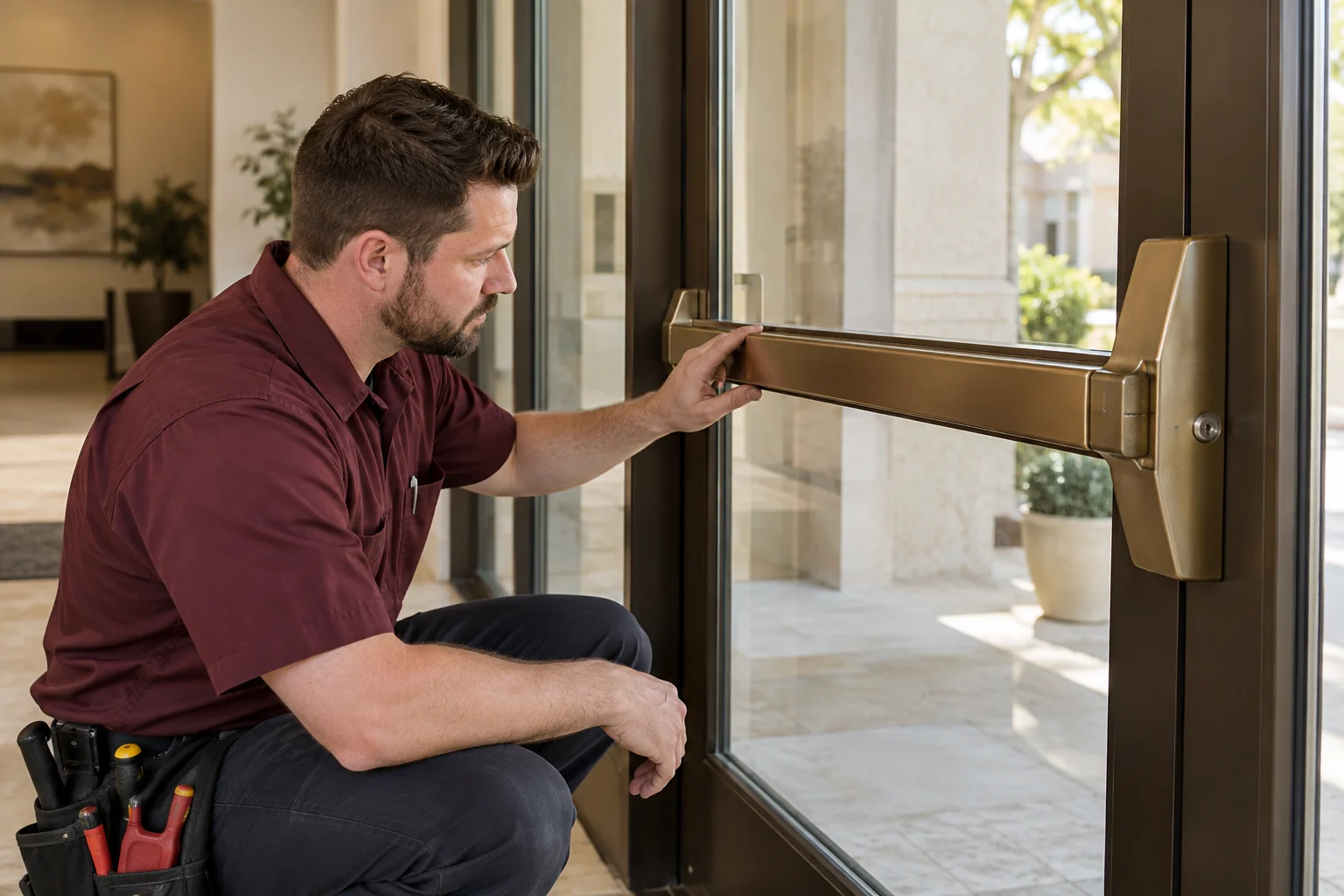
Many commercial doors have hardware that lets anyone push out without a key, even when the door is locked from outside. These exit devices, often called panic bars, exist so people can get out in an emergency without searching for a key. They are a safety feature, and any change to them should be handled with care.
Requirements for exit hardware, fire doors and accessible entrances are set by local authorities and building codes, and they vary. We do not state rules here. If you are unsure whether your doors comply, ask your building department, your fire marshal's office or your landlord, and bring in a qualified professional.
Our guide to panic bars and exit devices describes how they work in plain terms, and accessibility checks for commercial doors explains why door hardware and clearances matter. Never disable or block an exit device to save inconvenience.
Pay attention to how doors behave day to day. A device that sticks, a bar that does not return, or a door that no longer closes fully behind a person can all affect safety and security together. If a door cannot latch, it cannot protect the building at night, and if it cannot open easily from inside, it cannot protect people during an emergency. Report such faults promptly and avoid temporary fixes with wedges or tape.
When an employee, tenant or partner leaves
A departure is the most common reason a business rethinks its keys. Even if everyone parted on good terms, you cannot know how many copies of their key exist. The simplest, cleanest response is to rekey the affected locks so old keys stop working.
Acting promptly matters, but so does acting proportionately. Rekeying a single office door is a small task. Rekeying an entire building may be a bigger one, and a master key system can make it easier or harder depending on how it was built. Think about which doors the departing person could actually open.
A business that rents out space has a version of the same issue at each lease change. When a tenant moves out, the outgoing keys should be accounted for, and the cylinders on that unit are often rekeyed before the next tenant arrives. The incoming tenant then starts with the confidence that nobody from the previous occupancy can walk in, which is a reasonable expectation to set at the start of a lease.
Also consider electronic access. If your business uses cards or codes, remove the person's access at the same time. Our comparison of access control and keys for a small business explains how each approach handles departures, and why some businesses choose a mix.
Do not forget the people who are not on the payroll. Cleaners, maintenance workers, landscapers and delivery contractors often hold keys or codes, and they may change as vendors change. Add them to your key log. When a vendor relationship ends, treat it with the same care as an employee departure. Honest, friendly vendors will understand, and the habit protects everyone.
Keeping track of keys
A key log is a modest tool with a large payoff. A simple list noting who received which key, on what date, and when it was returned makes security decisions factual. Without it, managers are left guessing.
Store spare and unissued keys in a locked cabinet, not in an unlocked drawer, and limit who may open it. Keys that cannot be copied casually help too. Restricted key systems limit duplication to authorized sources, so a staff member cannot walk into a store and make a copy. They cost more to set up, but they give a business real control. See restricted and high security keys for the idea.
Whatever system you use, make sure keys are never marked with the business name and address. A lost key labeled with its location is an open invitation. Use a code or a number instead, and keep the translation in a safe place.
Finally, think about what happens if you are unavailable. Does someone else know where the spare keys live, who to call about a door and how to reach the property manager? A business that depends on one person's memory is fragile. A one page sheet describing the doors, the keys and the contacts, stored where a second trusted person can find it, makes the whole operation sturdier.
Weather, humidity and the life of business hardware
South Florida is hard on commercial hardware. Doors that face the sun expand, doors that face rain swell, and salt in the air attacks metal. Rear service doors, which often get less attention, can be the first to fail.
Regular attention prevents emergencies. Open and close each door and listen. Watch for rubbing, grinding or sticking. Note any door that needs a shove to latch. These small observations, passed to a locksmith before something breaks, turn a surprise failure into a planned repair.
Keep an eye on the less obvious doors: the back entrance by the dumpsters, the side door used by staff on breaks, the roll up door in a warehouse bay. They collect dirt and moisture, and they are used by people in a hurry. A little attention to how smoothly they latch and how securely they lock repays itself, because intruders and weather both test the weakest door first.
During hurricane season, secure doors matter more than usual. Before a storm, check that locks work smoothly, that spare keys are in a known place, and that someone besides you can open the building if needed. After a storm, inspect doors for warping and corrosion before you assume everything is fine.
What to tell a locksmith when you call about a business
Start with the building and what you have: a glass storefront, a metal back door, a wooden office door, a roll up gate. Say what is wrong or what you want to change. Mention the number of doors involved, and whether the building is leased, since the landlord may need to be informed.
Explain the access you need. Who should be able to open which doors? Does anyone need after hours access? Is there an alarm system or camera that interacts with the door? These details shape the recommendation, and they help the work and the price be explained clearly before it begins.
After the work, the hardware is tested with you, including every key and every door involved. Keep a record of what was done. For more on phone conversations, see what to ask a locksmith on the phone.
Related pages and general notes
Business owners often have personal lock needs too, and the overview of locksmith services in Hollywood ties everything together. For door hardware on the home side, see lock installation in Hollywood. Neighboring communities follow similar patterns, including commercial help in Hallandale Beach.
This page is general guidance and does not describe any particular building, street or local regulation. Fire, accessibility and building requirements vary, so ask the appropriate authority when you are unsure.
The process is straightforward: call, describe the situation and the place, hear the work and the price explained before it begins, and test the finished work together. Take your time over the first call, because a clear description saves effort for everyone.
If you manage several locations, apply the same approach to each, but do not assume that they share the same needs. A quiet back office and a busy front counter ask different things of their doors. Treat each entrance as its own question, write down what you learn, and revisit the plan whenever staff, tenants or the way you use the space changes. A good key plan is a living document rather than a one time purchase.
Common questions
What is the difference between a commercial and residential lock?
Commercial hardware is built for heavier use, with stronger parts and higher grades. It is made to survive constant cycling and rougher treatment. Residential locks can fail early when used on a busy business door, so match the hardware to how the door is actually used.
Should I rekey when an employee leaves?
Often yes, especially if the person had keys to sensitive areas and you cannot be certain all copies were returned. Rekeying makes old keys useless. Decide which doors that person could open, and rekey those, along with removing any electronic access.
What is a master key system?
It is an arrangement where individual keys open specific doors while a higher key opens many. It reduces the number of keys people carry and gives managers control. It needs careful planning before installation, because changing the structure later is a bigger job.
Can I change the lock on a leased space?
Check your lease and talk to the landlord or property manager first. Many leases require approval or require that a key be held by the building. Requirements vary, so confirm before making changes.
Why does my storefront door keep sticking?
Common causes include sagging, misalignment between latch and strike, worn hardware and weather. Do not adjust heavy closers or exit hardware yourself. Describe the symptoms to a locksmith, who can inspect the door and explain what needs attention.
How do I keep track of business keys?
Keep a written log of who holds which key and when it was issued or returned. Avoid labeling keys with the business address. Consider restricted keys if you need to control copying. Go over the log whenever staff or tenants change.
Talk through the job before work begins
Explain the problem, what has to work again and who needs access afterward. We talk through the scope and the price first, and work begins after you agree.
Call (954) 888-8804