Commercial Locksmith in Plantation
A business door is used far more than a house door, and it has more people depending on it. This page is general guidance for Plantation owners and managers who need to understand commercial lock work before they call.
Call (954) 888-8804Why a shop door is not a house door
Walk up to a house and you find a handful of people who use the front door a few times a day. Walk up to an office suite, a salon or a small warehouse and the same door may open hundreds of times, be pushed by strangers, and be held with a hip or a delivery cart. Hardware that is perfectly fine on a house wears out in a hurry under that kind of use, and the failures tend to show up at the worst moment, such as the morning a stuck latch keeps a full staff standing on the sidewalk.
For that reason, commercial locksmith work leans on sturdier parts: heavier cylinders, stronger strike plates, closers that are matched to the door, and exit devices on doors that serve the public. The price and the effort go up, but so does the length of time the hardware can be trusted.
This page is general guidance for people running businesses in Plantation. It does not describe local rules, and it does not claim any history with a particular building. Think of it as a plain explanation of the choices you will face, so that the conversation with a locksmith is easier.
Start by walking your own doors
Before calling anyone, spend ten minutes walking the property the way a stranger would. Try every exterior door, the back door that staff use for smoke breaks, the loading entrance, and any door to a storage room or electrical closet. Note which ones latch on their own, which ones need a shoulder push, and which ones are left propped open during business hours.
Then write down what you see. A short list such as which lock brand is on each door, whether the keyholes look worn or shiny, and which doors have been repaired before gives a locksmith real information. It also helps you notice a pattern, for example one door that fails every rainy season because the frame has swollen.
Bring the list into the phone call. A technician who knows there are five doors, two of them glass and one a metal back door, can describe the likely work and explain the price before anything is touched.
If you manage more than one location, do the same walk at each and keep the notes together. Patterns jump out when you can compare them. Maybe every door with the same brand of closer leaks oil, or every back door has the same loose strike. Fixing a pattern once is smarter than fixing the same fault one door at a time over several months.
- Check that each door closes and latches by itself without being pulled.
- Look for gaps between the door and the frame that let light through.
- Note any key that has to be wiggled or lifted to turn.
- Count how many people hold a key to each door and write the number down.
- Photograph any hardware you cannot identify so it can be described by phone.
Keys, cylinders and who holds what
Most small businesses start with a few identical keys and slowly lose track of them. A former bookkeeper, a cleaning crew from two vendors ago, a landlord's contractor: any of them might still hold a working copy. The cure is not suspicion, it is a clean reset. Changing the cylinder, or rekeying it so old keys no longer fit, gives you a known starting point.
A better long term answer is a keying plan. Instead of one key that opens everything, a plan can give each person only the doors they need, with a smaller number of keys that open more than one. The ideas behind this are covered in our guide to master key systems for a business, and the idea of restricted blanks is explained in the article on restricted and high security keys.
Whatever you choose, keep a written key log with a name beside every key. It sounds old fashioned, but when someone leaves, it turns a vague worry into a short list of cylinders to deal with.
When a key is lost, treat it seriously but calmly. Ask when and where it was last seen, which doors it opened, and whether anything marks the key as belonging to your building. If there is doubt, rekeying the affected cylinders is usually a smaller job than people expect and is often more sensible than hoping the key stays lost.
Grades of hardware and what they mean
Lock hardware for buildings is commonly sorted into grades, and a higher grade generally means the parts are built to survive more cycles and more abuse. A lightweight residential style lockset on a busy office door may feel fine for a few months and then start to sag. A heavier commercial grade lockset costs more at the start, yet it tends to hold its alignment for much longer.
If you want to understand the labels before talking to anyone, the explainer on commercial lock grades walks through what the categories are meant to say and what they do not say. Grade is only one piece of the picture. A strong lock in a weak frame, or on a door that is not hung well, still fails.
Ask the technician to look at the whole assembly: the door, the frame, the hinges, the strike and the closer. A good recommendation addresses the weakest part, not just the one you pointed at.
Think too about what happens on the day a part fails. A door with a common, well supported lockset can usually be repaired with parts that are easy to identify. A door with an unusual or discontinued model may need a replacement of the whole assembly. Asking about this before you buy saves frustration later, and it is a fair question for any technician.
Exit devices and doors the public uses
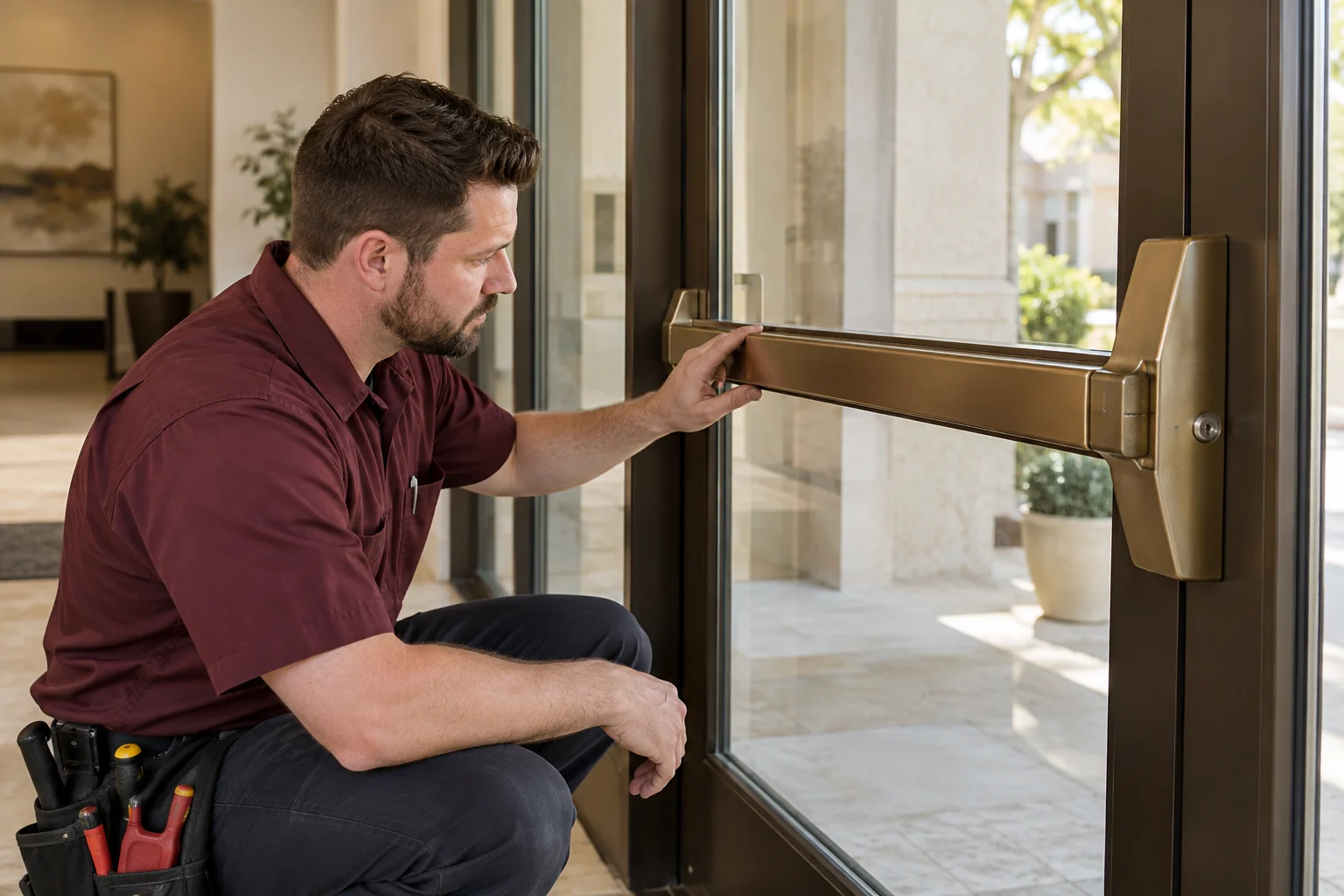
Doors that people use to leave a room full of customers are a different matter. An exit device, often called a panic bar, lets a person push a bar across the door and leave without any knowledge of how a lock works. These devices exist because people must be able to leave calmly and safely, and they should never be defeated with chains or extra latches.
If your doors have exit hardware, it needs regular attention: the bar should move freely, the latch should retract fully, and the door should not be held shut by anything else. The article on panic bars and exit devices explains how these work and what a repair visit usually looks at.
Rules about exits, egress and fire safety vary by building and by use. Requirements vary, so ask your property manager, your landlord or the authority that oversees your building before you change anything on an exit door.
Ease of use matters as much as strength. A door that is hard to pull open, or that has a closer set so firmly that a customer struggles, creates its own problems. Our piece on door compliance walkthroughs for commercial properties explains what such a look at your entrances usually covers, and again, which standards apply to your building is a question for the people who oversee it.
Glass storefronts and aluminum frames
Plantation has plenty of shopping plazas and office parks with glass doors in narrow aluminum frames. These doors use a special kind of lock that mounts into a thin stile, and they behave differently from a wooden or steel door. A bottom pivot that is worn, a top pivot that has drifted, or a latch that no longer lines up can all make the door hard to lock even though the lock itself is fine.
Salt air, humidity and daily cleaning products take a toll on the metal. Corrosion shows as white powder or a rough feel on the moving parts, and it is a sign to get the door looked at before it seizes. Our article on storefront door lock repair describes the symptoms that point to alignment rather than to a bad lock.
If a glass door will not lock, do not tie it shut with a chain or wire and leave. Tell your locksmith exactly what the door does so the right parts can be brought.
Keys versus electronic access
Many owners ask whether they should move from keys to card readers, fobs or keypad codes. The honest answer is that it depends on how many people come and go, how often staff change, and how much you value an audit trail. A keypad on a back office door can make sense when the same six people use it every day. A card system can make sense when you have many doors and a lot of turnover.
Electronic systems bring their own homework: power, batteries, backup entry, software settings and someone responsible for removing users. A long comparison is in our piece on access control versus keys for a small business.
Many companies mix the two, using electronics for the main entrance and traditional keys for storerooms. Your locksmith can talk through which doors benefit and which do not, and the work and the price are explained before it begins.
When someone leaves the company
Staff changes are the most common reason a business calls for lock work. An employee who held a key or knew a code leaves, and the owner wonders whether the door is still secure. In most cases a change of the lock or a code reset is a small, calm step that removes the doubt.
Do it on a schedule rather than only after a bad parting. Many owners keep a simple rule that anyone with a key who leaves triggers a look at which doors that key opened. Our guide on rekeying an office after an employee leaves lays out the steps in order.
If the person was on bad terms, or if anything seems to have been taken, treat it as more than a lock problem and talk to the people who handle your insurance and your records. The locksmith can secure the doors, but the larger decisions belong to you.
One more habit helps. When you hand out a key, say plainly that it must not be copied. Many keys are stamped with a note to that effect, but a stamp is only a request, and a copy machine at a hardware store does not read it. Restricted key systems exist for exactly this concern, and they are worth discussing if staff turnover is high.
Planning around storms and a humid climate
South Florida buildings face wet and salty air for much of the year, and a hurricane watch can put a whole street's worth of business owners on the phone at once. Doors swell, strikes rust, and closers leak oil. If you know a storm is coming, the most useful prep is to make sure every door latches properly, because a door that only half latches is the one that blows open.
After a storm, check each door again before you reopen. Look for frames pushed out of square, glass that has shifted, and bolts that no longer slide cleanly. Anything that now sticks is a sign of movement.
It is also worth keeping a record of your doors in photographs, taken in normal weather. If you ever need to describe damage for an insurer, or for a locksmith on the phone, those pictures save a lot of back and forth.
Hurricane season is also a reminder to think about where the keys are. If you evacuate, someone you trust should know where a spare is kept, and the key log should be somewhere that does not depend on the building being open. Planning that in calm weather is a lot easier than improvising during a watch.
Rental suites, landlords and shared walls
Many Plantation businesses lease their space, and that adds a layer of questions about who owns the lock. In some leases the tenant controls the suite door and the landlord controls the building entrance. In others the landlord keeps a master key or requires that any change be approved first. Read your lease or ask your property manager before any cylinder is swapped, because changing a lock without telling the right person can create a dispute that has nothing to do with security.
When a tenant moves out, the same logic applies in reverse. The next occupant should not have to wonder who still holds a key to the suite. Landlords and property managers often rekey between tenants as a routine step, and the logic is similar to residential turnover, which you can read about in the guide to tenant turnover rekeying for property managers.
Shared walls matter too. A door between two suites, or from a suite into a common hallway, may be used by people who do not work for you. Keep such doors on your own key plan, and make sure everyone knows which key opens which door, so nobody is forced to guess when something goes wrong.
Finally, keep a short note of who gave permission for each change and when. If the landlord or a neighboring tenant ever asks what was done to a door, a simple record answers the question in a minute.
How to get a clear answer when you call
Call and describe the situation and the place: what kind of business it is, how many doors are involved, what the doors do, and whether anyone is locked out or the building is exposed right now. The work and the price are explained before it begins, and you should expect to be told what will be done and why.
When the work is finished, the doors are tested with you. Open and close each one, turn each key, and try the exit hardware from the inside. If something feels off, say so then. It is far easier to adjust a latch while the technician is standing there.
If you want to compare how other nearby areas are handled, see the pages for Plantation locksmith services, commercial locksmith help in Sunrise and commercial locksmith help in Davie. For the full range of business work, see the main commercial locksmith page.
Common questions
Do I need commercial grade hardware on a small office door?
Not always, but doors that see steady traffic, face a public walkway or serve a rental space usually benefit from sturdier parts. The right choice depends on how the door is used and what the frame can support. A technician can look at the door and explain the difference before you commit to anything.
Can a locksmith rekey several doors so one key works on all of them?
Yes, in many cases the cylinders can be keyed alike so one key opens several doors. Whether that is a good idea depends on who needs access to what. Some owners prefer a plan where each person holds only the keys they need. Describe your doors and staff when you call.
What should I do if a glass door will not lock at closing time?
Do not force it or tie it with a chain. Note what the door does, such as dragging on the floor, missing the latch or spinning the key without engaging. Then call and describe it. Alignment and worn pivots are common causes, and they are usually repaired rather than replaced.
How do I know when to change locks after an employee leaves?
Go through which doors the person's key opened and whether they knew any codes. If any of them might still have access, changing or rekeying those cylinders and resetting codes removes the question. Many owners do this routinely so it never feels personal.
Are exit devices something I can adjust myself?
Leave them to a trained technician. They carry safety importance, and a wrong adjustment can stop the door from opening when someone needs to leave. You can safely check that the bar moves freely and the door closes, then report what you notice and ask who handles repairs in your building.
Does this page mean the company has worked on specific Plantation properties?
No. This page is general guidance for business owners in Plantation and does not describe any particular building, street or past job. Requirements for businesses vary by building, landlord and use, so ask your property manager or the relevant authority about any rules that apply to your doors.
Talk through the job before work begins
Say what went wrong and what you need to work when we leave. Scope and price are settled with you ahead of the work.
Call (954) 888-8804