Commercial Locksmith in Sunrise
Owners and managers in Sunrise can use this general guide to think through business locks: who holds keys, which hardware suits which door, how exits stay safe, and what to settle before any technician starts work.
Call (954) 888-8804How business locks differ from household locks
A front door at home opens a few times a day. A shop door, a clinic entrance or an office suite door may open hundreds of times, and it opens for people who do not own the building. That difference changes everything about the hardware. Commercial locks are built with heavier internal parts, stronger fixing points and finishes that tolerate constant handling, and they are usually graded to describe how much abuse they can take.
The second difference is the number of people involved. A household has a handful of key holders. A business may have owners, managers, staff, cleaners, delivery partners and a landlord, each with different reasons to come and go. The question is no longer only whether a lock works but who is allowed to use it and when.
This page is general guidance for people in Sunrise. It does not describe any particular building, and it makes no claims about local rules, which differ between properties and can be changed by landlords, associations or authorities. Use it as a checklist of questions, then confirm the details with whoever controls your space.
It also helps to separate two kinds of problems. Some are emergencies, like a door that will not lock at closing time, a key snapped inside a cylinder, or a break in that leaves a frame damaged. Others are projects, like redesigning keys after growth or replacing worn hardware across a building. Emergencies call for a simple, sturdy fix first. Projects deserve patience, a survey of every door and a written plan that you can follow without pressure.
Mapping every door before you change a single lock
The most useful commercial lock project begins with a walk through the building and a notebook. List every door that matters: the main entrance, the back door, storage rooms, the manager's office, a server closet, a cash room, a loading door and any gates. Write down what lock is on each one, how many keys exist, and who currently carries them.
This exercise often reveals surprises. One storeroom lock may be keyed differently from everything else. A back door may have been fitted with a consumer grade deadbolt that is too light for its use. A forgotten gate might still open for a former employee. Seeing the whole picture on paper lets you decide where to spend effort rather than guessing.
Then assign each door a purpose. Is it public during business hours, staff only, management only, or sealed? Doors that are meant to stay open to the public need hardware that locks from inside at closing time without delay. Doors with sensitive contents need tighter control over who holds a key. Our overview of commercial locksmith services describes the kinds of work that follow from a survey like this.
Keep the finished map somewhere safe, and keep a second copy away from the building. A key chart that sits in an unlocked drawer next to the register is a security risk of its own. Update it whenever a key is issued, returned or replaced, and go over it with managers once in a while so nothing drifts. A map that is accurate on the day you make it and wrong a year later stops being useful.
Keying plans and master key systems
A keying plan decides how keys relate to locks. In a simple setup, each lock has its own key, and a manager carries a large ring. In a master key system, every door has a key of its own, and a higher level key can open a whole group of doors. A grand master can open everything. The structure is built into the lock cylinders, so it has to be designed before the locks are made.
The advantage is convenience and control. A cleaner might carry a key that opens only common areas. A department head might open all rooms in a department. The owner keeps the top key and the record of who has what. When someone leaves, the business can retrieve or replace specific keys rather than rekeying a whole building.
The trade off is that a master system introduces more complexity and needs disciplined records. If the plan is sloppy, it becomes easy to lose track of keys. If it is built carefully, it saves effort for years. For a clear introduction, read our article on master key systems for a business, and the related piece explaining keyed alike and master key setups helps you choose between them.
Hardware grades and what they mean
Commercial hardware is often described by grade, a ranking that reflects durability and strength. A lower grade may be fine for a private office that sees light use. A higher grade suits an entrance that opens constantly, or a door that faces a risk of forced entry. Matching the grade to the door avoids two common mistakes: spending on strength you do not need, and installing a light lock where a heavy one is called for.
Grade is not the whole story. A strong lock on a weak door or frame is only as good as the weakest part. Look at the door material, the hinges, the frame, the strike plate and the screws that hold everything. A reinforced strike plate with long screws that reach the framing makes a large difference, and so does a frame that has not been bent or rotted by moisture.
Humidity matters in South Florida. Exterior steel doors can rust at the bottom edge and around hardware, and wooden frames can swell and shrink with the seasons. Hardware that sticks or no longer lines up is a sign that the door may need attention before the lock can do its job. For a deeper look at the rankings, see the guide to commercial lock grades.
A practical way to choose is to ask three questions about each door. How often does it open in a normal day? What would a person gain by forcing it? What would it cost the business if it failed? A busy front entrance with low risk needs durability above all. A quiet storeroom holding expensive stock needs resistance to forced entry. Writing short answers beside each door keeps the decision grounded and makes it easy to explain your choices to a partner, landlord or technician.
Exit devices and keeping people safe
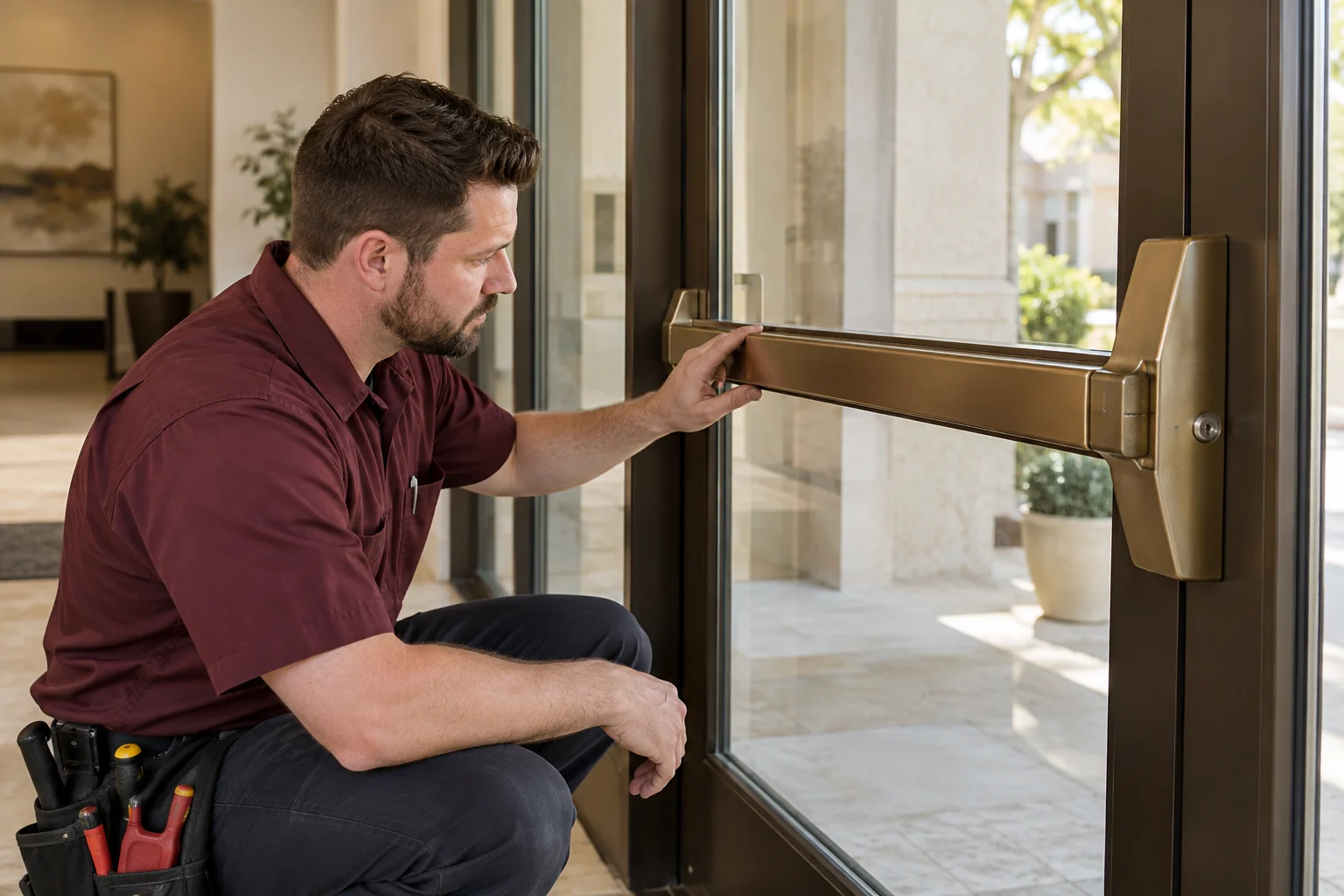
A business door must protect the property without trapping the people inside. Panic bars and other exit devices exist for this reason: a person pushes the bar and the door opens, even in a crowded or stressful situation. These devices are common on back exits, stairwells and doors in places where groups of people gather.
Locks and exit hardware have to work together. Adding a keyed deadbolt to a door that is meant to be an emergency exit can create a serious hazard. Rules for exits vary by building type, use and occupancy, so the safe approach is to ask the building owner, your insurer or the local authority that handles building safety before changing anything on an exit route.
Maintenance matters as well. An exit bar that sticks, a closer that slams or a latch that no longer retracts fully can trap someone at the worst time. Test exit devices regularly by pushing them with the lights on and no pressure. If something feels rough, have it looked at rather than waiting. Our guide to panic bars and exit devices explains the main types and how they should behave.
Hurricane season adds a further consideration for exits. Doors that swell, warp or scrape in damp weather may stop closing fully, and a door that no longer latches is a security gap even if the lock itself is sound. After heavy weather, walk your building and test every exit, every closer and every latch. Catching a sticking door early is far easier than discovering it when you need to leave or lock up.
Storefronts, glass doors and shared entrances
Storefront doors have special demands. Many are made of aluminum framing with glass panels, and the lock sits in a narrow stile with little room for hardware. A lock for this kind of door has to be built for its slim shape, and the latch must catch properly even when the door flexes slightly with temperature or wind.
Wear shows up in typical ways. A cylinder that turns stiffly, a latch that no longer extends fully, a door that has to be pulled to lock, or a closer that lets the door drift are all signs of trouble. Repairing them early prevents a lockup that leaves a business unable to close or open. Our article on storefront door lock repair describes these problems in more detail.
Shared entrances raise another point. If a door serves several tenants, decisions about hardware often belong to the property owner or manager, not to a single tenant. Check your lease, speak with whoever manages the building, and agree on who may change locks and who must receive copies of new keys before any work starts.
When an employee leaves or a tenant changes
People come and go, and keys can follow them out the door. A sensible business has a routine for this moment. Collect keys, cards and codes when someone leaves, and write down what was returned. If there is any doubt that everything came back, change the lock or the key rather than relying on trust.
Rekeying is usually the practical response. Instead of replacing hardware, the cylinders are changed internally so the old keys stop working, and new keys are issued to the people who should have them. It is cleaner than hoping nobody kept a copy, and it gives you a fresh record. Our article on rekeying an office after an employee leaves covers the steps in plain language.
The same thinking applies when a commercial space changes hands. A new tenant should assume that previous tenants, brokers, contractors and cleaners may have held keys. Resetting the locks on day one establishes a clean starting point and is one of the simplest ways to protect new stock, equipment and records.
Landlords and property managers face this at scale, with many spaces turning over in a year. A consistent routine saves them effort: reset on every turnover, record every key issued, and keep the paperwork where it can be found. Our guide for rekeying between tenants describes how managers organize that routine without turning it into a burden.
Access control and when keys are not enough
Some businesses outgrow traditional keys. When many people need entry at different times, a keypad, a card reader or a smartphone credential can be easier to manage. Access can be granted or removed without collecting a metal key, and some systems keep a record of who entered and when. That log can matter for accountability and for investigating a problem.
These systems are not magic. They rely on power, network connections, software settings and a plan for what happens during an outage. A good design includes a mechanical backup, so that a failed battery or a lost connection does not lock people out or leave a door unsecured. It also includes a clear process for adding and removing users.
Before deciding, compare costs and complexity honestly. Our article on access control versus keys for a small business discusses where each approach fits. Many Sunrise businesses end up with a mix: keys for some doors, electronic access for the main entrance, and a clear record of both.
Whatever you pick, plan for the quiet failures. Batteries run down, cards get lost, and codes are shared with people who should not have them. Decide who is responsible for checking batteries, who removes lost cards from the system, and how often codes are changed. A system that nobody maintains slowly turns into a false sense of security, which can be worse than a plain lock that everyone understands.
Preparing for a commercial locksmith visit
Commercial visits go more smoothly with preparation. Know which doors are involved, what type of lock is on each, and who has authority to approve changes. If you do not own the building, confirm with the owner or manager that you may alter the locks. A locksmith will normally want to know that the person requesting the work is entitled to do so.
Have your list of key holders ready, along with any existing keying chart or paperwork. If a previous locksmith left records, find them. Let the person on the phone know whether the work is urgent, such as a broken lock on a door that will not secure, or planned, such as a keying redesign for a growing company.
On the day, expect the work and its price to be explained before it begins, and expect the result to be tested with you present. Try every lock, check that doors close and latch on their own, and confirm you have the correct number of keys. For this area, see also the neighboring page on lock installation in Sunrise and our general Sunrise locksmith guide.
After a break in or attempted entry
If you arrive to find a door damaged or a lock tampered with, do not enter if you think someone could still be inside. Contact the authorities first and wait for them. Once the scene is safe and any report is made, you can focus on securing the building.
A forced door usually needs more than a new lock. The frame may be split, the strike plate pulled loose, and the door itself bent. A temporary repair can keep a business protected overnight, while a full repair can follow once the damage has been assessed. Take photographs for your records, and keep damaged parts if anyone asks to see them.
Then look at what the incident taught you. Was the door weak, was the lock light, or was a key missing? Our guide on recovering after a break in offers a practical checklist, and it is worth reading before you ever need it. A short plan written in calm conditions is far more useful than decisions made in a hurry.
Common questions
What is the difference between rekeying and replacing locks in a business?
Rekeying changes the internal pins of existing locks so old keys no longer work, while replacing swaps the entire hardware. Rekeying suits locks that are in good condition. Replacement is better when hardware is worn, damaged, too light for the door, or no longer matches your security needs.
Do I need a master key system?
A master key system helps when many doors and many people are involved, because different keys open different groups of doors. It adds complexity and needs careful records. Small businesses with a few doors may be well served by simple keying, and a locksmith can help you decide.
Who can approve lock changes in a leased space?
It depends on your lease and your building. Often the property owner or manager must approve changes, and some buildings keep a master key for emergencies. Check with whoever manages the property before work begins, and ask whether new keys must be shared with them.
Can I put a keyed lock on an emergency exit?
Do not add one without guidance. Exit routes are meant to open easily from the inside, and a keyed lock can create a danger. Requirements vary by building and use, so ask the building owner or the local authority that handles safety rules before changing exit hardware.
What happens to keys when an employee quits?
Collect keys, cards and codes, and record what comes back. If you cannot be sure every copy was returned, rekey the affected locks or change the codes. This prevents former staff from having access and gives you a clean record of who holds keys now.
How should I prepare for a commercial lock visit?
Know which doors are involved, what hardware they use, and who is authorized to approve work. Gather any key records you have. Explain whether the job is urgent or planned. Expect the work and price to be explained first, and the finished result to be tested with you.
Talk through the job before work begins
Start by describing the situation, the lock or key involved and who must have access. You hear the price and the plan before anything is done.
Call (954) 888-8804