Commercial Locksmith in Miramar
Shops, offices, clinics and rental units all depend on doors that work every single day. This guide helps Miramar business owners and managers think through key control, hardware grades and the calls that keep a property secure.
Call (954) 888-8804What makes a business lock different from a house lock
A residential lock might be used a handful of times a day. A storefront or office door can be operated hundreds of times, by people who are not careful and who never think about the hardware. That volume wears out springs, latches and cylinders at a rate a household set was never designed for, and it explains why commercial work uses sturdier parts.
The second difference is who holds the keys. At home you can count them on one hand. In a business, keys pass through owners, managers, cleaners, delivery contractors, seasonal staff and former employees. The real security question is rarely whether the lock is strong. It is whether you know who can open it.
This page is general guidance for businesses in and around Miramar, and it does not describe any particular building or district. Every property differs, and requirements for doors, exits and access vary, so use these notes to ask better questions rather than as a rulebook.
A good first exercise is to walk your property and list every lockable thing: the main entrance, the back door, the stockroom, the office, the cash drawer, the cabinets and the gate. Next to each, write what kind of lock it is and who holds a key. Most owners are surprised by how many items are on the list and by how many nobody remembers.
Hardware grades and why they matter
Locks are sorted into grades according to how much use and abuse they are built to survive. A light duty lock in a busy doorway will loosen, sag and eventually fail, often at the worst time. A heavier grade costs more up front but holds its alignment and keeps working, which usually saves money over the long run.
For a storefront, think about how the door is actually used. A back door that people lean on and slam shuts has different needs from a quiet interior office door. Latches, strike plates, hinges and the door closer all work as a system, so replacing only the lock when the door itself is sagging will not solve the problem.
Ask the locksmith to explain which grade they suggest for each door and why. The guide to commercial lock grades explains the vocabulary so the conversation is easier, and the commercial locksmith service page describes how business work is usually organized.
A practical test is to ask what happens when the door fails. If it fails open, what is exposed? If it fails closed, who is stuck outside, and for how long? Doors guarding cash, medication, records or expensive stock deserve a stronger build than a door leading to a janitor closet, and spending evenly across all doors usually means overspending on some and underspending on others.
Key control: the part that people skip
Most business break ins that use no force involve a key that was copied, lent or never returned. The simplest fix is also the most overlooked: keep a written record of who holds which key, and recover or rekey when anyone leaves. A tidy list takes an hour to write and saves a lot of worry.
Restricted key systems add another layer. With a restricted or high security keyway, blanks are not sold freely and copies require authorization from the owner. That makes it harder for a former employee to duplicate a key at a hardware counter, which is how many unauthorized copies appear in the first place.
For some businesses, a keyed system is not the right tool at all. If many people need access at different times, electronic credentials can be added and removed without chasing down metal keys. The article on access control versus keys for a small business compares both approaches in plain terms, and restricted high security keys explains how controlled keyways work.
Whichever path you choose, set a simple rule for lost keys. The person who loses one reports it right away, and the owner decides whether to rekey. A culture where nobody is embarrassed to say a key is missing is more protective than any piece of hardware, because the sooner a problem is known, the smaller it is. Go over your key list every few months so it never drifts out of date, and update it whenever staff, vendors or tenants change.
Master key systems for offices and multi unit properties
A master key system lets one key open many locks while each lock also has its own key that opens only that door. Owners get access everywhere, and staff or tenants get only what they need. It is a handy design for offices with several rooms, buildings with multiple suites, and property managers handling a group of units.
The trade off is that the system must be planned. Adding doors later is easier when the original layout left room for growth, and a poorly planned system can create unintended overlaps where a key opens a door it should not. A locksmith will usually ask for a list of doors, who needs access to what, and how many levels of access you want.
Good records matter even more with a master system because one lost master key affects many doors. Before agreeing to a design, ask what happens if a master key goes missing and how the system can be repaired. The notes on master key systems for business and on keyed alike versus master keyed locks make the options easier to compare.
One more planning point: think about how your business may change. A shop that plans to add a second unit, an office that expects to sublease a room, or a landlord who may split a suite into two should say so now. Designing for the expected growth costs little at the start and avoids the expense of redoing the system later, and it keeps the number of different keys that people must carry as small as possible.
Storefronts, glass doors and the lock that wears first
Glass storefront doors typically use narrow stile hardware with a lock mounted in a thin metal frame. These parts take a lot of wear, and over time the latch can stop catching, the cylinder can turn stiffly or the door can drop slightly so the bolt no longer aligns. Customers might not notice anything, but you will, usually when closing up at night.
If a storefront door begins to drag or the key feels rough, deal with it early. A door that does not lock reliably is a security problem and an insurance headache, and forcing it can crack glass or bend the frame. Describe the door type, the symptoms and whether the problem is always there or only in certain weather.
Humidity can swell wooden frames, and coastal air corrodes metal parts, especially on doors that face the street. A locksmith can often service the hardware before it fails completely. For common symptoms and fixes, read the guide to storefront door lock repair, which describes what a technician looks at first.
Cleaning habits matter more than people think. Mopping water into the door threshold, spraying cleaner into the keyway or letting grit collect at the bottom of the track all shorten the life of storefront hardware. A light wipe of the faceplate and an occasional check of the closer are low effort routines that keep a busy door working smoothly through the season.
Exit devices, panic bars and the doors people leave through
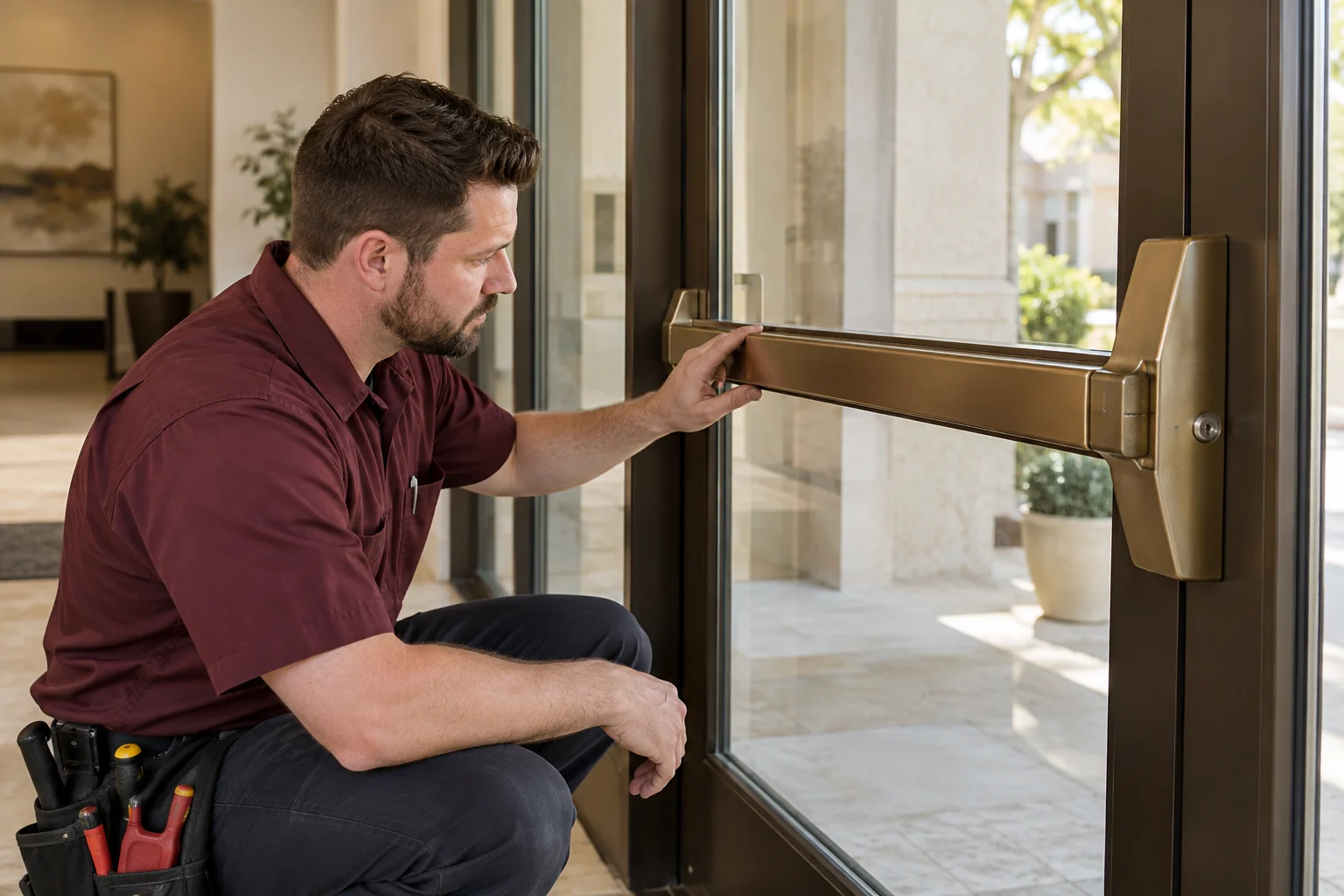
Some doors must open easily from the inside, even when locked from the outside. Panic bars and other exit devices exist so that people can leave a building in an emergency without a key or special knowledge. They are a life safety matter, not a convenience, and tampering with them is a serious mistake.
Because exit rules depend on building use, occupancy and local requirements, do not guess which devices your doors need. Ask the building authority, your property manager or the fire marshal's office what applies. A locksmith can install and service the hardware, but the decision about which devices are required for your space belongs with the people who set those standards.
Maintenance is simple but often forgotten. Exit devices should operate smoothly and latch securely, and the door should close fully on its own. If a bar sticks, rattles or leaves the door ajar, have it looked at. The overview of panic bars and exit devices explains how the hardware works, and the article on door compliance audits for commercial buildings describes what a walkthrough usually checks.
If you are a tenant, remember that the exit hardware on your suite may belong to the building. Altering it without permission can cause trouble with the landlord and with those who inspect the premises. Ask in writing before changing any hardware that is part of the exit route, and keep a copy of the answer.
When an employee leaves or a tenant moves out
This is the moment most businesses think about keys, and it is also the moment most of them are busy with something else. If a person with keys leaves, especially on difficult terms, the clean answer is to rekey the doors they could open. Rekeying changes the cylinder so their key no longer works, without replacing all the hardware.
Property managers face the same question with every tenant change. A unit that was empty for a few weeks could still have a spare key floating around, so turnover is a natural time to rekey. The cost of a rekey is small beside the cost of a dispute about who had access to a unit. Doing it as a routine step, not as a reaction to a problem, makes it simpler and removes any awkwardness.
Do not forget the less visible keys: the mailbox, the file cabinet, the supply closet and the back gate. Many break ins start with a minor key that nobody tracked. For a walk through the process, the page about rekeying an office after an employee leaves is a useful companion,.
Planning around weather and hurricane season
South Florida businesses carry extra preparation tasks, and doors are part of that. Before a storm, check that every door closes and latches without force, that weatherstripping is intact and that no hinge is loose. A door that sticks in dry weather may swell and refuse to close after heavy rain.
After a storm, walk the property and test each lock. Water intrusion can affect electronic keypads, door controllers and card readers, and debris can jam tracks and latches. If a door will not lock, do not leave it unsecured while you wait. Ask what temporary measures are sensible, and have the permanent fix done once conditions allow.
Keep a simple list of your lock details: door locations, hardware type, and who holds keys. If a storm or break in damages a door, having that information ready speeds up everything from repair to insurance paperwork. Store a copy off site so that a damaged office does not take your records with it.
Remember the basics of weather too: a door that is propped open during a storm warning or left unlatched because it will not close is an invitation. If a door has trouble closing in humid conditions, have the frame and hinges adjusted ahead of time rather than during a warning, when everyone else is also trying to get help.
After a break in or attempted entry
A damaged door after an attempted entry needs attention in a specific order. First, make sure it is safe to be there and call the proper authorities for a report. Then photograph the damage before anything is moved, since insurers and managers usually want to see it.
Next, the property needs to be secured. A locksmith can assess the door, the frame, the strike and the lock, and tell you which parts can be repaired and which need replacing. If keys were stolen or the lock was compromised, rekeying or replacement is the sensible step even if the door still appears to work.
Think about how entry happened, too. Was a weak frame, a short strike plate screw or an unlit rear door involved? Fixing only the visible damage leaves the cause in place. A calm assessment after the incident is worth the time, and the broader services overview shows the kinds of repairs a locksmith can help with.
Finally, resist the urge to leave a temporary fix in place for months. A board or a chain may keep the door shut for a night, but it does not provide real protection and can hide damage that grows worse. Set a firm date to have the permanent repair finished, and write it down so it does not slip.
How to prepare when you call
Contact with Half Off Locksmith is by phone. Explain what kind of business you run, which doors are involved, what the problem is and whether you are the owner or the manager. The work and the price are explained before it begins, and the finished work is tested with you.
Collect a few details first: the number of doors, the type of door such as glass, metal or wood, the current hardware if you know it, and whether keys have been lost or people have left. If you rent the space, check your lease or ask your landlord who is responsible for locks and whether changes need approval.
Finally, think about the future. Is this a one time repair, or is it a chance to organize the whole property into a clean key plan? Many owners find it worthwhile to solve the larger problem while someone is already on site, because a single organized visit usually beats three separate repairs spread across a season. Neighbors in other cities can look at the pages for Pembroke Pines and Weston to see how the same ideas apply.
Common questions
What is the difference between rekeying and replacing locks for a business?
Rekeying changes the internal pins so old keys stop working while the hardware stays put. Replacement installs new hardware. Rekeying suits sound locks when you only need key control. Replacement makes sense when hardware is worn, damaged or the wrong grade for how much the door is used.
Do I need a master key system?
Only if different people need different levels of access. A master system lets one key open many doors while each user keeps a key for their own area. It needs planning, so a locksmith will ask for a door list and a description of who needs access to what. Bring a rough floor plan if you have one, because it speeds up the conversation and avoids mistakes about which door is which.
Who decides what exit hardware my doors need?
Requirements depend on how the building is used and on local rules, so they vary. Ask the building authority, fire marshal's office or your property manager. A locksmith can install and service exit devices, but should not be the one guessing which ones your space requires.
Should I rekey every time a tenant or employee leaves?
It is a sensible habit, especially when people had access to sensitive areas or left on bad terms. Rekeying removes the risk of unrecovered copies. For lower risk doors, you can decide case by case, but a written key record helps you choose clearly.
What should I do about a storefront door that drags or sticks?
Do not force it. Describe the symptoms, including whether it happens in humid weather, and ask for the door, frame and hardware to be checked together. A sagging door or worn latch can often be corrected before it fails, and early attention protects the glass and frame.
Can a locksmith help after an attempted break in?
Yes. After safety and a police report, a locksmith can assess the lock, strike and frame, secure the opening and advise whether rekeying or replacement is wise. Photograph the damage first and keep the receipt, as insurers and managers often ask for documentation.
Talk through the job before work begins
Explain the problem, what has to work again and who needs access afterward. We talk through the scope and the price first, and work begins after you agree.
Call (954) 888-8804