Home | Cities | Pembroke Pines
Commercial Locksmith in Pembroke Pines
Business doors face heavier use and higher stakes than home doors. This page offers general guidance for Pembroke Pines shops, offices and property managers on hardware, key control, exit devices and planning for staff changes.
Call (954) 888-8804What business doors have to put up with
A front door at a home might open a dozen times a day. A front door at a busy shop can open a few hundred times, pushed by customers carrying bags, children and boxes, and slammed by wind when the air conditioning pulls against it. That difference is the heart of commercial locksmith work. The hardware is the same family of parts, but it is chosen, installed and maintained for a much harder life.
This page is general guidance for business owners and managers in Pembroke Pines. It does not describe particular shopping areas, buildings or landlords, and it does not state local codes as fact. Requirements for fire safety, accessibility and building use vary by property and by authority, so wherever this page touches those subjects, the advice is to ask the right office for your own building.
What it can do is help you see your doors the way a locksmith sees them. Every door has a job, every job has a failure mode, and most of the trouble comes from a door being asked to do more than its hardware was ever meant to handle. The sections below walk through the common cases, from the front counter to the back stockroom.
Taking stock of every door you have
Before talking to anyone about upgrades, walk the space and make a simple list. Include the front entrance, any side and back doors, the stockroom, the office, the restroom, the utility closet and any gates or roll down shutters. For each one, note what kind of lock it has, whether it closes properly, and who is supposed to hold a key.
This exercise often turns up surprises. A rear door that nobody uses may be held shut by a bolt that is rusty and loose. A door to an office may have a lock that is a decade older than the rest of the hardware. A key may be stamped with a number that nobody can match to a door. Finding these early is far better than finding them during a problem.
Keep the list somewhere safe and update it when anything changes. It becomes the basis for every conversation with a locksmith and for decisions about which doors deserve better hardware first.
If you manage a property with several tenants, extend the list into a simple table with one row per door and one column for each fact you care about. Add a column for the date of the last service. A door that has not been looked at in years is a better candidate for attention than one that was adjusted last season, and the table shows you that at a glance. It also helps when ownership changes, because the new manager inherits a clear picture instead of a drawer of unlabeled keys.
- Note the make and style of each lock and whether it is a deadbolt, a latch or an exit device.
- Mark which doors are used by the public and which are staff only.
- Record how many keys exist for each door and who holds them.
- Check each door for sagging, dragging or a loose strike plate.
- List any doors that are never used but still open to the outside.
- Flag any lock that feels rough, sticks, or has been repaired more than once.
Storefront doors and glass
Storefront doors are often aluminum framed glass doors with a narrow stile, meaning the vertical frame beside the glass is slim. That leaves very little room for lock hardware, which is why storefront locks have a particular look and why standard house locks do not fit. If you replace a storefront lock, bring the exact details of the existing one to the conversation, because a lock that is almost the right size is the wrong lock. Rim cylinders, hook bolts and surface mounted devices are common, and each one has to match the frame.
Because these doors are mostly glass, their security rests on the hardware and on where the lock engages the frame. A weak strike, a loose pivot or a bent bottom rail can make a door feel secure when it is not. Salt air and humidity add corrosion to the mix, so metal parts near the floor and threshold wear out sooner than you would expect. Hinges, pivots and the bottom corner of the frame are the usual victims, and a short look at them every few months catches trouble early.
When a storefront door starts to drag, rattle or refuse to latch, treat it as a maintenance matter before it becomes an emergency. The guide on storefront door lock repair explains the common failures and what a repair usually involves.
Offices, suites and shared buildings
Offices raise a different set of questions. A suite door may be managed by a landlord, a property manager or the tenant, and the rules about who may change a lock differ from one lease to another. Before any work begins, find out who controls the hardware and whether the building expects a certain kind of key system.
Inside the suite, you may want some rooms to open for everyone and others for only a few people. A server closet, a records room and a manager's office are common examples. Strong yet simple hardware, combined with sensible key control, usually works better than layers of complicated devices that nobody maintains.
Filing cabinets and desks matter more than owners tend to think. A small lock on a drawer can protect payroll files, customer records or cash boxes. The article on file cabinet and desk locks explains what those locks can and cannot do, and when a drawer deserves something stronger.
Back doors, deliveries and staff entrances
The back of a business is where most deliveries arrive, where staff come and go, and where trash is carried out. It is also the part of the property that customers never see, which means trouble can go unnoticed. A back door propped open with a brick may be convenient, but it also invites anyone to walk in.
Good back door practice is mostly about habits and a little hardware. A door that closes and latches by itself prevents the propped open problem. A sturdy deadbolt or a properly installed exit device keeps the door secure when the building is empty. A view of the door from inside, whether a window, a camera or a simple peephole, helps staff decide whether to open.
If your property has an alley or a service area, think about lighting and visibility along with locks. A solid door in a dark corner is less effective than a solid door in a visible one. Walk the area after closing and see it as a stranger would.
Staff habits matter as much as hardware here. If employees regularly prop the door because the latch is stiff, fix the latch instead of scolding the staff. If keys are left on hooks near the door, move them. A secure back entrance is built from small, sensible decisions repeated every day, and the locksmith's part is to make the right choice the easy one.
Exit hardware and the safe way out
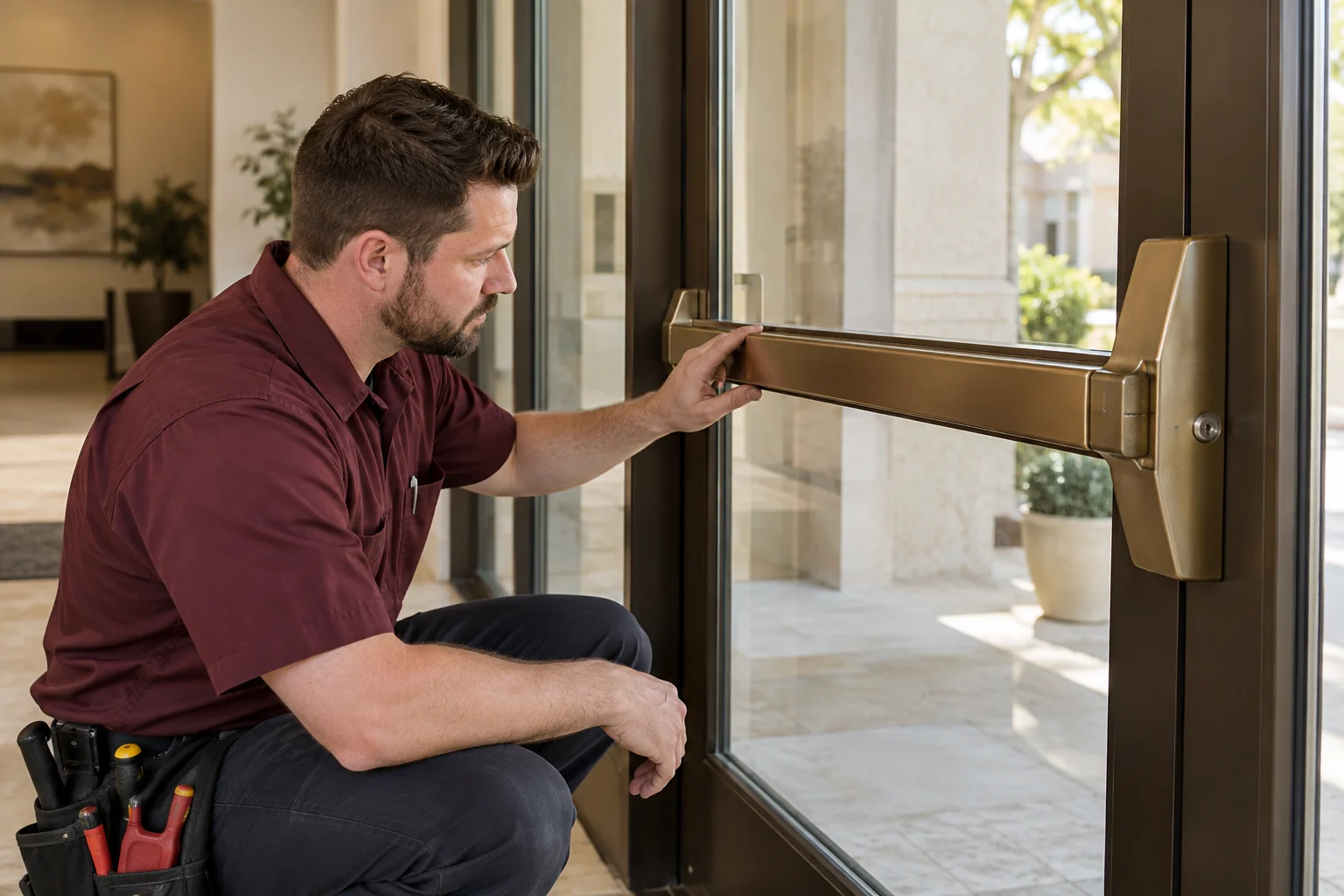
Many commercial doors must allow people to leave easily, even when the door stays locked from the outside. Push bars and panic devices serve this purpose. They let someone press a bar to leave without needing a key or a special motion, which matters in a crowded or emergency situation.
The rules for where such devices are required, and how they must work, depend on the use of the building and on local authorities. Do not assume. Ask the building department or fire authority that covers your property, and keep any inspection paperwork you receive. A locksmith can install, adjust and repair the hardware, but the question of what your space needs is one for the officials.
The overview of panic bars and exit devices explains how they work and what to look for when one begins to stick. Never chain, block or disable an exit device, even temporarily. It is there for the day when everyone needs to leave at once.
Keys, key control and staff turnover
Keys are easy to hand out and very hard to take back. Over months and years, a business can accumulate dozens of copies in unknown hands. Employees leave, contractors finish their jobs, and a cousin of the previous manager still has the front door key. None of this is malicious, but all of it is a risk.
Good key control starts with a written record of who holds which key, and a rule that keys are not duplicated casually. Restricted key blanks, which cannot be copied without authorization, add another layer for sensitive doors. When a person with keys leaves, especially on difficult terms, the clean answer is to change the locks involved.
Rekeying is usually enough, because it changes the lock's inner parts so old keys stop working without replacing the hardware. The article on rekeying an office after an employee leaves describes how to decide which doors to change first.
Master keys and access control
A master key system lets one key open many doors while individual keys open only their own. It is common in offices, apartment buildings and schools, and it reduces the number of keys people must carry. The cost is complexity, since a poorly planned system can create more master level access than anyone intended.
Electronic access control, with cards, fobs or codes, solves some of these problems. Lost credentials can be disabled without changing a lock, and entry logs show who came and when. It also needs power, software and maintenance, and it can fail in ways a mechanical lock never would. Many small businesses do well with a mix, using electronic control for the main doors and strong mechanical locks elsewhere.
To weigh the options, read about master key systems for business and access control versus keys for a small business. Both lay out the trade offs without assuming that more technology is always better.
Whatever system you choose, plan for the day it fails. Know where the mechanical backup key is kept, who may use it, and how a door can be opened safely if power or software goes down. A system that locks everyone out during a power cut has not really solved anything. Test the fallback before you need it, and write the steps on a card that a manager can find.
After a break in or a failed lock
If someone has forced a door or a lock has failed, the first priority is safety. Do not enter if you suspect someone may still be inside, and contact the appropriate authorities if a crime has taken place. Once the scene is safe and any report is made, the property still has to be secured, and that is where a locksmith comes in.
A forced door often has damage beyond the lock itself. The frame may be cracked, the strike plate torn from its screws, and the latch bent. Fixing only the lock leaves the weak point in place. A careful technician looks at the whole opening before suggesting a repair, so that the door is actually stronger afterward, not just closed. Ask what was found, what was changed, and what still deserves attention, so that nothing is left to chance on the next busy day.
The checklist for recovering after a break in covers the practical steps, including what to photograph, whom to notify and how to secure the property while repairs are arranged. Consider changing every lock whose key could have been taken.
Hurricane season and a business that must close up
Hurricane season asks something particular of a business. Before a storm, owners secure inventory, board windows and lock up for days at a time. Afterward, they return to doors that may have swollen, shifted or collected debris. A door that latched fine before the storm may refuse to close properly once the frame has moved a fraction.
Build a short routine around this. Before the season starts, check that every exterior door latches fully and that every key you hold still works. Make sure at least two trusted people have working keys, since the owner may be away. After a storm, test each door again from the inside and outside before trusting it overnight.
Gates, roll down shutters and padlocks also deserve a look. Padlocks exposed to rain and salt corrode from the inside, and a lock that will not open on the day you need it is a problem in its own right. Replace any that feel gritty or stiff, and keep a spare key somewhere that is not inside the building you may be unable to enter. If your business shares a building with others, coordinate with the property manager so that everyone knows who holds the main keys and how the common doors will be handled when the weather turns.
Planning work around a working business
A business cannot always close its doors for a repair. Good planning means thinking about when the work will cause the least disruption, which doors can be done first, and how the space will stay secure in the meantime. Tell the locksmith about opening hours, deliveries and any days that are especially busy.
Large jobs, such as replacing hardware on every door or installing a new access system, usually work better in stages. Start with the most exposed or most worn doors, test how the new setup works in daily life, and then continue. For new hardware on a single door, the page on lock installation in Pembroke Pines explains what installation involves.
Half Off Locksmith works from a simple process: you describe the situation, the work and price are explained first, and the finished work is tested with you. You can see the wider range of business services on the commercial locksmith page, and neighboring cities such as Plantation and Miramar have their own pages as well.
Common questions
What is the difference between commercial and residential locks?
Commercial hardware is built for far heavier daily use, with sturdier bodies, stronger strikes and parts that can be serviced. Residential locks are designed for lighter traffic. Commercial doors also often involve exit devices, closers and key control systems that homes rarely need, so the whole opening has to be considered.
Should I rekey or replace the locks when an employee leaves?
If the lock is in good condition, rekeying is usually enough, because it makes the old key useless without changing the hardware. If the lock is worn, damaged or poorly matched to the door, replacement may be wiser. A locksmith can look at each door and explain which fits.
Who decides what exit hardware my building needs?
Requirements depend on how the building is used and on the local fire and building authorities. Do not guess. Ask the office that covers your property, and keep any inspection records. A locksmith can install, adjust and repair the hardware once you know what is required.
Is a master key system a good idea for a small office?
It can be, if the layout justifies it. A master system reduces the number of keys people carry, but it also concentrates access in the master key. Plan which doors need individual keys, restrict who holds the master, and keep written records. Simple setups often work better than complicated ones.
Can electronic access control replace all my keys?
Not always. Cards, fobs and codes are convenient and can be disabled when lost, but they depend on power and software and can fail. Many businesses use electronic control on main doors and strong mechanical locks on others. A locksmith can discuss which mix suits your space.
How do I keep my business secure while a repair is underway?
Tell the locksmith about your hours and any doors that must stay usable. The work can often be planned in stages so the space remains closed and secured between steps. After any repair, test each door with the technician so you know it latches and locks before you leave.
Talk through the job before work begins
Start by describing the situation, the lock or key involved and who must have access. You hear the price and the plan before anything is done.
Call (954) 888-8804