Home | Cities | Southwest Ranches
Commercial Locksmith in Southwest Ranches
A business door has to do more than a house door: let the right people in, keep the wrong people out, and open freely in an emergency. This page is general guidance for owners and managers in Southwest Ranches.
Call (954) 888-8804What makes commercial locking different
A home lock protects a household. A commercial lock protects stock, equipment, records, cash, staff and the business itself. That wider responsibility changes the choices. Doors are used far more often, by many more people, and the consequences of a failure are bigger than a locked out homeowner. A shop door that sticks during opening hours costs customers, and one that fails overnight can cost far more.
Commercial hardware is also built to a heavier standard. Cylinders, latches, closers and hinges are designed for repeated use, and the difference shows in how long they last. A residential lock on a busy office door may work for a while and then wear out sooner than expected. If you use the wrong grade of hardware, you often end up paying twice, once for the first lock and again for its replacement.
This page is general guidance for businesses in Southwest Ranches. It does not describe local rules, and it does not claim that work has been done at any particular property. Its aim is to help you ask sensible questions, understand your options and approach the subject in an orderly way.
Starting with a walk around the building
A sound commercial lock plan begins with a calm walk through the premises. List every door: front entrance, rear door, loading door, side exits, storage rooms, offices, server closets, a cash room, and any gate or fence. Next to each, note the type of lock, how old it appears and who uses it. You will probably be surprised by how many different locks, and how many different keys, you have accumulated.
Then ask which doors matter most. A front door gets used all day and needs durability. A cash room needs control over who can enter. A back door may need to be easy to leave through yet hard to enter. Different doors have different jobs, and the hardware should match the job, not the budget of the day.
Take photographs as you go. A phone picture of each lock, each door label and each frame gives you a record you can show a locksmith, a landlord or an insurer, and it saves you from describing a door from memory. Store the photos with your key list so the two stay together. Even a simple folder on a shared drive is a real improvement over relying on whoever happens to remember.
Finally, look at the condition of each door and frame. A strong lock in a weak frame is a weak door. If the frame flexes, the latch barely engages the strike or the door sags, fix that before you spend money on fancy hardware. The page on commercial locksmith services shows how those pieces fit together.
- List every door, gate and storage room that has a lock.
- Note the lock type, age and who uses each door.
- Rank doors by how much they protect and how often they are used.
- Check frames, hinges and strike plates, not only the lock.
- Count the keys in circulation and who holds each one.
Understanding lock grades
Commercial locks are sorted into grades that describe how much abuse they are built to take. A higher grade usually means heavier materials, tighter tolerances and longer life under repeated use. Grades matter because a lock built for light duty will not hold up on a door that opens hundreds of times a day.
You do not need to memorize standards to make good decisions. You need to know your door's use. Is it a busy entrance, a quiet closet, or a door facing the weather? The article on commercial lock grades explains the idea in plain terms and helps you ask the right questions when a vendor suggests hardware.
Ask a locksmith why they recommend a particular lock. A good answer relates to the door's traffic, its exposure and your security needs. A poor answer is a brand name and a shrug. The goal is a lock that fits, not the most expensive one on the shelf.
Also consider how a lock will be serviced. Hardware that can be rekeyed without being removed, or that uses common parts, is easier to maintain over the years. A very unusual lock can become a headache if the parts are hard to find, so ask what repairs would look like before choosing something exotic. Simple and sturdy usually ages better than clever and delicate, particularly in air that carries salt.
Controlling who has keys
In most small businesses, keys are the weak point. They get copied, lent, lost and left in drawers. Over time nobody can say with confidence who can enter, and an employee who left years ago may still have a working key. That is not carelessness. It is what happens when keys are handled informally.
A master key system is one structured answer. It lets certain people open many doors with one key, while others open only what they need. Done well, it reduces the size of the key ring and increases control. The article about a master key system for a business describes how such systems are organized and what to consider before choosing one.
Whatever system you use, keep a written record. Who holds which key, when it was issued, and when it was returned. When a key is not returned, you know exactly which locks are affected. That record turns a security worry into a manageable task.
Think about restricted keys too. Some key systems limit who can have copies made, so a key cannot simply be duplicated at the nearest kiosk. That adds a step when you need another copy, but it also means a departing employee cannot easily leave with a duplicate. For a business with sensitive areas, the extra control is often worth the inconvenience, and the trade off is worth discussing before you commit to a system.
Keys or electronic access
Some businesses move from keys to keypads, cards or fobs. Electronic access has real advantages: you can remove a person's access without collecting a key, you can give different people different permissions, and some systems keep a record of entries. For a business with many staff or high turnover, that flexibility is valuable.
It also adds dependencies. Electronics need power, software and sometimes a network. A storm, an outage or a failed controller can affect your ability to open your own door, so a plan for power loss and a mechanical backup are important. The article on access control versus keys for a small business compares the two approaches fairly.
Humidity and salt air along the coast are hard on outdoor electronics. A reader placed on an exposed wall faces rain, sun and corrosion. If you choose electronic access, ask how the hardware handles those conditions and how it is maintained.
Plan for the human side as well. Staff need to know what to do when a card stops working, a code is forgotten or a battery runs low. A short written procedure, kept where managers can find it, prevents a minor glitch from turning into an hour of confusion at the front door. Decide who can issue and cancel credentials, and keep that list short, so that changes happen deliberately and not by accident.
When an employee leaves
Every business eventually says goodbye to someone who held a key. Handled well, the transition is routine. Handled badly, it leaves a former employee with a working key and nobody the wiser. The question to ask is simple: does this person still need access, and if not, what do we change?
Collecting the key is the first step, but you cannot be sure no copy exists. Where the role was sensitive, such as a manager, a bookkeeper or someone with access to a cash room, rekeying the affected locks is a sound precaution. The piece on rekeying an office after an employee leaves walks through the decision.
Treat this as policy, not a reaction. If your business has a standard process for departures, including key return, a record update and a decision about rekeying, nobody takes it personally, and nothing gets forgotten.
Remember that departures are not only about keys. Alarm codes, keypad codes, shared passwords for electronic locks and access to a lockbox all belong on the same checklist. A single sheet that lists every way someone could enter the building makes the check simple to run and hard to get wrong. Go over that sheet whenever the team changes, even when the change is routine and friendly.
Exit doors, panic bars and safe egress
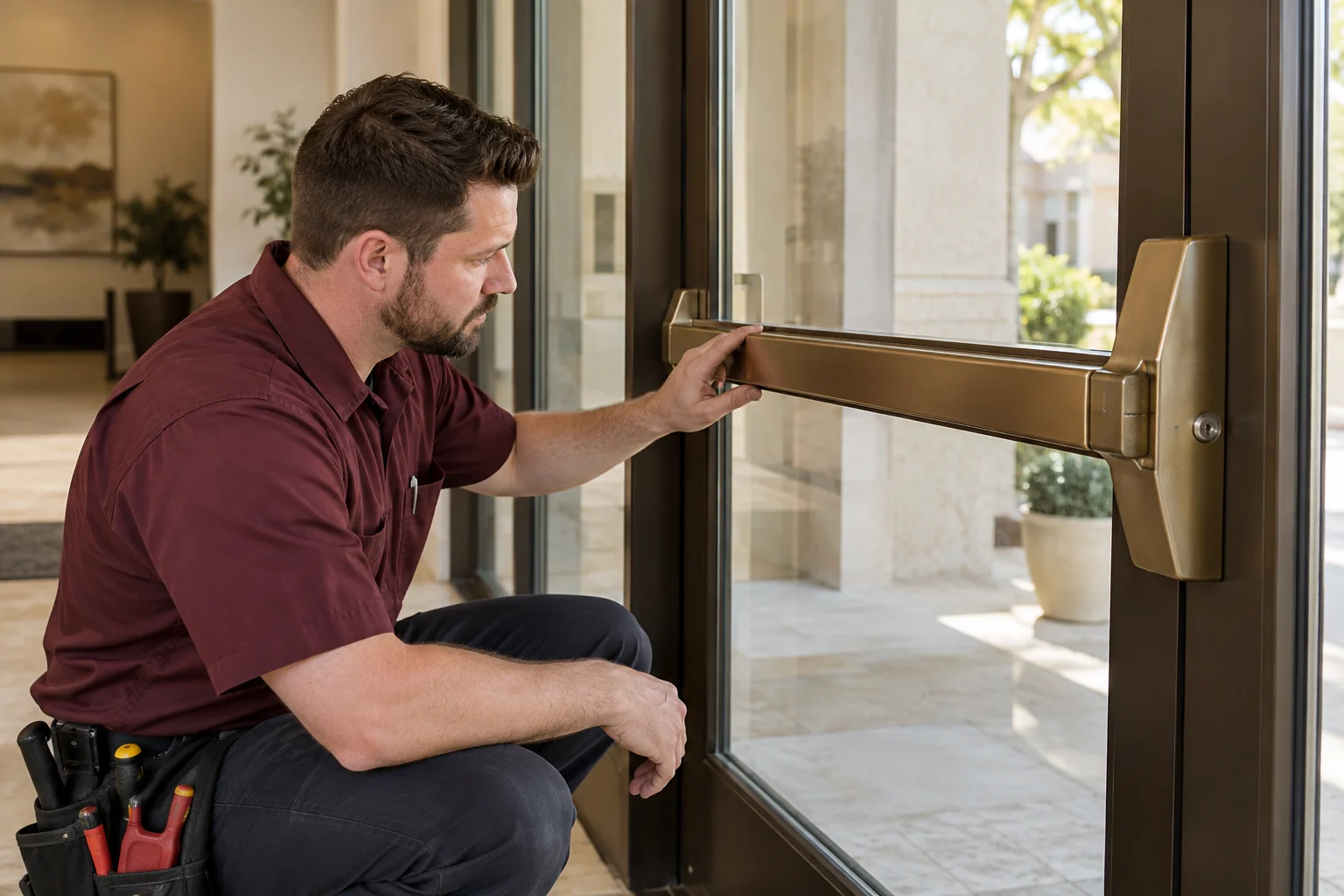
Doors that people use to leave a building in an emergency have special demands. They must open easily from inside, without a key or special knowledge, even while remaining secure against entry from outside. Panic bars and exit devices exist for this purpose, and choosing and maintaining them correctly matters.
Requirements for exit hardware, fire doors and accessible entrances are set by authorities and differ by building type and location. Do not assume what applies to you. Ask your building department, fire marshal or landlord what requirements govern your premises, and then choose hardware that satisfies them. Our article on panic bars and exit devices explains how they work in general terms.
Never chain, block or disable an exit door for convenience. A door that cannot be opened easily from the inside is a safety problem, however secure it seems. If a door is hard to use, fix the hardware instead of working around it.
Doors also need to work for everyone who uses the building, including people with limited strength or mobility. Handle style, closer tension and the force needed to open a door all matter, and they are easy to ignore until someone struggles. Standards and obligations vary, so ask a qualified person what applies to you. The article on door compliance audits for commercial properties explains what an audit usually looks at, without claiming to state your particular obligations.
Storefronts, offices and the small locks
Glass front doors, aluminum frames and narrow stiles each pose their own locking challenges. The hardware has to fit a thin frame, resist forcing, and survive thousands of daily uses. Problems usually show up as a latch that no longer catches, a cylinder that turns hard or a door that does not close fully. The guide on storefront door lock repair covers common causes.
Inside the office, filing cabinets, desk drawers and cash boxes also need attention. They hold the most sensitive paperwork and the most portable valuables. The piece on file cabinet and desk locks explains what is available and how to manage the keys.
Salt air and humidity reach indoor locks as well, especially in buildings with open doors or weak air conditioning. A lock that feels gritty or stiff is an early warning. Addressing it early is simpler than dealing with a failure on a busy morning.
After hours, deliveries and the open door problem
Many break ins at small businesses are not clever. They exploit a door left unlatched, a back entrance propped open for a delivery or a key under a flowerpot. The most valuable security habit is also the least glamorous: a closing routine that someone owns. A short checklist at the end of the day, covering every door, gate and window, catches most of what hardware cannot.
Deliveries create a particular weakness. A door propped open for a few minutes can stay open for an hour when the staff gets busy. If your business receives frequent deliveries, think about a door that holds itself closed but can be released easily, or a clear sightline from the counter to the delivery door. The aim is to make the right behavior the easy behavior.
Lighting and visibility again do much of the work. A well lit entrance that can be seen from the street discourages tampering, and an alarm sticker means little without a real habit behind it. Pair good habits with sound hardware and the combination is far stronger than either alone.
If you share a building with other tenants, coordinate where it makes sense. A shared back corridor, a common loading area or a shared gate affects everyone, and a lock change that one tenant makes can lock out another. Talk to your landlord or property manager before changing any shared door.
Planning installs and upgrades
If you are adding or replacing locks, a little preparation saves trouble. Decide what the lock must do, check the condition of the door and frame, and ask about key control and future flexibility. For new hardware, the page on lock installation in Southwest Ranches offers further guidance.
Think about how many doors will eventually share a system. Choosing locks that can be keyed alike or fitted into a master key arrangement later gives you room to grow. Buying isolated locks that cannot join a system leaves you with a ring of unrelated keys.
Plan the work around your operations too. Changing the locks on a door you use all day requires a plan for how the business stays open while the work happens. Mention this when you call so that the visit can be organized around your needs.
Working with a locksmith you can trust
A commercial locksmith has access to your business, and that makes trust essential. Ask who will come, what the work involves and what the price covers before the work begins. Ask what will be tested when the job is finished. A reasonable professional will welcome these questions.
Half Off Locksmith serves Broward County. You call and describe the situation and the place, the work and the price are explained before it begins, and the finished work is tested with you. Keep a record of what was done, including which keys were issued and which locks were changed.
For a broader look at the area, read about locksmith services in Southwest Ranches, or compare with commercial locksmith help in Davie if you operate in more than one place. The principles stay the same: know your doors, control your keys and choose hardware that fits.
Common questions
What is the difference between residential and commercial locks?
Commercial locks are built for heavier use and are usually made of sturdier materials with tighter tolerances. A busy door can wear out a residential lock early. The right choice depends on how often the door is used, what it protects and how exposed it is to weather, not only on price.
What is a master key system?
It is a keying plan in which certain keys open many doors while others open only specific ones. A manager might hold a key for everything, while staff hold keys for their own areas. It reduces key clutter and improves control, though it needs careful planning and record keeping.
Should I rekey after an employee leaves?
It depends on the role and what the person could access. Collect the key first. If the person had access to sensitive areas, or you cannot be sure no copy exists, rekeying those locks is a reasonable precaution. Having a standard policy for departures makes the decision simple.
Are electronic locks better than keys for a business?
They offer flexibility, such as removing one person's access without collecting a key. They also depend on power and equipment, so plan for outages and keep a mechanical backup where appropriate. The better choice depends on your staff size, turnover and tolerance for maintenance.
What rules apply to exit doors in my building?
Requirements for exit hardware, fire doors and accessibility vary by building type and location. Ask your building department, fire marshal or landlord what applies to your premises. A locksmith can explain how hardware works, but you should confirm the governing requirements with the authority that sets them.
How do I keep track of keys?
Keep a written record of who holds each key, when it was issued and when it was returned. Limit copies and use a consistent process for new hires and departures. When a key goes missing, the record shows which locks are affected so you can decide what to change.
Talk through the job before work begins
Start by describing the situation, the lock or key involved and who must have access. You hear the price and the plan before anything is done.
Call (954) 888-8804