Home | Cities | Southwest Ranches
Automotive Locksmith in Southwest Ranches
Car keys have changed from simple metal blades into small electronic devices, and fixing them is its own specialty. This page is general guidance for drivers in Southwest Ranches facing a lost key, a failing fob or a sticking ignition.
Call (954) 888-8804Why a car key is more than a piece of metal
Not long ago a car key was a cut piece of brass that fit a lock and turned an ignition. Today most keys carry a tiny transponder chip that speaks to the vehicle when the key is near the ignition. If the chip is missing or unrecognized, the engine may turn over briefly and then refuse to run, or it may not respond at all. Many keys also hold remote buttons, and some are slim cards or fobs that never enter a lock.
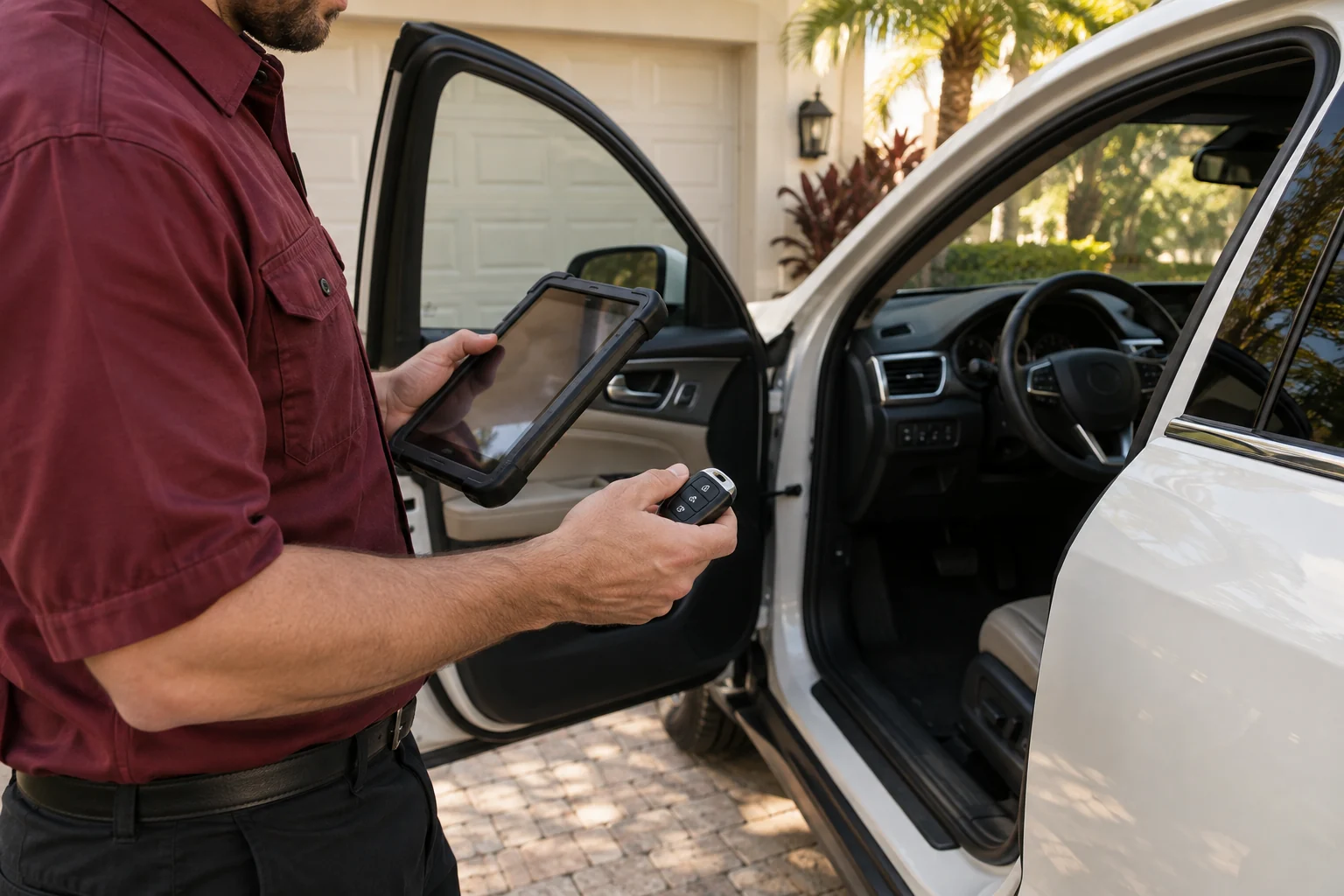
That shift changes what a locksmith does. Cutting the metal blade is only one step. The key may also need to be paired with the car, which is called programming, and the process varies with the make, the model and the year. This is why you should always ask whether a person can handle your particular vehicle before you commit to a visit.
This page is general guidance for drivers in Southwest Ranches. It does not describe local rules or claim any particular job in the area. It is meant to help you understand your options and ask better questions so that you spend your time and money well.
It also helps to separate three situations that people often lump together: a lost key, a broken key and a key that works but misbehaves. Each leads to a different kind of visit. A lost key needs a new one created, a broken key may leave a piece in the lock or ignition that must be removed carefully, and a misbehaving key might point to a worn lock or a weak battery. Naming the situation correctly at the start makes every later step simpler.
When you have lost every key
Losing the only key to a vehicle is stressful because nothing short of a new key will fix it. In that situation the key must be created from scratch, and the vehicle must be told to accept it. A technician needs to identify your car, confirm that you own it and then produce a key that works. You will usually be asked for proof such as a registration or title, along with identification.
Do not hurry to have the car towed to a dealer without knowing your choices. A mobile locksmith who handles automotive work may be able to make the key where the car is parked, which can save a tow. The article on locksmith versus dealership for car keys compares the two paths honestly, including the situations where a dealer is the right call.
Before calling, gather what you can. Know the year, make and model, and have the vehicle identification number handy, which is visible on the dashboard near the windshield and on the registration. Mention whether the car uses a traditional key, a key with a plastic head, or a push button start. Those details help the person on the phone say what is possible.
- Have the year, make and model of the vehicle ready.
- Find the vehicle identification number on the dash or registration.
- Be prepared to show proof of ownership and identification.
- Say whether the car uses a blade key, a chipped key or push button start.
- Ask whether the work can be done where the car is parked.
Spare keys and why they matter
If you still have one working key, you are in a much easier spot than someone with none. Making a copy from an existing key is usually simpler than building one from nothing, because the vehicle can learn the new key while the old one is present. The longer you wait, the more you risk losing that advantage.
A spare also protects you from everyday trouble: a key dropped in a lake, snapped in a lock, bent in a pocket or locked inside the car. The article on whether a spare car key is worth it walks through the reasoning. For many drivers, one spare kept at home pays for itself the first time it is needed.
Where you keep the spare matters. Hiding it on the vehicle itself, under a bumper or in a wheel well, is a known habit and invites theft. Keep it at home, in a secure place, or with a trusted family member. Never leave a spare fob in the vehicle, since some systems let a thief use it.
Tell the people who share your car where the spare lives and who may use it. A key that nobody remembers is as useless as a key that does not exist, and a key that everybody can reach is a security gap. A single secure spot, agreed in advance, is worth more than a clever hiding place.
Fobs, proximity keys and push button start
Many newer vehicles use a proximity fob. You keep it in a pocket or bag, and the car senses it when you walk up and when you press the start button. When the fob battery weakens, the car may show a warning or fail to detect it, which is a very common cause of a no start. A new battery can solve it, though the fob may need to be rechecked afterward.
Losing a proximity key is a bigger matter, because the car must be told to forget the missing one and accept a new one. That is both an inconvenience and a security step: a lost fob should not keep working. Our article about a lost push to start key explains what usually happens next.
If your remote buttons work inconsistently, try replacing the battery first and check for water exposure or cracks in the case. Heat and humidity are rough on electronics. The guide on a key fob that is not working covers common causes and when the issue is more than a battery.
What programming means
Programming is the step that introduces a new key to the vehicle. The car holds a list of keys it trusts, and a new key is added to that list through a process that depends on the manufacturer. Some vehicles allow a simple routine when you already have working keys, while others require specialized equipment that talks to the car's computer.
This is also why an unprogrammed key that looks perfect may do nothing. The metal blade can open the door and turn the ignition, but if the chip is not recognized, the engine will not run. A key that costs less and looks identical can be a poor bargain if it cannot be programmed. The piece on transponder key programming goes deeper into how it works.
Ask what happens to your old keys during programming. In some cases, adding a new key leaves the others intact. In other cases, the process erases the list and requires every key to be reprogrammed together. If you have several keys, bring all of them so nothing stops working unexpectedly.
Cut styles: standard, laser and everything between
Metal blades come in different forms. Traditional keys have cuts along the edge, while many newer ones have a milled groove down the middle of the blade, often called a laser cut or high security key. The second kind needs different cutting equipment, and not every shop has it.
This affects both what can be duplicated and how. A key with a milled track cannot be copied on a basic machine meant for edge cut keys, and a poor copy may slip, stick or break. The guide on laser cut versus standard car keys explains how to tell them apart.
If your key is hard to turn or leaves metal shavings in the ignition, stop using it and have both the key and the lock checked. A worn key can damage the inside of the ignition cylinder, and a damaged cylinder can then wear out good keys. Catching it early protects both.
Ignition problems that are not the key's fault
Sometimes the key is fine and the ignition is the problem. A cylinder can wear with age, collect grit from a pocket full of lint, or stiffen in extreme heat. Signs include a key that needs jiggling, a steering wheel that stays locked, or a key that will not come out. In those cases a new key will not help until the cylinder is dealt with.
A steering wheel lock is a safety feature that can bind when you turn the wheel against it as you try to start the car. A gentle wiggle of the steering wheel while turning the key is a standard tip for that specific situation, and it is safe. Beyond that, do not force the key. The articles on a key stuck in the ignition and the page on ignition repair explain what can be done.
Never spray oil into an ignition cylinder. It may loosen things for a day and then attract dirt that makes the problem worse. If the problem keeps returning, the cylinder may need repair or replacement, and a technician can explain which.
Heat, salt and a car that lives outdoors
Vehicles in South Florida live a hard life. Direct sun bakes interiors, plastic key shells grow brittle, and rubber buttons on fobs wear through. Salt air accelerates corrosion on metal parts, including door lock cylinders and ignition contacts. A car parked outdoors is exposed to all of it, day after day.
Small habits help. Keep the fob out of a hot dashboard, avoid leaving keys in a car baking in the sun and wipe off visible moisture. If your key has started to look worn, crack at the head or lose its rubber coating, consider replacing it before it fails. Replacing a key that still works is much simpler than replacing one that does not.
Door locks also suffer. If a lock turns reluctantly, try your spare key, since a worn primary key can make a healthy lock seem stiff. If both feel rough, mention the sticking when you call so the technician can bring the right approach.
Rain and car washes add a little more moisture to the mix. Water that works its way into a door lock or a fob can leave a film of corrosion that shows up weeks later as a key that sticks or a button that no longer responds. If you notice a fob that has been through the wash or dropped into a puddle, open the case when you can, let it dry fully and replace the battery before assuming the electronics are lost. Patience with a wet fob often saves it.
Locked out of the car is a different problem
Sometimes the question is not a missing key but a car you cannot open. Maybe the keys are on the seat, or in the trunk, or a fob battery has died. Opening a vehicle without damage requires care, since doors contain wiring, airbag components and delicate seals. Avoid wedging tools into the door or window yourself.
If a child or animal is inside, treat it as an emergency. Heat can build inside a closed vehicle sooner than most people expect, so contact emergency services at once. The article on keys locked in a car describes the options, and the page on lockout service in Southwest Ranches covers general lockouts.
Once you are back in, think about prevention. Many people lock their keys in the car because they step out with the engine running or the door open. A habit of touching your pocket before closing the door is a simple fix. If your fob has a hidden metal blade, learn where it is stored.
Motorcycles, work vehicles and older cars
Not every vehicle is a recent sedan. Motorcycles, golf carts, boats on trailers, work trucks and older cars each have their own keys and their own quirks. An older car may use a simple mechanical key with no chip, which is easier to duplicate, but the lock itself may be worn from decades of use. A motorcycle key is small and easy to misplace, and the ignition often sits exposed to weather.
If you drive for work, a lost key is more than an annoyance, because the vehicle may be how you earn a living. Keeping a labeled spare at the office or with a trusted person turns a lost day into a minor interruption. The page about motorcycle key replacement covers the two wheeled case in more detail.
Describe your vehicle fully when you call. Mention anything unusual: a key that was already copied, an aftermarket alarm, or a past ignition repair. Aftermarket systems can add layers that affect how a new key must be handled, and a technician who knows about them beforehand arrives better prepared.
Finally, remember that older vehicles sometimes have two separate keys, one for the doors and one for the ignition, or a trunk lock with its own key. Make sure every lock you rely on is covered when replacement keys are made, so you do not discover a missing piece when it is inconvenient.
Understanding the cost and the process
Car key work varies widely in what it involves, so the price depends on the vehicle, the key type and what has to be done. A basic chipped key is not the same job as a push button fob. The guide on the cost of car key replacement explains what drives the difference and how to compare offers fairly.
Half Off Locksmith serves Broward County. You call and describe the vehicle and the situation, the work and the price are explained before it begins, and the finished work is tested with you. Testing means trying the new key in the door, the trunk if it has a lock and the ignition, and confirming that the remote functions work.
If you would like a wider look at what is available in the community, see the overview of locksmith services in Southwest Ranches or the main page on car key replacement. Together they show how automotive work fits with the rest of what a locksmith does.
Common questions
Can a locksmith make a car key if I have no spare?
In many cases yes. A new key can be created and programmed to the vehicle, provided the car is identified and you can show it is yours. Registration or title and identification are normally requested. Ask on the phone whether your specific make, model and year can be handled and where the work would take place.
Why won't my new key start the car?
Most likely the chip inside the key has not been programmed to the vehicle, or the key does not match the car's system. A metal blade that fits the lock is not enough on its own. A technician can check whether the key needs programming or whether something else, such as the ignition, is involved.
My fob works only sometimes. What should I do?
Replace the battery first, since a weak one is the most common cause. Look for cracks or moisture in the case, as heat and humidity affect electronics. If the problem continues with a fresh battery, the fob or the car's receiver may need attention, and a technician can diagnose which.
Should I get a spare key now?
A spare is usually easier and gentler on your plans when you still have a working key, because the car can learn a new key with the old one present. Waiting until you have lost every key leaves you with a more involved process. Store the spare at home, not on the car.
What if my key is stuck in the ignition?
Do not force it. Check that the car is in park, gently turn the steering wheel left and right while easing the key, and make sure the battery is not completely dead. If it will not release, stop and call for help, since forcing can damage the key or the cylinder.
Is a dealer the only option for modern keys?
No. Many locksmiths handle keys and programming for a wide range of vehicles, and some can work where the car is parked. Some vehicles or situations do point toward a dealer, so ask directly whether your vehicle can be handled and compare the process and price before deciding.
Talk through the job before work begins
Tell us what happened, which doors or keys are involved and who needs to get in. The price and the plan are agreed with you before any work starts.
Call (954) 888-8804