Commercial Locksmith in Tamarac
Running a small office, shop or professional suite in Tamarac means thinking about who can open what, and when. This general guide covers door hardware, key records, cabinets, accessibility and how to prepare for lock work.
Call (954) 888-8804Thinking about locks as part of how the business runs
A lock is not only a barrier. In a business it is also a rule written in metal. It says who may enter, at what times and into which rooms. When a business is small, those rules live in people's heads, and everything works until someone is sick, someone quits, or the staff grows. Writing the rules down and matching them to hardware is the heart of commercial lock planning.
Consider a typical day. Someone opens in the morning, a supplier delivers midday, a cleaner arrives after closing, and a manager takes cash to the bank. Each of those people needs a different level of access, and each moment brings its own risk. Mapping these routines shows you which doors need which locks.
This page is general guidance for people operating businesses in Tamarac. It does not say anything about specific buildings, landlords or local rules, which vary. Where a decision depends on your lease, your building manager or an authority, we say so, and we suggest asking them rather than assuming.
A useful exercise before any purchase is to imagine three bad days. On the first, a key goes missing. On the second, a trusted employee leaves on poor terms. On the third, someone forces the back door overnight. For each day, ask what your current locks would allow and what you would have to do to recover. The gaps that appear are the places where your effort and budget will do the most good.
Small offices and professional suites
An office suite often has a single entrance door, a few interior doors and a storage or records room. The entrance is usually the first line of protection, so it deserves hardware that will last under daily use. Interior doors vary: a conference room may need no lock, while a records room may need a strong one.
Professional offices handle private information such as client files, financial records or personal details. A locked room, a locked cabinet and a clear policy on who holds keys together make a basic layer of protection. They also make it easier to explain to clients how their information is handled.
Think too about the cleaning crew and the building staff. Many offices share a corridor, a lobby or a service door with other tenants. Ask the property manager who holds keys to your suite and whether they can be changed. Our general overview of commercial locksmith services describes the kinds of work involved.
Waiting rooms and reception areas raise a further design question. Visitors need to reach the front desk, but not the rooms behind it. A door between the two should close and latch on its own, with a lock that staff can operate easily from inside, perhaps with a keypad so that nobody fumbles for keys while greeting a client. Planning that small door well improves both privacy and the feel of the office.
Retail shops and strip center storefronts
Retail doors endure heavy traffic. A front door may open hundreds of times a day, and the hardware inside wears accordingly. A cylinder that turns stiffly, a latch that no longer extends or a door that drifts open are signs that service is due, and they tend to appear at inconvenient moments.
Closing routines deserve a word. Many shops lose stock or cash not to dramatic break ins but to doors that were never fully locked at night. A simple checklist, with a second person confirming that the front, back and any side doors are secure, catches that mistake. Keeping the checklist near the exit and signing it gives the routine weight and makes gaps easy to trace.
Shops also have a back door for deliveries and trash. That door often receives less attention, yet it is a common point of entry for trouble. A strong lock, a sturdy frame and a habit of keeping the door closed when not in use help protect stock and staff.
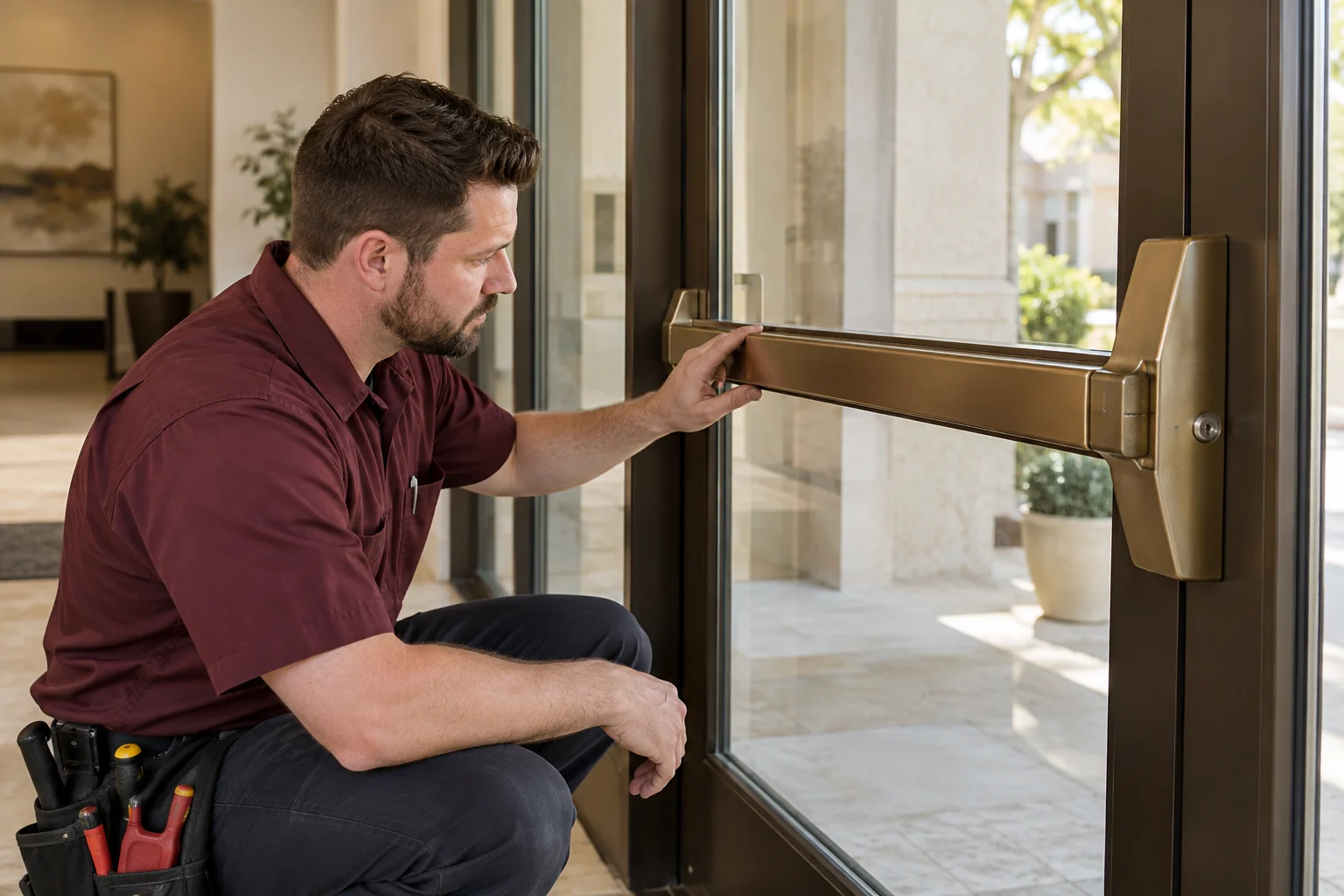
Glass storefront doors need hardware that fits narrow frames. Not every lock fits them, and some replacements require care to avoid damaging the glass. Read our article on storefront door lock repair to learn what to watch for, and ask about the frame as well as the lock whenever a door begins to misbehave.
Humid air and salt in the atmosphere take a toll on exterior hardware. Metal parts corrode, springs stiffen and finishes dull. Wiping handles and keeping the keyway clear is a modest habit that slows wear. During storm season, check that doors still close on their own and that closers do not slam or hang. A door that fails to latch overnight is an open invitation, however good its lock may be.
- Test the front door lock each week and note any stiffness.
- Keep the back door closed and latched when not in use.
- Replace worn cylinders before they fail at closing time.
- Check that glass doors still close fully and latch.
Keys for shifts, seasons and temporary staff
Businesses with shifts or seasonal staff face a revolving door of key holders. The simple solution of handing out copies leads to a pile of unrecorded keys. A better approach is to decide in advance who needs a key, for which doors, and for how long.
For temporary workers, consider whether a key is needed at all. A manager may open and close, or a keypad code may be changed after the season. If keys are issued, record the name, the date and the key number, and collect it on the last day. Treat missing keys as an event that triggers a lock change.
Delivery partners, contractors and cleaners fall between staff and strangers. Where possible, arrange for someone from the business to let them in and lock up after them, or use a door that opens only to a limited area. If they must hold a key, make it a separate key to a limited set of doors, record it, and ask for it back when the contract ends. Clear terms avoid awkward conversations later.
Restricted key systems can help. They use key blanks that are not sold freely, so duplicates can be made only through an authorized channel. That slows unwanted copying considerably. Our article on high security and restricted keys explains how they work and when they are worth the effort.
Whatever you choose, make the handover and the return part of the routine, not an afterthought. A short sign out sheet, a labeled tag instead of a business name on the keyring, and a rule that keys never leave the premises unless specified all reduce the chance of loss. A key tagged with your shop name is a gift to anyone who finds it, so use a number or code instead.
Cash rooms, stock rooms and sensitive areas
Some spaces deserve stronger protection than the rest. A room that holds cash, medication, tools, electronics or confidential records should have a sturdy door, a strong lock and a limited list of key holders. A thin interior door with a light knob lock offers little real protection.
Think in layers. An outer door, an inner door and a locked cabinet give anyone attempting entry several hurdles. Each layer slows them down and increases the chance that someone notices. The aim is not to make theft impossible but to make it difficult enough that the effort is not worthwhile.
Safes can complement locks. A suitably sized safe, bolted down, keeps cash and key documents protected even if a door is breached. Our guide on choosing a safe covers the main points, and our page on safe opening explains what can be done if a combination or key is lost.
Record the combination or key of any safe in a sealed place that is separate from the safe itself, and tell at least one other trusted person where it is. Check that the safe is anchored to the floor or a wall, because a safe that can be carried away protects very little, however strong its door may be. Businesses are often caught out when the one employee who knew the combination leaves or becomes unavailable. A little redundancy in who knows what turns that scenario into a minor inconvenience.
Desks, file cabinets and everyday storage
Not every lock protects a door. Desk drawers, file cabinets and storage units carry small locks that often receive no attention. These locks are usually modest in strength, yet they offer a sensible first barrier for papers, small valuables and personal belongings.
A common problem is lost keys. Cabinets are often sold with two keys, which are soon misplaced. When both are gone, the contents become inaccessible. A locksmith can make a key or open the lock without ruining the furniture. Keep a spare in a safe place, and note the number stamped on the lock, which can help to identify the key.
Our article on file cabinet and desk locks explains how they work and what can be done when keys are lost. For businesses with many cabinets, keying them alike under one key reduces the number of keys to track, though it concentrates access, so think about who should hold that key.
Do not forget mailboxes, display cases and equipment cabinets. Each is a small container with a small lock, and each tends to be forgotten until the key vanishes. Add them to your key record along with the doors, so that when someone asks who holds the key to the supply cabinet, the answer is written down rather than remembered, and the lock can be rekeyed if the holder moves on.
Accessibility and door hardware
Doors in places open to the public must work for everyone, including people with limited hand strength, people using wheelchairs and people carrying packages. Hardware choices influence this. Lever handles are easier than round knobs, and some doors need push buttons or automatic openers.
Rules about accessibility apply to many businesses, and they affect door width, handle type, closing force and threshold height. Requirements vary by building and use, so check with your landlord, your building manager or the authority that handles such rules before changing a public entrance.
A lock change can unintentionally affect accessibility if it replaces a lever with a knob or adds a latch that is hard to operate. Our guide on door compliance audits for commercial spaces offers a plain overview of what an audit looks at, which helps you prepare for a conversation with the people who decide.
Practical details matter here. Thresholds that catch a foot, doors that close too hard or too slowly, and handles mounted at awkward heights can all cause trouble. Walk your entrance as a visitor would, then try it again as a person with limited strength, carrying something in one hand. If the door feels hard to use for you, it is probably hard for someone else, and a modest adjustment may fix it.
Keeping records you can actually use
Good records turn locks from a mystery into a system. At minimum, keep a list of doors, the type of lock on each, the number of keys issued and the names of the holders. Add the date of any change. A page in a notebook is better than nothing, though a spreadsheet is easier to update.
Keep the record somewhere secure and make a copy. A key list in an unlocked drawer by the register defeats its own purpose. Limit who can see it to the people who need it, and update it whenever a key is issued, returned or replaced.
Go over the list periodically. Walk the building with the sheet in hand and check each door. Do the keys that were issued still exist? Has anyone left? Do all locks match the record? This habit takes little time and catches drift before it becomes a problem. Pair it with a yearly check of closers, hinges and strike plates, since loosened screws on a busy door tend to appear gradually and are easy to tighten when found early. Our article on master key systems for a business shows how a structured system makes records easier to maintain.
Planning a lock change without disrupting the day
Lock work can be scheduled to avoid disturbing customers or staff. Decide which doors need attention, and choose a time when the business is quiet. Replacing the main entrance lock at midday can interrupt trade, while rekeying an interior door after hours might not.
Tell the people affected. Staff should know when locks will change and when new keys will be available. A short note prevents confusion and unexpected lockouts. If you are a tenant, inform the property manager so that they can note the change and, where required, receive a key.
The usual sequence applies. You call and describe the doors and the place. The work and price are explained before it begins. When it is done, the work is tested with you, and you receive the right number of keys. See also the local pages on lock installation in Tamarac and rekey service in Tamarac for related guidance.
After an incident, a move or a change of ownership
Some events call for an immediate look at the locks. A break in, an attempted entry, a theft by someone with keys, a change of ownership or a move into a new space all raise the same question: who can enter now? Start by assuming that former keys still exist.
After an incident, make the building safe and report it as needed. Then repair damage to doors and frames, and consider rekeying or replacing locks. Examine the weakness that was exploited, such as a light lock or a thin frame, and fix that, not only the visible damage.
When you take over a space, rekey everything before you stock it. Previous tenants, brokers, contractors and cleaners may have held keys. Our guide to recovering after a break in lays out practical steps, and the article on rekeying an office after an employee leaves describes a related routine that suits many small businesses.
Common questions
How many keys should a small business have?
Only as many as there are people who truly need them, plus one or two spares stored securely. Keep a written list of who holds each key, and collect keys when people leave. If you cannot account for a key, consider rekeying the lock.
Can I rekey my office if I rent the suite?
It depends on your lease. Many landlords require approval and may ask for a copy of the new key. Contact the property manager before you change anything, and keep their answer in writing so everyone is clear about who holds access.
What are restricted keys?
Restricted keys use blanks that are not sold freely, so copies can be made only through an authorized channel. This reduces casual duplication. They are useful for businesses that want tighter control, though they require planning and a clear process for ordering extra keys.
Should file cabinets be locked?
If they hold private papers, valuables or client information, yes. Cabinet locks are usually modest but still add a barrier. Keep a spare key in a secure place, and consider keying cabinets alike if you have many, while thinking about who should hold that key.
Do door locks affect accessibility rules?
They can. Handle style, closing force and latch operation all influence how easily people can use a door. Requirements vary by building and use, so ask your landlord or the authority that handles such rules before replacing hardware on a public entrance.
How do I prepare for a commercial lock visit?
List the doors involved, note the type of lock on each, and confirm who may approve changes. Gather any key records. Explain whether the job is urgent or planned. Expect the work and price to be explained first and the result to be tested with you.
Talk through the job before work begins
Explain the problem, what has to work again and who needs access afterward. We talk through the scope and the price first, and work begins after you agree.
Call (954) 888-8804