Commercial Locksmith in Weston
A business door works harder than a house door, and the people who hold keys change more often. This page is general guidance for Weston owners and managers who want sound control over who can enter which spaces.
Call (954) 888-8804How business locks differ from home locks
A home front door might open a handful of times a day. A shop or office door can open hundreds of times, and each of those openings wears the latch, the hinges and the closer. Hardware built for a house tends to loosen and sag under that kind of use, which is why commercial buildings call for sturdier parts designed for heavy traffic.
The people side differs as well. A family knows who holds a key. A business may have employees, managers, cleaners, delivery contacts, landlords and contractors, all with different needs. Some should reach only the front area, others the stock room, and a few the safe or the server closet. Planning who can go where is as important as choosing the lock itself.
Finally, a business door sits inside a web of obligations. Insurance, landlord requirements, fire and accessibility expectations and the nature of the premises can all shape what hardware is allowed or required. We do not state those rules here, since they differ with each building. The sensible habit is to ask your landlord, insurer or the relevant local authority what applies, and then plan your locks around the answer.
It also helps to think about your neighbors in a shared building. Plazas, office parks and mixed use developments often have common corridors, shared entrances and a landlord who controls some doors while you control others. Knowing where your responsibility begins and ends keeps you from paying for work on something that belongs to someone else, and from changing something that you were never permitted to touch.
Understanding hardware grades
Commercial hardware is graded by how much use and abuse it is built to take. The ratings are not a marketing flourish. They reflect testing for cycles of opening and closing, resistance to force and strength of the parts. A higher grade usually means heavier internal components and a longer working life under busy conditions.
Choosing a grade means matching the door to its job. A rarely used storage room does not need the same hardware as the main entrance on a busy street. Spending more on the doors that take the heaviest use and carry the highest risk is often more sensible than buying the highest grade for everything. Our explanation of commercial lock grades walks through the idea in plain terms.
When you talk to a locksmith, describe how the door is used. How many people pass through it each day? Is it exposed to weather? Does it open onto a public space or a private corridor? Answers to those questions say more about what you need than a model number does. They also help you avoid paying for strength you will never use, or skimping where it matters.
A final point on hardware is maintenance. Even the sturdiest lock needs occasional attention, such as tightening loose screws, checking that the latch lines up with the strike, and making sure the closer still brings the door to a gentle stop. Ten minutes of attention at regular intervals extends the life of the hardware and flags problems while they are small and manageable.
Keys, master keys and restricted systems
Even a small business can end up with a confusing tangle of keys. A master key system organizes them in layers. One key, held by the owner, opens everything. Department keys open groups of doors. Individual keys open only one room. The benefit is that each person carries only what they need, while the owner keeps overall control.
Such systems need planning. The design should reflect your actual structure, not just your current staff, and it should leave room to grow. A system built too tightly can force a costly redo when you add a room or a department. Our guide to master key systems for business sets out the questions worth asking before you commit.
Restricted keys add another layer. With them, the key blanks are controlled, so a copy cannot be cut at any counter without authorization. For a business that worries about stray copies, this is a useful protection. It does bring a small cost in convenience, because getting another key means going through the proper channel. Read more in our piece on high security and restricted keys.
When an employee leaves
Staff turnover is the most common reason a business needs to change its locks. A departing employee may hand over every key, or may not. Even with good intentions, a former employee could have had a copy made years ago. The only certain way to end access is to change what the keys open.
Rekeying is usually the practical answer, since it changes the lock to respond to new keys without replacing the hardware. It is especially valuable when the departure was unfriendly, but it is wise even when it was amicable. Treat it as ordinary hygiene, in the same way you would change a password. Our guide to rekeying an office after an employee leaves covers the steps.
Keep a log of who was issued which key, and when it came back. Without such a record, you cannot be sure what is outstanding. Consider using key tags with numbers, not names or addresses, so a lost key does not announce what it opens. If your team is large or turns over often, think about whether an electronic system would serve you better than metal keys.
Keys versus electronic access
Electronic access control replaces or supplements keys with cards, fobs, codes or phone credentials. Its great advantage is that a lost credential can be disabled without changing a lock, and that a record shows who entered and when. For a business with many users or frequent change, that can simplify management.
The trade offs are real. Electronic systems need power, upkeep and sometimes network connections. They have a higher starting cost and a need for planning, and they can fail in ways a simple key does not. Many businesses find that a mix works well, with electronic control on main entrances and good mechanical keys on secondary doors.
Our article on access control versus keys for a small business helps frame the decision. Ask yourself how many people need access, how often it changes, and how much a record of entries would help you. Ask also what happens if power fails. A thoughtful answer to that last question is part of any sound plan.
Whichever route you take, keep a plan for the unexpected. Know where the master or override key is stored, who is trusted to use it, and what you will do if a reader or controller stops responding in the middle of a business day. A tested fallback turns a stressful outage into a short interruption, and the small effort of writing it down pays for itself the first time it is needed.
Storefronts and the doors the public uses
Storefront doors take a beating. Glass doors with narrow frames, aluminum hardware and constant traffic mean that latches wear, closers drift and locks loosen. A door that does not close properly is a security gap and an annoyance, and customers notice. Regular attention prevents small faults from becoming failures.
Typical symptoms include a lock that needs a shove to engage, a key that sticks, a door that hangs low and drags, or a closer that slams or barely moves. Each can often be fixed with adjustment or a part replacement, if caught early. Left alone, they usually get worse, and a door that cannot be locked at closing time is a serious problem. Our guide on storefront door lock repair describes common faults.
Coastal humidity and salt air work against aluminum and steel parts, so wipe hardware occasionally and watch for corrosion. Keep the area around the lock clean, and do not let paint or sealant clog the mechanism. If the door is part of a hurricane preparation plan, think about how any shutters or barriers will interact with the locks, and plan the work in the right order.
Customers form impressions from small things, and a door that sticks or a lock that rattles tells them something about the care a business takes. Keeping the entrance in good order is a quiet form of marketing as well as security. Make a habit of trying the lock from outside at closing time, and again at opening, so any problem is caught before it affects a busy shift.
Exit devices and doors that must open easily
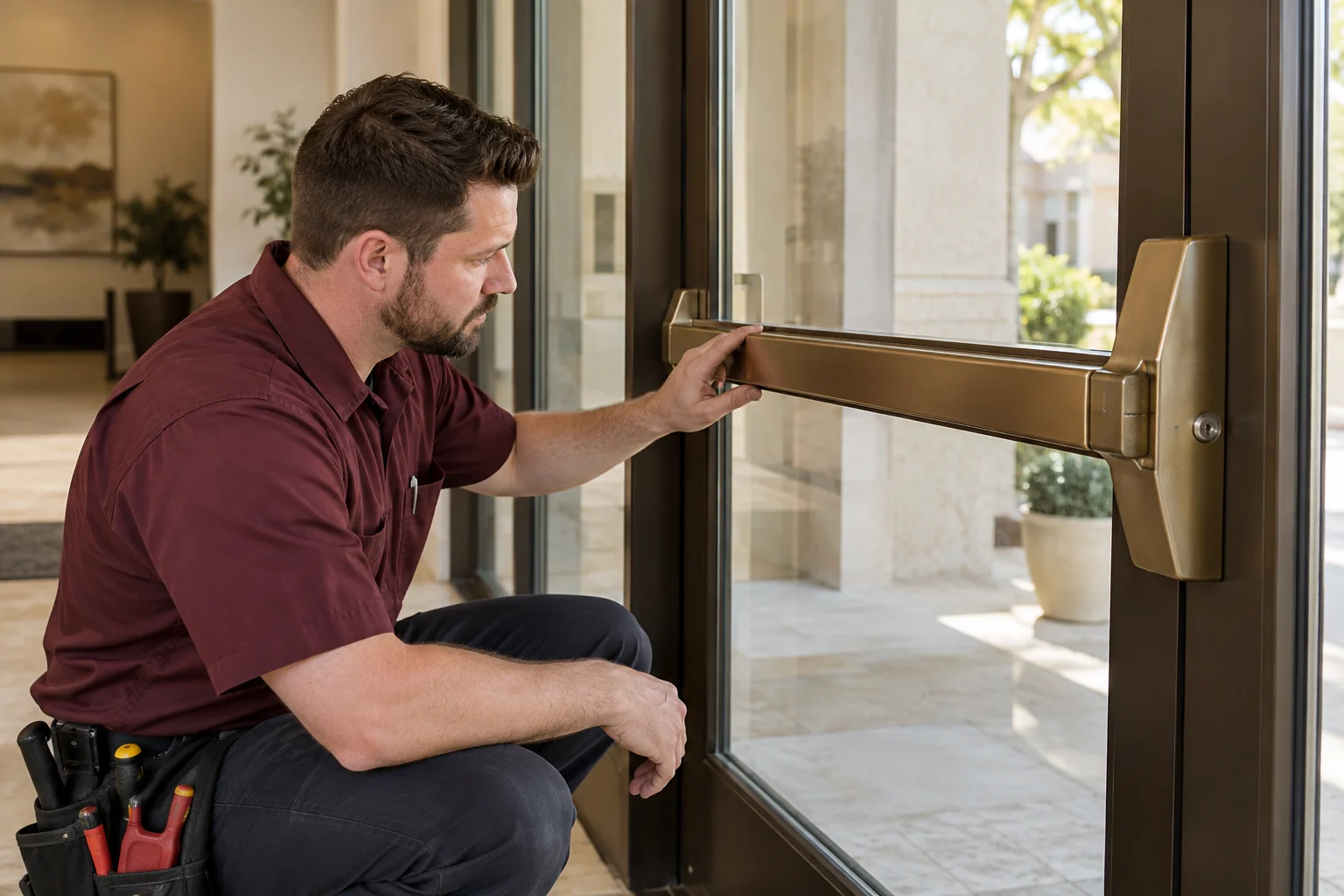
Some doors in a business have a special duty: they must let people out readily and without special knowledge, even while remaining secure from the outside. Panic bars and similar exit devices serve this purpose. A person pushing on the bar releases the latch, with no need to find a key or turn a knob.
Because these doors matter for safety, they should never be altered casually. Chaining, blocking or disabling an exit door can have serious consequences. Requirements for exit hardware depend on the type of building and its use, and they are enforced by local authorities. Ask your landlord or the relevant local office what applies to your premises. Our guide to panic bars and exit devices explains how they work.
If an exit device sticks, rattles or fails to latch, treat it as a priority. Do not wait for an inspection to point it out. Maintenance is generally straightforward when handled early, and a working exit door protects both your people and your business. Remember also that a working device on an emergency exit must remain easy to use, whatever your security concerns may be.
Accessibility and door audits
Doors also have to work for people with different abilities. Handle shapes, the force needed to open a door, the clear width and the way a threshold sits can all affect whether someone can enter independently. These are not minor details, and they matter for customers, employees and visitors alike.
Businesses sometimes carry out a walk through audit of their doors to spot problems. The idea is to look at each door from the point of view of someone using it with limited reach, strength or vision. Our article on door compliance audits for commercial buildings describes what such a walk through might cover.
We do not claim to state what the law requires for your building, because that depends on many factors. What we can do is explain how hardware works and help you carry out changes you have decided on. For questions about what is required, ask your landlord, your attorney or the relevant local authority. A locksmith's role is to make the hardware do what you need it to do.
Keep records of any changes you make to doors and hardware, with dates and notes about what was done. If a question arises later from an inspector, an insurer or a new landlord, those records settle it. They also help the next person who works on the door understand what is already there, which saves time and avoids repeated guesswork.
Offices, desks and internal security
Security is not only about the front door. Inside an office, filing cabinets, desks, cash drawers, supply rooms and server closets may all need protection from people who are inside the building legitimately. Internal locks help limit who sees sensitive records and who can reach money or equipment.
Small locks are often overlooked and often misused. A cabinet lock whose key lives in the top drawer is no lock at all. Think about where keys are kept, who holds them and what happens when they are lost. Our guide to file cabinet and desk locks covers the practical side, including how such locks are changed or replaced.
Decide what really needs locking, rather than locking everything out of habit. Excessive locking frustrates staff and encourages shortcuts like propping doors open. Protect what is sensitive and valuable, and make everyday access easy. A system people can work with is far more secure in practice than a strict one they find ways around.
How a commercial visit works
As with any locksmith job, you call and describe the situation and the place. Explain what kind of business it is, what doors are involved and what has happened. If you are a tenant, mention that, since landlords often have a say in locks. The work and the price are explained before the work begins, and the finished work is tested with you.
Be ready to establish that you are authorized to request the work. A manager, an owner or a person with delegated responsibility is the right contact. Tenants should confirm what their lease allows, and building managers should confirm who may order changes. Clarifying this at the start prevents awkward disputes and wasted effort later.
Plan any work around your business. Some jobs can be done after hours or on quieter days, and some cannot. Tell the person on the phone what constraints you have. No one can promise exact timing before seeing the door, but good planning makes disruption smaller. Afterward, make sure you know how many keys or credentials exist, who holds them and where records are kept.
Planning ahead and related reading
Many commercial lock problems arrive without warning, but many can be foreseen. Walk your premises periodically and test every door. Does it close and latch by itself? Does the key turn easily? Are there signs of forced attempts? A short monthly walk takes little time and reveals trouble before it becomes expensive.
If you are thinking about new hardware, it can help to read the general page on lock installation in Weston and the overview of commercial locksmith services. For a broader picture of the area, see the page on locksmith services in Weston. Neighboring communities have similar pages, such as commercial locksmith help in Sunrise.
This page is general guidance for businesses in Weston. It does not describe any particular building, street or neighbor, and it does not replace advice from your landlord, insurer or local authorities. Use it to prepare good questions, to understand the options, and to decide what to do first. The goal is a business where the right people can enter the right places, and no one else can.
Common questions
Can a business door lock be rekeyed after staff changes?
Yes, in most cases. Rekeying changes the lock so that old keys stop working and new ones are required, without replacing the hardware. It is a common response to staff turnover. A locksmith can examine your locks and tell you whether rekeying is practical or whether replacement makes more sense.
What is a master key system?
It is a layered arrangement in which one key opens every lock, other keys open groups of locks, and individual keys open only one. It lets each person carry only what they need while the owner keeps overall control. It should be designed carefully, with room for future changes.
Do I need electronic access control?
Not always. Electronic systems suit businesses with many users or frequent change, since a lost credential can be disabled without changing locks. Smaller operations often do well with good mechanical keys. Weigh upkeep, power needs and cost against how much you value entry records and easy management.
Are there rules about exit doors in my building?
Yes, there are, and they differ with the building and its use. Do not alter, block or disable exit hardware without checking. Ask your landlord, insurer or the relevant local authority what applies to your premises, and use a locksmith to carry out the approved work.
Who can order lock changes at a leased space?
Usually the lease governs this. Landlords often have rights or requirements about locks and keys. Check your lease, and involve your landlord or property manager before changes. A locksmith will want reasonable confirmation that you are authorized to request the work.
What should I prepare before calling?
Know the address, the type of business, which doors are involved and what has gone wrong. Note the lock type if you can see it, and have proof that you are authorized to request the work. Mention any limits on timing or access so the plan fits your operations.
Talk through the job before work begins
Say what went wrong and what you need to work when we leave. Scope and price are settled with you ahead of the work.
Call (954) 888-8804