Commercial Locksmith in Coconut Creek
A business door does more than keep strangers out. It controls who comes and goes, protects stock and records, and has to open freely in an emergency. This page is general guidance for Coconut Creek owners and managers.
Call (954) 888-8804What makes a business lock different from a house lock
A front door at home usually has one family, a handful of keys and a simple routine. A business has staff who change, vendors who visit, cleaners who come after hours and sometimes tenants who share a building. Every one of those people adds a question about who holds a key and what that key should open. Commercial hardware exists to answer those questions in an organized way.
The hardware itself is also built differently. Commercial locks tend to use heavier cylinders, stronger strike plates and levers instead of round knobs, because a door in a public building gets used hundreds of times a day. Closers, panic bars and electric strikes show up on commercial doors far more often than on homes. Each added piece has to work with the others, or the door becomes a problem instead of protection.
This page is general guidance for businesses in and around Coconut Creek. It does not describe any particular building, and the right answer for your door depends on the door itself, so a technician needs to look at it before anything is decided. If you are choosing between several kinds of work, the overview on the commercial locksmith page shows how the services fit together.
Start with an honest list of your doors
Before calling anyone, walk the property and write down every door that locks. Include the front entrance, a rear or loading door, the office behind the counter, the storage closet, the server or supply room, any gate and any side exit. Note which ones are used by customers and which are staff only. This list is the single most useful thing you can hand to a locksmith, because it turns a vague request into a defined job.
Next to each door, write what is on it now: a knob, a lever, a deadbolt, a panic bar, a keypad or an electronic reader. Write down who has a key and, if you can, how many keys exist. Many owners discover during this exercise that nobody can say for certain how many copies are out there. That uncertainty is the usual reason a business decides to rekey.
Finally, mark the doors that matter most. A door to a cash room or inventory area deserves more attention than a door to a break room. Your list becomes a priority order, so the work can be done in a sensible sequence instead of all at once.
Take a few photographs while you walk. A picture of the door, the lock face, the edge of the door and the frame lets a technician understand much of the situation before arriving. It also gives you a record of how things looked before any work started, which is handy if more than one person manages the property.
- Count every lockable door, including gates and storage rooms.
- Write down the hardware type on each door.
- Record who holds keys, and how many copies exist.
- Rank doors by what is behind them.
- Note any door that sticks, drags or fails to latch.
Rekeying a business after staff changes
When an employee leaves, especially one who held a key to the main door or to a stockroom, the safest assumption is that the key still exists somewhere. Rekeying changes the inside of the lock so old keys no longer turn it, while the lock hardware itself stays on the door. It is usually the simplest answer when the locks are sound and the only problem is who holds a key. The article on rekeying an office after an employee leaves walks through how owners usually think about it.
Rekeying is also a good moment to tidy the whole key system. If the shop currently has six unrelated keys on every ring, a locksmith can often recombine doors so that staff carry fewer keys. That is easier to supervise and easier to hand back when someone moves on. You can read more about how the process works in the guide on how rekeying a lock works.
If your locks are old, damaged or no longer matching your needs, replacement may make more sense than rekeying. The fair way to decide is to look at the condition of each lock rather than treating every door the same. A technician can explain the difference between a lock that only needs new pins and one that is worn through.
Keep a simple key log after the work is done. Write down each key by number or stamp, the door it opens and the person it was handed to, and ask people to return keys when they leave. The log costs a few minutes to maintain and saves a great deal of guessing the next time someone resigns or a key goes missing. Without it, even a freshly rekeyed building slowly drifts back into the same confusion.
Master key systems and who gets which key
A master key system lets one key open many doors while individual keys open only one. The owner or manager carries the master, a department head carries a key that opens that department, and a staff member carries a key for the door they actually use. Done well, it cuts the number of keys on a ring and makes it easy to see who has access to what. The idea is explained plainly in the article on master key systems for business.
The tradeoff is that more flexibility means a more complicated lock design, and every extra level of access is a small extra risk. If a master key is lost, far more doors are affected than if an ordinary key goes missing. That is why many owners keep the top level of keys in very few hands and keep a written record of every key issued.
A related idea is keying several locks alike so one key works on all of them, which suits a small shop with a front door, a back door and an office. The guide on keyed alike and master key choices compares the two approaches so you can match the setup to your size.
Exit devices, panic bars and doors that must open in an emergency
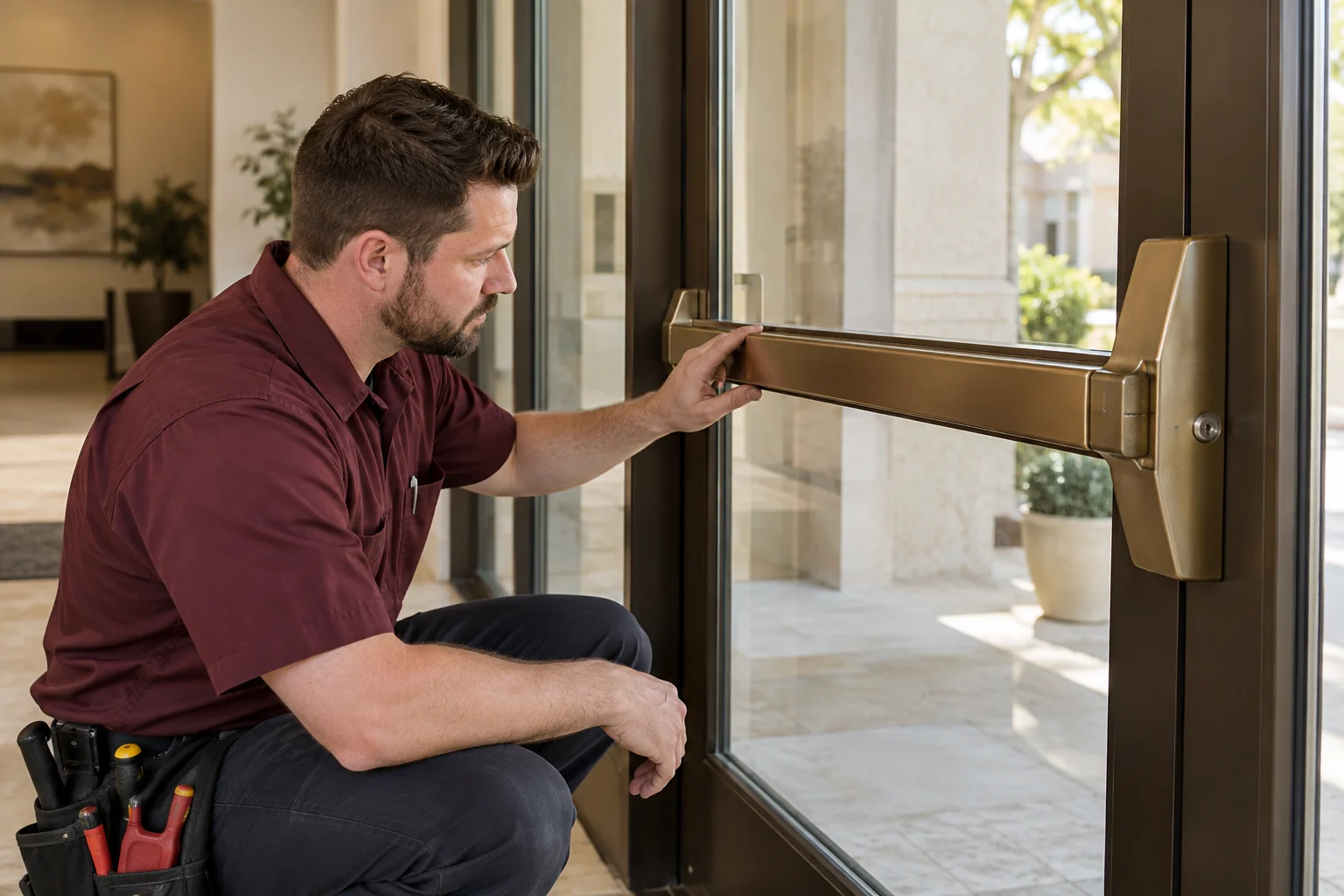
Some doors in a business are meant to open from the inside with one push, even when locked from outside. Panic bars and similar exit devices do this. They are common on rear doors, stockroom exits and any door that leads people out of a busy space. They are also a safety item, so a business owner should treat them with care and not defeat them to save a few steps.
Exit devices take heavy wear and can loosen, stick or stop latching correctly. A bar that does not retract smoothly, or a door that hangs open because the latch no longer catches, deserves attention soon. The article on panic bars and exit devices explains what the parts do and what to watch for.
Requirements for exits, fire safety and accessibility vary and depend on the building and its use. This page does not state what applies to you. Ask your landlord, property manager or the local authority that handles building and fire matters, and tell the technician what you learn so the hardware choices fit. For doors that must meet accessibility needs, the guide on door compliance checks for commercial spaces is a useful starting point.
Storefronts, glass doors and shared entrances
A storefront door is a different problem from a solid steel door. Many are aluminum frames with glass panels, and the lock is often a small cylinder at the bottom of the frame or a hook bolt that engages the strike in the header. These parts are exposed to heavy traffic, cleaning chemicals and, in a coastal climate, salt air that attacks metal finishes.
Common storefront complaints are a key that turns stiffly, a lock that no longer lines up after the door shifts, or a cylinder that spins without moving the bolt. Some of those need a small adjustment and others need a new cylinder or a repaired latch. The article on storefront door lock repair helps you describe the symptom clearly when you call.
Shared entrances add a human layer. In a plaza or office building, the landlord may control the main door while each tenant controls their own suite. Before changing any lock, find out who owns the door and who must approve the work. A good locksmith will ask this and will not touch a door you are not authorized to change.
Keys, cards and keypads: choosing what fits your staff
Traditional keys are simple to understand, but they are hard to track. A copy can be made without anyone knowing, and a lost key means changing locks. Keypads and card readers move the control from metal keys to codes or credentials that can be turned off for one person without touching the door hardware.
That flexibility has a cost: electronics need power, setup, and someone to manage the list of users. A reader on a door that is propped open all day, or a code shared with the whole staff, adds convenience but weakens control. The article comparing access control and keys for a small business lays out the tradeoffs without pushing one answer.
Many small businesses end up with a mix: ordinary keys on interior doors and electronic control only on the main entrance or a sensitive room. That keeps cost and complexity reasonable. Whatever you choose, plan who manages it, because a system nobody supervises slowly becomes a system nobody trusts.
Think about what happens when the power or the network is down. Hurricane season in South Florida makes outages a real planning topic, not a remote one. Ask how a given door behaves without power, whether a mechanical key still works as a backup, and where that backup key is kept. A door that locks everyone out during a storm recovery is a bad surprise for staff and for anyone trying to check on the building.
Understanding hardware grades
Commercial locks are sold in grades that describe how much abuse they are built to take. A higher grade usually means thicker metal, stronger internal parts and a longer expected life under heavy use. A door that opens a hundred times a day in a busy retail space needs a sturdier lock than a closet that opens once a week.
Matching grade to use saves money and trouble. Putting a light duty lock on a busy entrance means it wears out and loosens early. Putting heavy hardware on a rarely used door spends budget that could protect something more important. The reference on commercial lock grades explains how to read the labels.
Coastal conditions matter too. Humidity and salt air can corrode thin plated finishes and make keys stick, and those problems tend to show up first on the doors people use most. When you talk to a technician, mention if the door faces outdoors or sits near a pool, loading area or open walkway. It affects which finish and which internal parts make sense.
Regular care extends the life of any grade. A door that drags on its frame, a closer that slams, or a latch that barely catches puts extra stress on the lock every single day. Fixing the door alignment often solves a problem that seems to be about the lock. A technician who looks at the whole door, not only the cylinder, can often save you from replacing parts that were never the real cause.
Adding locks to a new space or a new tenant move in
A new tenant often inherits a space with locks from a previous occupant. The first practical step is to rekey every door so keys from the old tenant, the old contractor and the old management no longer work. Doing this before moving inventory in is far easier than doing it after.
If the space needs additional hardware, such as a lock on an office door, a deadbolt on a back door or a secured storage cage, talk it through with the technician before buying anything. Doors differ in thickness, frame material and swing direction, and hardware that looks right in a catalog may not fit. If new hardware is the main goal, the page for lock installation in Coconut Creek covers that side in more detail.
Keep the lease in mind. Some leases limit what a tenant can change on exterior doors, or require that the landlord keep a key. Read yours or ask the property manager, then tell the technician what you learned. That avoids doing work that has to be undone.
How to prepare for a call and what happens next
The most helpful call is a short, specific one. Say what kind of business you run, which door or doors are involved, what the hardware looks like, and what is wrong or what you want to change. If a door will not lock, say whether it is the key, the latch or the door alignment that seems off. The more clearly you describe the situation, the fewer surprises on site.
The process is simple. You call and describe the situation and the place. The work and the price are explained before it begins, so you can decide with full information. When the work is finished, it is tested with you at the door, so you can see for yourself that it operates the way it should.
If you manage more than one location, or your property has several doors, ask for a plan rather than a single repair. A planned approach often covers locks, keys and records together. Nearby communities have their own pages as well, such as commercial locksmith help in Margate, and the full list of work is on the services page.
Common questions
Can a commercial locksmith work on a door I rent?
Often yes, but you should confirm who owns and controls the door first. In many leases the landlord has a say over exterior doors and may require a copy of the key. Check your lease or ask the property manager before any work begins, and tell the technician what you learn so the plan stays within the rules.
What is the difference between rekeying and replacing a business lock?
Rekeying changes the internal parts so old keys stop working while the lock stays on the door. Replacing swaps the whole lock for new hardware. Rekeying fits sound locks with a key control problem. Replacement fits worn, damaged or unsuitable hardware. A technician can look at each door and tell you which applies.
Do I need a master key system for a small shop?
Not always. A shop with a few doors may do fine with keys that are keyed alike, so one key opens everything the owner needs. A master system makes more sense when different people need different levels of access. The right choice depends on staff size, layout and how much control you want over who holds what.
How do I know if my panic bar needs attention?
Watch how it behaves. If the bar sticks, does not return fully, or the door fails to latch after closing, it needs a look. Also notice any loose mounting or unusual noise. Because these devices are part of safe exit, do not leave a faulty one in use. Describe the symptoms when you call.
Should I choose electronic access control or regular keys?
It depends on how many people need access and how often they change. Electronic control makes it easy to remove one person without changing hardware, but it needs power, setup and someone to manage users. Regular keys are simpler but harder to track. Many small businesses use both, with electronics on the main or sensitive doors.
What should I tell the locksmith when I call about a business door?
Describe the type of business, which door is involved, what hardware is on it, and what the problem or goal is. Mention whether it is a glass storefront door, a steel back door or an interior office door. Also say whether you own the space or rent it. That helps the technician come prepared.
Talk through the job before work begins
Say what went wrong and what you need to work when we leave. Scope and price are settled with you ahead of the work.
Call (954) 888-8804