Commercial Locksmith in Margate
A business door gets used far more than a home door, by more people, with higher stakes. This page is general guidance for Margate owners and managers on storefront locks, key control, exit hardware and planning.
Call (954) 888-8804Why business doors are a different job
A front door at home might open a few times a day. A shop door can open hundreds of times, often with a tired hand, a delivery cart or a customer pushing from the other side. That repeated use wears hinges, latches and cylinders in ways that a house rarely sees, so commercial hardware is built heavier and is expected to be maintained.
There is also a different kind of risk. A business holds inventory, cash, records and equipment, and it often has staff who come and go. The question is not only whether a stranger can get in, but who has a key, who knows a code, and what happens when someone leaves the company.
Finally, a commercial door has to meet the needs of customers, employees and emergency exits at once. Locking the door tightly is easy. Locking it in a way that still lets people leave safely in an emergency is the real skill, and it is why a business should treat doors as a system rather than a pile of separate parts.
Because every building is different, this page stays general. It will help you ask better questions, but a careful look at your own doors will always matter more than any list.
A useful first step is a walk around your own premises at closing time. Try every door from the outside, notice which ones latch on their own and which need a push, look at who can see the entrances, and note any door that has been propped open or left unlocked out of habit. Those small observations often reveal more about your real security than a catalog of hardware ever could, and they give you something concrete to describe when you call for help or advice.
Storefronts, glass doors and aluminum frames
Many Margate shopfronts use aluminum framed glass doors. These carry narrow stiles, which means there is little room for the lock body. Hardware for these doors is often a surface mounted or a narrow profile lock, sometimes with a hook shaped bolt that grabs the frame.
Glass doors depend on the frame and the closer more than on the lock. If the door drags on the floor, if the closer slams it, or if the pivot hardware has loosened, the lock will fail to line up. A bolt that only catches when you push on the glass is a warning that the door has moved.
Salt air and humidity speed up corrosion of aluminum, steel screws and exposed hardware near the coast, so a door that was fine last year can start to bind. Regular attention to hinges, closers and thresholds costs less effort than waiting for a day when the door will not lock at all.
If your storefront door has begun to feel off, read storefront door lock repair for the common causes and what is worth checking.
Look also at the glass itself, the weatherstripping and the threshold. A worn threshold lets the door drop slightly as it swings, and a failing seal can let humidity swell the frame or corrode parts of the latch. After a storm, check the door for any shift in alignment. Hurricane season brings wind pressure that can rack a door in its frame, and boarding or shutters can leave hardware strained or bent. Catching a small misalignment early prevents a bigger failure on a busy morning.
Understanding commercial lock grades
Commercial hardware is sorted by grade, based on how it performs in strength and durability testing. The highest grades use thicker metal, stronger springs and parts built for heavy daily use. Residential grade hardware on a business door tends to wear out early, and may loosen or fail when it is needed.
Choosing a grade should be tied to how a door is used. A back door that opens a few times a day for deliveries, a main entrance used by many customers, and a private office door each deserve different decisions.
Higher cost does not always mean a better fit. A very strong lock on a weak frame or a thin door still leaves a weak spot. Look at the whole assembly: the door, the frame, the hinges, the strike and the lock.
Our article on commercial lock grades explains what the labels mean and how to match them to the doors in your building.
If you rent your space, remember that the landlord may own the doors, the frames and some of the hardware. Ask what you may change, what must stay, and who pays for repairs to existing parts. Get permission in writing before you replace anything, especially a main entrance. If a lock fails because of age, a clear record of when you reported it protects you from a dispute about responsibility later.
- Heavy use doors need hardware built for heavy use.
- Strong locks still depend on solid frames and hinges.
- Different doors in one building may need different grades.
- Corrosion near the coast can shorten the life of exposed parts.
- Plan replacement before failure rather than after a lockout.
Keys, key control and master systems
In a small business, the usual problem is not the lock but the number of keys. Over time copies multiply, nobody remembers who has one, and a former employee may still carry access. Key control is simply the habit of knowing who holds which key.
A master key system lets several locks work with their own keys while a higher level key opens all of them. A manager might hold the master, while staff carry keys for only their areas. It reduces the number of keys people carry, and it gives you a way to limit access by role.
Master systems take planning, because adding or changing a key later affects the whole structure. They also trade some security for convenience, since one key now opens many doors. Keep records and store the master carefully.
Read about master key systems for business and high security and restricted keys, where copies need proper authorization.
Whatever system you use, make one person responsible for the keys. That person keeps the list, hands out new keys, collects them when people leave and knows where the spares are stored. A small team can do this on a single page of paper. A larger one may need a more formal log. The point is that nobody should be wondering who has access, because the answer is written down and kept up to date.
When an employee leaves
Every business eventually faces this moment. An employee who held a key, a code or a fob leaves, and the owner has to decide how much change is needed. The answer depends on the person, the circumstances and the sensitivity of what they could reach.
For a key, the simplest solid answer is to rekey the affected locks, so the old key no longer works. For a code, change it. For a fob or card, deactivate it in the system. Waiting is the risky choice, because a forgotten key is easy to ignore until something goes wrong.
Handle the transition calmly and consistently. If you treat every departure with the same routine, nobody feels singled out, and you do not have to improvise when the situation is tense. A written checklist helps, and so does a record of who has been issued what.
Our article on rekeying an office after an employee leaves goes through the steps, and rekey guidance for Margate explains what the work involves.
Employees also leave under friendly terms, and it is fine to say so. Rekeying is not an accusation. It is housekeeping, the same as collecting a uniform or closing an email account. A matter of fact tone helps everyone involved, and it removes the question of whether a lost or kept key could ever cause trouble in the future. If a key is simply missing, treat it the same way and change the lock.
Keys, codes or access control
Mechanical keys are simple and dependable. They need no power, no network and no training. Their weakness is that they can be copied, lost and handed around without any record.
Keypads and card or fob systems solve some of those problems. You can change a code in seconds, disable a lost card without changing the lock, and in many systems see a log of who entered. The tradeoffs are cost, setup and the need for power and maintenance.
Many small businesses use a mix. A mechanical key for the back door, a keypad on a storage room, and a card reader on the main entrance is a typical pattern. The right combination depends on how many people you have, how often they change, and how much you need to know about who goes where.
Whatever you choose, keep a mechanical override for power loss and a plan for what happens if a system fails. Our article on access control versus keys for small business compares the options.
Cost is only part of the comparison. Think about training, about what happens when a staff member forgets a code, and about who manages the system when the person who set it up has moved on. Systems that depend on one person's memory tend to fail at the worst time. Pick something your team can actually run on an ordinary day, and write down the steps for adding and removing people so the job does not depend on a single employee.
Exit devices and panic bars
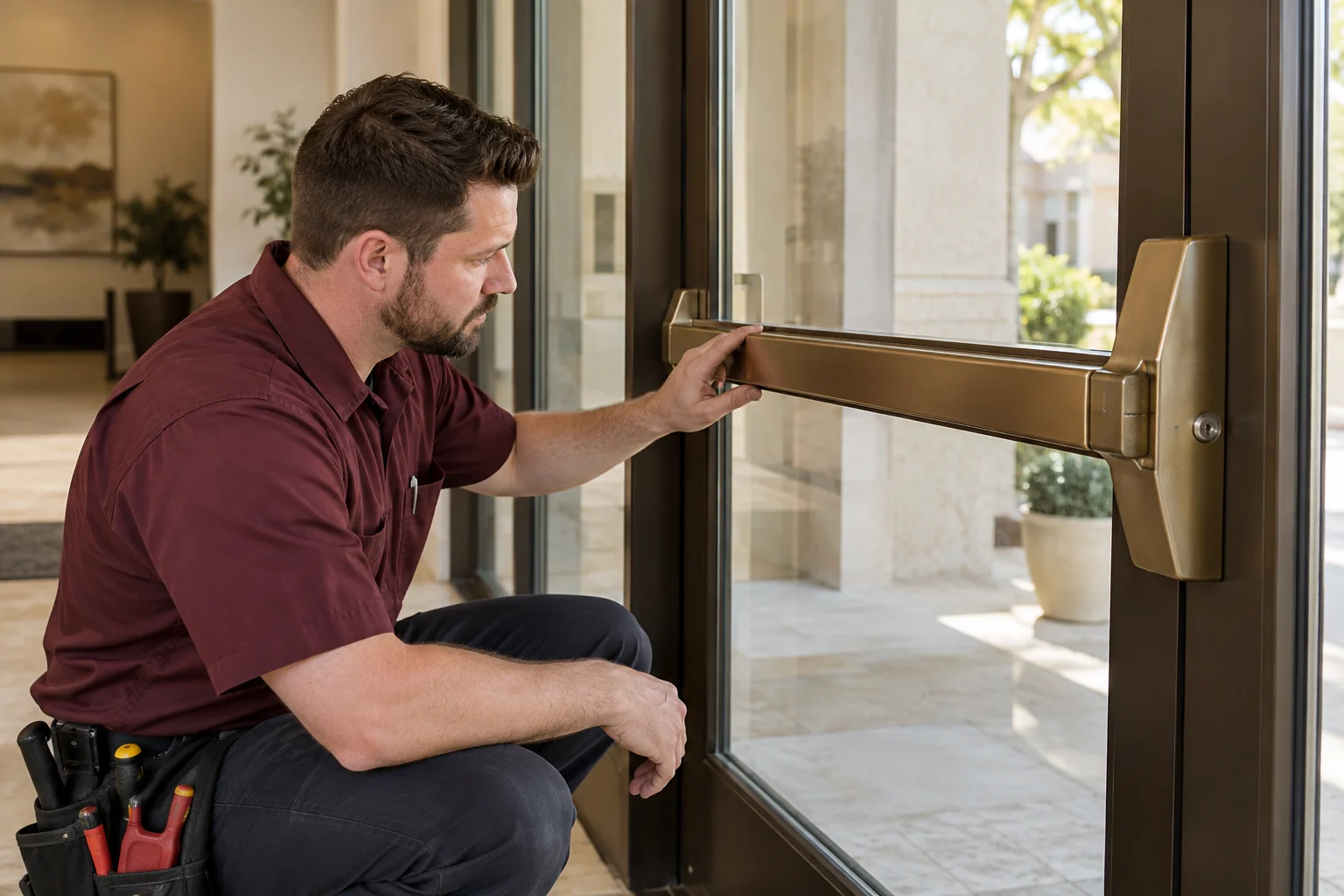
Many commercial doors need to open easily from the inside for people leaving. Panic bars, also called exit devices, let someone push a bar to open the door without a key or a special action. They exist because a locked door in an emergency can trap people.
Rules about when exit devices are required, and how they must work, depend on the building type, the occupancy and local fire and building authorities. This page does not state those rules. Ask your local building or fire office, or your landlord, what applies to your space.
Exit devices need care. The latch, the bar and the strike must line up, and the door must close fully so the device can engage. A device that sticks, rattles or fails to latch should be looked at promptly.
Read our business guide to panic bars and exit devices, and door compliance audits, to understand what to ask and who to ask.
Never chain, block or disable an exit device to stop people leaving by that door. It may seem like a simple answer to theft or loitering, but it removes the one thing the device was built to provide. If a door is being misused, talk to a professional about alternatives that keep it safe, such as alarms, signage or a change in how the door is supervised. Staff should know where every exit is and how it works.
Interior doors, desks and cabinets
Not every lock in a business guards the front door. Office doors, storage closets, server rooms, file cabinets and desk drawers all hold things that matter. Choose lock types to match what is behind each door.
Cabinet and desk locks are usually simple and offer limited resistance. They are meant to discourage casual access, not to stop a determined person. If the contents are truly sensitive, a better storage option may be needed.
Keys for these small locks are often forgotten. A desk key lost years ago can leave a drawer inaccessible and a replacement can take effort if nobody knows the brand. Keep a record, and label spare keys.
Our guide to file cabinet and desk locks covers what these locks can and cannot do, and how to replace one when the key is gone.
Mailboxes and cash drawers are another corner of the same problem. They are small, easily overlooked, and often secured with whatever lock came with them. If you receive important mail or handle money, treat these as real locks with real keys that someone is responsible for. Our guide to mailbox lock replacement shows how these small locks are approached.
New locks, upgrades and planning ahead
If you are moving into a new space, one of the first jobs is to find out who holds keys to it. Previous tenants, the landlord, contractors, cleaners and former staff might all have copies. Changing the locks before you open is a sensible step.
When planning new hardware, think about the whole building. Make a simple list of every door, its purpose, its current lock, and who needs access. Decide which doors share keys and which do not. Think about spare keys and who will store them.
Our guide to lock installation in Margate covers hardware choices, and the commercial locksmith page explains the wider services. Ask your landlord what you are allowed to change, since leases often limit alterations to doors and frames.
What to expect when you call
Call and describe the building, the doors in question, the locks you have now and the problem. Mention whether the business is open, how many people use the door, and whether the building has an owner or manager who should be told.
The work and the price are explained before it begins. If the job involves several doors, ask for the plan door by door, so you know what each one gets and what the keys will do. Ask how many keys will be issued and how extra copies are handled.
When the work is done, it is tested with you. Walk through each door, from both sides, and try every key. Test the door closers and the exit hardware as customers and staff would. Confirm that nothing sticks, rattles or fails to latch. Ask for the keys to be counted out loud and written on your list, with the name of each person who will carry one.
This page is general guidance for Margate businesses and does not describe specific past work. Requirements for fire, access and building use vary, so confirm them with the relevant local office or your landlord.
Common questions
Can residential locks be used on a business door?
They can be fitted, but they are not built for the volume of use a business door sees and tend to wear out sooner. Commercial hardware is made for heavier use. Describe how many people use the door and how often so a sensible grade can be discussed.
How do I stop old employees from using their keys?
Rekey the affected locks so the old keys stop working, and change any codes or deactivate any cards the person held. Do this as a routine for every departure, and keep a record of who was issued which keys so you know exactly what to change.
What is a master key system?
It is a setup where each lock has its own key, and a higher level key opens many or all of them. Managers hold the master, and staff carry only the keys for their areas. It needs careful planning and records, because changes later affect the whole system.
Should my business use keys or a keypad?
It depends on how many people use the door and how often they change. Keys are simple and need no power, while keypads and cards are easier to update and can record entries. Many businesses combine both and keep a mechanical backup.
Do I need panic bars on my doors?
Requirements depend on your building type, how many people use it and local fire and building rules. This page cannot say what applies to you. Ask your local building or fire office, or your landlord, and keep any answer in writing.
Can work be planned around business operations?
Tell the person on the phone when your space is busiest and which doors you cannot do without. The plan can be explained before work begins, so you can decide how to arrange it. Ask how each door will be secured while work is in progress.
Talk through the job before work begins
Start by describing the situation, the lock or key involved and who must have access. You hear the price and the plan before anything is done.
Call (954) 888-8804