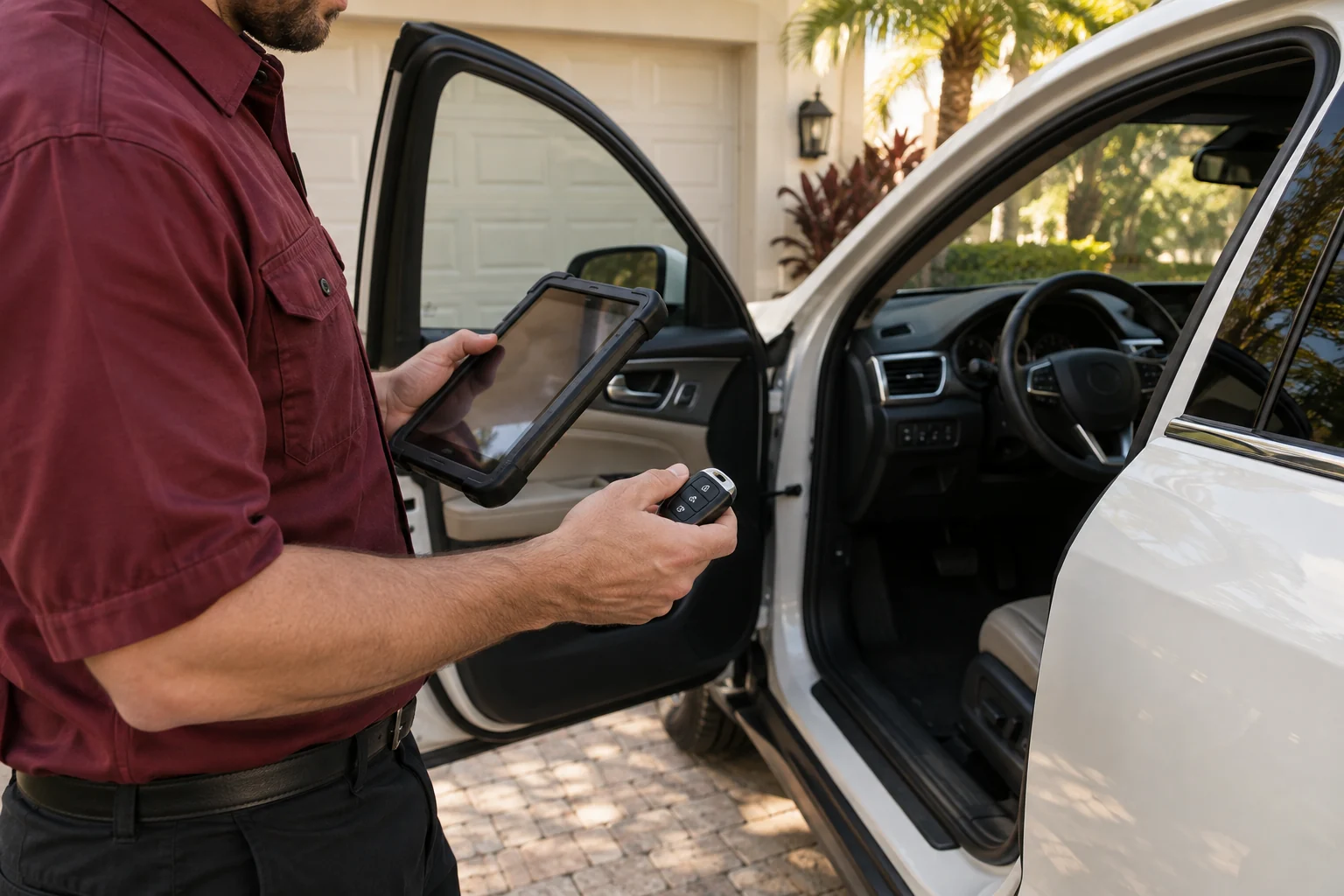
Automotive Locksmith in Davie
A vehicle you cannot start or enter turns a normal day into a problem to solve. This general guidance for Davie drivers covers lost keys, tired ignitions, used cars, work trucks and the choices that make each situation easier.
Call (954) 888-8804Why car keys are more than metal
Think of a car key as a conversation. When you press a button or turn the key, a small exchange takes place between the key and the vehicle, and the car decides whether to cooperate. Older keys had no such exchange; the shape of the metal was enough. Today, the shape may be only half of the story, and the other half is a code stored in a chip.
This is why a replacement key cannot always be copied at a hardware counter. The blade may cut perfectly and still fail to start the engine, because the car does not recognize the chip. A locksmith who works on vehicles can cut the blade and also introduce the new key to the car, which is the step most people have never heard of.
It also explains why prices vary from car to car. A basic metal key is a small job. A chip key adds programming. A smart key adds pairing and a more complex device. Knowing roughly which type you have lets you ask the right questions, and it lets the technician prepare before the visit instead of discovering the details at your car.
This page is general guidance for drivers in Davie, written without claims about particular streets or businesses. It is meant to help you understand the problem before you call. For the main service overview, see the page on car key replacement, which sets out the kinds of keys and the way they are made.
You bought a used car: how many keys came with it?
Used vehicles are a common source of key trouble. The seller may hand over one key and mention a spare they cannot find. Previous owners may have lost keys without telling anyone, which means unknown keys could still be out there. Even when a dealership supplies two keys, you cannot be sure they are the only ones in existence.
Sensible buyers treat the key count as part of the purchase. Ask how many keys the car came with originally, and how many you are receiving. If a smart key or fob is missing, replacing it can take more planning than the buyer expects, and it is better to know before the sale closes than after.
Once you own the car, think about whether the old keys should still work. On some vehicles a locksmith can add new keys and remove the old ones from the car's memory, so lost or unknown keys no longer start the engine. Ask whether that is possible for your model, because it brings a kind of peace of mind that is hard to buy any other way.
Do not forget the paperwork. Keep the bill of sale, title or registration with you when you meet the technician. If the vehicle came from a private seller, the paperwork matters even more, since it ties the car to your name. A calm, organized folder makes a new key request simple, and it saves everyone from awkward questions.
Trucks, SUVs and work vehicles
Bigger vehicles bring their own habits. Work trucks carry tool keys, gate keys and ring after ring of other tags, and the ignition cylinder carries the weight with every turn. The heavy ring is a quiet cause of wear that eventually leaves the driver with a key that sticks or a cylinder that will not release the key.
Trucks also have more places to be locked out of. Toolboxes, bed covers, cab doors and tailgates may each have a lock. A key lost on a job site can open more than the cab. Think about which locks share a key, and whether you want them to.
The cost of a key for a truck or a larger SUV can differ from that for a small sedan, because the key type and the programming steps depend on the model. For a general sense of what affects the price without naming numbers, read the car key replacement cost guide. It explains the factors a technician weighs when they give you an estimate.
If the vehicle belongs to a business, think about a policy. Who may hold a key? Where are spares kept? What happens when a driver leaves? For several vehicles, a simple register of keys by vehicle and driver prevents the confusion that arises when a van is needed at dawn and the only key is in someone's pocket across town.
Shared cars and family vehicles
In a household with several drivers, keys travel. A teenager takes the spare to school, a spouse leaves one in a jacket, a grandparent keeps one for emergencies. This works until it does not, and then nobody is sure where any key is. Counting the keys is a surprisingly useful habit.
Decide who owns which key and where each lives when not in use. A hook by the door, a drawer or a small lockbox in the house gives each key a home. The goal is to make it easy to find a key and hard for a key to quietly disappear.
If a key goes missing, think about its path. Was it lost in a place where someone could find it and connect it to your car? A key to a vehicle that is parked outside the home can reveal where you live. In some cases it is wise to have the key removed from the car's memory, or at least to watch the vehicle carefully until the question is settled.
Ignition wear and the key that sticks
An ignition cylinder is a small mechanism that has lived a hard life. It turns thousands of times, supports a swinging keychain, and sits in a dashboard that bakes in the sun. Over time the internal parts wear, and the key begins to hesitate. It may need a little jiggle, it may not release in the off position, or it may turn in the lock but not engage the starter.
Do not ignore these signs. A cylinder that is beginning to fail will often fail completely, and usually at an inconvenient moment. Early attention can mean a repair or a replacement at a time and place of your choosing, rather than in a parking lot.
If a key breaks off, resist the urge to dig at the piece. Extraction is a specific task, and unplanned attempts can push the fragment deeper. The page on ignition repair describes the service, and the article on a key stuck in the ignition helps you separate a steering lock issue from a worn cylinder.
Think about what else the ignition touches. In many vehicles the same key operates the doors, the glove box and the trunk, and a replacement cylinder must be matched to those locks or the key set must be remade. Mention any other lock that feels stiff, so the whole set can be considered in one visit.
Locked out at the trunk, the door or the pump
Lockouts happen in predictable places: at the fuel pump, in a shop lot, at the beach, at home in the driveway. The details differ, but the principles are the same. Protect yourself first, avoid force, and give the locksmith a clear description of the car and your location.
The trunk is its own puzzle. Keys locked in the trunk may be reachable through the back seat in some vehicles, while others offer no path at all. If you have a rear seat release, a technician can often use it. If you do not, other methods apply. Tell the person on the phone what model you have, and let them guide you.
The article on keys locked in the trunk explains the options in detail. For house and vehicle lockouts generally, the Davie page on lockout service covers what to do and what to tell the locksmith, and it contains notes on staying safe in the heat.
If a child or animal is inside the car, tell the person on the phone at once and contact emergency services if anyone seems unwell. Heat in a closed vehicle changes the situation completely. Everything else, including the lock and the cost, comes second to the safety of whoever is inside.
Restricted keys and why some cannot be copied
Some vehicle makers use keys that are protected against casual copying. The blade may be unusual, the chip may be locked to the car, or the key may be registered in a record that proves who is allowed to make more. This is meant to protect owners, and it also means that shortcuts do not work.
If your key carries a mark or a card that speaks about authorization, treat the card as valuable. Without it, the process of making a new key may require more steps, such as proof of ownership and a manufacturer's code. A locksmith can explain what applies to your car.
To understand the idea behind these keys, read about high security and restricted keys. It will help you ask the right questions and explain why a copy from a kiosk may not be possible.
Plan ahead if your key is of this kind. A replacement may involve more steps and more time than a basic copy, and that is a reason to make a spare early, while you hold a working key and every document you may need. Keep the paperwork that came with the car in a safe place at home, and not in the glove box.
Motorcycles, scooters and smaller vehicles
Two wheeled vehicles have keys too, and losing one can be an irritating surprise. Motorcycle keys may be simple or may include a chip, and the ignition switches can be exposed to weather. Parking outdoors in humid, salty air takes a toll on small switches and keyways.
Replacing a motorcycle key follows the same principle as for a car. The type of key decides how it is made, and some models require the key to be introduced to the bike. A locksmith can discuss what yours needs if you can tell them the make, model and rough year.
For more on this topic, read about motorcycle key replacement. If you ride, keep a spare at home and avoid carrying both keys on the same ring.
Smaller vehicles are often parked in tight places and carried on trailers, where keys get lost in transit. Before any trip, check that you have the key on you, not in a bag that will ride separately. Bikes also tend to be stored under covers in damp conditions, so a light check of the ignition switch for corrosion at the start of each season helps.
Heat, sun and the habits that protect a key
Cars in this part of Florida face conditions that older key designs did not anticipate. A closed car in summer sun can reach temperatures that soften glue, warp plastic and drain small batteries. A fob left on the dashboard cooks, and the battery inside it may weaken far sooner than the maker expected. Keep fobs in a bag, a pocket or a cup holder out of direct sun.
Moisture is the other enemy. Beach days, rainstorms and sweaty pockets all push damp air into the small gaps of a key head. If a fob gets wet, dry it carefully and leave it alone for a while before trying it. A fob that works poorly after a soaking is better looked at than pressed until it fails.
Little habits stretch the life of the ignition too. Take unneeded items off the ring, so the cylinder carries less weight. Insert the key gently and straight. Turn it without force. If the steering wheel is locked against the key, ease the wheel while you turn, and never use a tool to lever the key.
Finally, remember storms. When a hurricane warning is posted, check that your spare key exists, that the fob battery is healthy and that you know where the vehicle documents are. People who leave the area in a hurry often discover a missing spare at the worst possible moment.
What a visit should look like
You call, describe the vehicle, say where you are and explain the problem. The locksmith explains what the work involves and what the price will be before starting. The work is done at the vehicle, and at the end the finished key or repair is tested with you.
Be ready to show that the vehicle is yours, with a registration or title and a photo ID. A responsible technician will ask for this even when you are in a hurry. It protects you, and it protects every other driver.
Test everything before you let the technician go. Start the engine more than once. Use the remote buttons. Lock and unlock each door. If the key came with a fob, check each function. Only when you are satisfied should the job be finished, and the paperwork put with your vehicle documents.
If you are parked somewhere awkward, say so. A narrow lot, a busy shoulder or a spot under a low roof changes how and where the work can be done safely. Keep your phone charged, and stay with the vehicle in a safe place while you wait. A clear description of your location, with a street name or a landmark, will serve you better than a general area.
Neighboring cities and what comes next
Drivers cross city lines constantly, and the guidance here applies across Broward. If you want to compare, you can read how the same service looks in Plantation or Miramar.
Before the next problem comes, take two steps. Make a spare key for every vehicle you own, and put it somewhere other than the car. Then count your keys, and write down which belongs to which vehicle. That list is easy to produce on a calm day and very hard to produce in a parking lot.
If you need help now, call and describe what happened. The work and the price are explained before it begins, and the result is tested with you.
Common questions
Can I get a key made if I have lost every key to my car?
In most cases, yes. A key can be produced from the vehicle's own information, and many cars then need the new key introduced to the vehicle. You will normally be asked to show proof of ownership. It takes more preparation than copying a working key, so a spare is worth having.
Why does my new key not start the car?
Most modern cars need the chip in the key to match the car's records. A blade that was cut correctly may turn the ignition and still fail to start the engine if the chip was not introduced to the car. A locksmith who works on vehicles can complete that step.
What should I do when I buy a used car with only one key?
Ask how many keys the car originally had, and have a spare made while the one key still works. On some models a locksmith can also remove unknown keys from the car's memory so lost ones no longer start it. Ask whether that is possible for your vehicle.
Is a worn ignition something I can ignore?
It is risky to ignore it. A cylinder that sticks or hesitates often fails completely, usually at a bad time. Lightening your keychain helps, and an early repair or replacement is usually easier than an emergency one. Describe the symptoms to a locksmith when you call.
Can motorcycles and scooters have keys replaced too?
Yes. The process depends on the key type, and some models need the key introduced to the bike. Tell the locksmith the make, model and approximate year. A spare kept at home, away from the bike, avoids most of the trouble.
What proof will I need for a new car key?
Expect to show that the vehicle is yours, usually with a registration or title and a photo ID. This protects you and other drivers. If you have a key card or code paperwork from the manufacturer, bring it, since it can simplify the process.
Talk through the job before work begins
Tell us what happened, which doors or keys are involved and who needs to get in. The price and the plan are agreed with you before any work starts.
Call (954) 888-8804