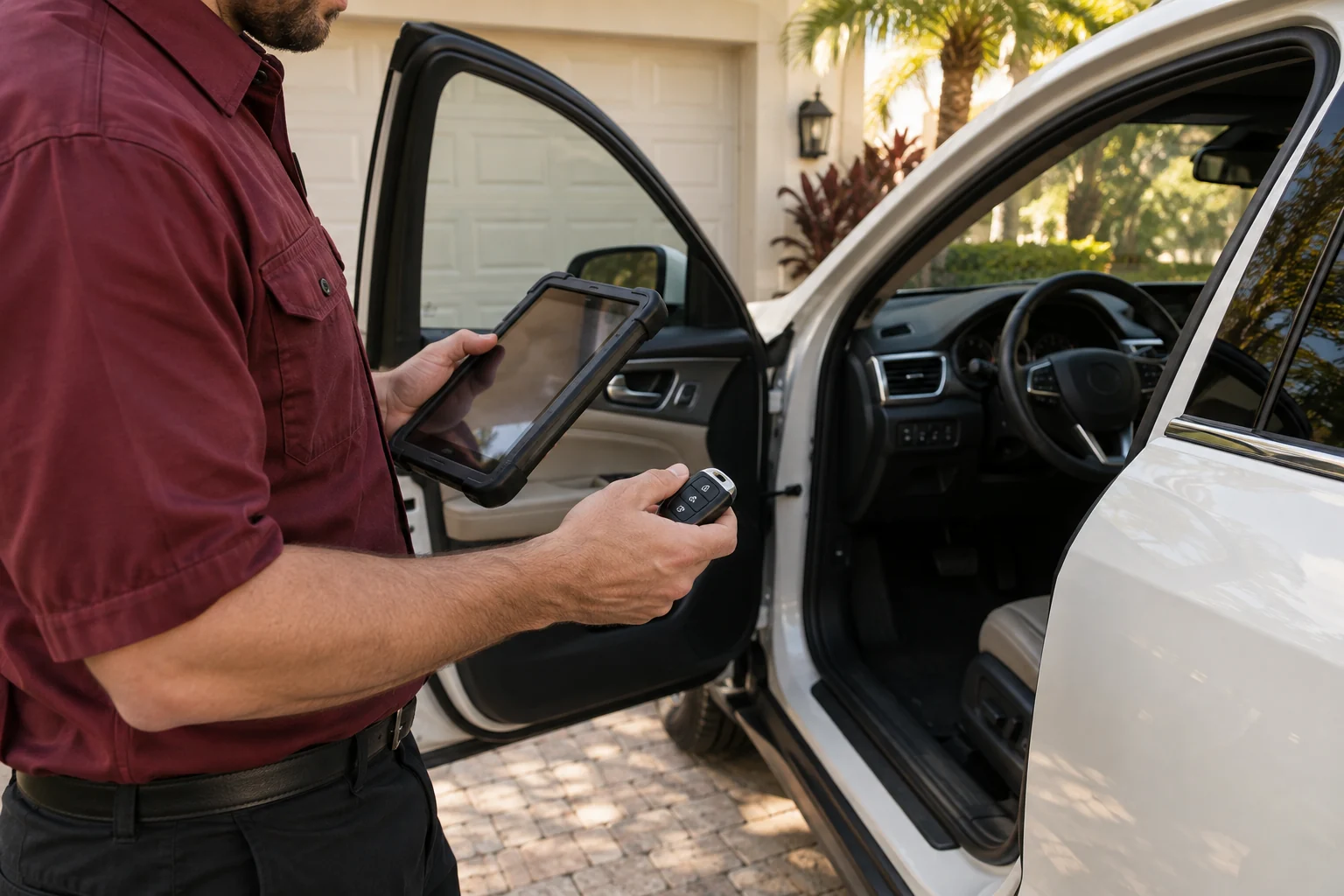
Automotive Locksmith in Plantation
Car key problems usually announce themselves with a symptom. This page is general guidance for Plantation drivers, organized by what you notice, so you can work out what is wrong and what to tell a locksmith.
Call (954) 888-8804Start with the symptom, not the part
When a car key fails, people tend to name a part. They say the key is dead, or the ignition is broken, or the computer is confused. Usually they are guessing. The more useful approach is to describe what you actually see and hear: whether the doors unlock, whether the dashboard lights up, whether the engine turns over, and whether the key feels different in your hand.
This page follows that approach. It is general guidance for drivers in Plantation, Florida. It does not describe particular roads, parking areas or businesses, and it does not state local rules as fact. Every vehicle is different, so the final answer always depends on the make, model and year, and on what the locksmith finds when they look at the car.
Read the section that matches your symptom and skip the rest. If you are stranded in a place that feels unsafe, put that first. Move to a lit, public spot if you can, tell someone where you are, and call. The diagnosis can happen from the phone, and the details below will help you describe things clearly.
Keep in mind that a locksmith cannot see your car through the phone. Anything you notice is useful, from a smell of burning to a warning light that stays on. Small observations, offered plainly, help the technician arrive with the right equipment, and they help you understand the explanation of the work when it comes. You do not need to know technical words, only to say what happened in your own.
The key turns but the engine does not start
This is one of the most confusing cases. The key goes in, it turns, the dashboard lights come on, and yet the engine refuses to run. Sometimes the starter clicks, sometimes there is silence, and sometimes a small light shaped like a key or a padlock blinks on the dash. That blinking light often points to the immobilizer, the system that checks the chip in your key.
If the chip in the key is damaged, worn or no longer recognized, the car may refuse to start even though the key looks perfectly normal. The metal can be right while the electronics are not. A weak battery in the car can cause similar symptoms, so it is worth noting whether the lights are bright or dim and whether anything else in the car behaves oddly.
Try your spare key if you have one. If the spare works, the first key is the problem. If neither works, the cause may lie in the car. Tell the locksmith exactly what you tried, including the order, because the sequence often points to the cause. Avoid repeated, rapid attempts to start the engine, which can drain a weak battery and hide the original symptom. A few patient tries, with notes on what the dashboard did each time, are far more useful than many hurried ones. The article on transponder key programming explains how these chips are paired with a vehicle.
The remote works but the key does not, or the reverse
Many keys carry two separate jobs. The blade, or the contact with the ignition, does one thing, and the remote buttons do another. They rely on different parts, and either can fail on its own. A remote that locks and unlocks from across the lot may sit alongside a blade that no longer turns the ignition. Or the blade may work while the buttons are dead.
If the buttons fail, start with the small battery in the fob. It is the most common cause and the simplest fix, when the manufacturer allows owners to replace it. If a fresh battery makes no difference, the fob may have lost its pairing with the car, or the circuit board inside may be worn or damaged by moisture.
If the blade is the problem, look at it closely. A bent, chipped or visibly worn blade can fail to turn the cylinder smoothly. Do not force it. Describe the symptom, and a technician can say whether the key needs to be recut or replaced. The guide to why a key fob stops working lists the usual suspects in order.
Worn, bent or cracked keys
Keys age. The metal edges wear down from thousands of insertions, the plastic head cracks in the heat, and the ring hole stretches. A key that has been used daily for many seasons and carried in a pocket with other metal objects is likely to be much more worn than it looks.
A worn key is a warning. It may still work today, but each use pushes the pins inside the lock to wear in the same direction, and a copy cut from a worn key inherits the wear. Make a new key from the original code, not from the tired key, and retire the old one. A locksmith can often cut a fresh key to the factory pattern if the vehicle details are known.
A cracked plastic head is a warning too, since the chip inside may be damaged or about to fall out. If the head is loose, taped or held together with glue, replace the key before it fails. The article on laser cut and standard car keys helps you tell what kind of blade you hold.
When every key is gone
Losing the last key is the hardest version of this problem, and also the one with the most solutions. Nearly every vehicle can have a new key made, even when none exists. The steps depend on the make and model. They may involve cutting a blade from the vehicle's lock or its code, and then programming a new chip or fob to the car.
Because there is no old key to copy, the process asks more of you. You will be asked to prove ownership. Have your registration, title or similar paperwork ready, along with identification. If the vehicle is in a locked space, such as a garage with restricted access, tell the locksmith in advance so access can be arranged.
For push button vehicles, the article when a push to start key is lost describes what is involved. If cost is on your mind, the car key replacement cost guide explains the factors that shape the total without quoting numbers. Ask for the total to be explained before work begins.
Keys locked inside, in the trunk or in a running car
Lockouts come in several forms. The keys may be on the seat, in the ignition, in the trunk or in a purse you left at home. Each has its own considerations. A trunk lockout is different from a cabin lockout, since the trunk mechanism may be separate. A running car with the keys inside raises a safety question about fumes and fuel.
If a child or a pet is inside a closed car, treat it as an emergency. Say so right away. Cabins in South Florida heat climb to dangerous temperatures, and emergency services have the authority and tools to act at once. A locksmith can help in many cases, but do not wait if a life is at risk.
Otherwise, try the other doors and the trunk release before calling, and do not use force on the door or window. Damaging weather stripping or bending the door frame creates new problems. Read about car lockout solutions and keys locked in the trunk for more detail on what to expect.
Stuck keys, tight steering and ignition wear
An ignition cylinder is a mechanical part that works hard. When it wears, you may notice a key that is hard to insert, a key that turns only after wiggling, or a key that sticks and refuses to come out. A steering wheel that locks hard against the key is a different matter, and it can often be released by gently moving the wheel while turning the key.
If the key will not come out, check that the vehicle is fully in park. In many cars the shifter must be in the right position, and a worn interlock can confuse the system. Do not pull hard on the key. If it snaps, the repair becomes more involved. Stop, and describe the symptom.
The page on ignition repair explains what may be involved, and the article on a key stuck in the ignition describes the safe steps you can take first. Never take apart a steering column yourself. Airbag wiring and other safety parts sit nearby, and mistakes there are dangerous.
Used cars, family cars and rentals
A used car often arrives with a surprise. The seller may hand over only one key, or a key that is worn, or a fob that has lost its pairing. Some used vehicles come with keys that have been programmed by earlier owners who still hold copies. If you buy a used car, treat the key situation as part of the purchase and plan to make a spare.
Family cars bring another pattern. Several drivers share a car, keys get passed around, and a lost key is more likely. A good habit is to count the keys on purpose, perhaps once a year, and to store the spare away from the vehicle. A key hidden in a magnetic box under the car is easy for a stranger to find.
If you are driving a rental or a vehicle that belongs to an employer, contact the owner before arranging key work. The company may have its own process, and unauthorized changes can cause problems. Explain the situation to the locksmith, and they can work with the owner's requirements.
Dealers and leasing companies sometimes keep records of key codes and programming history for vehicles they handle. If your car came through one, ask whether the key code can be provided to you. Having it shortens the process, and it helps avoid disputes about who is entitled to a key. Keep any such paperwork with your vehicle documents at home rather than in the glove box.
What to write down before you call
A short list on your phone saves a lot of back and forth. Vehicles look alike from the outside, and small differences decide which key blank, which chip and which programming method are needed. If you can read the details off the registration card or the plate on the door frame, the call becomes much simpler.
Take a moment to look at the key you still have, if any. Is the head plain plastic, or does it fold? Are there buttons? Is the blade cut along the edge or milled in a channel down the middle? Any of these facts narrows the choices. If you have no key at all, a photo of a similar key from a family member's car is not helpful, so stick to describing your own vehicle.
Finally, think about timing and place, and say what is realistic. If the car is in a spot where you cannot wait, say so. If the vehicle must be moved before work can happen, mention it. Honest detail makes for an honest plan, and it helps the technician decide what to bring.
- The make, model, year and color of the vehicle.
- The vehicle identification number, if you can read it from the dashboard or door frame.
- What kind of key you have, such as plain, flip, smart key or push button fob.
- Whether any key still works, even one kept at home.
- Exactly where the vehicle is and whether it is safe to work there.
- What you noticed on the dashboard when the problem started.
Mobile service, towing and where the car is
Where the car sits matters. A vehicle in a driveway is easy to reach. A vehicle in a parking structure may be hard to reach with equipment. A vehicle on a busy road is a safety issue. A vehicle at a repair shop may be better handled through the shop. Tell the locksmith where the car is and what is around it.
If a car cannot start and has no working key, a locksmith who works on vehicles can often come to the car, which avoids towing. In some cases, however, towing is the better choice, such as when a key problem is tied to a mechanical fault. A good technician says so plainly when that is the case. Either way, you deserve a clear explanation of why one route suits your situation better than the other, and of what each route would involve for the car and for your day.
Discuss the options at the start. Ask what the work will involve, where it will happen and what the final result will look like. Half Off Locksmith follows a simple process: you describe the situation and place, the work and price are explained before anything begins, and the finished work is tested with you.
Habits that keep you out of trouble
The strongest protection is a spare. Make one before you need it, test it fully, and keep it somewhere safe and separate from the car. Replace fob batteries when the car warns you. Keep the plastic head of your key intact, and do not hang a heavy bunch of keys from the ignition key, since the weight wears the cylinder.
Learn how your car's key works. Does it have a chip? Is it a push button system? Is there a hidden mechanical blade in the fob? Knowing these answers makes any later call shorter and easier, and it helps you spot when something is going wrong. The article on whether a spare car key is worth it makes the case for planning ahead.
If you drive in or near other cities, you can compare notes with the pages for Sunrise and Lauderhill. And for the overall picture of locks in the city, see the general page for locksmith services in Plantation.
Common questions
Why will my car not start even though the key turns?
Many modern cars check a chip in the key before they allow the engine to run. If the chip is damaged, unpaired or unreadable, the car may refuse to start while the key still turns. A weak car battery can look similar. Try a spare key and tell the locksmith what you saw on the dashboard.
My remote buttons stopped working. Is the whole key bad?
Not necessarily. The remote and the blade or chip are separate systems. Start by replacing the small battery in the fob if the manufacturer shows how. If that does not help, the fob may need to be paired again or repaired. A locksmith can test it and explain what is wrong.
Can a new key be made if I have no key at all?
In most cases, yes. A key can be created using the vehicle's details and then paired with the car's system. You will need to prove ownership with registration or title and identification. Tell the locksmith the make, model and year, and where the vehicle is parked.
What should I do if my key is stuck in the ignition?
Do not pull hard, since the key can snap. Check that the car is fully in park and that the steering wheel is not locked against the key. Gently move the wheel while turning the key. If it still will not release, stop and call a locksmith, because the cylinder may be worn.
Is a trunk lockout different from a normal lockout?
It can be. The trunk mechanism is often separate from the doors, and some cars let you reach the trunk from the cabin while others do not. Tell the locksmith exactly where the keys are and whether the cabin is open. Do not force the trunk or the door.
Should I buy a used car with only one key?
It is common, but plan for a spare. A single key means one loss leaves you stranded, and copying from a working key is simpler than creating one from nothing. Also ask whether earlier owners may still hold keys, and consider having the car's key system reset with the new keys.
Talk through the job before work begins
Start by describing the situation, the lock or key involved and who must have access. You hear the price and the plan before anything is done.
Call (954) 888-8804