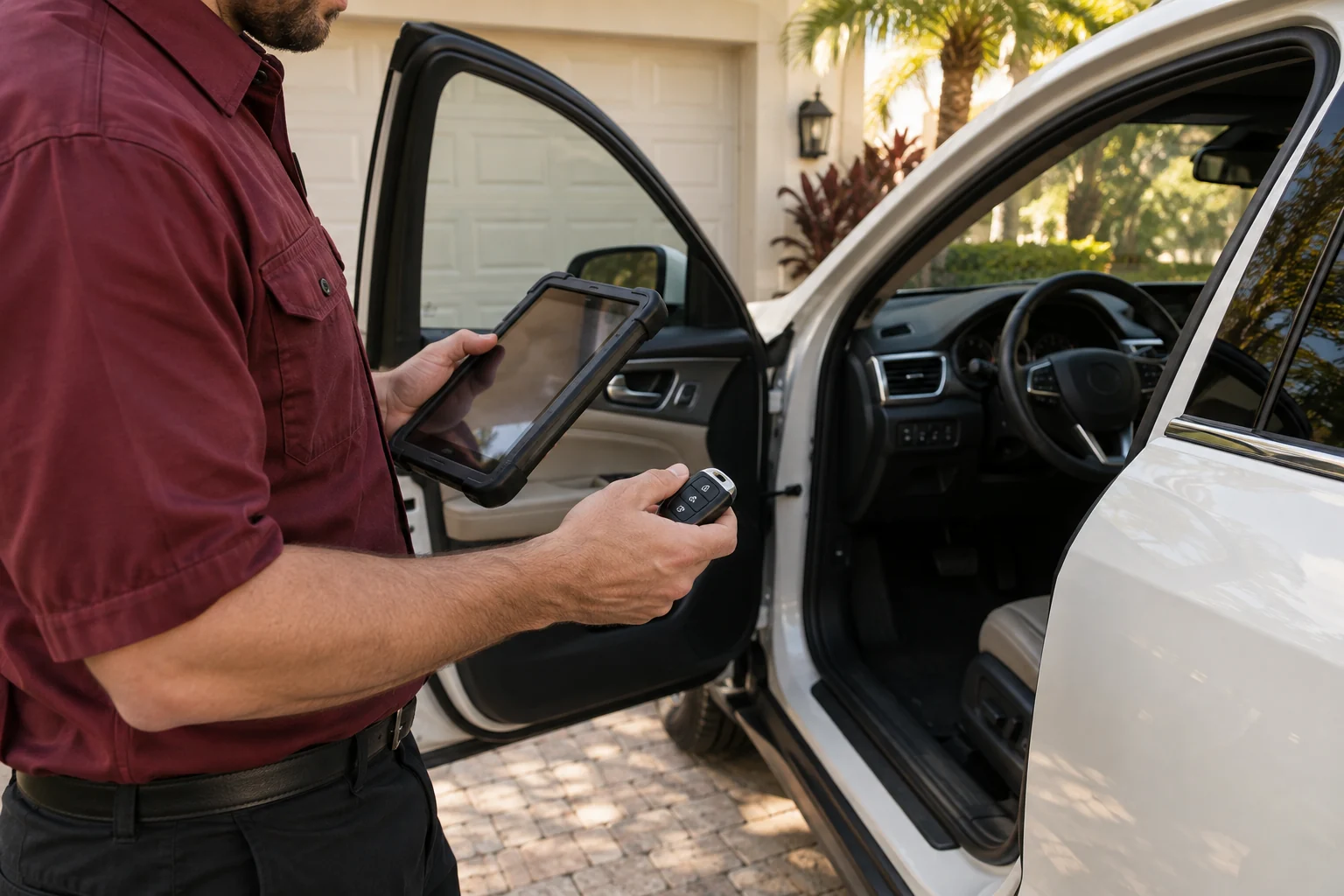
Automotive Locksmith in Lauderhill
When a car key fails, the answer depends on the vehicle, the key and what exactly went wrong. This page is general guidance for drivers in Lauderhill, with the facts that help you make a sensible call.
Call (954) 888-8804Start with the car you actually drive
Car key help is never one size fits all, because the right approach depends on the vehicle. A decade old compact with a plain metal key is a different job from a newer crossover with a smart fob and a push button ignition. Before you call anyone, take a minute to note the make, model, year and, if you can read it, the vehicle identification number on the dash or door frame.
Look at the key itself, too. Does it have a thick plastic head? There is probably a chip inside. Does it have buttons for lock and unlock? That suggests a remote built into the head or a separate fob. Does it have no blade at all, only a plastic shape you carry in your pocket? Then you have a proximity key. Each of those leads to a different set of steps, and knowing which you have shortens the conversation.
This page is general guidance for drivers in Lauderhill. It makes no claims about local rules or businesses, and it is written for the ordinary situations that come up anywhere in Broward. The main service pages on car key replacement and ignition repair go deeper into the work itself.
One more habit helps before any trouble starts: take a clear photo of your registration, the vehicle identification number and the front and back of your key, and keep it in your phone. If the key is ever lost, those images answer most of the first questions in a minute, and they help you describe a fob that you no longer have in your hand. It is a tiny effort that pays off on the one day you need it.
Buying a used car and the keys that come with it
A used car purchase is a classic moment to think about keys. The seller may hand you a single key and a promise that the other one is somewhere at home. Before you pay, ask how many keys exist, whether any have been lost, and whether the spare works. A car with only one key is a car that is one mishap away from a bigger problem.
If the car has come with only one key, plan to add a second soon after buying. With a working key available the job is usually simpler than starting from nothing, and it avoids the stress of a complete loss. Also consider that prior owners may still hold copies. If that worries you, ask a locksmith whether the car allows keys to be erased from its memory, which on many vehicles can be done during programming.
Check the keys themselves for wear. A key with rounded teeth, a cracked head, or a fob with worn buttons is near the end of its life. It costs less effort to replace a worn key on your own schedule than to do it after it fails. The article on whether a spare car key is worth it explains why a second key is more than a luxury.
How different keys are made and programmed
A basic key is cut to match the lock. A transponder key is cut and then programmed so the car recognizes the chip inside the head. A remote key adds buttons for locking and unlocking, and those buttons are paired to the car separately. A proximity fob is paired to the car and is not cut at all, apart from an emergency blade hidden in the casing.
The cutting is done by machine, either by copying an existing key or by following a code. A laser cut key, with a groove milled into the flat of the blade, needs a different machine from a standard edge cut key. The programming is done with a diagnostic tool that talks to the car's computer. Some cars allow a simple on board procedure, while others require special equipment.
If you want the details, the article on laser cut versus standard car keys covers the blades, and the page on transponder key programming explains what happens when a chip and a car are introduced. You do not need to understand every step, but knowing the vocabulary helps you follow what a locksmith tells you.
- A standard key is cut only and has no electronics.
- A transponder key needs cutting and programming to start the engine.
- A remote key head adds buttons that are paired separately.
- A proximity fob is paired to the car and may have a hidden emergency blade.
- A laser cut key needs a different cutting machine from an edge cut one.
Locksmith or dealership: how to think about it
Both routes can produce a working key, and the right choice depends on the car and your circumstances. A dealership has access to manufacturer data and parts for its own brand. A mobile locksmith comes to the vehicle, which matters if the car cannot be driven or if you have no working key to bring it in. Many people choose based on convenience and on how the quote is explained.
What to compare is not only price, but also what the price includes. Does it cover cutting, programming and any extra keys? Does it assume the car can be driven in? How will you get the vehicle to the dealer if it will not start? Whoever you pick, ask for the work to be explained before it starts, and for the finished keys to be tested with you.
The article on locksmith versus dealership lays out the comparison in more depth, and a separate guide to what affects the cost of a replacement car key explains why quotes vary. Neither source quotes prices, because these depend on the vehicle and the situation, and anyone who gives a number without asking about your car is guessing.
Coverage and insurance questions sometimes enter the picture, and they are worth asking about on your own side. Some insurance policies or service agreements cover lost keys, and some do not, so look at yours before deciding. If the car is leased or financed, check the terms about replacement keys, since the lender or lessor may have views on who may make them. Those are conversations for you to have with the other party, not something a locksmith can settle for you.
When the ignition is the real problem
Sometimes the key is innocent. If a key that looks fine turns stiffly, sticks, or refuses to come out, the ignition cylinder may be the cause. These cylinders contain small parts that wear with use, collect dust and, in humid places, can corrode. A heavy keychain hanging from the key adds weight and strain, which speeds wear over time.
Signs worth noticing include a key that needs wiggling, a car that starts only after several tries, dash lights that flicker as you turn the key, and a key that feels gritty. Do not ignore these. A failing ignition can leave you stranded without warning. The article on ignition cylinder problems describes how the symptoms develop.
If your key will not turn at all, avoid forcing it. The steering wheel may be locked against a wheel load, and gentle pressure on the wheel while turning may release it. If it still will not move, stop, and ask for help. Forcing can break the key or damage the ignition, turning a repair into a replacement. Mention the symptoms and how long they have been there when you call.
Broken keys and keys that come apart
A key can snap in a door lock or in the ignition, usually where it has been bent or weakened over time. When that happens, the remaining piece inside the lock needs to be removed with the right tools. Digging at it with household items often wedges it deeper or damages the cylinder.
If the key breaks, keep any piece you have, since it can help in cutting a replacement. Do not spray lubricant into the lock, which can make extraction harder, and do not try to start the car with a piece of metal. The guide on removing a broken key from a lock explains what professionals do and why you should leave it to them.
Some fob cases crack or come apart without the electronics being damaged. In many cases the circuit board can be moved to a new shell, which is simpler than replacing the whole key. Bring all the pieces, because the locksmith may be able to rebuild the key from them, and describe what happened. A cracked shell caught early is a small problem compared with a lost fob.
Heat, humidity and daily wear on keys
South Florida is hard on car keys. Heat builds up in a parked vehicle, and a fob left on the dash bakes in the sun. Humidity and sweat find their way into buttons and boards. Salt air does its share on the coast, and the rainy season brings sudden downpours that soak pockets and bags.
You can reduce the harm with simple habits. Keep fobs out of direct sun, avoid leaving them in a hot cup holder, and dry them if they get wet rather than leaving them damp. Replace batteries at the first sign of reduced range. If a fob goes through the wash, do not press buttons repeatedly. Let it dry in open air and have it checked.
Weight on the key ring matters too. A large bundle of keys, charms and tags hanging from the ignition stresses the cylinder and wears both parts. Where possible, carry only the car key on the ring that goes in the ignition, and keep the others separate. It sounds minor, but it is one of the more effective ways to extend the life of an ignition.
Cars that sit outdoors through the rainy months face one more issue: moisture in door lock cylinders. Because most drivers rely on the remote, the mechanical door lock on the driver side can go months without a turn, and then stiffen or seize. Use the metal key in the door now and then so you know it works, since a dead battery or a failed fob leaves it as your only way in. If it feels rough or refuses to turn, mention it before it becomes a lockout.
Motorcycles, scooters and other vehicles
Not everything with an ignition is a car. Motorcycles, scooters, boats on trailers, golf carts and small utility vehicles all use keys, and some of them use transponders. Motorcycle keys in particular are small, easy to lose and sometimes costly to replace because the electronic side is just as involved as it is for a car.
If you ride, treat a spare key as a necessity. Keep one at home rather than on the bike, and avoid storing it in a pocket of the saddlebag. The article on motorcycle key replacement explains how it works, and it is worth reading if you have a vehicle that is not a standard car.
When you call, say plainly what vehicle you have, since not every locksmith handles every type. If yours is unusual, ask whether the work is possible before you commit. An honest answer saves you time, and a straightforward no is better than a promise that cannot be kept.
Protecting yourself from bad service
Key work is attractive to scammers because stress makes people agree to things without thinking. Be cautious of anyone who will not explain the price, who changes it on arrival, or who insists on drilling a lock that could be opened another way. A professional can describe the plan, the parts and the result in plain terms.
Proof of ownership is a good sign, not an annoyance. A locksmith who asks for registration or identification before making a key is protecting you and everyone else. Someone who will make a key for any car without asking anything is a hazard. If you are asked for identification, be glad.
Also be careful with online listings and unsolicited offers. A business that gives only a vague name, no clear description of its work, or an unwillingness to say what vehicle types it handles deserves a second look. Ask how the process works, what the price depends on, and what happens if the key does not work on the first try. Clear, patient answers are a good sign, and a pushy or evasive tone is a reason to hang up and call somebody else.
The article on high security and restricted keys explains why some keys can only be copied by authorized sources. Be wary of a crude copy of a restricted key, which may not work well. For nearby coverage, the page for Plantation gives similar general guidance for that place.
How a call and a visit usually go
You call and describe the vehicle, the key and what has happened, and say where the car is. The locksmith explains the work and the price before starting, you agree, the work is done, and the finished keys are tested with you. Testing means starting the car, using every button on the fob, trying the door and trunk, and checking any spare.
Have your identification and proof of ownership ready, and if you can, the vehicle identification number. If there is a working key, bring it. If the car is parked in an awkward place, say so, since access can change how the work is done. Be honest about what you know and do not know.
Speak up if something seems off during the work. If the price differs from what was explained, if the plan changes, or if the key does not behave as it should when you test it, say so before the visit ends. A professional expects questions and will explain. The goal is to leave with keys that work in every way you need, including the spare, the trunk and every button on the remote.
After the work, store the spare somewhere safe, away from the car, and keep a note of the key type and the date. If you also deal with home or business locks, the pages on lockouts in Lauderhill and commercial locksmith work in Lauderhill cover those sides.
Common questions
Do I need to prove I own the car?
Yes, usually. A responsible locksmith asks for identification and some evidence of ownership, such as a registration or title, before making a key. It protects you and others, because the same service in the wrong hands would be a theft tool. Be cautious of anyone who skips the step.
Should I add a second key when I buy a used car?
It is a good idea. A car with only one key is a lost key away from a harder, more stressful repair. Adding a spare while one still works is usually simpler. Ask whether old keys can be erased from the car's memory, which some vehicles allow during programming.
Why will my key not turn in the ignition?
It could be a worn key, a worn cylinder, debris, or a steering wheel lock under load. Do not force it. Gentle pressure on the wheel while turning sometimes releases it. If it keeps happening, the key or the ignition needs attention, and a locksmith can tell which.
Can a cracked fob case be fixed?
Often the circuit board can be moved into a new shell, which is simpler than replacing the whole fob. Bring all the pieces and describe what happened. Water damage or a damaged board is a different matter, and the locksmith will tell you honestly what can be saved.
What should I do if a key breaks in the lock?
Leave the broken piece alone, keep any part you have, and call. Do not spray anything into the keyway or try to dig it out. The remaining piece needs proper tools to remove, and attempts at home often push it further in or damage the cylinder.
Do locksmiths handle motorcycles and other vehicles?
Some do, but not all handle every type. Say what vehicle you have when you call and ask if the work is possible. Many bikes and scooters have transponder keys, so the process can resemble a car. An honest answer up front saves you time.
Talk through the job before work begins
Start by describing the situation, the lock or key involved and who must have access. You hear the price and the plan before anything is done.
Call (954) 888-8804