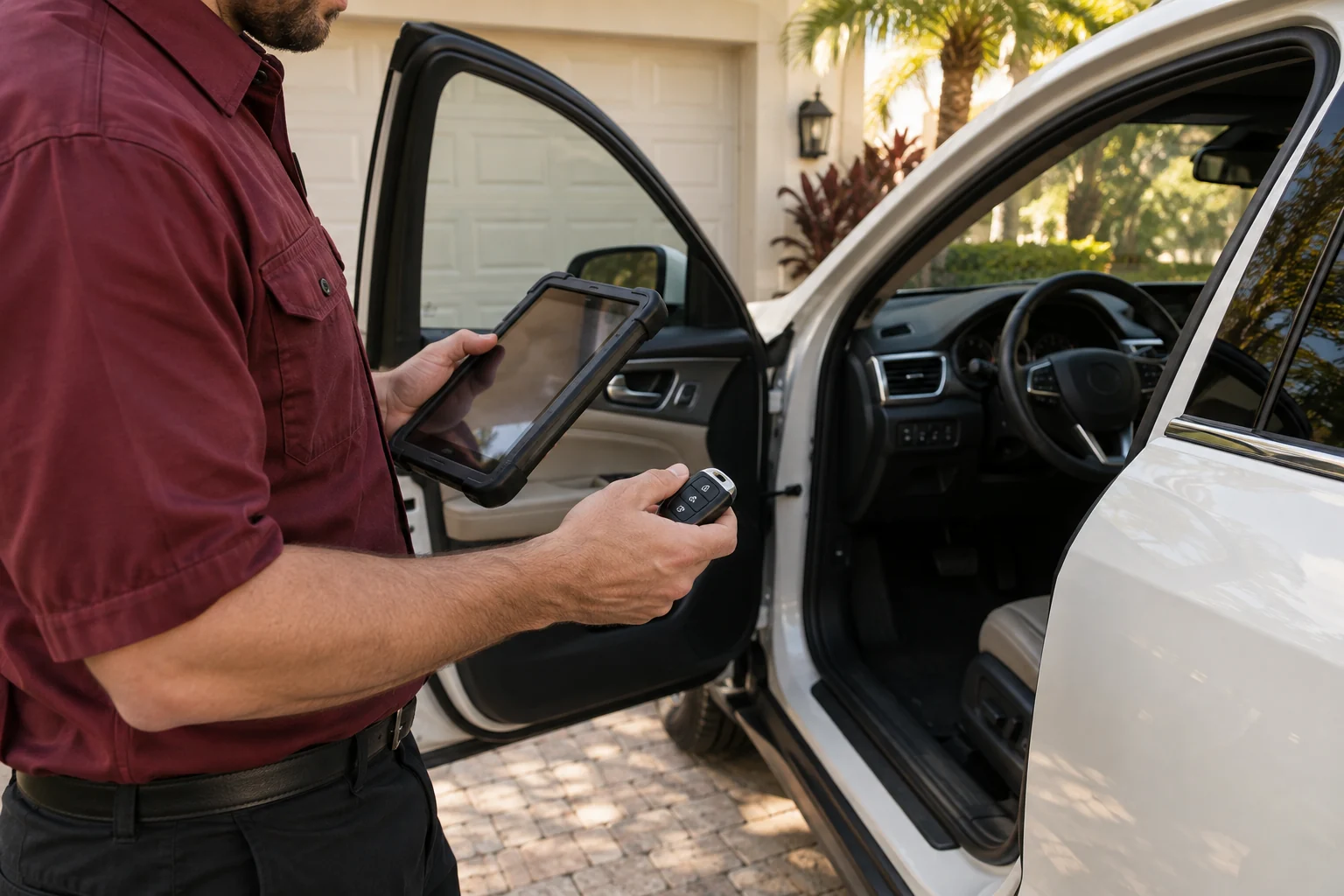
Automotive Locksmith in Weston
Modern car keys are small computers as much as pieces of metal, and that changes what happens when one is lost or fails. This page is general guidance for Weston drivers facing key, fob, ignition or lockout trouble.
Call (954) 888-8804Why a car key is not just a cut piece of metal
A few decades ago, a car key was a shaped blade, and any shop with a cutting machine could copy it. Today most vehicles use keys with an embedded chip that talks to the car. The chip carries a code, and the car will refuse to start unless it recognizes that code. A key cut perfectly but not matched to the car may turn in the lock and still do nothing.
Other vehicles go further and use a fob that never enters a lock at all. You carry it in a pocket or bag, and the car senses it nearby. A button on the dash starts the engine. These systems are comfortable to live with and awkward to replace, because the fob must be introduced to the vehicle through a specific procedure that needs the right equipment.
Knowing which kind of key you have makes every conversation easier. A key with a thick plastic head probably holds a chip. A fob with buttons that locks and unlocks the doors is a remote. A smart fob that works without being inserted is the most advanced kind. Look at what you have, and mention it, along with the make, model and year, when you call.
When the only key is gone
Losing every key to a vehicle is more stressful than losing one of two. There is nothing to copy from, and the car must be told to accept a brand new key. The process usually involves identifying the vehicle, confirming that it belongs to you, producing a key that fits the lock, and then programming it so the car recognizes it.
Expect to be asked for proof. A registration or title and personal identification are normal, because nobody should be able to walk up to a car and have a key made without showing a connection to it. If your documents are inside the car, say so, and ask what alternatives exist. A responsible professional will find a reasonable way to confirm ownership.
Our page about car key replacement explains the services in more detail. Do not panic about the cost of an all keys lost situation before you have heard the plan. The work and the price should be explained before it begins, and you can decide then. Meanwhile, avoid trying to start the vehicle in unusual ways, which can leave you with new problems.
Spare keys and why they matter
Having a working spare is the simplest insurance a driver can buy against a bad day. With a spare in hand, copying is typically simpler than creating a key from scratch, since the existing key can be used as a reference. Without one, the process starts from nothing. That difference is why locksmiths gently nag everyone about spares.
A spare only helps if you keep it somewhere useful. Leaving it in the glove box defeats the purpose, since losing the car's contents loses both keys. Give one to a trusted person, or keep it at home in a place you can reach. Our article on whether a spare car key is worth it explains the thinking in more depth.
Test the spare occasionally. Batteries in remotes die, and a key that has sat in a drawer for years may no longer be programmed properly if the car has been serviced. Try it in the door and the ignition once in a while. It takes a minute, and it is far better to discover a problem on a calm afternoon than in a dark parking lot.
Transponder keys, laser cut keys and fobs
The terms can be confusing. A transponder key holds a chip. A laser cut key, sometimes called a sidewinder, has a milled groove on the blade instead of the familiar jagged edge, and it is harder to copy by casual means. A fob is a remote, sometimes with a blade tucked inside, and a smart fob is a keyless remote that works by proximity. Many keys combine more than one of these.
Each type needs the right equipment. Cutting a laser key requires a different machine than cutting a standard key. Programming a transponder requires a tool that speaks to the vehicle's computer. Our explanation of laser cut versus standard car keys and the guide to transponder key programming help you understand what happens behind the scenes.
This is also why a copy made at a general key counter may not behave like the original. It might open the door yet fail to start the engine, or it might work for a while and fail later. When in doubt, tell the person doing the work that the vehicle has a chip, and ask how the key will be tested to confirm it starts the car and operates the remote functions.
Locksmith or dealership: how to compare
Drivers often wonder whether to go to the dealership or a locksmith. Both can make keys, and the choice depends on your situation. A dealership has direct access to the manufacturer's information and parts for its own brand. A mobile locksmith travels to the vehicle, which matters when the car cannot be driven or towed easily.
Convenience is a real factor. If the vehicle is stuck in a parking lot with no key, getting it to a dealership may mean arranging a tow. Meanwhile, a locksmith who can work where the car sits may remove that step. On the other hand, some unusual or very new models may need manufacturer specific procedures. Ask whoever you call whether they can handle your exact vehicle.
Our article on car key replacement by locksmith versus dealership lays out the comparison point by point. Whichever route you choose, ask for the work and the price to be explained before it begins, ask what the key will be able to do, and ask how many keys you will receive. Clear answers beat assumptions every time.
Think also about what comes after the key is made. Will the old lost key still start the car? Can it be removed from the system? Will the remote buttons work, and will the new key be tested in both the door and the ignition? These are practical questions, and they apply no matter whom you choose. A short list on your phone is enough to keep the conversation focused on what matters to you.
Key fobs that stop working
A fob that suddenly stops responding has a short list of likely causes. The battery is the first suspect, since it is the simplest and most common failure. Fobs also fail because of water damage, worn buttons, or a lost connection with the car after a battery replacement in the vehicle itself. Distinguishing among them is half the battle.
Try a few simple things before assuming the worst. Check whether the physical key hidden in the fob still opens the door. Try the spare. Notice whether the dashboard shows any warning about the key. If the spare works and the main fob does not, the problem lies in the fob itself, and not in the car. Our guide on what to do when a key fob stops working explains the checks.
Replacing a fob battery is sometimes a simple job, and sometimes it needs care to avoid breaking the casing or losing programming. If you try it yourself, take photos as you open it so you can reassemble it correctly. If the fob has been through a washing machine or a swimming pool, the electronics may be beyond saving, and a replacement is the realistic path.
Push button start and what happens when the fob is lost
Push button systems are convenient and, when the fob goes missing, they can feel mysterious. The car cannot start without detecting a recognized fob nearby, and there is no keyhole to fall back on in the same way. Many fobs carry a small emergency blade for the door, but the starting function remains tied to the electronics.
If you lose a smart fob, the usual path involves creating and programming a new one. This is not a casual job, and it needs specialized tools. Our article on what to do when a push to start key is lost sets out the typical steps. Have your documents ready, and have the vehicle accessible.
One more point is worth making. When a fob is lost, ask whether the lost one can be disabled in the vehicle, so that someone who finds it cannot use it. Practices differ between makes, and not every vehicle allows it. It is a reasonable thing to raise, particularly if the fob disappeared somewhere you cannot trace, and the answer will tell you something about how well the work is being done.
Finally, keep an eye on the smaller signals your car gives you. A dashboard light about the key, a delay before the engine starts, or a fob that works only when held close to the dash can all mean a weak battery or a failing component. Dealing with these hints early is usually calmer than waiting for a complete failure on a day when you have somewhere to be.
Ignition trouble: when the key will not turn or will not come out
Ignition cylinders wear out. Over years, the tiny parts inside lose their shape, and the key may begin to stick, to turn only with jiggling, or to refuse to come out. Weight is a culprit as well. A heavy ring of keys and charms swings on the cylinder with every bump, which accelerates wear. A lighter ring is kinder to the ignition. Many drivers are surprised by how much this matters, and the fix costs nothing but a few minutes at a kitchen table sorting out which keys really need to travel with you.
Sometimes the symptom is the steering. On many vehicles, a lock engages the steering wheel when the key is out, and turning the wheel against it while the key is in can bind the mechanism. If the key will not turn, a gentle wiggle of the wheel while turning is a common first thing to try. Do not force it, because forcing can snap the key. Our guide to a key stuck in the ignition covers the safe things to check.
When the ignition itself has failed, the repair may involve replacing the cylinder, and sometimes also rekeying it to match your existing key. Our pages on ignition repair and the article on ignition cylinder problems give more background. As ever, describe the symptoms to the locksmith as precisely as you can, since small details point to the cause.
Locked out of the car
A car lockout is a different problem from a house lockout, and it has its own risks. If a child or pet is inside, treat it as urgent and say so right away. In heat, the inside of a closed car warms alarmingly, and waiting is dangerous. In such cases, contact emergency services without delay, because they are equipped for exactly this.
If nobody is inside and nothing is at risk, check the other doors and the trunk, and consider whether a spare key can be brought to you. Do not wedge tools into door frames or window seals, because modern doors contain airbags, wiring and electronics that are easy to damage. Our guide to car lockout solutions sets out what is sensible.
Prevention is straightforward, if dull. Make it a habit to check for keys before shutting the door. Be careful with vehicles that lock automatically after a short period. Keep a spare somewhere a trusted person can reach. If your vehicle has a smart fob, remember that the car may not lock if the fob is inside, but some will, so keep the fob in your hand.
Documents, ownership and why you are asked questions
Anyone who makes a car key is in a position of some responsibility. A key is, after all, the means of driving a vehicle away. For that reason, a careful professional will ask who you are and how you are connected to the car before cutting or programming anything. Treat the questions as a sign of a sound process, not as suspicion directed at you.
The usual items are identification and something that links you to the vehicle, such as registration or title. Some situations are more complicated: a car belonging to a relative, a company vehicle, a vehicle recently purchased and not yet retitled, or a rental. In those cases, explain your position honestly and ask what would be acceptable. There is often a sensible path, though it may need an extra phone call or document.
Keep copies of your vehicle paperwork somewhere other than the glove box. A photo on your phone and a printed copy at home cover most situations. It sounds dull, but when the one key is gone and the paperwork is locked in the car, having a second set of documents turns a messy problem into a simple one. This habit costs almost nothing.
Heat, humidity and a car parked outdoors
Cars in South Florida live a hard life. Sun bakes dashboards, plastic parts become brittle, and batteries inside fobs lose capacity sooner in heat. Rain and humidity creep into locks and electronics. A key left on a hot dashboard can suffer, and a fob dropped in a puddle may stop responding altogether.
Small habits go a long way. Keep fobs out of direct sun, away from water, and out of pockets that go through the laundry. Replace fob batteries on a sensible schedule instead of waiting for a failure. Avoid hanging heavy items on the key ring, and keep the ring tidy so the ignition is not carrying extra weight.
When something does go wrong, the details help. Tell the locksmith what the car has been through, whether it sat in floodwater, whether the battery went flat, whether anyone else worked on it recently. These facts can explain odd behaviors. For related guidance, you might look at the page for locksmith services in Weston or at the pages for neighboring areas such as automotive locksmith help in Miramar.
Common questions
What should I tell the locksmith about my car?
Give the make, model and year, and say what kind of key you have: a plain key, a chipped key, a remote or a push button fob. Explain what has happened and where the car is. Be ready to show registration or title and identification so the work can proceed responsibly.
Can a key be made if I have lost every key?
Often yes, though the process is more involved than copying a spare. A new key must be produced for the lock and introduced to the vehicle's system. The work depends on the vehicle and requires proof of ownership. The work and the price are explained before anything begins.
Why does my copied key open the door but not start the car?
Most likely the key lacks a properly programmed chip. The blade can be cut to turn the lock, but the car's system will not recognize the key without the right code. A locksmith with programming equipment can match the key to the vehicle and test it with you.
Should I try to fix a key stuck in the ignition myself?
Gentle checks are fine, such as making sure the car is in park and wiggling the steering wheel slightly. Do not force the key, tap it hard or spray random products into the cylinder. Forcing can snap the key or damage the cylinder, which makes the repair larger.
Is my key fob battery something I can change?
Often, yes, but be careful. Fobs vary, and prying the wrong way can crack the casing or disturb the contacts. Photograph each step. If the fob still fails after a new battery, or has been wet, it likely needs professional attention or replacement.
What if a child or pet is locked inside the car?
Treat it as an emergency. In heat, a closed car becomes dangerous in a short span. Contact emergency services first, and tell any locksmith you call about the situation right away. Do not wait for convenience, and do not attempt to force the window if you can avoid it.
Talk through the job before work begins
Start by describing the situation, the lock or key involved and who must have access. You hear the price and the plan before anything is done.
Call (954) 888-8804