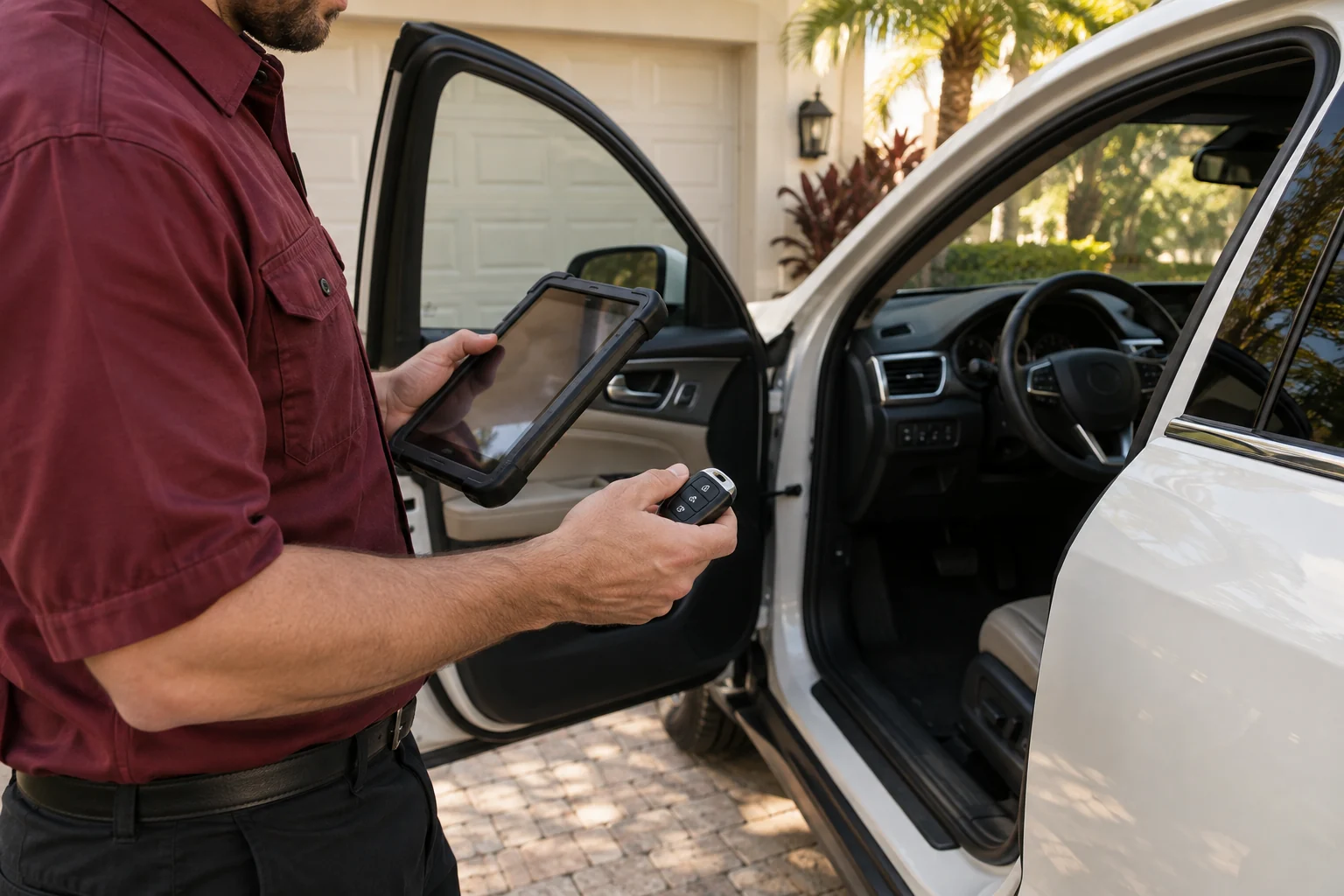
Automotive Locksmith in Miramar
Lost a car key, cracked a fob or found your ignition fighting you? This guide explains how automotive locksmith work actually goes, so Miramar drivers can make calm decisions and describe the problem clearly.
Call (954) 888-8804Why a car key is more than a piece of metal
A modern car key is part mechanical and part electronic. The blade turns the lock or ignition, but a small chip inside the head also sends a coded signal that the vehicle must recognize before the engine will run. If that code is missing or wrong, the key can feel perfectly normal in the ignition and still do nothing. This is the single biggest reason people are surprised when a copy that looked right does not work.
That design protects cars from casual theft, and it also means that replacement is a two part job. Someone has to cut or produce the physical key, and someone has to teach the vehicle to accept it. Both steps need the right equipment, the right information about your vehicle and proof that you are entitled to the car. Skipping either one is how people end up with a key that looks right and does nothing.
This page is general guidance for drivers in Miramar and nearby areas, written without claims about any specific local business or street. It exists so that when something goes wrong with a key, you already know the vocabulary, the choices and the questions worth asking before work starts.
Which type of key does your car use?
Cars on Broward roads use several kinds of keys, and the type decides how replacement works. Older vehicles may have a plain metal key with no chip at all. Many cars from the late nineties onward use a transponder key, which looks like an ordinary key with a thick plastic head. Others use a remote head key that combines the blade with lock and unlock buttons, or a flip key whose blade folds into the fob.
Newer vehicles often use a push button start with a proximity fob. You never insert anything into a slot, and the car simply senses the fob inside the cabin. A few use a high security key with a milled track along the blade instead of the familiar jagged edges, which needs a different cutting machine.
If you are unsure which type you have, look at the head of the key, check the owner's manual and note whether the car has a start button. Telling the locksmith this on the phone narrows the job at once. Reading about transponder key programming explains the electronic half of the job, and the notes on blade styles help you describe what you are holding.
The reason this matters is practical. A locksmith who knows your key type before arriving can plan the right blanks, the right cutting method and the right programming approach. A caller who only says that the car key is broken leaves all of that to guesswork, and guesswork is where delays and misunderstandings begin. Even a photo of the key head, if you can describe it, helps.
- Plain metal keys have no chip and are simply cut to match.
- Transponder keys carry a chip the car must recognize.
- Remote head and flip keys add lock and unlock buttons to the key.
- Proximity fobs let the car start without inserting a blade.
- Laser cut keys use a milled track and need special cutting equipment.
When every key is gone versus when one still works
The two situations feel alike but are handled differently. If you still own one working key, a locksmith can often use it as a reference and produce an additional key without disturbing the car's setup. If every key is lost, the vehicle's own system has to be accessed to add new ones, which takes more steps and more information from you.
In both cases you will be asked for ownership documents, usually the registration or title together with photo identification. This is a normal protective step and a sign that the person helping you takes theft seriously. Have these ready before the call, and be prepared to explain where the car is parked and how it is secured.
Do not wait for the last key to fail. Making a spare while you still have a working one is the easier, calmer path, and the article on whether a spare car key is worth it walks through the reasoning. The service page for car key replacement describes how the work is carried out from first call to final test.
Keys locked inside the car
Locking keys inside a vehicle is one of the most common calls there is. Before you phone anyone, check the obvious: try every door, including the rear doors and the trunk release if you can reach it, and confirm that nobody carries a spare to you. Do not wedge tools into the door frame or force the window, because airbags, wiring and weather seals sit right there, and the repair costs more than the lockout.
If a child or pet is inside, treat it as urgent and say so at the start of the call. In summer heat the inside of a closed vehicle becomes dangerous much sooner than most people expect, and in that situation emergency services are the right call first. A locksmith can help in other cases, but a life at risk comes before everything else.
When the vehicle is simply locked with nobody inside, give the make, model and year, the exact place you are parked and whether the keys are visible. The technician opens the car using methods designed not to harm the paint, weatherstripping or electronics. For more detail, see the guide to solutions when keys are locked in the car,. If the keys ended up in the trunk, the same cautious approach applies: do not pry at the lid or latch, because they are harder to fix than a simple lockout, and describe whether the rear seat folds down so the technician knows the layout.
Afterward, think about how it happened. Keys left on a seat, in a cup holder or in a bag that stayed in the trunk are common. Some people find it useful to keep a spare on a different ring from the daily bunch, and to pick one fixed place where keys always go. Small habits like that remove most lockouts without any equipment at all.
A fob that stopped responding
Not every dead remote means a new key. Before assuming the worst, think about the simple causes. A weak coin battery is the most frequent culprit, followed by a fob that was dropped or soaked, or one that has worn buttons. If the car still starts with the physical key or by holding the fob against a marked spot on the dash, the chip is probably fine and only the remote side has failed.
Moisture matters here. In humid weather and during rainy season, a fob carried in a pocket can pick up damp and corrode its contacts. Drying it out and replacing the battery sometimes brings it back, though the case may need opening with care so the circuit board is not damaged. If it fails again, replacement is the better answer.
If the fob truly will not work, a locksmith can look at whether the shell is cracked, the board is damaged or the programming has been lost. The page on key fobs that stop working lists the checks in a sensible order, and what to do when a push to start key is lost covers the harder case where nothing is left.
Ignition cylinders that stick, wobble or refuse the key
Sometimes the key is fine and the car is the problem. A worn ignition cylinder lets the key turn only with wiggling, sticks halfway, will not come out of the ignition, or spins without engaging anything. These are signs of wear inside the cylinder, and in some vehicles they can also involve the steering column lock.
Do not force a key that will not turn. Bent keys, broken blades and snapped pieces inside the cylinder turn a repair into a larger one. If your key is old and rounded at the edges, a fresh copy cut from the original code may behave better than the worn one, but if the cylinder itself is worn, only repair or replacement will fix it.
A few habits protect the ignition. Keep the key ring light, since a heavy bundle of keys and charms hanging from the key swings with every bump and wears the cylinder from the inside. Turn the wheel slightly if the steering lock is binding while you turn the key, and never lean on the key with force. If the key begins to feel notchy, do not wait for a failure at a bad moment.
A technician will examine the cylinder, explain what is worn, and tell you whether a repair will do or whether the part should be replaced and keyed to match your vehicle. The information on ignition cylinder problems, the advice on a key stuck in the ignition and the ignition repair page will help you recognize what you are seeing.
Locksmith or dealership?
Many drivers assume the dealership is the only place that can make a key for their vehicle. In practice both routes exist, and each has trade offs. A dealership usually has the manufacturer's resources but may require you to bring the vehicle to them, which is difficult if the car will not start and has no key to turn.
A mobile locksmith comes to the vehicle, which matters when your car is stuck in a parking lot or at home. The questions to ask either way are the same: does the replacement work with remote buttons, can an extra be made at the same time, and is the work tested before you pay?
There is no universal answer, and anyone claiming one should be questioned. Compare what each option involves for your specific car. The article comparing a locksmith versus a dealership for car key replacement sets out the factors so you can decide based on your own circumstances.
Whichever route you choose, ask for the work to be described in simple terms. You should hear what will be produced, whether the old keys will keep working, and how the finished key will be tested. If the answer is vague, ask again. A clear answer before any work starts is the strongest protection against a surprise at the end.
Cars that sit outdoors in South Florida
Vehicles in this region spend a lot of time in heat, sun and humid air, and that takes a toll on keys and locks. Plastic fob housings become brittle, rubber button pads crack, and coin batteries run flat sooner. Salt air near the coast adds corrosion, especially on door lock cylinders and trunk latches that are rarely used.
Doors that are seldom locked with the key can seize up. If you notice the key turning stiffly in the driver's door, address it before the lock fails entirely. A little grit and corrosion is a normal reason, and a locksmith can service or replace the cylinder before you end up locked out of your own car.
Hurricane season also matters for planning. If you evacuate, you may leave a vehicle in an unfamiliar lot or travel in a rental car. Keep a spare key, a photo of your registration and the vehicle details in a safe place at home so that you can handle a key problem from anywhere.
Parking choices help too. A shaded spot or a garage reduces the heat load on a key left in a console or on a dash, and keeping the fob away from sunlit glass avoids the warping that cracks housings. When the car goes through a car wash or sits in heavy rain, check that the fob is not left in a pocket that gets soaked.
Smaller vehicles and special cases
Not every vehicle is a typical sedan. Motorcycles, scooters, golf carts and work vans have their own key styles and sometimes use simpler or older systems. Some need keys cut by code, others need chips programmed in unusual ways, and parts for older models can be harder to find.
If your vehicle is out of the ordinary, say so at the beginning of the call. Give the make, model, year and anything unusual such as an aftermarket alarm or a locked steering column. The more precise your description, the more accurate the explanation of what the work involves will be.
The guide to motorcycle key replacement is a useful starting point for two wheeled riders. For neighbors in nearby areas, the page for Pembroke Pines covers the same service in that area, which can be useful if you commute across city lines and a key problem strikes away from home.
Getting ready for the call
Contact with Half Off Locksmith is by phone only. Start by describing what happened in plain words: the key is lost, snapped, stuck, or the car locked itself. Then give the vehicle details, your location and whether you can show ownership. The work and the price are explained before it begins, and the finished work is tested with you.
Have your vehicle information at hand: make, model, year and, if you can read it through the windshield, the vehicle identification number. Know where the car is parked, whether it is in a garage, a lot or on the street, and whether it can be moved. If it is in a place with limited access, mention that too.
After the work, ask the technician to start the car, lock and unlock it with every key, and test every function you rely on. Keep the receipt and ask what was done. A calm, tested result is the whole point, and you should leave feeling that you understand what you paid for.
If you have several drivers in the household, bring up every key that exists. Teen drivers, a spouse and a relative who borrows the car may each hold a copy, and some systems let the locksmith remove keys that are lost so they no longer start the car. Ask whether that is possible for your vehicle, especially if a key went missing in a place where someone else might find it.
Common questions
Can a locksmith make a new car key if I have lost all of them?
Often yes, provided you can show ownership with registration or title and a photo identification. The key has to be produced and programmed so the vehicle accepts it. The details depend on the make and model, so describe your car clearly and ask what steps your vehicle requires before work begins.
Why did my copied key open the door but not start the car?
The metal part matched, but the chip in the head was not programmed to the vehicle. Most modern cars check an electronic code before the engine will run. A copy without that code can turn the lock yet still fail to start, so ask whether programming is included.
Should I replace my ignition or just the key?
It depends on where the wear is. If the key is rounded and old, a fresh key may help. If the cylinder is worn, the key will keep struggling. A technician can examine both and tell you which one is the real problem before you agree to any work.
What should I do if my child or pet is locked in the car?
Call emergency services first, especially in warm weather, because a closed vehicle heats up in a hurry. A locksmith is not a substitute for emergency help when a life is at risk. Once everyone is safe, a locksmith can help with any remaining lock problem.
Is a dead fob always a sign that I need a new key?
No. A weak battery, a damp board or worn buttons are common causes and can sometimes be solved without a new key. If the car still starts with the physical key, the chip may be fine. A locksmith can check the fob and tell you which repair applies.
What proof will I be asked for?
Expect to show that you own the vehicle, usually with the registration or title and a photo identification. This protects you and the car from misuse. If you do not have the paperwork with you, ask what alternatives are acceptable before arranging the visit.
Talk through the job before work begins
Say what went wrong and what you need to work when we leave. Scope and price are settled with you ahead of the work.
Call (954) 888-8804