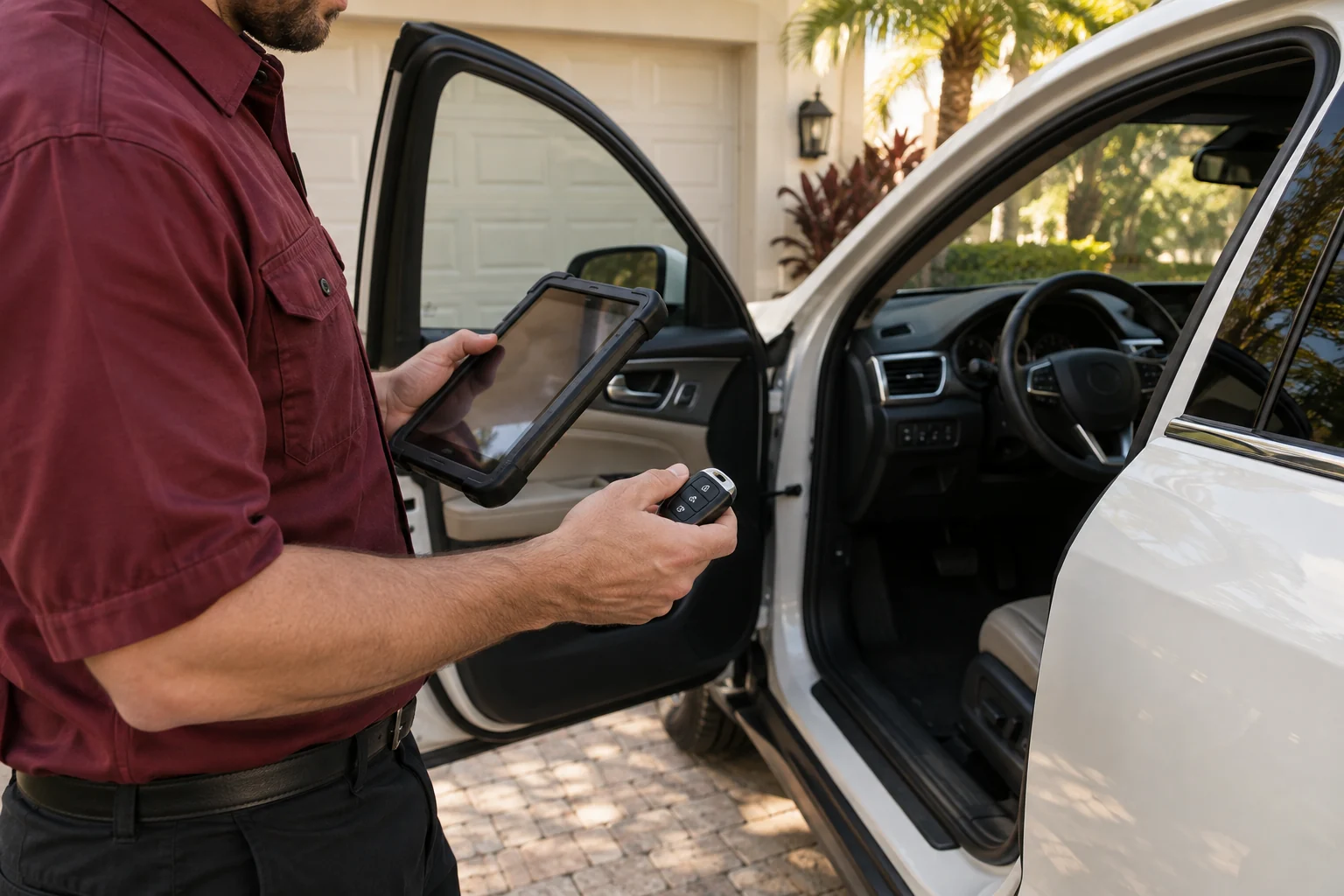
Automotive Locksmith in Wilton Manors
Car keys are no longer simple pieces of metal. This page is general guidance for drivers in Wilton Manors on how modern keys work, what can go wrong, and how to prepare for a call about a vehicle.
Call (954) 888-8804Why a car key is more than a cut piece of metal
For many years a car key was just a blade cut to match the ignition lock. Anyone with a copy machine and a blank could duplicate it. Today most vehicles on the road use keys that carry a small electronic chip, and the car will not run unless it recognizes that chip. The metal blade turns the ignition or opens the door, but a second, invisible conversation happens between the key and the vehicle.
That conversation is the reason a key can look perfect and still fail to start the car. If the blade is cut correctly but the chip has not been introduced to the car's computer, the engine may turn over briefly and then stop, or it may not respond at all. Understanding this saves a lot of frustration, because it explains why a simple copy from a hardware counter sometimes does nothing.
This page is general guidance for drivers in Wilton Manors and does not describe particular streets, lots, or businesses. The technical points apply to almost any vehicle owner in Broward County.
If you are trying to figure out what kind of key you have, the guide to transponder key programming explains the chip in more detail, and laser cut versus standard car keys covers the shape of the blade.
The main kinds of keys you might be holding
A traditional key is all metal, with cuts along one or both edges. These are found mostly on older vehicles and are the simplest to copy. A transponder key looks similar but has a plastic head containing a chip. A laser cut key, sometimes called a sidewinder, has a groove milled into the flat face of the blade rather than cuts on the edges, which makes it thicker and harder to copy casually.
A remote head key combines the blade with lock and unlock buttons in the same plastic head. A key fob or smart key goes further: it may have no visible blade at all, or a small emergency blade hidden inside. It talks to the car by radio, so you can keep it in a pocket and the car senses it. Push button start vehicles rely on this type.
Each type needs different handling. Cutting a blade is a mechanical task. Programming a chip or a fob is an electronic task using special equipment. A technician who handles vehicle keys will ask you what you have, because the answer changes what is needed and what to prepare.
If you are not sure which you own, look at the key head. A plastic head, a rubber button pad, or a fob without a blade are all clues. You can describe it on the phone even without knowing its technical name.
- Basic metal keys have no chip and are the simplest to duplicate.
- Transponder keys carry a chip that the car must recognize.
- Laser cut keys have a milled groove on the blade face.
- Remote head keys combine the blade and the buttons.
- Smart keys and fobs communicate by radio and enable push button start.
When you have lost every key
Losing the only key to a car is stressful, but it is a solvable problem. A locksmith can create a new key for many vehicles on site without towing the car to a dealership, provided the right information and equipment are available. This is often called an all keys lost situation, and it requires more steps than copying an existing key because there is nothing to copy from.
Normally the process involves confirming you own the vehicle, identifying the correct key type, cutting the blade from the car's code or from the lock itself, and then programming the electronics so the car accepts the new key. Some vehicles also let a technician erase the lost key from the system, so that the missing key cannot start the car even if someone finds it.
Be prepared to show proof of ownership, such as a registration or title and a matching photo identification. This is not an obstacle but a protection. A responsible technician wants to know that the person asking for a key is entitled to one, just as you would want in the reverse situation.
The article on car key replacement lays out the overall picture, and locksmith versus dealership compares the two routes so you can decide which suits your timing and situation.
Push button start and the lost fob problem
A push button start car has no ignition slot. You carry a fob, press a button on the dash, and the car starts if it detects the fob nearby. When that fob goes missing, you cannot simply cut a replacement blade and turn a key. A new fob must be matched to the vehicle's computer, which usually requires specialized tools and the vehicle's security information.
If the fob is lost, do not assume the car is ruined. Check obvious places first: coat pockets, bags, the car's interior, and the floor of wherever you last parked. Some owners discover the fob is inside the vehicle after being locked out. If it is truly gone, a locksmith who handles smart keys may be able to supply and program a replacement.
If the fob works only some of the time, the cause is often much simpler than a full replacement. A weak battery is the usual culprit, and it can mimic a bigger fault. Our walkthrough on a key fob that is not working covers the first things to try, and losing a push to start key explains what comes next.
Keep in mind that a spare fob cut and programmed while you still have a working one is far easier than starting from nothing. It is one of the strongest arguments for not waiting until the last key is gone.
Ignition trouble and keys that will not cooperate
Sometimes the key is fine and the problem is the lock. An ignition cylinder is a mechanical part that wears with use. If you carry a heavy key ring that hangs from the ignition, the weight can speed that wear. Signs include a key that is hard to insert, a key that only turns when you wiggle it, or one that sticks and will not come out.
A key that will not turn can also be caused by a steering wheel lock that has engaged. When the wheel is turned against the lock, it can bind the ignition. This is a common and harmless cause. Gentle pressure on the wheel in the direction it wants to go, while turning the key, often releases it. Do not use force, because a broken key inside the ignition makes the situation worse.
If the key has worn smooth, if the ignition has become sloppy, or if a piece has snapped off inside, stop and call. Forcing it risks damaging the cylinder. Read about ignition cylinder problems and a key stuck in the ignition for what is happening inside, and see the ignition repair overview for the repair side.
Parking on a slope with the wheels turned and the weight resting on the steering lock is another quiet cause of stiff turning, so straightening the wheel before you shut the engine off can spare the cylinder some strain. The earlier you address a worn ignition, the better. A cylinder that is replaced before it fails completely is a planned repair, while one that fails in a parking lot is an emergency.
Locked out of the car
A car lockout is one of the most common reasons people call. Keys end up on the seat, in a trunk, or in a bag that is now behind a locked door. The first step is to stay calm and make sure everyone is safe. If a child or a pet is inside the vehicle, that changes the urgency, and emergency services should be contacted without delay.
Do not try to jam something into the door frame or window seal. Modern doors contain wiring, airbags, and electronic components close to the glass and the lock linkage, and improvised tools can scratch the paint, bend weatherstripping, or damage hidden parts. A trained technician has gentle methods designed to avoid harm to the vehicle.
Before calling, note your exact location, the vehicle's make and model, and whether any of the doors or the trunk are open. If you have a second key at home or a family member who can bring one, that may be the simplest solution. If not, describe the situation clearly and the work and the price will be explained before it begins.
For more on this topic, see keys locked in the car and keys locked in the trunk, each of which covers its own tricky points.
Information to have ready when you call
Preparing a few facts makes a car key call smoother. The make, model, and year of the vehicle matter because key systems differ widely even among similar looking cars. If you can read the vehicle identification number, usually visible through the windshield on the driver's side near the dash, have it available, since it helps identify the correct key code and parts.
Tell the technician what happened and what you have. Do you have one working key and want a spare? Have you lost all keys? Is the fob damaged or just unresponsive? Is the key broken in the lock? Each answer points to a different job and a different set of tools. Being specific at the start means fewer surprises later.
Also have your proof of ownership available. A registration, title, or lease agreement and your identification will usually be needed before a key is created. If the car belongs to a company, a letter or paperwork from the owner may be needed.
Ask, too, whether the key you are replacing is the only style your car accepts, since some models take more than one kind of blank and the choice affects handling. Finally, tell the person where the vehicle is. A car in a garage, a carport, or a condo lot is easier to describe than a car on a busy road, and the location affects what is practical. Honesty about the situation helps everyone plan.
Living with humidity, salt, and sun
Vehicles parked outdoors in South Florida face conditions that affect keys and locks. Heat can warp plastic key heads over time and weaken the glue that holds a key shell together. Humidity encourages corrosion on exposed contacts. Salt air near the coast is especially hard on metal parts and on the buttons of key fobs.
Fobs also suffer from being dropped, carried with coins and other keys, or exposed to water at the beach or pool. A fob that has been through a wash is not always dead, but moisture can affect the circuit board and the battery contacts. If yours has gotten wet, resist the urge to keep pressing buttons and instead let someone assess it.
A little care goes a long way. Keep your key out of direct sun on the dashboard, avoid leaving it in a hot parked car if you can, and replace the battery before it is completely drained. A tired battery shortens range and can leave you stuck exactly when you least want it.
Door locks and trunk locks on older cars can also stiffen from corrosion. If a door lock feels gritty or the key resists, that is a hint it needs attention before it gets worse.
Spare keys, and the wisdom of making one early
The easiest key problem is the one you prevent. Having a spare made while the original still works is almost always simpler than recovering after a loss. The technician can copy and program from a working key, and there is no scramble. The article on whether a spare car key is worth it argues the case.
Where you keep the spare matters. A key in the glove box or hidden in a magnetic box under the bumper is in the worst spots because anyone who gets into the car finds it. A better plan is a spare at home in a secure place, or with a trusted person. Treat a spare like any valuable item.
Motorcycles and other vehicles also have their own key systems. If you ride, you may be interested in motorcycle key replacement. The general approach is the same: identify the key type, confirm ownership, and create the key.
Some drivers like to keep one full featured fob for daily use and a simpler blade key, where the car allows it, tucked away at home for emergencies. Others prefer two identical fobs so that either one can be the daily key. Both approaches work, and the right one depends on the vehicle and on how many people drive it. Think of a spare as insurance against the stress of a bad day. It does not need to be fancy, but it does need to exist and to be in a sensible place.
Choosing who you call
A vehicle key job involves your car, your money, and proof that you own the vehicle, so it is worth being a little careful about who you choose. A good provider listens, asks questions, and explains what will be done and why. They do not pressure you or give vague answers.
Be wary of anyone who cannot or will not explain what the work involves. The work and the price should be explained before it begins. You should know what you are agreeing to. If something changes on site, you should hear about it before it is done, not afterward.
For more on judging a provider, see how to choose a locksmith you can trust. The principles apply as much to vehicles as to doors.
Keep any paperwork you are given, including a note of the key type and what was programmed, since it makes a later spare simpler. When the work is finished, the new key should be tested with you. Start the car, lock and unlock using the buttons and the blade, and confirm that everything responds. If something is off, say so before the technician leaves.
Common questions
Can a locksmith make a car key without the original?
For many vehicles, yes. When no original exists, the technician confirms ownership, identifies the key type, cuts a blade, and programs the electronics so the car accepts it. Some vehicles are more complicated than others, so describe the make, model, and year when you call so the right approach can be planned.
Why does my car not start even though the new key turns?
Most modern cars need the chip in the key to be recognized by the vehicle. A correctly cut blade without a matched chip may turn the ignition but fail to start the engine. Programming the key to the car solves this, and it is a separate step from cutting the metal.
What proof of ownership will I need?
Expect to show a registration or title together with matching identification. If the vehicle is leased or belongs to a business, paperwork from the owner may be needed. This is a protection for you, because it makes it harder for someone else to obtain a key to your car.
Is it safe to try to open my own locked car?
Improvised tools can scratch paint, tear seals, and damage wiring or airbag components near the door. If someone is trapped inside, contact emergency services right away. Otherwise, it is usually wiser to have a trained technician open it gently or to retrieve a spare key.
My key fob works only sometimes. Do I need a new one?
Not necessarily. A weak battery is a frequent cause and is an easy fix. Moisture, a cracked case, or worn buttons can also be involved. Try replacing the battery first, and if the problem continues, have the fob examined before deciding whether to replace it.
Should I get a spare key even if my current one works?
Yes, it is generally the easiest time. Copying from a working key avoids the extra steps of an all keys lost situation. Keep the spare somewhere secure and not inside the car, so a single bad moment does not leave you without any way to drive.
Talk through the job before work begins
Explain the problem, what has to work again and who needs access afterward. We talk through the scope and the price first, and work begins after you agree.
Call (954) 888-8804