Commercial Locksmith in Wilton Manors
A business door has to do more than a house door: it must welcome customers, protect stock and records, and let people leave safely. This page is general guidance for Wilton Manors owners and managers planning lock work.
Call (954) 888-8804How a business door differs from a home door
A house has a handful of people with keys and a predictable routine. A business has employees who come and go, deliveries, cleaners, managers, vendors, and sometimes a landlord with a separate key. The door sees far more use, so the hardware wears out sooner, and the question of who is allowed through at which hour becomes the heart of the problem.
Commercial doors are also often built differently. Storefronts use aluminum and glass frames with narrow stiles, which limits what kind of lock can fit. Back doors may be heavy steel. Office suites may have hollow interior doors that look alike but need different treatment from an exterior entry. Each of these calls for hardware that matches the door and the way people use it.
This page is general guidance for Wilton Manors business owners and does not describe any specific street or building. Requirements that apply to your premises depend on your lease, your property manager, and the authorities that govern your building, so those are the places to confirm anything formal.
If you are new to business lock work, the overview of commercial locksmith services shows the range of jobs that fall under this heading, from simple rekeying to full systems.
Hardware grades and why they matter on a busy door
Lock hardware is sorted into grades according to how much punishment it is built to take. Lighter residential grade locks are designed for a few openings a day. Commercial grade hardware is tested for far heavier use and for greater resistance to force. Putting a light lock on a busy shop door will often work for a while and then start to loosen, stick, or fail.
The practical result is simple: the more traffic and the more valuable the contents, the stronger the grade you want. A small office with two employees has different needs from a restaurant that opens its doors constantly. Your technician can look at how the door is used and suggest where heavier hardware is justified and where it is not.
Grades also relate to how a lock is installed. A strong lock set into a weak door or an unreinforced frame is only as good as the weakest part. The explainer on commercial lock grades goes through the categories, and it helps to read it before comparing quotes.
Salt air and humidity in South Florida also take a toll on exterior commercial hardware. A finish that looks fine inside an air conditioned office can corrode within a short season on a rear service door. Mentioning where the door sits helps with choosing materials that will hold up. Door closers, hinges, and thresholds are part of the same conversation, because a lock cannot do its job if the door swings loose, slams, or fails to pull shut on its own. A tired closer is one of the most common reasons a commercial door will not latch, and it is often overlooked until the lock gets blamed.
Key control: knowing who holds what
The most common weakness in a small business is not the lock but the key situation. Keys are copied at the hardware counter without anyone noticing, handed to relatives, left with a former employee, or stored in a drawer that everyone can open. A lock is only as secure as the list of people who can open it, and many owners simply do not have a list.
There are ways to improve this. Keep a written log of each key issued, to whom, and on what date. Use keys that are stamped as not to be duplicated, though stamping alone does not prevent copying. For serious control, a restricted keyway system limits copying to authorized requests, as explained in restricted and high security keys.
When someone leaves, the response should be automatic. If they held a key, you either recover it with a record or you rekey. The article on rekeying an office after an employee leaves goes through what to do, including how to handle the situation without drama.
Back doors deserve the same attention as the front. Many losses happen through the entrance customers never see, where the hardware is older and the lighting is poor. A rear door with a strong deadbolt, a solid frame, and a reinforced strike plate is a modest improvement with real effect. A simple habit helps: look over who holds keys at set times, such as the start of each season. A few minutes with a list can catch an old key before it becomes a problem.
- Keep a written record of every key issued and returned.
- Rekey when someone who held a key leaves and it cannot be accounted for.
- Limit copies and know where spares are stored.
- Go over the key list on a regular schedule.
Master key systems for multiple doors
When a business has many doors and many people, carrying a ring of ten keys is impractical. A master key system solves this by letting different keys open different sets of locks in a planned hierarchy. An employee might have a key that opens only the front and the break room, a supervisor might have one that opens those plus the stockroom, and an owner might have a master key that opens everything.
Designing a system means deciding the levels first, on paper, before any cylinders are pinned. Who needs access to what, and when? Which areas must stay restricted? Planning the structure up front avoids a messy system that has to be redone later. The guides on master key systems for business and keyed alike and master key setups explain the vocabulary.
A master system does add complexity inside the cylinders, since extra pins allow more than one key to work. That makes it important to have it designed and documented properly. It also means a lost master key is a bigger event than a lost single door key, so the highest level keys deserve the strictest handling.
Planning also forces useful questions. Does the bookkeeper really need the stockroom? Should the part time opener be able to reach the office safe? Writing the answers down turns vague habits into rules that a locksmith can build into the hardware, and that you can explain to the people affected. Even a small business with only a few doors can benefit. Two or three levels of access is often enough to stop everyone from carrying every key.
Storefront doors and glass
Many retail and office entrances in Wilton Manors, like those across Broward County, are glass doors in metal frames. These doors have narrow edges, so the lock may be a hook bolt or a surface mounted device rather than a typical deadbolt. They also take a lot of daily handling, and the hardware can loosen or the door can drop slightly so it no longer lines up with its latch.
A door that drags on the floor, a latch that no longer catches, or a lock that needs to be pulled and lifted to turn are all signs of alignment problems. Often the fix is an adjustment rather than a new lock. The guide on storefront door lock repair describes common symptoms and what usually causes them.
Glass doors also raise the question of how well the door is secured at night. A strong lock on a glass door matters, but so does thinking about lighting, visibility from outside, and whether valuable items are visible from the street. These decisions are about the whole picture rather than one lock.
Weather plays a role here as well. Sun, rain, and salt air work on the weatherstripping and the bottom sweep of a storefront door, and a gap at the threshold lets in moisture that reaches the lock case. Cleaning and lubricating hardware is not glamorous, but it extends its life noticeably. If a storefront lock is failing, do not wait for it to give up completely on a busy day. A door that will not lock is a security problem, and a door that will not unlock is a business problem.
Exit devices and safe ways out
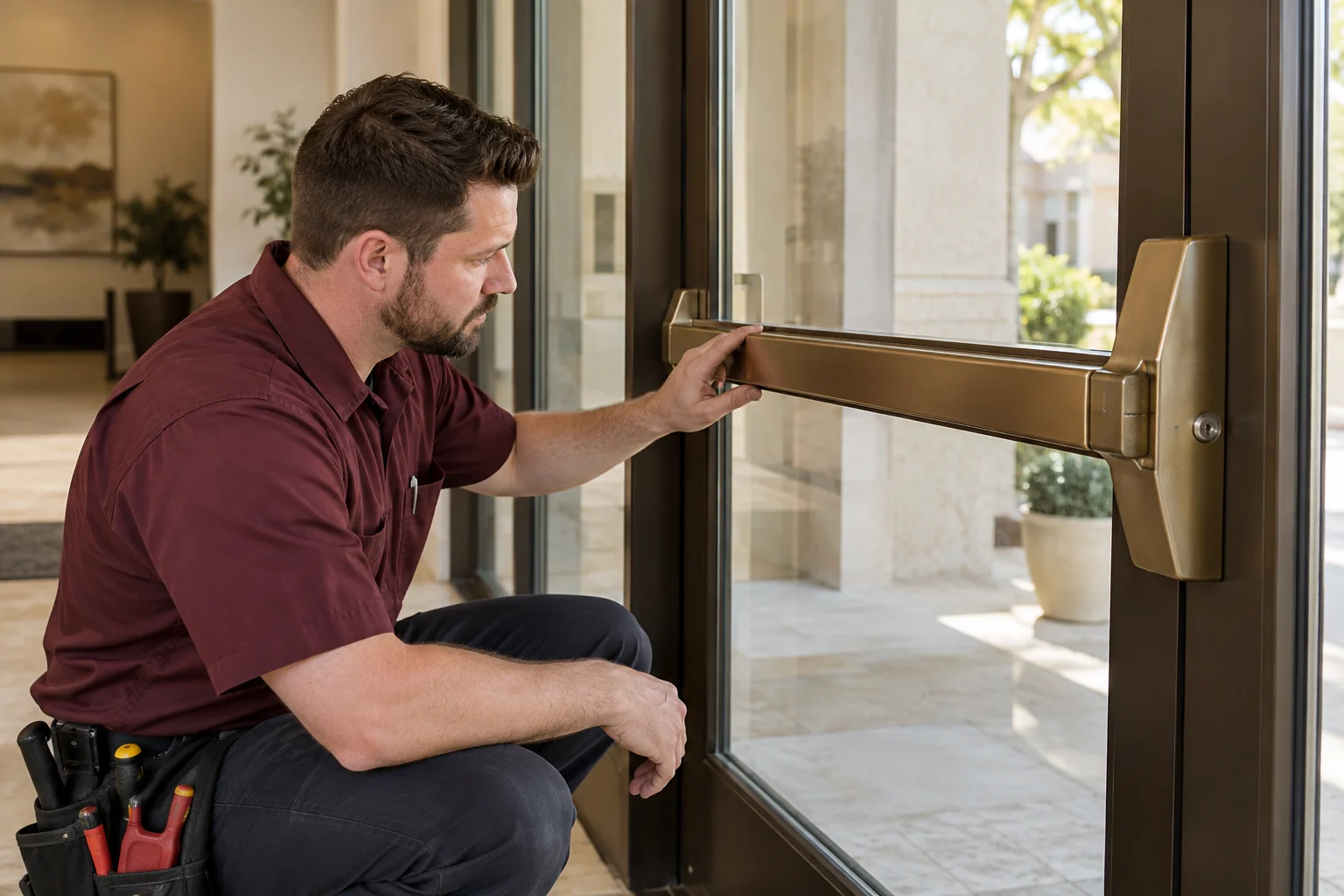
Any commercial space where people gather needs doors that let them leave easily in an emergency. Panic bars and other exit devices allow someone to push to open without needing a key, a twist, or special knowledge. The point is that in a crisis nobody should have to think about how to get out.
At the same time, the outside of an exit door needs to stay secure. A well designed exit device lets people leave from inside but keeps the door locked against entry from outside. The overview of panic bars and exit devices explains how these work and what to check.
Rules about egress, fire safety, and accessibility are set by the authorities that govern your building, and they vary. Do not rely on a general web page, including this one, to tell you what your particular door must do. Ask your property manager, your insurer, or the local building and fire officials. Your locksmith can then install hardware that meets what they tell you.
Never chain or block an emergency exit, even temporarily. If a door seems hard to use in an emergency, treat that as a repair priority.
Electronic access control and tracking entry
Some businesses outgrow metal keys. Keypads, card readers, and fob readers let you give each person their own credential and cancel it the moment they leave, without collecting or rekeying anything. Many systems also record who entered and when, which is useful for sensitive areas or for settling a dispute about who unlocked the building.
Electronic access has its own considerations. It depends on power and on the control equipment, so you should understand what happens in an outage. Most systems have a mechanical or battery backup, and you should know how it works before you need it. The note on access control versus keys for a small business weighs the tradeoffs.
Think about the people who are not employees as well. Cleaners, contractors, delivery staff, and inspectors may all need to enter at times, and each of them should have an arrangement that can be ended cleanly. A temporary code or a card that is issued for a set purpose is easier to manage than a physical key that might be copied. The right choice depends on how many people need access, how often they change, and how much you need a record. A shop with one owner and one employee may do well with good mechanical keys, while an office with rotating staff may benefit from credentials that can be turned off remotely.
Whatever you choose, plan for the day the system fails. A door that cannot be opened in a power loss is a risk of its own.
Tenant turnover and shared buildings
Commercial spaces often change hands. When a new tenant moves in, the old tenant's keys do not disappear. Everyone who ever held a key to the space is a possible entry, so rekeying at turnover is standard practice for good reasons. It is simple, it is a small job compared with the risks it removes, and it sets a clean record.
If you are the tenant, check your lease for who controls the locks. Some leases require the landlord to hold a copy of every key, and others allow you to change them with notice. Ask your landlord or property manager before changing anything on the main entry, and keep a copy of any permission in writing.
Landlords managing several units benefit from a consistent system, ideally with a master key that works across the building while each tenant keeps a separate key for their own space. The guide for turnover rekeying for property managers gives a workable routine.
Take a walk through the space on move in day and write down every door, every lock, and every key you were given, then compare the count with what you expected. Gaps in that list are exactly what a rekey closes. Shared buildings also have shared doors, such as lobbies, stairwells, and service entrances. Decide who is responsible for those so that a lock failure does not become an argument.
Preparing for the storm season
Hurricane season matters for commercial properties. Shutters and boards go up, doors can swell or shift, and after a storm a building may be without power for a time. It is sensible to check door hardware beforehand: do the locks turn smoothly, do the doors close cleanly, and do the exit devices release properly?
After a storm, test every lock again. A frame that shifted slightly can leave a latch no longer catching. Water intrusion can also affect electronic access hardware, so if your doors rely on power, confirm that they still respond. Having a plan for how the building can be secured if electronics fail is part of good preparation.
Consider, too, who in your organization can act if you cannot. A manager who knows where the spare keys are, and who is authorized to use them, can open the building for inspectors or repair crews while you are away. Write this down in a short plan and share it with the people it concerns. Keep keys and credentials in an orderly place that is easy to reach but not obvious. If an emergency means you must leave in a hurry, you want to know where the important keys are and who else can reach them.
This kind of walk through costs little and avoids a lot of trouble. It also gives you a chance to spot hardware that is worn and should be addressed before the pressure of an approaching storm.
Starting the conversation with a locksmith
The right way to begin is to describe your situation plainly. How many doors, what kind, how many people need access, and what problem are you trying to solve? Mention any known issues such as sticking latches, lost keys, or a recent staffing change. The more clearly you describe it, the easier it is to suggest a sensible plan.
Ask for the work and the price to be explained before it begins, and ask what you will have at the end: how many keys, which doors, and what documentation of the system. When the job is complete, the finished work should be tested with you door by door.
Related topics may help as you plan. If your concern is a former employee, read about changing keys after a departure. If you want to compare how neighboring communities approach this, general guidance for commercial locksmith work in Oakland Park or in Fort Lauderdale follows similar lines.
A good locksmith relationship is a long one. Once someone understands your doors, your people, and your goals, each later change becomes easier.
Common questions
How often should a business rekey its locks?
There is no fixed schedule. Rekey when a key holder leaves without returning a key, when a key is lost, when a tenant moves in or out, or when you cannot say who holds copies. A periodic key check helps you spot when the time has come.
What is the difference between keyed alike and master keyed?
Keyed alike means several locks open with the same single key. Master keyed means each lock has its own key but a higher level master key also opens a group of them. Master systems offer layered access, while keyed alike simply reduces the number of keys carried.
Do I need commercial grade hardware for a small office?
Not always. Heavier grades make sense on doors that see constant traffic or protect valuable contents. A lightly used interior door may not need them. A technician can look at how each door is used and recommend where stronger hardware is worth it.
Who decides what exit hardware my building needs?
Requirements come from the authorities that govern your building, along with your lease and insurer, and they vary by property. Ask your property manager or local building and fire officials. Your locksmith can then install hardware to match what they tell you.
Is electronic access control better than keys?
It depends. Credentials are easy to cancel and can record entries, which suits changing staff and sensitive areas. Mechanical keys are simple and need no power. Many businesses use a mix, and planning for outages is important either way.
Can I change the locks on a leased space myself?
Check your lease first. Some require the landlord to keep a copy of every key and ask for notice or permission before any change. Get approval in writing from your landlord or property manager, then arrange the work so the right parties receive the new keys.
Talk through the job before work begins
Tell us what happened, which doors or keys are involved and who needs to get in. The price and the plan are agreed with you before any work starts.
Call (954) 888-8804