Home | Cities | Pembroke Pines
Automotive Locksmith in Pembroke Pines
Car keys are no longer simple pieces of metal. This page gives general guidance for Pembroke Pines drivers on lost keys, chips, push button start systems, worn ignitions and lockouts, and how to describe the problem clearly.
Call (954) 888-8804Why a car key problem feels bigger than a house key problem
When a house key goes missing, you can usually wait, borrow a bed somewhere and sort it out. When a car key goes missing, the whole day stops. You cannot get to work, collect children or run the short errand that was supposed to be simple. That pressure is exactly why it helps to understand the problem before you call, so the conversation is short and the decision is calm.
This page is general guidance for drivers in Pembroke Pines. It does not describe particular streets or parking areas, and it makes no claims about local rules. It simply explains how modern car keys work, which situations lead to which kinds of fixes, and what questions to ask. Every vehicle is different, so the final answer always depends on the make, model and year of your own car.
If you are stranded right now, get yourself and anyone with you to a safe spot, away from moving traffic and out of the sun if possible. Then call and describe the vehicle and where it is. The rest of this page can wait until you are sitting somewhere comfortable.
One more point before you read on. Whoever helps you should explain the plan and the price before work begins, and should test the result with you at the end. That is the basic pattern at Half Off Locksmith, and it is a fair standard to hold any provider to. If something in the conversation feels hurried or unclear, slow it down and ask again until it makes sense.
Lost, broken and worn: three different problems
People often say they lost a car key when the real situation is something else. A key that is completely missing is one problem. A key that has snapped in the lock or ignition is another. A key that still turns but works only some of the time is a third. Each leads to a different kind of repair, and mixing them up leads to the wrong expectations.
With a missing key, the locksmith usually creates a new key and programs it to the vehicle. With a broken key, the broken piece may need to be removed first, and the cylinder checked for damage. With a worn key, the fix might be as simple as cutting a fresh key from the original code and retiring the old one before it fails completely.
If you still own one working key, say so right away. Copying from a working key is generally simpler than starting from nothing, and it avoids the situation where you have no key at all. It is also a good reason to make a spare before trouble arrives. The article on whether a spare car key is worth it explains the thinking.
What the chip inside your key actually does
Most vehicles built in recent decades carry a tiny electronic chip hidden in the plastic head of the key. When you turn the key, the car sends a quiet signal, the chip answers with a code, and the engine is allowed to run only if the code matches what the car expects. This system is called an immobilizer, and it is the reason a plain cut key often unlocks the doors but will not start the engine.
That is why a hardware store copy is frequently disappointing. The metal may be cut perfectly while the chip inside remains blank or unmatched. A locksmith who works on vehicles uses the right equipment to cut the metal blade and to pair a chip with your car so that it recognizes the new key.
The page about transponder key programming goes deeper into how pairing works. For now, the key point is that a new car key has two parts to get right, the physical cut and the electronic identity, and both must match your vehicle.
Push button start and smart keys
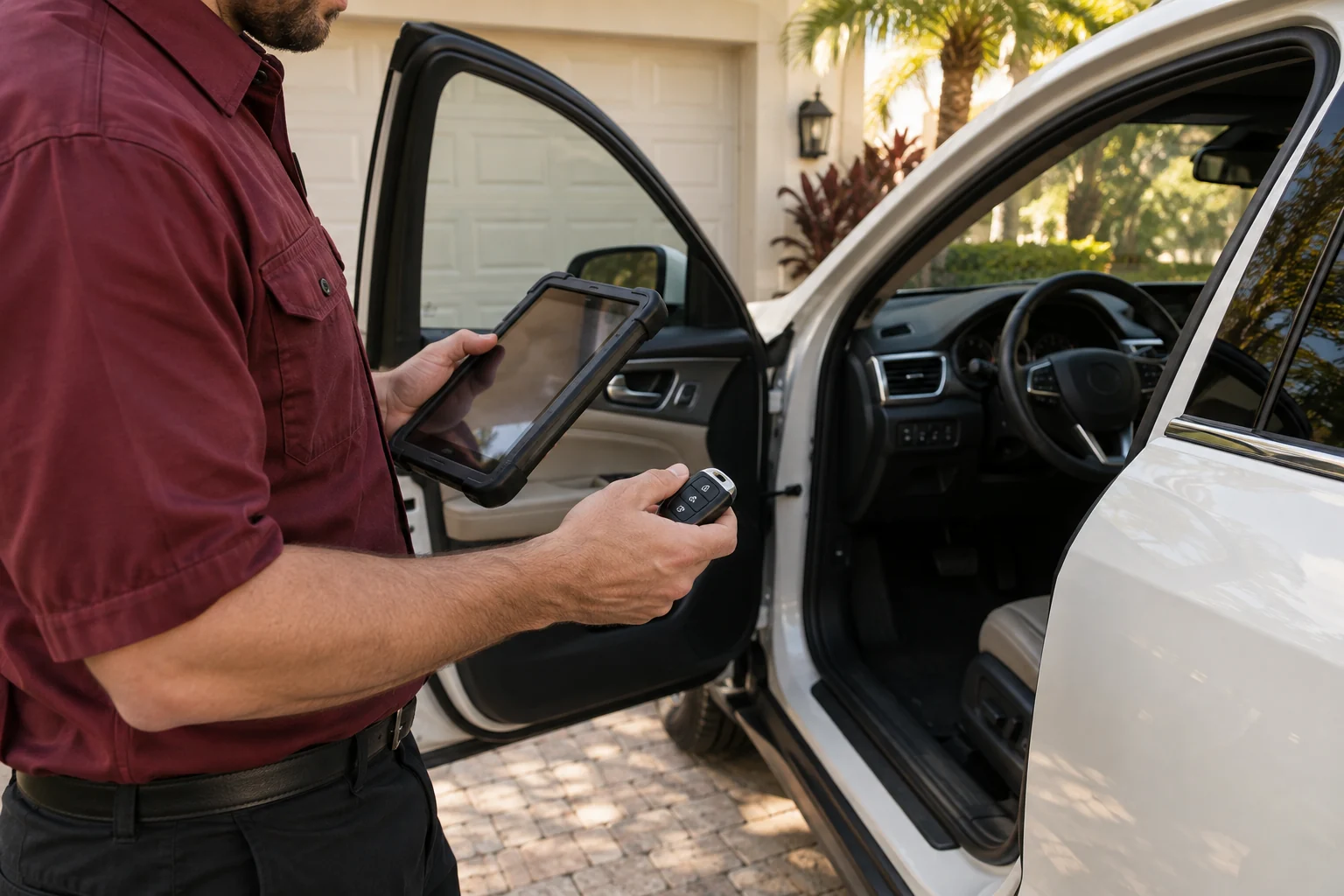
Many newer vehicles let you start the engine with a button while the key stays in your pocket. The key fob, sometimes called a smart key, constantly exchanges short range signals with the car. Inside the fob there is still usually a small hidden blade for emergencies, but the heart of the system is electronic.
These systems have their own failure modes. A weak battery in the fob can make the car stop recognizing it. Signal interference near some buildings can cause confusing warnings. A fob that has been dropped in water or crushed under weight can stop working altogether. Before assuming the worst, replace the battery if the manufacturer shows how, and see whether the dashboard displays a message about the key.
If the fob is truly gone, you will need a new one programmed to the vehicle. Read the guide on what to do when a push to start key is lost to see what the process involves, and why a key fob stops working for the troubleshooting steps worth trying first.
When the ignition is the real culprit
Sometimes the key is perfectly healthy and the lock it goes into is not. The ignition cylinder is a small mechanical part that takes thousands of turns over the life of a car. Over time its internal parts wear, and symptoms appear. The key goes in with difficulty, turns only when wiggled, sticks in position, or refuses to come out.
Be cautious here. Forcing a stuck key can snap it, and snapping a key in an ignition turns an inconvenience into a repair job. If a key is stiff, stop, take a breath, and check that the steering wheel is not locked against the key. Many cars hold the steering wheel when the wheel is turned, and a gentle movement of the wheel while turning the key can release it.
If the symptoms continue, the cylinder may need repair or replacement. The page on ignition repair explains the options, and the article about common ignition cylinder problems describes the signs in plain language. Do not try to take an ignition apart yourself, since airbags and wiring sit close by.
Locked out of the car
A car lockout is a different situation from a lost key, and it has a different goal. Here the key may exist but be inside the vehicle, in the trunk, or at home. The aim is to get you into the vehicle without scratching the paint, bending the door frame or damaging the weather stripping that keeps rain out.
Before you call, check every door and the trunk release, since a door can sometimes be unlocked after a moment of frustration. If a child or a pet is inside, tell the person on the phone immediately and say so again when the technician arrives. Heat inside a closed car in South Florida climbs sharply, and that fact changes how urgent the situation is.
For a broader look at the options, read car lockout solutions, and for the city specific page see lockout service in Pembroke Pines. If your keys are locked in the trunk, the guide on keys locked in the trunk explains a few special points about that case.
Heat, sun and cars that live outdoors
Vehicles in South Florida spend a lot of time parked in the open, and that exposes keys and fobs to a harsh combination of heat, sunlight and humidity. Plastic shells become brittle, rubber buttons wear smooth, and coin cell batteries lose strength. A key that has lived on a dashboard or in a hot cup holder tends to wear out sooner than one kept in a cool bag.
Ignition and door locks suffer too. Dust and salt find their way into keyways, and a lock that sees daily use may begin to feel rough long before it fails. If your key or fob has started behaving oddly, treat it as a gentle warning and have it looked at while you still have a working key to copy from.
Hurricane season adds one more habit. Before a storm, make sure each driver has a working key and that spare keys are not locked away in a house you may have to leave. A small spare kept with a trusted person outside your home can save a very frustrating afternoon after the weather passes.
What to tell the locksmith on the phone
The more precisely you describe the vehicle, the less guesswork is needed. Start with the make, model and approximate year. Then say what kind of key you have, such as a metal key with a plastic head, a flip key, or a push button fob. Say what has happened and whether any key still works.
Also mention where the car is, whether it is safe to work around it, and whether anyone is inside. If the car is in a garage or lot with restrictions, say so, because it may affect where work can happen. Have proof of ownership available, since a reputable locksmith will want to confirm the vehicle is yours before making a key.
If you are not sure of a detail, say that plainly. A guess about the year of the car can lead to the wrong key blank being prepared, while an honest statement that you are unsure lets the technician check the vehicle identification number on the dashboard or door jamb. That number tells a great deal about the car, including which key systems it was built with, and having it ready is one of the most useful things you can do.
- The make, model and year of the vehicle, and the color if you can give it.
- Whether you have a metal key, a flip key, a smart key or a push button fob.
- Whether any working key still exists, even one that stays at home.
- Exactly where the vehicle is parked and whether it is safe to work around.
- Whether a person or pet is inside the vehicle.
- Whether you can show registration or other proof that the vehicle is yours.
Locksmith or dealer: how to decide
Many drivers assume the dealer is the only source of replacement keys. In practice, there are two routes, and the right one depends on the vehicle, the situation and your schedule. A locksmith who works on vehicles can often come to the car, which matters when the car cannot be driven. A dealer may need the vehicle brought in.
Ask each option what is included, what you will receive, and what happens if the key fails to program. Compare the whole picture rather than a single number. The article on replacing a car key through a locksmith or a dealership sets out the comparison in detail so you can decide for yourself.
Whichever route you choose, ask that the new key be tested before you pay. It should unlock the doors, start the engine, and operate any remote functions you rely on. If a function is missing, you want to know before the technician has packed up.
Think also about the old key. If you are replacing a key because it was lost, ask whether the lost key can be removed from the car's memory so it can no longer start the engine. Many systems allow this when a new key is added. It is a sensible step, because a lost key is a key someone else might find, and the vehicle should only respond to the keys you now hold.
Motorcycles, older cars and other special cases
Not every vehicle follows the same pattern. Older cars may use a plain metal key with no chip at all, which makes copying simpler but also means the lock itself has had many years of wear. Motorcycles and scooters often use small keys with their own cuts and, on newer models, their own chips. Trucks and vans used for work may share a key code across several vehicles in a fleet.
If your vehicle falls outside the usual pattern, say so on the phone. Mention anything unusual, such as an imported model, a vehicle that has had its locks replaced before, or a key that was cut by a previous owner. A technician can plan better when nothing about the vehicle is a surprise. The guide to motorcycle key replacement covers the two wheeled side in detail.
Laser cut keys, with their milled channel along the blade rather than teeth along the edge, are another special case. They need different cutting equipment and are common on many newer models. The article on laser cut and standard car keys explains how to tell which one you hold and why it matters when ordering a copy.
Habits that save you from the next call
The least stressful car key problem is the one that never happens. Make a spare while you still have a working key. Store it away from the vehicle, and do not hide it on the car itself, since that invites trouble. Replace fob batteries as soon as the car warns you. Treat a sticking key as a signal rather than a nuisance.
If you manage several vehicles, such as family cars or a small business fleet, keep a simple list with each vehicle, how many keys exist and where they are kept. That list is worth more than it looks. When a key vanishes, it tells you immediately whether you have another one to copy from.
Neighbors in other cities face the same issues, and you can compare notes through pages such as automotive locksmith help in Miramar or automotive locksmith help in Davie. Whatever the vehicle and whatever the problem, the useful pattern is the same. Describe the situation honestly, ask what will be done and why, understand the price before the work starts, and test everything before the technician leaves. Drivers who follow that simple routine tend to feel in control even when the day has started badly. Keep the paperwork for any key you have made, note the date, and store it with the vehicle documents at home rather than in the glove box, so the information is still there the next time you need it.
Common questions
Can a locksmith make a new car key if I have lost every key?
In many cases yes. The technician creates a key for the vehicle and pairs its chip or fob electronics with the car. The exact steps depend on the make, model and year. You will need to show that the vehicle is yours, and it helps to know the vehicle details before you call.
Why does my copied key open the doors but not start the car?
Most modern cars use a chip in the key that must match the car before the engine will run. A plain copy can have the right metal cuts and still have a blank or unmatched chip. The chip has to be programmed to your vehicle, which requires proper equipment.
My key fob stopped working. Do I need a new one?
Not always. A weak battery is the most common cause, so try replacing it first if the manufacturer shows how. If the fob still fails, it may be damaged, unpaired or worn out. A locksmith can test it and tell you whether it can be reprogrammed or needs replacing.
What should I do if my key is stuck in the ignition?
Do not force it, since that can snap the key. Check whether the steering wheel is locked against it and gently move the wheel while turning the key. Make sure the car is in park. If it stays stuck, stop and call a locksmith, because the ignition cylinder may be worn.
Is it safer to call a locksmith or go to the dealer?
Both can be sensible. A locksmith who works on vehicles can often come to the car, which helps when the car cannot be driven. A dealer may require the car to be brought in. Ask each what is included and how the work is tested, then choose what suits your situation.
What proof of ownership will I be asked for?
Expect to be asked for registration, title or similar paperwork, and for identification that matches. This protects you as the owner, because a responsible locksmith will not make a key for a vehicle without confirming who it belongs to. Have the documents ready and the call will go smoothly.
Talk through the job before work begins
Tell us what happened, which doors or keys are involved and who needs to get in. The price and the plan are agreed with you before any work starts.
Call (954) 888-8804