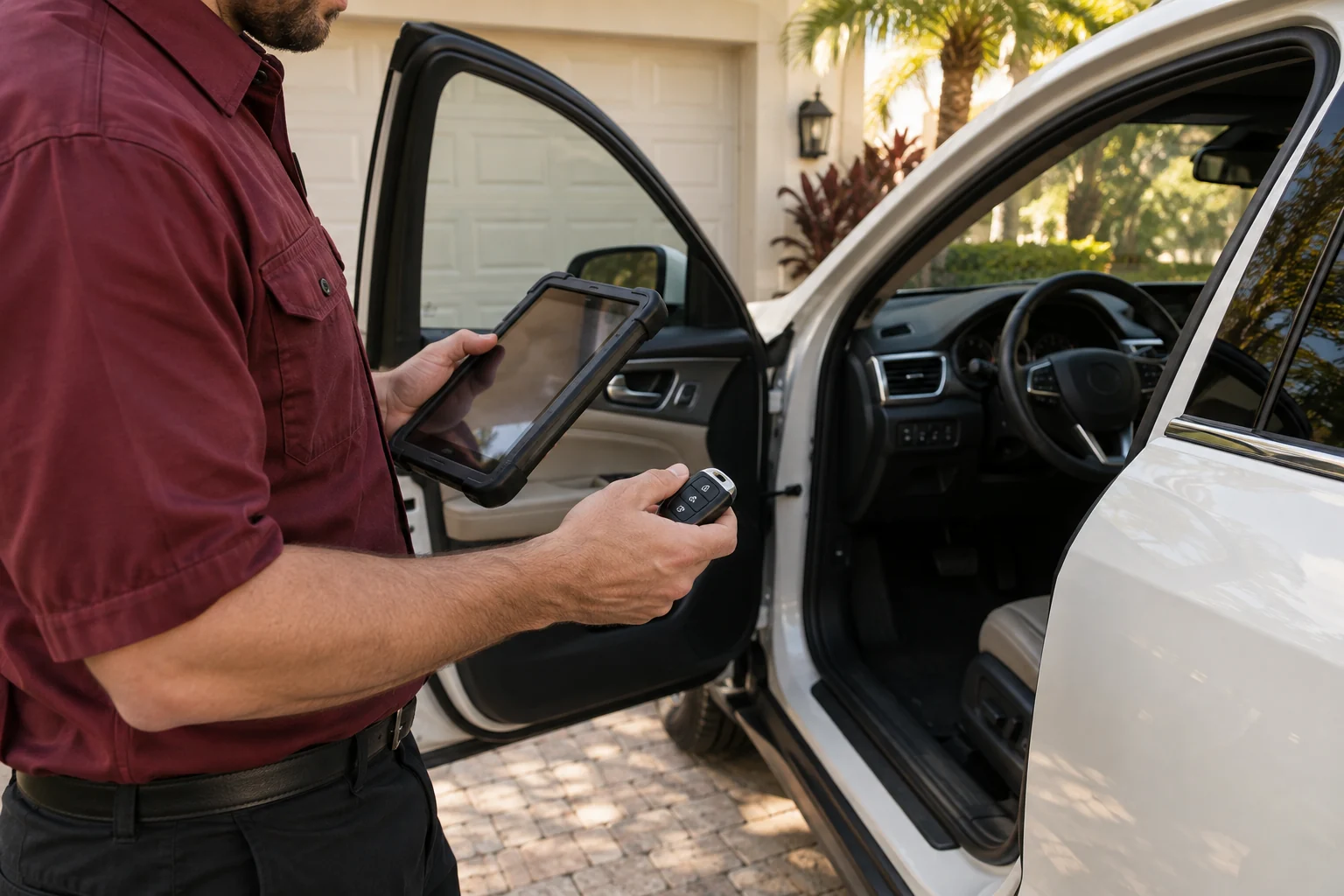
Half Off Locksmith technician and service van

Keys Locked in the Trunk? Why It Is Harder Than a Normal Lockout

Keys Locked in Trunk? Why It's Trickier Than the Cabin

Why the trunk plays by different rules

Most people picture a lockout as keys sitting on a seat with the doors shut. In that case the problem is a locked cabin, and the cabin is a space with several doors and a lock design that has been around for a long time. A trunk lockout is a different animal because the thing you need is sealed inside a separate compartment with its own latch.

On many modern cars the trunk lid has no exterior key cylinder at all. The manufacturer removed it to save cost and to cut down on water getting in, and the only ways to open the lid are an interior release, a button on the key fob, or a switch on the dash. If your fob is the thing inside the trunk, you have lost the very tool that was meant to open it.

That is why the first question a locksmith asks is not just what car you drive, but where exactly the keys are and what state the cabin doors are in. A car with unlocked doors and keys in the trunk is a very different situation from a car with every door locked and keys in the trunk.

Sorting out which situation you are actually in

Take a breath and describe the situation honestly before you do anything else. There are really three common versions of this problem, and each one leads to a different path forward.

In the first version the cabin doors are still unlocked, and the keys or fob are in the trunk. In the second, the cabin is locked and the keys are in the trunk, which means you are shut out of both spaces at once. In the third, the keys are in the trunk, and a person or animal is inside the cabin or the weather has turned dangerous, which changes the urgency completely.

Once you know which one you are in, the next steps become much clearer. Write down the make, model and general age of the car, whether it uses a traditional blade key or a push button start, and whether you own a spare. Those four details will shape almost every decision that follows.

It also helps to ask yourself a calmer question: did the trunk really close on the keys, or did they slide into the cargo area earlier while you were rearranging things? Checking pockets, bags and the ground around the car costs nothing and sometimes ends the whole story. Only after that careful look around should you assume the worst, and even then it is worth retracing your steps from the moment you last remember holding the keys, since a missing key is easy to mistake for a trapped one.

  • Note whether the cabin doors are locked or unlocked right now.
  • Note whether the key is a blade style key, a remote fob, or a smart key for push button starting.
  • Think about where a spare key actually lives and whether anyone can bring it to you.
  • Check whether anyone or anything is inside the vehicle before you decide how urgent this is.

The rear seat and the interior release

Many sedans and nearly every hatchback or SUV have a way through from the passenger area to the cargo space. In sedans this is often a folding rear seat back with a latch on the seat itself. If your cabin is still unlocked, you may be able to fold the seat from inside and reach what you left behind without touching the trunk lid at all.

Some trunks also have a manual release handle inside the cabin, often a lever near the driver's seat or a pull cord low on the floor. Check your owner's manual for the exact position, because manufacturers place these in different spots. Using a factory release the way it was designed is the safest option because it does not stress any hardware.

What you should not do is pry at the lid, force the seat latch, or yank on the weather stripping. The paint, the seal and the latch striker are all easier to damage than people expect, and a bent lid is a more expensive problem than the one you started with. If the factory options do not work, stop and call someone who handles this regularly.

Smart keys, push buttons and the car that will not lock on you

Push button cars add a twist. Many smart key systems detect the fob inside the cabin and refuse to lock the doors when the fob is nearby, but they treat the trunk differently. Some systems cannot sense a fob inside a closed trunk, so the car locks itself as you walk away and the fob is trapped behind it.

Other systems are designed with a trunk lockout in mind and will not let the lid close if the fob is inside. That feature is not universal, and it depends on the manufacturer and the model, so you cannot assume your car has it. Reading the manual before the problem happens is worth the few minutes it takes.

If the fob is trapped, you may find a hidden mechanical key blade inside a spare fob or inside the casing of the one in your pocket. That blade typically fits a small lock on the driver's door, which gets you into the cabin so you can try the interior release. If you want to understand what these keys are, our guide on what to do when a push to start key is lost explains the parts of a smart key in plain language.

Why not to force the lid or break something

Frustration pushes people toward shortcuts like prying with a screwdriver or wedging a hanger near the seal. These approaches usually end with a bent lid edge, torn weather stripping, scratched paint or a latch that no longer closes correctly. Salt air and humidity in South Florida make exposed metal rust more readily, so even a small scratch can become a bigger repair later. Cars that live outdoors in a condo lot or on a street feel this most, because the coating that protects the lid edge is the first thing to wear when it is scraped.

Forcing things also risks tripping a car alarm or interfering with the wiring that runs through the trunk gutter. Many cars route taillight, camera and sensor wiring right through the lid hinge area, and a rough pry can pinch or cut those lines. Fixing that damage costs far more in patience than a proper call would have.

A trained locksmith works with the vehicle's own mechanisms instead of against them, protecting the finish and the electronics while doing it. The goal is for the car to close and latch normally afterward, with nothing hidden that you will only find out about later.

When a locksmith is the right call

If the factory release does not work, the cabin is locked and the fob is trapped, a locksmith is the person to contact. Call and describe the situation plainly, including the make, model, the key type and where you are parked. The work and the price are explained before it begins, and the finished result is tested with you so you know the lid and the doors behave properly.

Locksmiths who handle vehicles regularly understand that the trunk and the cabin are separate systems. They can often open the cabin first and then use the interior release, or work on the trunk directly, depending on the vehicle design. Our overview of car lockout solutions goes deeper on how the cabin side of this works.

If you are in Broward County and the car is parked somewhere awkward, such as a condo garage, a marina lot or a shopping center, mention that when you call. Access rules vary by property, and the person on the phone can plan around them. For broader automotive help, see the car key replacement page.

Where you are changes how you should wait

Waiting in South Florida is not the same as waiting anywhere else. Direct sun on a parked car, afternoon storms, and stretches of open pavement all affect how comfortable and safe you are while you sort this out. Find shade or shelter, keep your phone charged, and stay away from moving traffic.

If the vehicle is parked at a curb or on a road shoulder, stand well away from the lane and keep your hazard lights on if you still have them. Avoid leaning against the trunk or standing between cars. Tell a friend or family member where you are, especially if it is late.

If a child or a pet is inside the cabin, treat that as an emergency and contact emergency services first, because that situation is covered in our guide to a pet or child locked inside. A locksmith can help, but emergency responders come first when a life may be at risk. For general weather tips while you wait, our article on staying safe when locked out in bad weather is useful.

Habits that stop it from happening again

Most trunk lockouts happen at the same moment: you are loading bags, groceries, luggage or beach gear, you set the keys down on top of something, and then you close the lid. The simplest habit is to keep your keys in your pocket or hand, never on top of the bags or inside the cargo area. Make a pocket your default home for them while you load.

A second habit is to know where your spare lives before you need it. A spare kept at home or with a trusted person is only useful if you can reach it. Read our piece on whether a spare car key is worth it and consider how a spare could save you from this exact situation.

Third, learn your car. Press the interior trunk release once on a quiet day, find the fold down seat latch, and check whether your fob warns you if it is left behind. Spending five minutes on a calm afternoon can save a long, stressful wait later. Share what you learn with anyone else who drives the car, since a spouse, teenager or coworker is just as likely to be the one standing in a parking lot with a shut trunk. If you rely on a smart key, read the guide on a key fob that is not working so you know what a failing fob looks like before it strands you.

Different body styles, different trunk stories

Sedans, hatchbacks, wagons, SUVs, pickups and convertibles all handle the cargo space differently, and that affects what is possible. A sedan has a sealed trunk behind the rear seat, which is the hardest version of the problem. An SUV or hatchback has a cargo area that is usually open to the cabin, so keys left in the back are often reachable once you are inside the passenger space.

Pickup trucks bring their own variations. A bed cover with a locking latch behaves like a small trunk, while a crew cab may have lockable storage under the rear seat. Convertibles often have a power operated roof and trunk working together, and forcing either one can upset the mechanism. Knowing which type you drive tells you how realistic a do it yourself option is.

Rental cars and borrowed cars add another wrinkle. You may not know where the interior release is, and the owner or the rental company may have rules about who is allowed to work on the vehicle. Contact them early, tell them what happened, and ask what they prefer, since requirements vary and the vehicle is not yours to experiment on.

What to have ready when you make the call

The more precise your description, the smoother the job goes. Have the make, model and approximate age of the car ready, along with the kind of key it uses. Say plainly whether the cabin is locked, whether the fob or key is in the trunk, and whether anyone or anything is inside the car.

Think about proof of ownership as well. A reputable locksmith will want to confirm that the vehicle is yours before opening it, so keep your registration or another document handy. It may be in the glove box, which makes this a good moment to remember that important papers should not live only inside a locked car.

Finally, tell the person where you are parked and anything unusual about the spot. Underground garages, gated communities and busy roadside shoulders all change how the work is planned. If you are near one of our service areas, our pages for automotive help in Hollywood and automotive help in Pembroke Pines offer general guidance for drivers in those places.

When a lost key becomes the real problem

Sometimes the keys are not in the trunk at all, and the trunk is simply the last place you remember seeing them. In that case you are really dealing with a missing key, and the solution is to replace or reprogram one rather than keep searching. Modern keys have chips that talk to the vehicle, so a new key has to be matched to the car, not just cut.

Learn how that process works in our explanation of transponder key programming, which covers why a duplicate from a hardware shelf often fails to start the engine. Laser cut keys have their own cutting method, described in laser cut versus standard car keys.

If you ever lose every key to a car, the replacement process is more involved but still very doable. A locksmith can create a new key on site for many vehicles, and the work is explained and priced before it starts. The earlier you plan for that possibility, the less disruptive it will feel.

Frequently Asked Questions

Why can't I just open the trunk the same way I open the doors?

The trunk has its own latch and release, separate from the door locks. Many cars have no key cylinder on the lid at all, so the only ways in are the fob, an interior release or a dash switch. If the fob is inside the trunk, those options can all be unavailable, which is why it feels harder than a regular lockout.

Is there a safe thing I can try before I call anyone?

If the cabin doors are unlocked, look for the interior trunk release or a folding rear seat latch, both of which are designed for owners to use. Check your manual for the exact location. Avoid prying the lid, pulling on seals or forcing a seat, because those actions can bend metal, tear weather stripping and damage wiring.

Will a trunk lockout damage my car if a locksmith handles it?

A trained locksmith works with the vehicle's own mechanisms, so the goal is to leave paint, seals and wiring untouched. The finished work is tested with you so you can see the lid and doors close and latch normally. If anything looks off, point it out before the technician leaves.

What if my smart key is locked in the trunk of a push button car?

Some smart key systems cannot sense a fob inside a closed trunk, so the car locks as you walk away. Many fobs hide a mechanical blade that fits a small lock on the driver's door. That can get you into the cabin so you can use the interior trunk release. If not, call a locksmith.

What should I do if a pet or child is in the cabin?

Treat it as an emergency and contact emergency services first. South Florida sun heats a closed car cabin in ways that are dangerous for living things. A locksmith can assist, but emergency responders are the right first call when a life may be at risk. Stay near the vehicle and keep the person or animal calm.

How can I keep my keys from ending up in the trunk again?

Keep keys in your pocket or hand while loading, never on top of bags or inside the cargo area. Learn where the interior trunk release lives, and know where your spare is kept. A short test on a calm day, such as pressing the release and folding the seat, builds the habit and the confidence.

Locked out or need a lock changed today?

Phone us with the details, and the plan and the price are explained before any work starts.

Why the trunk is a different kind of problem

When keys are left on a seat, the goal is straightforward: open one of the passenger doors, reach in and pick them up. A trunk lockout is more awkward because the keys are inside a separate compartment that has its own latch and is often built to stay shut even when the rest of the car is open. The thing you want to reach is behind a lid that does not respond to anything you do from the driver's area.

Many drivers assume the trunk simply follows the doors. In practice it does not. On a lot of vehicles, unlocking the doors leaves the trunk latched, and the trunk release button is a separate control. Some cars lock the release out when the vehicle is locked, others only when the keys are not detected nearby, and the details differ from one model to the next.

That is why the first questions matter. Is the car locked or only closed? Can you get into the cabin? Is there an interior release or a pass through to the rear seats? Answering those questions tells you whether this is a simple cabin entry followed by a trunk release, or a more involved situation where the trunk compartment itself is the obstacle.

How the latch and release usually work

A trunk lid is held shut by a latch that engages a striker on the body. Opening it normally takes one of three signals: a turn of the key at the lid, a press of the button on the key fob, or a pull or button inside the cabin. Some cars have a handle or a touch pad on the outside as well. Which one works depends on the car and on whether it is locked at that moment.

Most modern vehicles use an electric actuator behind the lid, not a simple mechanical cable. That actuator needs power and a signal, and the signal often passes through the body control module that also manages the door locks and the alarm. If the car has decided it is locked, that module may refuse to release the trunk until it recognizes a valid key.

This explains why people are so often surprised. They press the trunk button inside, nothing happens, and they conclude the car is broken. In reality the car is doing exactly what it was designed to do: protecting the cargo area while the vehicle is secured. Understanding that design makes it easier to work out which step is actually missing.

Check the easy things before you call anyone

Start with a calm look around. Walk the whole car and try each door, since one may have been left unlocked without you noticing. Look through the windows to see where the keys actually are, because sometimes what feels like a trunk problem is really a set of keys sitting on a seat or in a cup holder. Do not assume, check.

Next, ask whether you have another key. A spare fob at home, a second driver in the family, or a valet key can end the problem altogether. If someone can bring it, that is often the simplest answer, and you avoid any work on the vehicle at all. Check also whether the car has a mechanical key hidden inside the fob that works on a door lock.

If the keys are the only ones and they are inside the trunk, keep the car where it is and note your exact location. Being specific helps when you describe the situation to a locksmith: the make, model, year, whether the engine is off, and whether any door can be opened. Our overview on car lockout solutions covers the cabin side of this in more detail.

The rear seat pass through and why it is not always there

Many sedans and hatchbacks have a folding rear seat or a small pass through to the trunk. If a door can be opened and the rear seat released, a person can sometimes reach the cargo area from inside, which is how a lot of trunk lockouts end. It sounds easy, and sometimes it is.

The catch is that the release for the seat is frequently inside the trunk itself, or sits behind a lock or a latch that you can only operate from the cargo side. Manufacturers do this on purpose so that a thief cannot enter the car through a small gap and then fold the seat. Other vehicles have a rigid divider or a hard cover that cannot be moved at all.

Do not force a seat, pull on panels or push hard on the lid to try to make room. Doing so can bend a hinge, crack trim or damage a wire, and repairs cost more than the lockout itself. If the pass through is not obviously available, treat it as unavailable and move on to a safer plan rather than risking damage to the vehicle.

Why you should not pry, hammer or force the lid

A stuck trunk invites a lot of bad ideas: a pry bar, a screwdriver, a coat hanger, a sharp tug. Please avoid every one of them. The area around the latch contains wiring, a lock cylinder and, in many cars, sensors and an alarm trigger. Forcing the lid can bend the sheet metal, scratch the paint and set off a siren that you then also have to resolve.

There is also a safety side. Modern trunk lids are held by gas struts or springs under tension. A lid that suddenly releases can swing up and hit a face or hand, and a lid that is forced down can pinch fingers. Keep your hands away from the seam and make sure nobody is standing close when something is done to the latch.

If you suspect you may have damaged something already, stop and describe it honestly when you call. It is better for a technician to know about a bent edge or a dislodged trim piece than to discover it while working. The aim is to restore access with as little damage as possible, which is the opposite of force.

Smart keys, proximity sensing and why they complicate things

Newer cars use a smart key that does not need to be inserted into anything. The car senses the fob within a short range and allows the doors to unlock or the engine to start. That same sensing can create odd behavior with a trunk lockout, because the fob is physically inside the car, and the system may think a key is present while you stand outside it.

Some vehicles are built to stop you from locking a fob inside the cabin and will refuse to lock or will sound a warning. Others lock first and think later. A few treat the trunk differently from the cabin and detect the fob there, then block the lock in anticipation. The result is that identical looking cars can respond in different ways to the same mistake.

This is one reason a locksmith will ask for the exact vehicle information. Knowing the model and year lets them tell you how that car is likely to behave and what approach is appropriate. If you want a broader look at fob problems, our article on what to do when a key fob is not working and the one about a lost push to start key give helpful background.

What a professional does differently

A trained locksmith treats the vehicle as a system. Before touching anything, they identify the make, model and year, confirm that you are the owner or driver with a right to the car, and find out how the trunk and doors are wired on that model. The goal is to reach the keys without harming the finish, the seals or the electronics.

Often the plan involves entering the cabin carefully and then using the vehicle's own release or the correct tool for that model, rather than any rough method. In some cases the sensible option is making a new key for the car, which avoids opening the lid at all, though that depends on the model and on proof of ownership. The technician explains the choice before starting.

You should expect the work and the price to be described up front and the result to be tested with you afterward. After the trunk opens, check that it closes and latches normally, that the interior release works and that no warning lights or alarms appear. If anything seems different, mention it before the technician leaves so it can be looked at together.

It also helps to be ready with proof that the car is yours or that you are authorized to drive it. A registration, an insurance card or a photo identification that matches the paperwork is the usual kind of thing a responsible technician will ask to see. This is not an obstacle but a protection for owners, since the same skills used to help you could be misused by someone else. Having the documents nearby, perhaps in the glove box you can already open, keeps the process smooth and avoids repeat trips.

Other ways the situation resolves

Sometimes the answer is not about the trunk at all. If you have roadside assistance through your insurer, a membership or the manufacturer, they may have their own process and a spare key service. A dealership may also be able to cut or program a key from the vehicle information, though that can involve towing the car and a longer wait.

Another option is a spare made by an automotive locksmith. If the original is truly stuck inside, a new key may get you moving and also leaves you with a backup afterward. Our comparison of locksmith versus dealership key replacement helps you weigh convenience, process and timing without pushing you toward either one.

It can also help to know about transponder key programming, since most modern keys include a chip that must match the car. If a new key is needed, the chip will have to be programmed. That is routine for a locksmith who handles vehicles, and it is another reason to give the exact model and year when you call.

Whichever path you choose, ask what each one involves before agreeing. A good provider can tell you whether the vehicle needs to be moved, whether the work happens where you are parked and what you will have in your hand at the end. Compare that with the other options and pick the one that fits your schedule, your location and your comfort. Being informed keeps a stressful moment from pushing you into a choice you did not want.

How to avoid doing this again

Most trunk lockouts happen the same way: a bag goes in, the keys go on top of it, and the lid closes by habit. The fix is a habit of your own. Put the keys in a pocket or a purse before you open the lid, and say it out loud if it helps. Many people form a rule that the keys never leave their hand while the trunk is open.

A spare key is the second line of defense, and it should not live inside the vehicle. Keep one with a trusted person or in a secure place at home, not hidden on the car, where it can be found by someone else. Our notes on whether a spare car key is worth having explain why this small step pays off.

If you share a car with a partner, a teenager or a coworker, agree on where the keys go whenever the lid is open. Check that your car's manual covers the trunk release behavior as well. Knowing how your own model reacts to a locked trunk means a bad moment never turns into a confusing one, and you have a plan before the keys disappear.

If someone or something is inside the car

Everything above assumes the keys are the only thing at stake. If a child, a pet or a person who needs help is in the vehicle, the situation is different and should be treated as an emergency. Call emergency services first, because heat builds up in a closed car in South Florida and can turn dangerous, and a trunk problem is the smallest concern in that moment.

If the person in the car is awake and can move, talk them through the interior controls and any door that opens from inside. Our guide on what to do when a pet or child is locked inside explains how to judge urgency and what information to give. Stay with the vehicle and keep your voice calm.

Once everyone is safe, the trunk and the keys can be dealt with in a relaxed way. A locksmith can then help with entry, a replacement key or a latch that needs attention. Putting safety ahead of the key problem is always the right order, and it keeps a stressful event from becoming a worse one.

Heat, humidity and parking outdoors in South Florida

Cars in Broward County spend much of their time parked outdoors in strong sun, heavy rain and salty air. Those conditions are hard on trunk latches, seals and wiring. A latch that is stiff, a lid that needs a second push to close or a release button that works only sometimes can all turn a small mistake into a bigger one.

If your trunk feels sticky, takes more force than it used to or sounds different when it closes, have it looked at before it becomes an emergency. Rust, dried grease and a worn striker are common causes, and a technician can often tell you whether the problem is minor. Treat a lid that sometimes pops open or will not latch as a warning sign.

Heat also stresses small batteries inside key fobs, so a fob that has been weak for weeks may fail just when you need it. Replace the fob battery on a schedule and test the buttons. Handling these small points reduces the odds of finding yourself outside a locked car looking at your keys through a gap, and it costs far less effort than most fixes. If you are in the area, our car key replacement page explains the services available.

Common questions

Why will my trunk not open when the car is unlocked?

On many vehicles the trunk latch is separate from the door locks. Unlocking the doors may leave the trunk closed, and the release button may only work when a valid key is detected. This is a design choice that protects the cargo area, not necessarily a fault with the car.

Can I get into the trunk through the back seat?

Sometimes. Some cars have a folding rear seat or pass through, but the release is often inside the trunk or locked on purpose. If it is not clearly available, do not force panels or seats, because damage can cost more than the lockout itself.

Is it safe to pry the lid open myself?

No. Prying can bend metal, scratch paint, break wiring and trigger the alarm. Lids are also held by springs or gas struts and can swing unexpectedly. It is safer to describe the situation to a locksmith and let them choose a method suited to your car.

What information should I have ready when I call?

Have the make, model and year, your exact location, whether the car is locked or only closed, and whether any door opens. Mention if you have a spare key available. Be ready to confirm you are the owner or driver so the work can proceed properly.

Could a new key solve the problem without opening the trunk?

Often yes. If the keys inside are the only set, an automotive locksmith may be able to make and program a new one for your vehicle, depending on the model and proof of ownership. That gets you driving and leaves a backup afterward.

How can I stop this from happening again?

Make it a habit to put keys in a pocket or bag before opening the trunk, and never set them on top of what you load. Keep a spare with someone you trust or at home. Replace the fob battery on a schedule and keep the latch in good shape.

Call Now