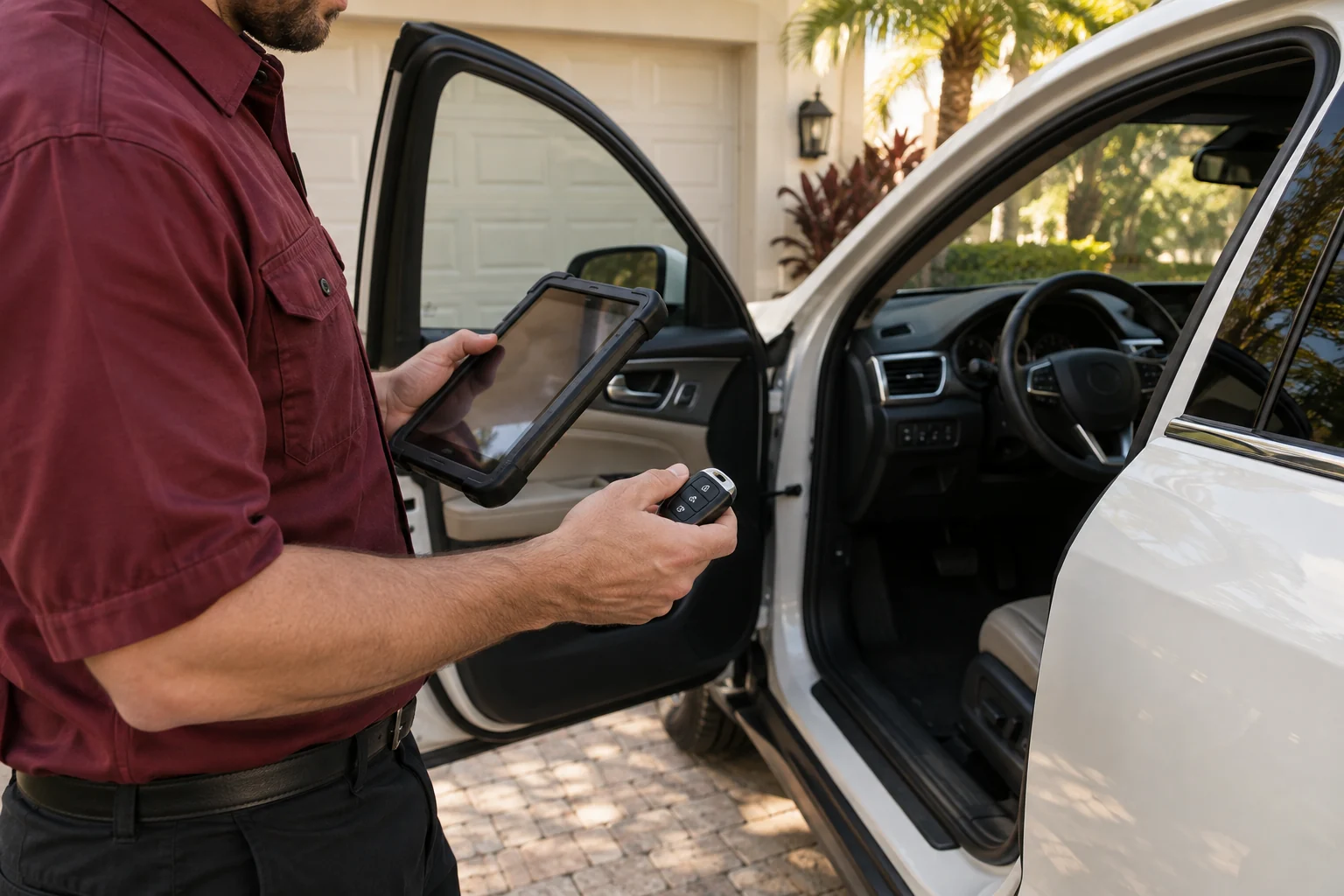
Automotive Locksmith in Hollywood
Car keys are small computers now, and losing or breaking one is rarely simple. This general guide for Hollywood drivers explains the common vehicle key problems, what to tell a locksmith, and how to avoid a repeat.
Call (954) 888-8804Why car keys became a specialist subject
A generation ago, a car key was a notched piece of metal that any hardware counter could copy in a minute. Today most vehicles use keys or fobs that carry a small chip, and the car will not run unless it recognizes that chip. Some use no traditional blade at all, relying on a proximity fob and a push button to start. The lock is only one part of a larger system.
That change is why a lost key is more than an inconvenience. Replacing it involves cutting the physical key where one exists, and also introducing the new key to the vehicle so that it is accepted. Different manufacturers handle that differently, and some models are far more demanding than others.
Understanding the basics will help you ask the right questions. Our article on transponder key programming explains the main idea most owners run into. You do not need to become an expert, only to know what kind of key your car uses.
Look at your key and note what you see. A plain metal key with a thick plastic head probably holds a chip. A key with a wavy groove cut into the flat side of the blade, rather than notches on the edge, is cut differently and needs different equipment. A flip key folds a blade into a fob, and a push button fob may have only an emergency blade hidden inside. Knowing which one you have helps the first phone call enormously.
Locked out of the car
A vehicle lockout can happen in a grocery lot, a driveway or a parking garage. Keys sit on the seat, a fob stays in a bag in the trunk, or the doors lock behind a driver who stepped out for a moment. The first rule is safety. If a child or pet is inside, particularly in warm weather, call emergency services before anything else.
If nobody is in danger, check the simple things. Is there a spare key at home that someone can bring? Does your car have a phone app or a roadside service that can help? Are all doors really locked, including the trunk and any rear door you rarely use? Resist the temptation to pry at the window or wedge a tool into the door, which can damage seals, wiring and the glass.
Opening a car door properly takes the right tools and some care, because modern doors contain airbags, wiring and electronics. A careless attempt with the wrong tool can turn a simple lockout into a repair bill for the door panel, so patience and proper equipment really are the point. Our guide to car lockout solutions explains the options.
Keys locked in the trunk are a trickier variation that surprises many people, because the cabin may be open while the keys sit out of reach. Tell the locksmith exactly where the keys are. Also mention if the car has a rear seat pass through, since that can change what is practical. Whatever the case, the aim is to open the vehicle without leaving marks, and you can inspect the door, seals and paint with the locksmith afterward.
Lost or stolen car keys
Losing the only key to a vehicle is a harder problem than locking it in, because there is nothing to copy. The locksmith needs to produce a new key from the vehicle itself, using identifying information, and then make the car accept it. Expect to be asked to prove that the vehicle is yours before any key is made.
Bring registration, identification and anything else that shows ownership. A reputable locksmith will insist, and you should be suspicious of anyone who does not. This protects you as an owner, because it makes it harder for someone else to obtain a key to your car.
Think through the logistics as well. If the car is in a garage or a lot you cannot easily leave, say so. If it is parked on a public road, think about where it is safe to wait. Have a way to reach the vehicle, and be ready to confirm which car you mean if several are parked together. Small details like these help the visit run smoothly and keep misunderstandings to a minimum.
If you suspect your keys were stolen rather than lost, think about whether your address is attached to them, and consider securing the home as well. Our page on car key replacement describes the service,. Many owners compare a locksmith with a dealership, weighing convenience, towing and the ability to have the work done where the car is parked. Ask each option what is involved before you decide.
Keep your documents safe. A vehicle title or registration stored in the glove box is useless if the car itself is the problem. Take a photo of the registration and keep a copy at home. Having proof of ownership available when you need a key is the difference between a simple appointment and a frustrating delay.
Key fobs that stop working
Many fob problems are not as serious as they seem. The most common cause is a weak battery, which can make the car respond only when the fob is held very close, or not at all. Replacing a battery is a simple, inexpensive step that fixes more problems than people expect.
If a fresh battery does not help, other causes include a cracked case, worn buttons, water damage or a fob that has lost its connection to the car. Humidity and heat are rough on electronics, and a fob that has been through a rainstorm in a pocket may eventually fail.
Our article on why a key fob stops working walks through the likely causes in order. Before you assume the fob is dead, check whether the car's own battery is healthy, since a weak vehicle battery can mimic a fob problem.
Proximity systems deserve special mention. With a push button start, the car looks for the fob nearby and allows the engine to run when it finds one. If the fob is lost, the car may be locked and unable to start until a new fob is introduced. Do not assume that a spare in a drawer will fix everything; check that it still works, since a spare with an exhausted battery is a spare in name only.
Keys stuck, broken or worn
A key that sticks in the ignition, snaps off in a door lock or turns only with effort is giving you a warning. Worn keys lose their shape, and a worn key wears the lock in turn, so the problem compounds over time. Replacing a key that is merely tired is far easier than extracting a piece of one.
A broken key fragment inside a lock should not be pushed or forced. Stop, leave it alone, and get help. Pushing it deeper can make removal harder and may damage the cylinder. Patience helps here, because careful removal with the right tools usually saves the lock.
A key that will not come out of the ignition, or will not turn, can have several causes, from a worn key to a steering lock that has engaged under tension to a failing ignition cylinder. Gentle checks are fine, such as making sure the car is in park and that the steering wheel is not locked against the key. Anything forceful risks the cylinder, so stop if it does not respond easily.
Wear shows in the key as well. If you hold two copies side by side and one looks rounded and shiny where the other is sharp, the rounded one is wearing out and may not turn the lock reliably much longer. Retiring it before it breaks, and using a fresh copy as your daily key, extends the life of both the key and the cylinder.
Ignition cylinder problems
The ignition cylinder is the part you turn with the key. Over years of use it wears, collects debris and can begin to misbehave. Symptoms include a key that is hard to turn, a car that sometimes will not start until you jiggle the key, and a key that seems to fit loosely.
Do not ignore early signs. A cylinder that fails completely can leave you stranded, and in some cases the repair involves more than the cylinder alone. Catching it while the car still starts gives you more options and avoids being towed.
We cover this in detail in ignition cylinder problems, and the service page on ignition repair explains what repair or replacement involves. Keep in mind that a car that will not start is not always an ignition issue, because batteries, starters and anti theft systems can all play a part.
Spare keys and planning ahead
The ideal time to make a spare key is when you still have a working one. Duplicating an existing key is generally a simpler task than creating one from scratch after every key is lost. If your car came with two keys and you have lost one, consider replacing it now rather than waiting.
Think about where spares should live. A key in a drawer at home is helpful if you are locked out nearby, less so if you are across town. A trusted family member can be a better holder. Avoid hiding a key on the vehicle, since thieves know the usual places.
Our piece on whether a spare car key is worth it explains the reasoning in more depth. If you drive a motorcycle, a similar logic applies, and the guide to motorcycle key replacement covers the differences.
Weather, salt and outdoor parking
Cars in Hollywood spend much of their lives outdoors. Sun, humidity, salt air and sudden rain wear on locks, rubber seals, fobs and ignition cylinders. Over time, door locks can grow stiff or gritty, and a key that once turned freely may begin to catch.
Simple care helps. Avoid leaving fobs in a hot dashboard, keep them away from water, and replace batteries before they die completely. If a door lock feels rough, mention it before it fails, since a lock that is struggling can seize at an inconvenient moment, such as during a storm.
Storm season brings its own concerns. Before a hurricane, people move cars, pack bags and hurry around, and keys are easily lost. Make sure every driver knows where spares are, and consider whether a spare is worth making before the season starts rather than after the weather arrives.
If your car has been through flooding or heavy water exposure, tell the locksmith. Water in door locks, fobs and electronics can cause strange behavior long after the water has gone, from locks that refuse to respond to fobs that work only sometimes. Describing what the car has been through helps sort out whether the key, the lock or the vehicle wiring is at the heart of the trouble.
What to tell the locksmith when you call
Good information saves time. Start with where the car is and what happened. Then give the make, model and year, and say what kind of key you have if you know: a traditional blade, a key with a plastic head, a flip key, or a push button fob. If you are unsure, describe what it looks like.
Say what you still have. Do you have one working key, no keys, or a damaged one? Is the problem a lockout, a lost key, a broken fob or an ignition issue? Mention anything that might affect the work, such as a car parked in a garage, an unusual location, or a child or pet inside.
After you describe the situation and place, the work and the price are explained before it begins. Be ready to show proof of ownership. When the work is finished, the key and the lock are tested with you. For more on phone questions, our guide to what to ask a locksmith on the phone helps.
Related pages and general notes
If your car problem comes with a home lockout, the page on lockout service in Hollywood may help, and the overview of locksmith services in Hollywood shows everything in one place. Nearby areas follow similar patterns, including automotive help in Hallandale Beach.
This page is general guidance for drivers in Hollywood and does not describe any local ordinance, parking rule or vehicle requirement. Registration, title and ownership rules vary, so check with the relevant office if you are unsure what documents you need.
The simple message is to act early. A worn key, a weak fob or a sticky ignition is simpler to deal with before it fails, and the cost of waiting is usually a worse day at a worse moment. And if it has already failed, a clear, calm phone call is the right starting point.
Keep a short note in your phone with the details a locksmith will ask for: make, model, year, the kind of key you use, and where your registration is. Add the number of working keys you currently own. That small record, written while everything is calm, saves time when you are standing next to a locked car in the heat, with a dead phone battery and groceries melting in the back seat.
Common questions
Can a locksmith make a car key if I have lost all of them?
In many cases yes. The key is produced using information tied to the vehicle and then introduced to the car so it is accepted. Expect to show proof of ownership, such as registration and identification. Details vary by make, model and year, so describe the car on the phone.
Will a spare key work as well as the original?
A properly made and programmed spare works the same way as the original. Low grade blank copies without the right chip may open doors but not start the engine. Ask what kind of key you are getting and have it tested with you before the work is finished.
My fob stopped working. Do I need a new one?
Not necessarily. A weak battery is the most common cause and is simple to replace. If a new battery does not help, the fob may be damaged or need to be reintroduced to the car. Describe the symptoms on the phone so the likely cause can be sorted out.
What should I do if my key breaks in the lock?
Stop and do not push the piece deeper or try to force it. A locksmith can remove the fragment using proper tools and check the lock afterward. Keep the broken parts, because they may help in making a replacement key.
Is it safe to try to open a locked car myself?
It is usually not worth it. Tools wedged into doors can scratch paint, tear seals and damage wiring or airbags. If a child or animal is inside, call emergency services first. Otherwise, calling a locksmith is generally the cleaner option.
How can I avoid being stranded again?
Keep a spare key somewhere sensible, replace fob batteries before they die, and deal with a stiff ignition or lock early. Treat small warning signs as information. Planning ahead is usually simpler than solving a lockout or lost key later on.
Talk through the job before work begins
Say what went wrong and what you need to work when we leave. Scope and price are settled with you ahead of the work.
Call (954) 888-8804