Commercial Locksmith in Lauderhill
Offices, shops, warehouses and rental buildings all need locks that survive daily use and keys that someone controls. This page is general guidance for owners and managers in Lauderhill.
Call (954) 888-8804Different buildings, different lock problems
A restaurant, a medical office, a warehouse bay and a small retail suite do not share the same lock problems. A restaurant door sees constant traffic, grease and humidity. A medical office worries about records and who can enter after hours. A warehouse has large doors, many people with access and valuable stock. A retail suite faces glass, a street and customers who test every handle.
Because of that, the first useful question is not which lock to buy but what the building does. Who needs to enter, when, and through which doors? What is inside that matters most, and what would happen if a door failed? Writing short answers to those questions makes every later choice easier, from the grade of hardware to how many keys to cut.
This page is general guidance for businesses and property managers in Lauderhill. It does not describe any local rules, which vary by building use and by the people responsible for enforcing them. For the wider picture, the overview of commercial locksmith work sets out what is offered and how the different services connect.
Property managers and the turnover cycle
If you manage rental space, the most important rhythm in your work is turnover. A tenant leaves, a new one arrives, and the question is who still holds a key. Past tenants, their staff, their cleaners, contractors and sometimes their relatives may all have had copies. Until you change the locks, you cannot be sure the space is yours to hand over.
The standard answer is to rekey between tenants. That means changing the key pattern inside the cylinders while the hardware stays on the door, so the old keys stop working and new ones are issued. It is a modest job compared with replacing locks, and it gives the incoming tenant a clean start. The article on tenant turnover rekeying for property managers explains how managers usually organize it.
Keep a log. Record which units were rekeyed and when, how many keys were issued, and to whom. When a tenant asks for an extra key, check the log first. If something goes missing, the log tells you where to start looking. Check your lease and any local requirements about who must receive copies, since such rules vary and are worth confirming with the people who set them.
Key control that actually works
Key control is a set of habits, not a product. The core idea is that every key is accounted for. Keep a list of who holds each key, issue the minimum number needed, and collect keys when roles end. Avoid marking keys with the address they open, since a lost key then becomes a map to your door.
A second habit is to limit duplication. Ordinary keys can be copied at almost any hardware counter, which means a key you gave to one person may exist in several copies within a week. Restricted keys are cut on blanks that only authorized sources can supply, and the cutting needs proof of authority. That friction is the point, and the article on high security and restricted keys describes how it works.
Third, make returning keys routine. When an employee, vendor or contractor finishes, collect their keys when the job ends and note it. If a key does not come back, treat it as lost and decide whether the affected locks should be rekeyed. The guide to rekeying an office after an employee leaves walks through the thinking.
Contractors deserve their own line, because they are the most common source of stray keys. A painter, an electrician or a cleaning crew may need access for a week, and the temptation is to hand over a key and forget about it. Better to issue a clearly labeled key, write down the date and name, and collect it on the last day. If the work is long or the building is sensitive, consider asking for the job to be done while a staff member is present, and rekeying afterward if a key does not come back.
Think also about the keys that live in places rather than pockets. A lockbox by the back door, a hook in the manager's office and a drawer in the break room all hold keys that anyone passing might take. Every key should have one home that you can name, and that home should be locked. If you cannot say where a key is, assume anyone could have it.
- Keep a written list of who holds which key.
- Issue only the keys a person truly needs.
- Avoid stamping addresses or door names on keys.
- Collect keys when a person leaves or a job ends.
- Treat any missing key as a reason to consider rekeying.
Matching hardware grade to the door
Commercial hardware is built for more use than a household lock, and the grading system helps you match product to door. A closet used twice a day does not need the same lock as a main entrance that opens hundreds of times. Using a light duty lock on a busy door leads to loosening, sticking and early failure.
Think about the door itself. Metal doors, wood doors and glass doors take hardware differently. A storefront with narrow aluminum stiles limits what can be fitted, and a heavy steel back door may suit a different type of lock entirely. Frames matter as much as doors, since a strong lock in a weak frame is only as secure as the frame.
In humid, salty conditions, finishes and materials also matter. Hardware near the coast corrodes sooner than the same product inland, and moving parts can stiffen. Ask about corrosion resistance when choosing exterior hardware. Doors that face the open weather, such as a rear service door beside a dumpster or a loading area, take the worst of it, and are often the doors that people forget until they stick. Wiping hardware down and noting any stiffness catches trouble early. The article on commercial lock grades explains the grading in plain terms and helps you ask better questions.
Glass doors and entrances that face the public
Front entrances take the most abuse, because customers and staff pull, push and lean on them all day. Glass doors with aluminum frames are common in retail and office suites, and their locks sit in a small amount of metal. Problems appear as a latch that no longer catches, a handle that wobbles, or a closer that slams or sags.
Do not ignore early signs. A door that sticks at opening time or needs a lift to lock is telling you something. Small adjustments to the closer, the strike or the hinge pins can restore smooth action before a failure leaves you unable to close the building. After a forced entry attempt, ask for the frame as well as the lock to be checked.
The page on storefront door lock repair describes common faults and what is usually done about them. Whatever the cause, avoid leaving the door unsecured while you wait, and make a plan for the building in the meantime, such as having someone stay on site until it is fixed.
Closers are the quiet cause of many storefront headaches. A door that is set to close too gently can sit slightly open and never engage the latch, so the building looks locked but is not. A door that slams wears the latch and the strike. Make it a closing routine to pull on the handle from outside after locking, and ask the locksmith to look at the closer whenever the door is serviced.
Master keys for buildings with many doors
A building with many doors and many people can become a key nightmare. A master key system gives each user a key that opens their own doors, while a manager holds a key that opens many or all. It reduces the number of keys carried and gives you structure, but it needs design.
A locksmith will usually ask how many doors, how many users and what groups of doors belong together. From that comes a plan showing which keys open what. Check the plan carefully before work starts, because a mistake that gives a key access to the wrong door is costly to correct. Keep the plan on file, and update it when the building changes.
Before committing, ask how new doors would be added later. A system designed with room to grow can take another tenant or another office without starting over, while one built too tightly may need a redesign the first time the layout changes. It is a short question to ask at the beginning and can spare you a larger job in the future.
Because a master key is powerful, it must be tightly held. Losing one can mean rekeying a large part of the system. The article on a master key system for a business explains what to plan for, and the guide to access control versus keys helps you decide whether electronics would suit you better.
Exit doors, safety and the rules you have to ask about
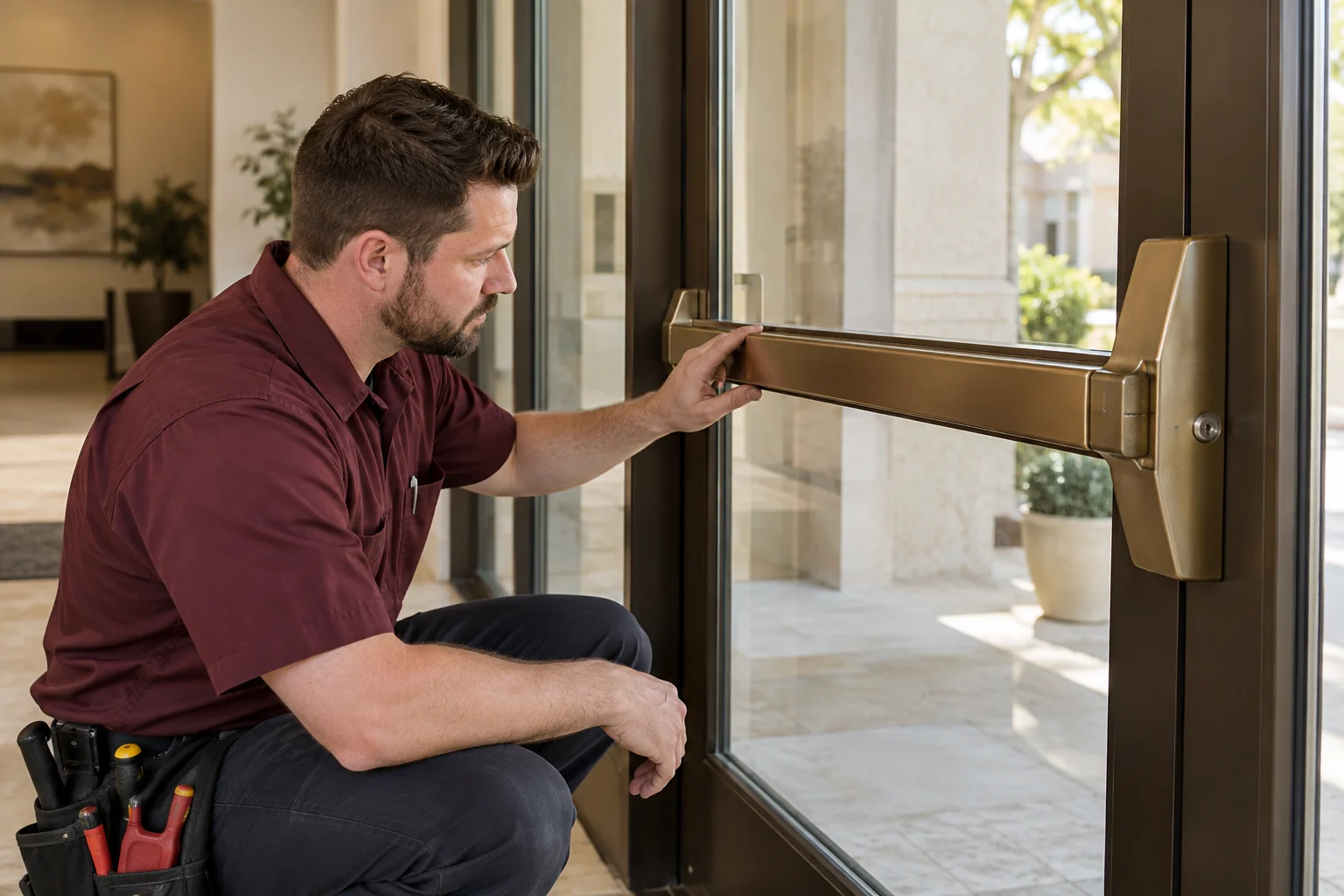
Doors that people use to leave in an emergency are the most regulated doors in any building, and for good reason. Exit hardware must let people out easily without keys or special knowledge. Panic bars are one type. The rules about what is required, where, and how doors must operate vary by use and location, and a general page cannot tell you what applies to your building.
The sensible approach is to ask the authorities responsible for your building, such as the local fire official or building department, and to involve a locksmith to explain the hardware and install what you are told you need. Never lock, chain or block an exit, even temporarily, and never fit a lock that stops people from leaving when they must.
For background, the article on panic bars and exit devices explains the main types, and the piece on door accessibility audits for businesses covers how doors are looked at for people with different abilities. Use these as preparation for your conversations with the people who decide.
Inside the office: cabinets, desks and storerooms
Not every lock in a business faces the street. Filing cabinets, desk drawers, storerooms, server closets and cash handling areas rely on smaller locks that often get less attention. They tend to be simple, widely copied and easy to forget until a key goes missing.
If you inherit furniture with no keys, a locksmith may be able to supply a key or a replacement cylinder without damaging the item. Describe the piece and note any markings on the lock face. Keep in mind that many such locks are meant to discourage casual access rather than stop a determined person, so use them as one layer among several.
The article on file cabinet and desk locks covers what is common. Where records are sensitive, ask about stronger options, and where a storeroom holds high value stock, consider whether the door and the frame, not just the lock, are up to the job. Layers work: a locked cabinet, in a locked room, in a locked building is harder to reach.
Shared spaces such as a copy room, a staff kitchen or a supply closet are often left on a common key that half the building carries. That is convenient, and it is also how a master key quietly turns into a pile of unaccounted copies. If a space holds anything of value, give it a key that only the people who need it hold, and ask the locksmith whether the lock can be rekeyed without disturbing the rest of the system.
Doing new work and rekeying together
When a lock is being added or replaced, it is a natural time to think about keys. New hardware can be keyed to your existing system, or you can use the moment to begin a better one. The page on lock installation in Lauderhill covers the installation side, and the page on rekeying in Lauderhill covers changing keys on existing locks.
Plan the work around your operations. A front entrance is easiest to service when the business is closed or quiet, and some work, such as access control, needs a closer look at power and wiring. Ask the locksmith what the job involves and how long the door might be out of service, and arrange a way to keep the building secure in the meantime.
Hurricane season adds a layer. Businesses that close ahead of a storm should know which doors will be locked, who holds the keys, and how the owner or manager will get back in afterward. Afterward, check every door, since wind and water can shift frames and swell wood. A simple written plan shared with two trusted people can save a lot of trouble.
Keep the plan in two places. A copy in the office is useful, but if the office is unreachable, a second copy held by a trusted person elsewhere keeps the information available. Include which doors have which type of lock, where spare keys are kept, and which person is allowed to approve work. When staff change, update the plan the same week so it never goes stale.
The call, the visit and what to prepare
Start by calling and describing the building, the doors involved and what you want. The locksmith explains the work and the price before it begins, you agree, the work is done, and the finished result is tested with you. For a business, testing means trying every door and every key, with the door open and closed.
Before you call, have your door list ready, along with any photographs and a note of who has authority to approve work. If you rent, ask your landlord what is permitted and whether keys must be shared. If you manage for an owner, confirm who signs off.
If you also work in another part of Broward, the page for Plantation offers similar general guidance for that place. In every case, a patient conversation about the building is worth more than any short list of products, and a good locksmith will tell you honestly when a simple adjustment is enough.
Common questions
Should I rekey locks between commercial tenants?
It is a common and sensible practice. You cannot know how many copies a previous tenant made or who holds them. Rekeying makes old keys useless and gives the new tenant a clean start without replacing hardware. Keep a log of what was done and which keys were issued.
What is the difference between a master key and a regular key?
A regular key opens one lock or one group of locks keyed alike. A master key is part of a designed system in which each door has its own key and a higher level key opens many doors. It reduces carried keys but needs careful planning and tight control.
How can I stop employees from copying keys?
Restricted key systems use blanks and cutting rules that limit duplication to authorized sources, and they are designed for exactly this. They add control but not perfection. Combine them with a key log, a habit of collecting keys, and rekeying when a key is not returned.
Who decides what exit hardware my building needs?
Requirements depend on how the building is used and where it is, so ask your local fire official or building department. A locksmith can explain how devices work and install what you are told is needed. Never block or lock an exit in a way that stops people leaving.
Is electronic access control right for a small business?
It can be, if you have many users, changing staff or want a record of entries. It depends on power, software and someone managing users. Many small businesses keep mechanical keys with good control instead. Weigh size, staffing and how much management time you can give it.
What should I prepare before calling a locksmith?
A list of doors, a note of what is wrong with each, who holds keys, and photographs of the locks and frames if possible. Know who can approve work and what your lease allows. This makes the call shorter and helps the locksmith plan the visit properly.
Talk through the job before work begins
Say what went wrong and what you need to work when we leave. Scope and price are settled with you ahead of the work.
Call (954) 888-8804