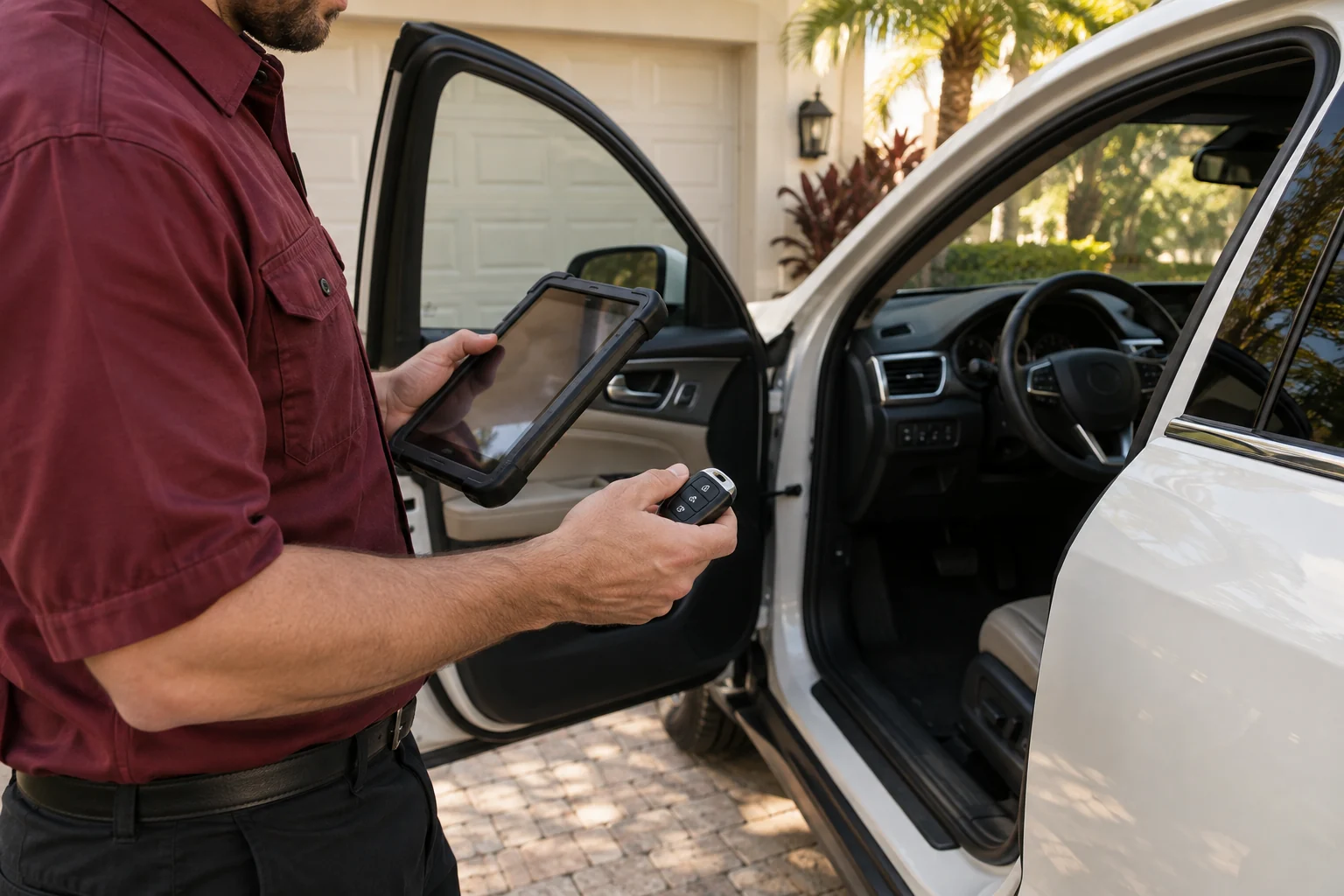
Automotive Locksmith in Sunrise
If you drive in Sunrise and have lost a car key, locked it inside, or watched a fob stop responding, this page explains how an automotive locksmith works, what information helps, and how to think through your options.
Call (954) 888-8804Why car keys are different from house keys
A house key is a simple piece of shaped metal. A modern car key is often a small system. The blade may be cut with a groove down the middle rather than teeth along the edge, and inside the plastic head there may be a transponder chip that sends a coded signal to the vehicle. If the signal is missing or wrong, the engine will turn over and then refuse to run, even though the blade fits the ignition perfectly.
Smart keys go further. They stay in a pocket or bag, and the car senses them as you approach, unlocks on touch, and starts with a push button. Behind that convenience sits a pairing process between the key and the vehicle's computer, and that process is what a locksmith has to perform when you need a new one.
This page is general guidance for drivers in Sunrise. It does not describe any specific makes or promise that a particular key can be produced, because that depends on the vehicle. What it does is give you vocabulary and a sensible order of steps, so that when you call you can describe your situation clearly and understand the answer you hear.
Keep in mind that the person on the phone cannot see your car. The more precisely you describe what happened, the better the plan will fit. Say whether the key broke, vanished, stopped responding, or simply will not turn. Mention any warning lights you noticed, whether the battery in the car itself is healthy, and whether the car has been serviced recently, since a weak car battery can imitate a key problem and send everyone down the wrong path.
When every key is gone
Losing the only key is the situation people dread, yet it is a normal job for an automotive locksmith. The work begins with proof of ownership, since nobody should create a working key for a car without knowing the person asking is entitled to it. Have your registration, title or similar paperwork ready, along with your identification.
Next the technician identifies the exact vehicle: make, model, year and, where needed, the identification number printed on the dashboard plate and the registration. With that information, the right blank is selected and cut to fit the locks. Then the electronics are paired so the engine accepts the key. Each step has to be done in order, and each one matters.
Some people worry that a replacement key leaves the lost one still able to start the car. That is a fair concern, particularly if the key disappeared somewhere public. Ask the locksmith whether the lost key can be removed from the car's memory during programming. On many vehicles this is possible, and it turns a frightening loss into a closed chapter, because the missing key becomes just a piece of plastic and metal.
If the car is parked somewhere inconvenient, say so in your first call. A vehicle in a garage, a parking structure or a gated lot may require a different approach from one on an open driveway. For background on the whole process, read the article on how car key replacement is priced and why it varies, and the overview page for car key replacement.
Transponder chips and programming in plain language
The chip in a car key does not hold a battery in most designs. It wakes up briefly when the key sits near the ignition, answers a question from the car, and goes quiet again. If the answer matches what the car expects, the engine is allowed to start. This is a theft deterrent, and it is the reason a key cut at a hardware counter often opens the door but will not start the engine.
Programming is the act of teaching the car to recognize a new key. Depending on the vehicle, this can be done with specialized equipment that talks to the car's computer through a diagnostic port. Some vehicles allow a simple procedure when a working key is already present, and others require more involved steps. A trained locksmith knows which approach fits your car.
It helps to understand this before you shop around. A copy that looks right but has not been programmed will not do its job, and a poorly programmed key can lead to trouble later. Our guide to how transponder key programming works goes deeper.
Blade style adds another layer. Some keys have teeth cut along the edge, while others have a winding groove milled into the side, and the second kind needs different cutting machinery. This is one reason a general purpose key kiosk cannot copy every key on the road, and why a locksmith who works on vehicles carries several kinds of cutting equipment. Ask what the shop uses for your blade type before you commit to anything.
Locked out of your car
A car lockout happens in parking lots, driveways, shopping centers and fuel stations. Before you call, take a breath and check the obvious things. Are all the doors locked, including the trunk and rear doors? Does a family member have a second key? Is there a spare in a safe place at home that someone could bring to you?
If the keys are inside, tell the locksmith which door is nearest to them and whether the engine is running. If a child or pet is inside, mention it immediately, and in hot weather treat that as an emergency. Call emergency services without waiting, because a closed vehicle in Florida sunshine heats up with alarming speed, and nothing about a lockout is worth a risk to a living being.
Entering a car without damage requires care around door seals, airbags in the door panel, wiring and window mechanisms. That is another reason to let a trained person do it. You can read more in the article about what happens when the keys are locked in the car, and the related guide about keys locked in a trunk covers a common variation.
Fobs that no longer respond
A key fob that stops working can be a small annoyance or a sign of something larger. Start with the simplest idea: the battery. Many fobs use a small coin cell that fades gradually, so you may notice that you have to press the button several times or stand closer to the car before it responds. Replacing the battery is often all that is needed, though some fobs have to be opened carefully to avoid damaging them.
If a new battery does not help, the fob may have lost its pairing, the internal circuit may be cracked from a drop, or the car's receiver may have a fault. A fob that has been through the wash or sat in a pool bag may have corrosion on its contacts, and salty air in coastal regions can slowly cause similar trouble. Look at the buttons: if the rubber is worn smooth, the contacts underneath may be worn too.
When the fob is the only working key, treat it carefully until you have a second one made. Our guide on why a key fob stops working walks through the likely causes, and the article about losing a push to start key describes what to expect if the worst happens.
- Try a fresh battery before assuming the fob is broken.
- Keep the physical emergency blade, if there is one, somewhere you can find it.
- Avoid carrying the fob in a pocket with coins or other keys that scratch it.
- Make a second key while the first one still works.
Ignition trouble and keys that stick
Sometimes the problem is not the key but the lock it enters. An ignition cylinder is a precise mechanical part, and it wears with use. A heavy keychain hanging from the key adds weight and leverage every time the car moves, and over time this can loosen the internal parts. The first signs are a key that is hard to insert, hard to turn, or one that works only after wiggling.
A key that refuses to come out of the ignition is a different symptom, often tied to the steering lock or the gear selector not being fully in park. Try gently turning the wheel while you turn the key, and make sure the shifter is properly seated. Do not force the key, because a snapped key inside the ignition makes everything harder.
If those simple checks do not help, it is time for a professional look. A locksmith can often repair or replace the cylinder and match it to your key. Read the article on common ignition cylinder problems for more detail, and see the service page on ignition repair for how that work is handled.
Replacing an ignition cylinder is more than a mechanical swap when the car has a transponder system, because the new cylinder and the key must still work together with the vehicle's electronics. Be wary of any plan that treats it as a trivial job. Describe the symptoms in order, including when they began and whether the steering wheel locks up, since those details help the technician decide whether the cylinder, the key or something else is the cause.
Why one spare key is worth making today
Making a duplicate from a working key is a much smaller job than creating a key from nothing. The locksmith can copy the blade and clone or program the electronics from the existing key, which removes the need to identify and recover the vehicle's codes. That is why the sensible moment to make a spare is before you lose the first one.
Think about how your household uses the car. If two people drive it, each should have a key, and a third should live in a safe place at home. If you travel, leave a spare with someone trustworthy rather than hiding it on the vehicle, since magnetic boxes under bumpers are well known to thieves and tend to fall off in rain.
Not every household needs the same number of keys, but nearly every household benefits from at least one spare. To weigh the decision yourself, read the article on whether a spare car key is worth it, and keep in mind that the cost of a duplicate is nearly always smaller than the cost of losing the only key on a day when you need the car.
Locksmith or dealership, and how to decide
Many drivers wonder whether to go to the dealership or call a locksmith. Both can make keys for many vehicles. The difference is usually practical. A mobile locksmith can come to the car, which matters when the vehicle cannot be driven, while a dealership usually needs the vehicle brought to it, sometimes on a tow.
Neither route fits every situation. Some very new or unusual vehicles need equipment that only certain shops carry, and a locksmith who is honest will tell you if your car falls into that group. For most common vehicles on the road, a trained automotive locksmith is a reasonable first call, and asking direct questions helps you compare.
Good questions include whether the key will be programmed to the car, what the total will be, whether any additional charges might appear, and what happens if the key does not work. You can see how the two options compare in our article on car key replacement from a locksmith or a dealership. Requirements about titles, registration and ownership paperwork vary, so ask the shop you choose what they need.
What a visit should look like
A professional visit follows a clear order. You call and describe the vehicle, the problem and where it is parked. The technician explains what the work will involve and the price before anything starts, and you can decide whether to go ahead. After the work, the key is tested with you: it should unlock the doors, start the engine, and operate any remote buttons.
Test the new key more than once. Lock and unlock the car with the blade and with the remote. Start the engine, switch it off and start it again. Open the trunk with the fob. If you received more than one key, check each of them. It is much easier to fix an issue while the technician is still there than after they have gone.
Keep the old key if you find it later. In some cases, a lost key that surfaces after a replacement can still be used or can be removed from the car's memory so it no longer starts the engine. If you are unsure, ask the technician to explain whether lost keys can be erased from the vehicle, because that matters for security when a key vanished in a public place.
Finally, keep a short record somewhere safe: the make, model and year of the car, plus a photo of the registration. When a key goes missing at a bad moment, having these details on your phone or in an email to yourself saves a great deal of time and helps the person on the call give you a clear answer.
Protecting vehicles in a South Florida environment
Florida conditions put steady stress on cars. Heat softens plastic and weakens key fobs, humidity can creep into electronic parts, and storms drive water into places it should not reach. A key that rides in a damp beach bag or a pocket during a rainstorm may stop working long before its battery dies.
Simple habits help. Keep fobs dry, and if one gets soaked, remove the battery and let it dry in open air before testing it again. Avoid leaving a fob on a dashboard in direct sun. Check the door and trunk locks now and then, and if a lock begins to feel rough, mention it to a locksmith before it seizes completely.
If your household also needs help with house doors, our overview of locksmith services in Sunrise covers homes and businesses, while the page on lockout service in Sunrise deals with locked doors at the home. Treat this page as a starting point, and call a Broward County locksmith whenever you want to talk through your own vehicle.
Common questions
What do I need to show to get a replacement car key?
Expect to show identification and proof that the vehicle is yours, such as a registration or title. You will also need to identify the make, model and year, and the locksmith may need the vehicle identification number. Requirements vary, so ask what documents are needed when you call.
Why does my copied key open the door but not start the car?
Most modern keys contain a transponder chip that must be paired with the vehicle. A key that is only cut to the right shape can turn the lock but will not be recognized by the engine computer. The chip needs to be programmed to the car before the engine will run.
Can I fix a key fob myself?
A new coin cell battery is a reasonable first attempt, and many fobs open with a small tool. If the fob still fails, the pairing, circuit board or contacts may have a problem. Forcing a fob open can break its casing, so ask a locksmith if you are unsure.
What should I do if a child or pet is locked in a hot car?
Call emergency services at once. Do not wait for a locksmith, because a closed vehicle in Florida heat becomes dangerous within minutes. Once the emergency is handled, a locksmith can help with the lock, any damage and a spare key so it does not happen again.
Is a locksmith or a dealership better for a new key?
Both can be correct depending on the vehicle. A mobile locksmith can come to a car that cannot be driven, while some very new or specialized models may need equipment only a dealership has. Ask each option about total price, programming and what happens if the key does not work.
How can I prevent losing my only car key?
Make a spare while the original still works, keep it somewhere safe at home rather than in the vehicle, and avoid weighing the key down with a heavy keychain. A second key is much simpler to create from a working one than from nothing.
Talk through the job before work begins
Tell us what happened, which doors or keys are involved and who needs to get in. The price and the plan are agreed with you before any work starts.
Call (954) 888-8804