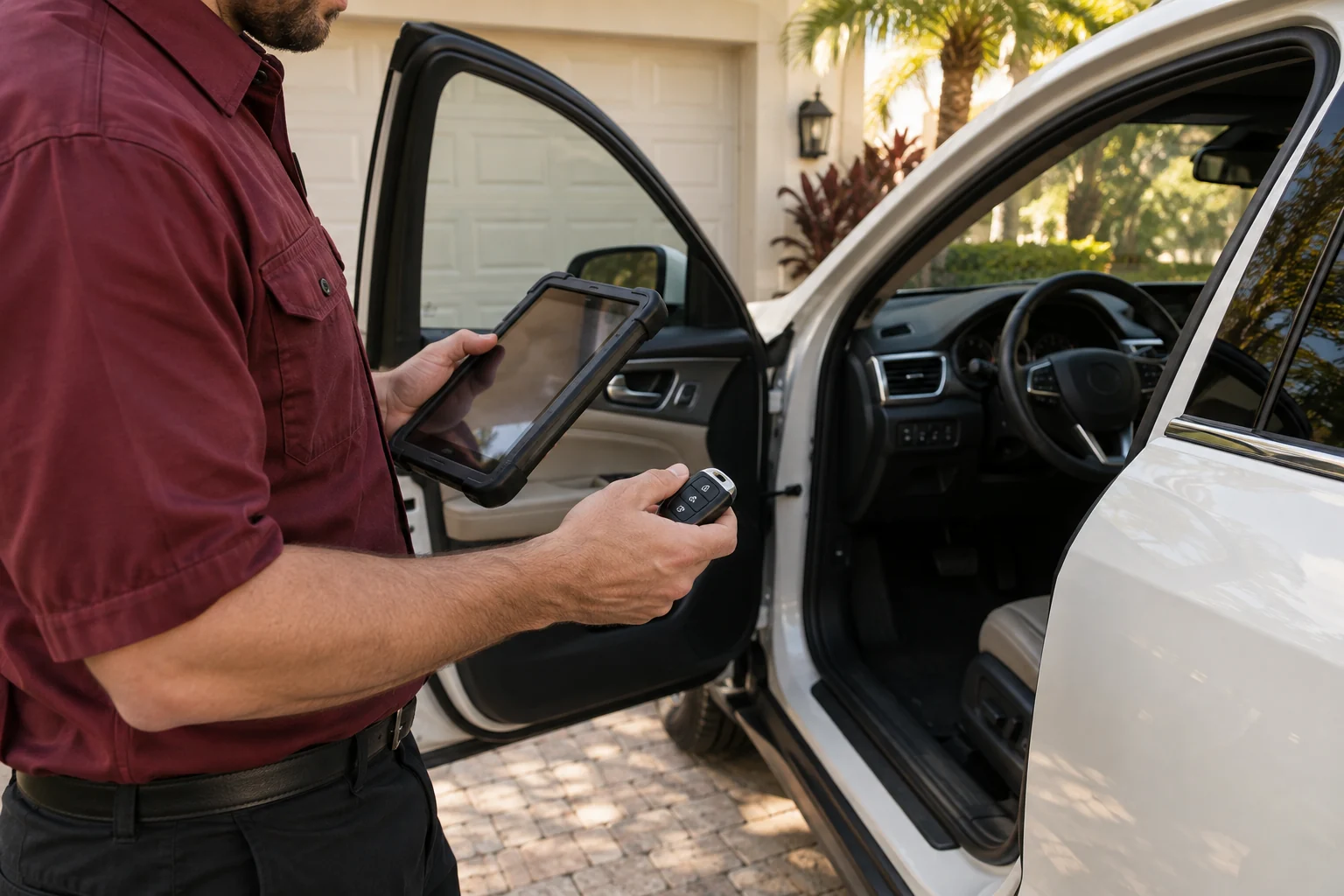
Automotive Locksmith in Dania Beach
Car key trouble tends to arrive at the worst moment, in a parking lot or a driveway with plans waiting. This page is general guidance for Dania Beach drivers on what automotive locksmith work involves and how to prepare for it.
Call (954) 888-8804What an automotive locksmith actually does
Most people picture a locksmith opening a house door, but a large share of the trade is vehicles. An automotive locksmith cuts and programs keys, repairs or replaces ignition cylinders, opens locked cars without damage, and sorts out fobs that have stopped talking to the vehicle. The work happens at the car, which is why it suits a driver who is stuck somewhere rather than sitting at a counter.
Modern keys are small computers wrapped in plastic and metal. Inside the head of many keys sits a transponder chip that the car must recognize before the engine will run. Others are smart keys that never touch a slot at all and rely on a radio exchange with the vehicle. A locksmith who works on cars needs to understand all of these, because the same street can hold a thirty year old sedan with a plain metal key and a recent crossover with a push button start.
This page is general guidance for people in Dania Beach, written without claims about specific streets or businesses. If you want the full picture of the key work itself, the main page on car key replacement goes into more depth, and the notes on ignition repair cover the other half of the trade.
When a lost key becomes a real problem
A single lost key is annoying. A lost key with no spare is a different situation, because there is nothing to copy from. The key then has to be created from the vehicle itself, using its identification information and, for most newer cars, a programming step that tells the car to accept the new key. That is entirely doable at the vehicle, but it takes more preparation than a copy of an existing key.
Start by being honest about where the key might be. Check pockets of the jacket you wore, the gap between car seats, the bag you carried, and the last place you set it down. Keys also fall out in parking areas near the vehicle and get kicked under it. A few minutes of searching is sensible, but if you have retraced your steps and nothing turns up, stop and plan the replacement rather than driving yourself in circles.
When you call, be ready to describe the vehicle: make, model, approximate year, and whether it starts with a key turned in a slot or with a button. Mention whether you have any key at all. Those few facts shape what the technician brings and how the job is explained to you before it begins. The comparison in locksmith versus dealership for car keys is worth a read if you are weighing your options.
Understanding the key in your hand
Cars use several generations of keys, and knowing yours helps the conversation. The oldest type is a simple cut metal key with no electronics. Next came transponder keys, which look nearly the same but carry a chip. Then laser cut keys, with a cut running along the middle of the blade rather than along the edge. Finally come smart keys and push to start fobs, which may not look like a key at all.
Each type has different needs. A plain metal key can be duplicated almost anywhere. A transponder key must also be programmed so the car recognizes it. A laser cut key needs a machine that can follow the internal track. A smart key needs the car to be paired with it through a diagnostic connection.
Two guides explain the differences in plain terms. The article on transponder key programming covers the chip side, while the comparison of laser cut and standard car keys explains why some blades cannot be copied on an ordinary machine. Reading both before a call can make the explanation you receive easier to follow.
Fobs, buttons and push to start systems
A fob that has gone quiet is not always a dead fob. The battery is the first suspect, since a weak battery can make the buttons work only up close or only now and then. Replacing it is a small job on many fobs, though the case can be fiddly to open without cracking it. If a fresh battery does not help, the fob may have lost its pairing, or its internal circuit may have been damaged by a drop or by water.
Push to start systems add another wrinkle. The car looks for the fob nearby and lets the engine start when the button is pressed. If the fob battery is weak, many vehicles have a backup method, often holding the fob against a certain spot, and the owner manual explains it for your model. When the fob is lost entirely, there is no backup, and a new one has to be made and paired.
Helpful reading here includes why a key fob stops working and what to do when a push to start key is lost. Both give you a clear sense of what is repairable and what needs replacing.
Worn ignitions and keys that will not turn
Ignition cylinders wear out. Years of turning, a heavy keychain pulling on the cylinder, and the occasional grit from outdoor parking all take a toll. Early signs include a key that needs jiggling, a key that sticks when you try to remove it, and an ignition that works in some positions of the key but not others. Ignore these signs and the next step is often a key that refuses to turn at all.
A locked steering wheel can mimic this problem. If the wheel is under tension against the lock, the key may feel stuck even though nothing is broken. Gently turning the wheel while easing the key is the standard first try, and the owner manual describes it. Force is the wrong answer, since a snapped key inside the cylinder turns a small repair into a bigger one.
When the cylinder is the problem, a locksmith can repair or replace it and make a key that works with the new part. The articles on ignition cylinder problems and a key stuck in the ignition describe the symptoms in more detail so you can describe them accurately when you call.
One more thing worth knowing is that an ignition and a door lock on the same car are often related. On many vehicles the door and ignition share the same key, and replacing one part can mean the key set must be matched again. Mention anything else that feels off, such as a stiff door lock or a trunk that sticks, so the technician can plan the whole job in one visit rather than several.
Locked out of the car
Keys locked inside a vehicle is among the most common automotive calls. It happens at gas pumps, beach parking areas, grocery lots, and driveways. The first rule is to avoid forcing anything. Prying a door or wedging tools in a window can damage weatherstripping, wiring in the door and the glass itself, and those repairs cost far more than the lockout.
If a child or pet is inside, treat it as an emergency and say so clearly when you call. South Florida heat turns a closed car into a dangerous place sooner than most people expect, so that situation changes how urgently help should be arranged, and emergency services are the right call if anyone is in distress.
For the ordinary case, a locksmith opens the vehicle using tools made for the purpose, and you can then check that nothing was marked. A more detailed look at the options is in the guide to car lockout solutions, and the page on lockout service in Dania Beach covers lockouts across home and vehicle.
Why spare keys matter more than people think
The easiest key you will ever make is the one you make while you still have a working key. Copying from an existing key is a simpler job than creating one from nothing, and it removes the stress of a situation where you cannot move the vehicle. A spare kept at home, away from the car, gives you a fallback that costs very little compared with an emergency replacement.
Think about how many people use the vehicle. A shared family car, a work vehicle or a car lent to a relative each increase the odds that a key goes missing. Having one spare per regular driver is a sensible habit. Store spares somewhere safe, not in a magnetic box under the bumper, since those are well known and sometimes lost to road spray or corrosion.
The article is a spare car key worth it goes through the reasoning and what to keep in mind for newer keys that need programming. If you are sorting out several things at once, a spare is a good thing to add to the same visit.
How the process usually unfolds
The process on this kind of job is straightforward. You call and describe the vehicle, the key situation and where you are parked. The locksmith explains what the work involves and what the price will be before anything begins. Then the work is done at the vehicle, and the finished key or repair is tested with you present before the job is considered complete.
Your part is to confirm the details that matter. Be ready to show that the vehicle is yours, since a responsible locksmith will want some sign of ownership before making a key for a car. That might be a registration or title document and an ID. This is a protection for you as well, because it keeps strangers from walking away with keys to your car.
If you are parked somewhere awkward, such as a crowded lot or a street with traffic, say so. Let the technician know whether the vehicle is in a position they can work beside safely. A calm description of the surroundings helps more than a hurried one.
Have your phone charged and your location clear. A street name, a nearby business or a parking level number gives the technician something concrete to work with, and it avoids the confusion that comes when a driver says only that they are near the water. If you are standing in sun, find shade while you wait, and keep your valuables with you rather than leaving them in an open car.
Heat, salt air and the life of a car key
Cars in coastal South Florida live a harder life than their key makers might have planned for. Salt air encourages corrosion on metal parts, strong sun bakes dashboards and key fobs left on them, and humidity works its way into small electronics. A fob that spends every afternoon on a hot dashboard tends to age sooner than one kept in a bag.
Small habits help. Keep the key out of direct sun where possible, avoid dunking it with wet swimwear, and dry it off if it gets soaked. A fob that has been in water should be dried thoroughly before you try it, and if it behaves oddly afterward it is better to have it looked at than to keep pressing buttons.
Ignitions suffer too. A key ring crowded with heavy items puts constant weight on the cylinder every time you drive. Trimming the ring and using a separate loop for house keys is an inexpensive way to extend the life of the ignition.
Hurricane season adds its own habits. If a storm is approaching and you may need to move the car or leave the area, check now that your spare key works and that you know where it is. Many people discover a dead fob battery or a missing spare only when they are loading the car in a hurry, and that is a poor moment to start solving it. A short check of every key you own before the season gets busy is time well spent.
Questions to ask before you agree to any key work
Before the work starts, a few plain questions protect you. Ask what exactly will be done: a copy, a new key made from the vehicle information, a programming step, or a cylinder repair. Ask whether the price you are given covers everything, including any programming and the visit to your location. If the answer is vague, ask again until it is clear, since a good technician is comfortable explaining their own work.
Ask what happens if the first attempt does not behave as expected. Some vehicles are particular about how a new key must be introduced to the computer, and a thoughtful technician will tell you in advance what testing will happen. You should see the key start the car, lock and unlock the doors, and operate any remote buttons before you accept the result.
It also helps to ask about the old key. If you still hold a damaged or worn key, the technician may want to look at it, since the wear pattern can reveal which cylinder it belongs to. Do not throw away old keys until the new one has been proven in every function. For a wider view of how to judge a business before you commit, the questions to ask a locksmith on the phone makes a good checklist.
Finally, keep your own records. Write down the date, what was done and the price you were quoted. If a problem appears later, that note makes the conversation simpler for everyone involved.
Neighboring cities and related help
Dania Beach sits among other Broward communities, and many drivers cross city lines daily for work, school or errands. A key problem can strike anywhere along that route. The general guidance on this page applies equally if you happen to be parked in a neighboring city, and you can read how the same service works in Hollywood or Fort Lauderdale.
Not every key issue is about the car. If you have misplaced a ring that holds both your car key and your house keys, you may need to think about the home as well, since someone holding that ring could know where you live. In that case, consider whether your home locks should be changed, and read about lost house keys: rekey or replace.
Whatever the situation, the next step is a phone call that describes it plainly. The technician will explain the plan, the price and the testing before and after the work, and you decide whether to go ahead.
Common questions
What information should I have ready when I call about a car key?
Have the make, model and approximate year of the vehicle, the place you are parked, and a description of the key situation. Say whether you still have any working key, and whether the car starts with a slot or a button. Keep proof of ownership nearby too, such as registration and an ID, because a responsible locksmith will ask for it.
Can a locksmith make a key if I have lost every key?
In most cases, yes. A key can be created from the vehicle's own information, and many newer cars then need the new key programmed so the car accepts it. This takes more preparation than copying an existing key, which is why a spare is worth having. The technician explains what your particular vehicle needs before starting.
Why does my key turn the lock but not start the engine?
On many vehicles, the engine will not run unless the car recognizes the chip inside the key. If the chip is missing, damaged or not paired, the key may turn but the car stays silent. A weak battery can also cause trouble. A locksmith can check whether the key, the car or the battery is the cause.
Is it better to call a locksmith or go to a dealership?
Both can make keys, and the right choice depends on your situation. A locksmith usually comes to the vehicle, which matters if the car cannot be driven. A dealership may suit someone who can bring the car in at their own pace. Ask each what the work includes and how the price is explained.
What should I do if my key breaks off in the ignition?
Stop trying to turn it, and do not push other tools into the cylinder. Forcing it can damage the ignition and make the repair larger. Call and explain what happened. A locksmith can remove the broken piece and then cut a new key, or repair the cylinder if it was damaged.
Should I get a spare key even if my current key works fine?
Yes, it is usually the simplest protection against a bad day. Copying from a working key is easier than making one from scratch, and you avoid being stranded. Keep the spare at home, not hidden on the car, and make one for each regular driver of the vehicle.
Talk through the job before work begins
Say what went wrong and what you need to work when we leave. Scope and price are settled with you ahead of the work.
Call (954) 888-8804