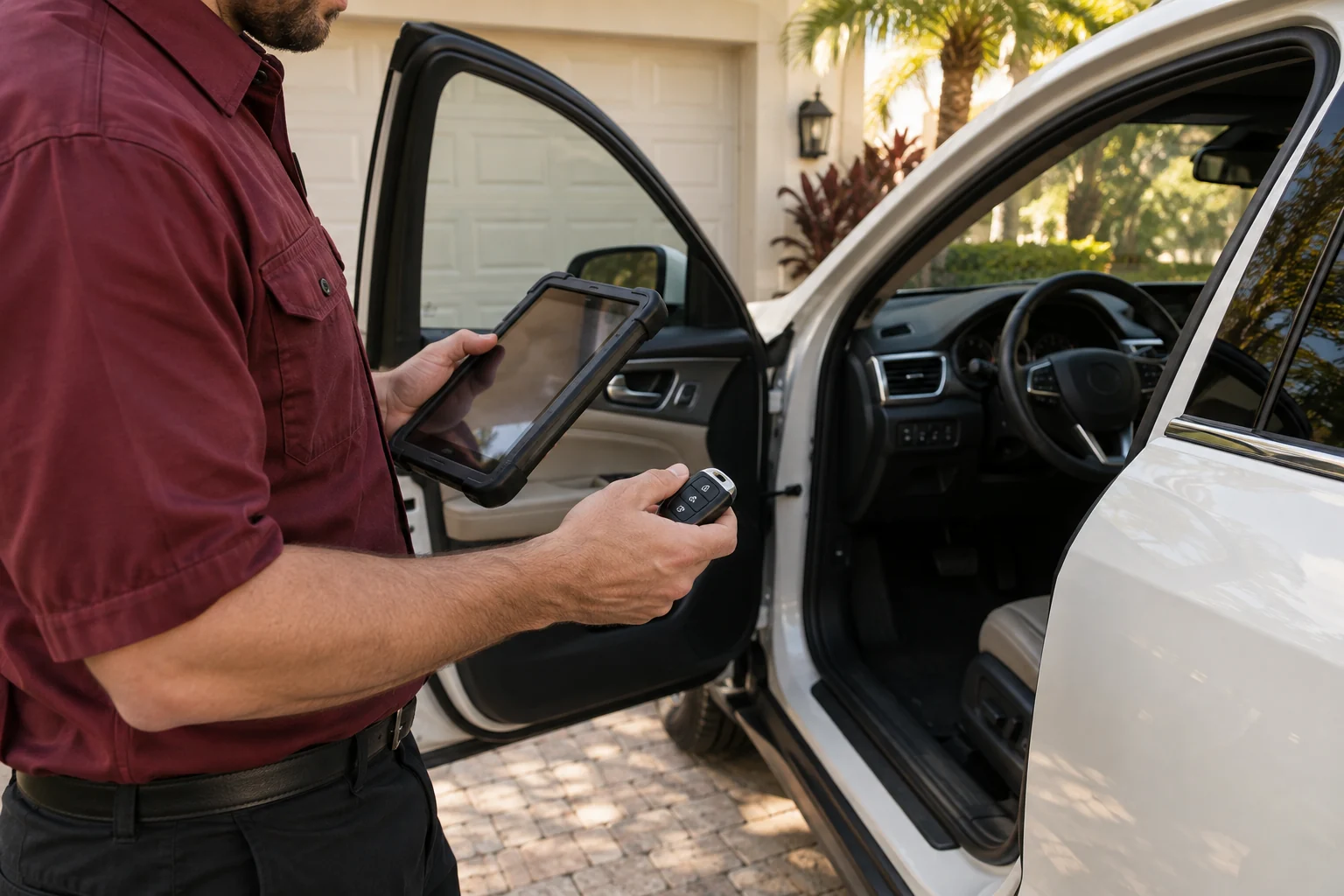
Automotive Locksmith in Parkland
Modern car keys are small computers wrapped in metal and plastic, and that changes what a lost or broken key means. This page is general guidance for drivers in Parkland who need to sort out a car key problem.
Call (954) 888-8804Why car keys are no longer just keys
Until fairly recently a car key was a piece of cut metal, and any decent shop could copy it in a minute. Today most vehicles use a key or fob that carries a small electronic chip. The car sends a low power signal, the chip answers with a code, and the engine will only start if the code is accepted. Cutting the metal blade correctly is only half the work, because the chip must also be introduced to the vehicle.
That is why a replacement key can feel complicated and costly compared with the old days. A lost key may involve identifying the vehicle, cutting a new blade, preparing a new chip and programming the car to accept it. Some vehicles also need older keys removed from memory, so that a lost key can no longer start the engine. Each step takes the right tools and knowledge.
Understanding this helps you ask the right questions. When you call, say the make, model and approximate year, whether the key is a blade, a remote head key, a smart fob with a start button, or something else, and how many working keys you have left. These details guide the plan, and they help a locksmith explain what will be needed before any work begins.
Types of keys you may be holding
A basic mechanical key has no chip. These appear on older vehicles and are the easiest to replace. A transponder key has a chip hidden in the plastic head and is the common type on vehicles from roughly the late nineties onward. A remote head key combines the transponder with lock and unlock buttons on the same piece. A smart key, also called a proximity fob, lets you start the car with a button as long as the fob is inside.
Another detail is the shape of the blade. Some keys have the familiar edge cut, with teeth along one or both sides. Others have a groove cut into the flat face of the blade, often called a laser cut or sidewinder key. The latter needs a different machine and more careful work. The article on laser cut versus standard car keys shows how to tell which you have.
If you are unsure what type you hold, do not worry. Describe what it looks like and what it does, and mention any buttons. You can also look for a code stamped on the key or in the owner's papers, but never share vehicle identification numbers or ownership papers with anyone you have not decided to trust.
- Mechanical keys have no chip and are the simplest to copy.
- Transponder keys carry a chip that must be programmed to the vehicle.
- Remote head keys add lock and unlock buttons to a transponder key.
- Smart fobs allow push button starting with the fob inside the car.
- Laser cut keys have a groove in the blade instead of teeth on the edge.
When you have lost every key
Losing the only key is the most stressful version of this problem. You cannot unlock or start the car, and the vehicle may be parked somewhere inconvenient. Take a calm moment and retrace your steps before you assume the key is gone. Check pockets, bags, the place you last parked, and anyone who might have borrowed it.
If the key is truly lost, a replacement is usually possible, although the process differs by vehicle. A locksmith will ask for proof that you own the car, usually with identification and registration or title, before creating a new key. This step protects you from someone else obtaining a key to your vehicle. Have those papers ready, and know where the car is.
Be careful about leaving the old key active. A lost key can be misused if someone finds it and knows the car. Ask whether the old key can be erased from the vehicle's memory when the new one is programmed. For the broader process and what to expect, see car key replacement.
Think also about the vehicle's location. A car parked in a gated lot, a garage, a parking structure or an apartment complex may involve extra steps, such as permission from a manager or a way for a technician to reach the car. Tell the person you call exactly where the vehicle sits and whether it can be moved. If the car is blocking something, say that as well, so the plan takes it into account from the start.
The spare key question
If you still have one working key, you are in a better position than you may realize. Making a copy while you hold a good key is generally simpler and calmer than recovering from a total loss. You can schedule the work at a convenient time, and you are not stranded while it happens. Think of a spare as insurance that costs less in stress than a full replacement.
Not every spare is the same. A simple blade copy opens doors but may not start the engine. A proper copy with a programmed chip does everything the original does. Decide what you need. Some people want a full spare for a family member, and others only want a door key for a valet or a hidden emergency kit. The article on whether a spare car key is worth it explains the trade offs.
Keep the spare somewhere you will remember and where it cannot be easily found by a stranger. Avoid hiding it on the vehicle itself, since a magnetic box under a bumper is a well known spot. A trusted household member or a secure drawer at home is a wiser choice.
Fobs that stop working
A dead key fob is not always a lost key. Often the problem is a weak battery, a worn button or a bit of moisture inside the case. In South Florida's humid climate, moisture and corrosion on fob contacts are real possibilities, especially if the fob has been dropped or carried in a pocket during rain. A new battery is a sensible first step if the fob is losing range or working only when held close.
If a fresh battery does not help, the fob may need cleaning, repair or reprogramming. Occasionally the car itself is the issue, with a weak car battery or a faulty receiver. Do not hurry to replace the fob until you know the cause. A basic explanation of common symptoms appears in why a key fob stops working.
If you have a smart key that will not start the car, look for a backup method in your owner's manual. Many fobs have a hidden blade for the door and a spot on the dashboard or console where you can hold the fob to let the car read it. Check the manual before you panic, and keep it with the vehicle.
Push to start and lost smart keys
Smart keys bring a particular difficulty. If you lose the only fob, the car cannot be started even though the vehicle may still unlock with a hidden blade. The vehicle's computer has to be taught a new fob, and that needs equipment and authority to access the system. It is not something to attempt with a gadget bought online.
If you still have one fob, a copy is usually easier and often less costly than starting from zero. If you have none, the process may involve the vehicle being brought to the locksmith or the locksmith traveling to the vehicle with specialist tools. The explanation in what to do when a push to start key is lost sets out the general path.
One more caution. If the vehicle has been towed or is parked in a place where it cannot be moved, tell the person you call. Some work can happen where the car sits, and some needs better access. Clear information avoids a wasted trip and lets everyone plan sensibly.
Keys that stick, break or will not turn
A key that sticks in the ignition or will not turn can have several causes. The steering wheel may be locked against the key, which is common and usually solved by gently turning the wheel while turning the key. A worn key, a worn ignition cylinder or debris in the keyway can also be responsible. Do not force the key, since a broken blade makes matters worse.
If a piece of the key has snapped off inside the lock, stop trying to start the vehicle and avoid pushing the fragment deeper. A locksmith can often remove the broken piece with the right tools and may be able to cut a new key from the remaining part. You can read more in what to do when a key is stuck in the ignition.
Repeated sticking is a warning sign. An ignition cylinder wears over time, particularly when a heavy bunch of keys hangs from the key and swings with each bump in the road. Lighten the ring to reduce wear, and have the cylinder examined before it fails completely. See ignition repair and the guide to ignition cylinder problems for typical symptoms.
Locksmith or dealership
Many drivers assume that the dealership is the only place that can supply a key. For many vehicles, that is not true. An automotive locksmith can often cut and program keys for a wide range of makes, and may travel to the vehicle, which matters when the car cannot be driven. Some makes and models have restrictions, and a few require the manufacturer, so it is worth asking about your specific car.
The practical differences include location, scheduling and the process for proving ownership. A dealership usually works from a fixed site and may need the vehicle brought in, while a locksmith can sometimes come to you. Neither is always the right answer, so compare the plans rather than assuming. The article on car key replacement from a locksmith or a dealership goes through the points to weigh.
Whichever route you choose, ask for the plan and the price in advance, and ask what happens if the programming does not succeed. A responsible provider explains this clearly and will not begin work until you agree.
Lockouts and keys left inside
Keys locked in a car are a common reason for a call. Resist the urge to improvise with wire, wedges or tools you saw in a video. Doors contain wiring, airbags and mechanisms that are easily damaged, and a repair can cost more than the original problem. A trained locksmith has methods designed to open the vehicle without harming it.
Before calling, check whether your vehicle has a phone app or a manufacturer service that can unlock it remotely, and whether a spare key is within reach. If a child or pet is inside, or the day is hot, call emergency services first. Parked cars in South Florida heat become dangerous within minutes, so treat any person or animal inside as an emergency.
For the usual routes and what to expect, see your options when keys are locked in the car. If you suspect the lockout came from a failing key or lock, mention that too, so the repair can be planned.
Caring for keys in the Florida climate
Heat, humidity and salt air are hard on car keys and fobs. A fob left on a dashboard in summer sun can warp, weaken its battery or crack its case, and a key that sits in a hot cupholder for months suffers a little each day. Keep your keys out of direct sun when you can, and avoid leaving them in a closed, parked car even if the doors are locked.
Water is the other enemy. Rain, pool water and sweat can seep into a fob and corrode its contacts. If your fob takes a swim, remove the battery, let the case dry out thoroughly in a cool place and have it checked before assuming it is ruined. Do not heat it with a hair dryer or place it in rice, because heat can damage the circuit board.
Finally, be thoughtful about the ring itself. A heavy bundle of keys, charms and tags drags on the ignition cylinder, and over years that weight wears the pins inside. Separate the car key from the rest when you can, and keep a small gap between the key head and any decoration. These habits cost nothing and lengthen the life of the whole system.
What a good visit looks like, and nearby pages
Start with a phone call. Say where the vehicle is, what happened, and what keys you have. The work and the price are explained before it begins, and you should know what will be done to the car. You will be asked for proof of ownership, which protects you. If something is unclear, ask until it makes sense.
When the work is finished, the new key is tested with you. You should see it unlock the doors, start the engine if it is meant to, and operate any remote buttons. Count the keys you receive and confirm that any old, lost keys have been dealt with as you wished.
This page is general guidance for Parkland and does not claim any history in specific neighborhoods. Drivers near the city edge may find the same advice for Coral Springs or Coconut Creek. And if you want to understand how a chip and a car are matched, the article on transponder key programming explains it in everyday language.
Common questions
What do I need to show before a new car key is made?
You will usually be asked for photo identification and proof that the vehicle is yours, such as registration or title. This protects owners from anyone trying to obtain a key to a car that is not theirs. If you cannot find the papers right away, say so and ask what else may be accepted.
Can a locksmith make a key without the original?
In many cases yes. For most vehicles, a key can be created from the vehicle's identifying information, after ownership is confirmed. Some makes and models are more restrictive. Describe your vehicle clearly when you call, and ask whether your particular car can be handled and what the process will involve.
Will the old lost key still start my car?
It depends on how the new key is added. On many vehicles the old key can be erased from memory, which stops it working. On others, old keys may stay active. Ask about this specifically if the lost key could be found by someone else, and decide what you want done. Do not assume that the old key is harmless just because it is missing. A key that someone else holds is still a way into your vehicle until it has been dealt with.
Why does my key work the doors but not the engine?
That usually means the metal blade is cut correctly but the electronic chip is missing, unprogrammed or faulty. The door lock only needs the right shape, while the engine also needs the right code. A copy cut at an ordinary counter often behaves this way. Programming the chip solves it. If your key worked before and stopped suddenly, the chip may have been damaged by a drop, heat or water, and that is worth mentioning when you describe the problem.
Is it worth repairing a worn ignition?
If the key sticks, turns roughly or sometimes fails to start the car, a worn cylinder is a likely cause. Repair or replacement now is usually calmer than waiting until the car will not start. A locksmith can examine the cylinder and explain the options before you commit to any work. Tell them how long the problem has been developing, because a slow decline points to wear rather than a sudden failure.
Can I have a spare made before I lose my only key?
Yes, and it is often the sensible choice. Making a copy from a working key is usually simpler than rebuilding access after a total loss. Decide whether you want a door only copy or a full key with a programmed chip, and keep the spare somewhere safe and easy to remember.
Talk through the job before work begins
Say what went wrong and what you need to work when we leave. Scope and price are settled with you ahead of the work.
Call (954) 888-8804