Why turnover is the moment that matters
Every rental has a handover problem. One tenant leaves, another arrives, and in between there are cleaners, painters, maintenance staff, a leasing agent and sometimes a photographer who all need to get through the door. With a traditional deadbolt, each of those visits means a physical key changing hands, and each key is a copy that may or may not come back.
Keypad deadbolts attract landlords because they change the question from who holds a key to who knows a code. A code can be created for one person, used for the days that person needs it, and then removed without anyone driving across town to collect anything. That is a genuine improvement over a ring of keys that nobody can account for.
The catch is that a keypad lock is not a magic fix. It adds batteries, software or a code list that somebody has to manage, and it still sits in a door that has to close, latch and resist force like any other. A landlord who treats it as a set and forget gadget usually ends up with a new set of problems instead of the old ones.
South Florida adds its own pressure to the decision. Rental turnover here can be steady, with seasonal tenants, condo units that change hands often, and owners who manage properties from far away. Anything that reduces trips to the property is attractive, which is exactly why it pays to think carefully before choosing a lock and a routine.
What a keypad deadbolt actually is
A keypad deadbolt is a normal deadbolt with an electronic way to operate it. Inside the door there is still a bolt that extends into the frame, and the keypad or motor simply moves that bolt when the right code is entered. Most models also keep a conventional keyway so a physical key can open the lock if the batteries die.
There are two broad families. The first is a standalone keypad, where codes are programmed at the lock itself using a sequence of button presses. The second is a connected lock that pairs with a phone app or a hub, which lets you add and remove codes remotely. Our guide on keypad locks versus smart locks goes deeper into where the line falls between them.
Standalone models are simple and have fewer things to go wrong, but changing a code means being at the door. Connected models save the trip, but they depend on a wireless connection, an account and an app that the landlord must keep up to date. Neither is wrong; they suit different kinds of properties and different kinds of owners.
Whichever you choose, the lock should be treated as a security device first and a convenience second. Look at the strength of the bolt, the body of the lock and the way it attaches to the door, not just the number of features on the box. Our explanation of deadbolt grades is a useful companion when comparing models.
Standalone codes or connected codes
The choice between standalone and connected usually comes down to how far you live from the unit and how many units you manage. A landlord with one duplex a few minutes away may be perfectly happy with a standalone lock and a short note in a notebook. An owner who lives out of state, or a manager with a dozen doors, will value the ability to change access without travelling.
Connected locks also keep some kind of log, showing which code was used and when. That can be helpful when a contractor says they were at the unit on Tuesday, or when a tenant disputes a lockout. It is worth reading how long the log is kept and who can see it before relying on it for anything important.
Standalone locks have their own advantages. They do not stop working when a home internet service goes down, they do not need an app account, and there is no company server that has to stay in business for the lock to keep functioning. For a property that sits empty for long stretches, that simplicity is a real selling point.
A reasonable rule is to ask what happens on the worst day. If the wireless connection fails, if the phone app is not updated, or if the person who set up the system is unavailable, can someone still get through the door safely and legitimately? The lock you choose should have a clear answer to that question.
- Choose standalone if you live nearby and want the fewest things that can fail.
- Choose connected if you manage several units or live far from the property.
- Check how many codes the lock can hold before you buy it.
- Ask whether the lock still works as a plain deadbolt with a key if the electronics fail.
- Confirm that someone besides you can reset the lock if you are unavailable.
A code plan for each stage of a tenancy
Good turnover practice begins with a written code plan. Decide in advance which codes exist during a vacancy, which exist during a tenancy, and who is allowed to hold them. Keeping it on paper, even a single page, prevents the slow drift where nobody knows which codes are still active.
During a vacancy, give each visitor their own code rather than sharing one among cleaners, painters and agents. When the job is finished, delete that code. If the lock supports it, set codes to expire on their own, so that a forgotten cleanup does not leave a door open to somebody who no longer has a reason to be there.
When a new tenant moves in, the tenant should choose or be given a personal code that no one else has used, and every code from the vacancy period should already be gone. The landlord and property manager should keep any master or management code separate and should never reuse a tenant code for staff.
At move out, remove the tenant code on the day the lease ends, not weeks later. Then walk the unit, confirm that the door locks and unlocks properly, and make sure that no stray codes remain in the memory of the lock. A simple checklist that is repeated every time is more reliable than good intentions.
Do not forget the keyed backup
Even a well made keypad lock needs a plan for when the electronics fail. Batteries run down, circuit boards can be affected by moisture, and a code entry pad can wear out where thousands of fingers have pressed the same few buttons. The physical key override is the safety net, and it deserves as much attention as the keypad itself.
Think about who holds that override key. If you hand copies to every contractor, you have recreated the exact problem you were trying to escape. A better approach is to keep one or two keys under your control, store them somewhere genuinely secure, and let codes handle everyday access.
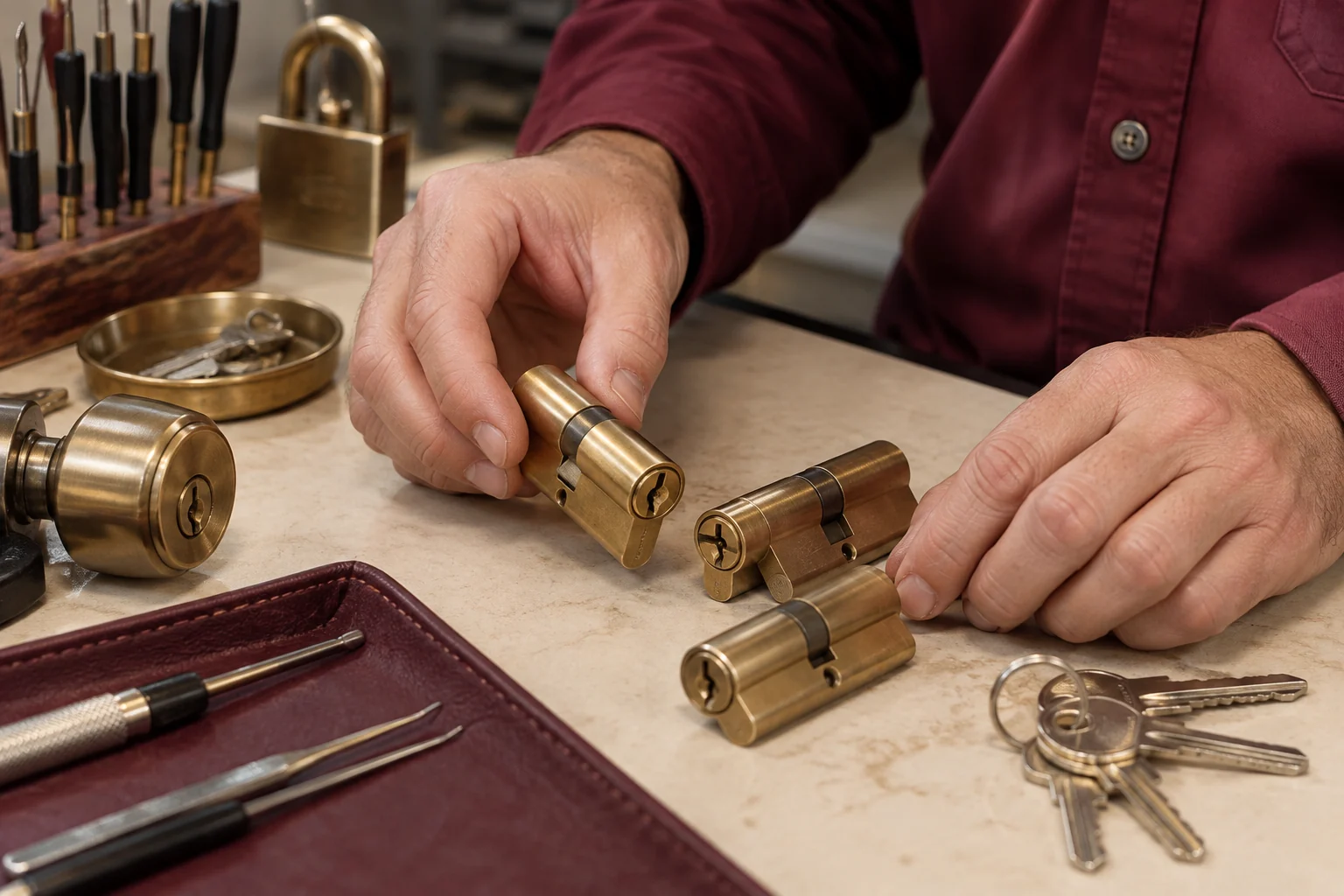
When a tenant leaves, ask whether the keyway needs attention too. If the old tenant ever had a key, that key may still open the lock, even if their code is gone. Having the cylinder rekeyed is the clean answer, and our article on how rekeying works explains what actually happens inside the lock when this is done.
Landlords who also want tenants to feel safe should be honest about the backup. A tenant who knows there is a key out there, and who holds it, is in a different position from a tenant who is told nothing. Clear communication about who has access avoids awkward disputes later.
Humidity, salt air and sun on a Broward front door
South Florida is hard on door hardware. Coastal humidity gets into places that are supposed to be sealed, salt air corrodes metal finishes, and a door that faces the afternoon sun can run hot enough to stress plastic parts and batteries. Electronics are more sensitive to all of this than a plain brass cylinder.
When choosing a keypad deadbolt for a Broward rental, look for a finish and housing designed for outdoor exposure, and think about whether the door is under a covered entry or standing directly in weather. A door in a breezeway behaves very differently from one that gets rain blown straight at it during a summer storm.
Batteries deserve particular attention in heat. They can lose capacity sooner than expected, and a lock that warns about low power may do so earlier in a hot climate than the packaging suggests. A routine of checking batteries at every turnover costs almost nothing and prevents the most common avoidable lockout.
Keep an eye out for early signs of trouble: buttons that stick, a keypad that responds slowly, a motor that sounds strained, or a bolt that does not fully extend. These are often signs of moisture, misalignment or low power rather than a failed lock, and catching them during a turnover inspection is much easier than discovering them when a new tenant calls.
The door matters as much as the lock
A keypad deadbolt can only be as secure as the door and frame holding it. If the strike plate is held by short screws, if the frame is soft or split, or if the door has swelled and rubs against the jamb, the new lock will not perform as it should. Many problems that look like lock failures are really door alignment problems.
Humidity makes this worse, because wood and even some composite doors move with the seasons. A bolt that lined up perfectly in a dry month may bind in a wet one, and an electronic motor struggling against a tight bolt will drain batteries and wear out sooner. Our article on a door that will not latch explains how to recognise the problem.
Before installing, check that the bore holes in the door match the lock, that the door closes without being pushed, and that the bolt travels cleanly into the frame. If any of those things is off, fix them first. Our door fit guide for smart locks covers the same checks in more detail and applies equally to keypad models.
Finally, consider a reinforced strike plate and longer screws that reach into the framing rather than just the trim. It is a small change that makes a real difference to how the door holds up under force, and it is worth doing whenever you replace or add a deadbolt, whether or not it has a keypad.
Condos, HOAs and rules you may not control
Many Broward rentals are condo units or homes in associations, and those come with their own rules. Some associations require that they keep a key or code to every unit, some restrict what hardware may be installed on a door, and some govern exterior appearance. These rules vary from one building or association to the next.
Before buying a lock, read the governing documents or ask the association office what is allowed and what must be reported. Our article on condo and HOA lock changes explains the kinds of questions worth asking. Do not assume that because a lock is legal to sell it is automatically allowed on your door.
Fire safety and access for emergency responders are also considerations in multi family buildings. Requirements differ, so ask the association, the building management or the local authority rather than relying on general advice. A lock that cannot be opened by the people who legitimately need to enter in an emergency is a liability.
If you rent the unit to short stay guests, there may be additional rules about how access is shared. Our guide to smart locks for short stay rentals goes through those situations and the habits that keep them manageable.
Common mistakes landlords make
The most frequent mistake is leaving old codes active. A code created for a painter in spring can still be sitting in the lock in autumn, belonging to a person who no longer has any reason to enter. It is easy to avoid with expiring codes or a deletion step in the turnover checklist, but it happens constantly.
Another common error is sharing one code among everyone. It feels simple, but it makes it impossible to know who used the door and forces a full code change whenever anyone leaves the job. Individual codes cost nothing extra and turn a vague situation into an accountable one.
Some landlords install a keypad lock and forget the rest of the opening. A thin strike, a weak frame or a sliding door beside the entry can undermine the whole effort. Walk the property the way an unwelcome visitor would and notice which part looks easiest to deal with.
Finally, many owners never test the backup. They assume the key works, the batteries will last and the tenant knows what to do when the lock beeps. A short walkthrough at move in, with the tenant opening the door by code and by key, prevents many late night phone calls.
- Delete every vacancy code before the new tenant takes over.
- Give each contractor and cleaner their own code.
- Test the key override after any lock or door adjustment.
- Replace batteries on a schedule rather than waiting for warnings.
- Record who holds management access and go over the list regularly.
When a keyed lock is still the better choice
Keypad locks are not right for every rental. A property with a very tight budget for maintenance, a door that is badly warped, or a tenant population that struggles with technology may be better served by a plain, solid deadbolt that is rekeyed at each turnover. Rekeying is a straightforward service that gives you a new key without replacing the lock.
For a landlord with a small number of units who is nearby and organised, regular rekeying is a perfectly sound routine. Our guides for rekeying rental property and tenant turnover rekeying for property managers lay out how that process works and when to do it.
There is also a hybrid approach. Some landlords keep a conventional deadbolt on the main door and add a keypad lock only to a secondary entrance or a common storage area. Others use a keypad for the vacancy period and switch to a keyed lock once a long term tenant moves in. The right mix depends on how the property is used.
If you are weighing the options, a locksmith can look at the actual door and tell you what fits. Half Off Locksmith can talk through smart lock options and rekeying and lockout service over the phone, and the work and its price are explained before anything begins.
Putting a turnover routine together
The simplest turnover routine has five steps. First, remove the departing tenant's code and confirm no stray codes remain. Second, rekey or replace the cylinder if a physical key was ever issued. Third, test the lock, the door and the strike. Fourth, set up codes for the vacancy and the new tenant. Fifth, record what you did.
Do these in the same order every time. A routine is valuable precisely because it does not depend on your memory or mood. Over many turnovers it quietly prevents the mistakes that cause the most trouble, such as forgotten codes, unchecked batteries and doors that no longer close properly.
Plan for the weather as well. As hurricane season approaches, check that doors still seal and latch and that batteries are fresh, and read our hurricane season lock checklist. If you are choosing hardware for several units, take a look at the full range on the services page to see how installation, rekeying and smart lock work fit together.
Lastly, give your tenants clear instructions. Tell them how to change their code, who to call when the lock beeps, and what to do if they lock themselves out. A tenant locked out of an apartment is a stressful situation, and our renter lockout guide is a helpful thing to share. This page is general guidance, and your own situation may call for different choices.