Automotive Locksmith in Tamarac
Drivers in Tamarac face the same key problems as everywhere: a single key, a dead fob, a stubborn ignition or a locked door. This general guide helps you understand the options and prepare for a useful conversation.
Call (954) 888-8804Starting from the symptom, not the part
When a car will not start or open, people often name a part: the battery, the fob, the ignition. Yet the first useful step is simply describing what you see and hear. Does the key turn the lock but not the ignition? Does the dashboard light up and then go dark? Does a security light blink on the dash? Each symptom points toward a different cause.
A key that turns but does nothing may have a damaged blade, a worn ignition or a pairing problem. A fob that unlocks the doors but will not start the engine may have lost its chip data. A car that starts but stalls moments later could be refusing an unrecognized key. A locksmith can often tell from your description which of these is likely.
This page is general guidance for drivers in Tamarac. It does not describe local streets or businesses, and it does not claim that any particular vehicle can be handled. What it gives you is a way of thinking through the problem calmly, so that your call to a locksmith is clear and your questions are the right ones.
Try to separate the key from the car in your thinking. If a second key works perfectly in the same vehicle, the fault lies with the first key. If no key works, the lock, the ignition or the car's electronics are more likely at fault. That single comparison, made in a minute at the roadside, narrows the problem more than any amount of guessing and tells the locksmith where to begin.
Buying a used car with only one key
A used vehicle often changes hands with a single key, and that is a risk worth fixing early. If the only key is lost, replacing it costs more effort than copying a working one. Making a duplicate soon after purchase turns a fragile situation into a stable one.
It also raises a security question. The previous owner may still hold copies, and so might friends, relatives or repair shops. A locksmith can sometimes program new keys to the car and remove old ones from its memory, so that keys you do not hold stop starting the engine. The details depend on the vehicle, so ask what is possible for yours.
Check the paperwork as well. You will need to show that the car is yours when keys are made, so keep the title or registration handy. If you buy from a private seller, ask for every key and fob they own, and the original manual if available. Our article on whether a spare car key is worth making explains why this step is usually wise.
Be careful with copies sold through unfamiliar channels. A key blank bought at a bargain online may be the wrong profile, may carry the wrong chip, or may not accept programming at all. A locksmith asked to work with a blank you supplied may not be able to promise a result. Ask first whether they prefer to supply the key, so you avoid paying twice for the same job.
Understanding your key type before you call
Car keys come in a few broad families. A plain metal key has no electronics and is rare on newer vehicles. A transponder key has a chip in its head. A remote head key combines the blade with buttons for locking and unlocking. A smart key stays in a pocket and works with push button ignition. Knowing which you have saves time on the phone.
Look at your key. If it has a plastic head with buttons, it is likely a remote head key. If it has no blade at all, or a small emergency blade inside the fob, it is probably a smart key. If the head is plain plastic and thick, a chip may be inside. Take a photo, and describe or send it if asked.
Blade cuts also differ. Some blades have teeth on the edge, and others have a groove milled into the sides. The second style needs different machines. Our guide to laser cut and standard car keys explains the difference, and the page on car key replacement shows how each type is handled.
Photograph the key front and back, and photograph any numbers stamped on the blade or the fob case. Those marks sometimes help a locksmith identify the right blank without a long search. Do not post the photos publicly, since a clear image of a key can be used to make a copy. Send them only to the person you are working with, and delete them from shared folders afterward.
Fobs, batteries and the little things that fail
Fobs are small and carry a lot of electronics. They live in pockets with coins and in bags with water bottles. Buttons wear, casings crack and batteries fade. In many cases the fix is simple and inexpensive, and it starts with a new battery of the correct type.
If the fob still fails after a battery change, the contacts inside may be corroded, a solder joint may have cracked, or the pairing with the car may be lost. Coastal air and humidity speed up corrosion, and a fob that went through a wash can fail slowly over the following weeks. A locksmith can inspect it and say whether repair or replacement makes more sense.
When you open a fob to change the battery, do it on a clean surface and note how the halves fit together. Small gaskets and tiny contacts are easy to lose. Press the new battery in the right way up, with the marked side facing as the old one did, and snap the case closed until it seats evenly. A casing that does not close fully lets in moisture, which is how many repaired fobs fail a second time.
Remember the emergency options built into your car. Many fobs hide a mechanical key, and many cars have a place where a weak fob can be held to start the engine. Check your manual before you need it. Our article on why a key fob stops working lists likely causes in plain words.
- Replace the battery first and note the type before you remove the old one.
- Keep the hidden emergency blade easy to find.
- Avoid dropping the fob into water or leaving it in the heat.
- Make a spare fob while the first one still works.
Push button cars and smart keys
Push button ignition feels simple, yet it relies on constant communication between the key and the car. The car senses the key nearby, checks its code and allows the engine to start. If the fob battery is weak or the key is missing, the car may display a warning and refuse to go.
Losing a smart key is more serious than losing a plain one. The car must be taught to recognize a new key, and often the old one should be removed from memory. This work needs the right equipment and proof of ownership. It is not a case for a hardware store copy.
Keep your remaining smart key away from metal containers and away from heat while you wait, since a damaged last key turns a bad day into a worse one. Do not leave it in the car overnight, where thieves can sometimes capture its signal. A simple signal blocking pouch, or even a metal tin, can help when the car is parked in public places.
If you have lost a smart key, tell the locksmith everything you remember. Where was it last? Could it have been taken? Is there a chance it will turn up? Our article on what to do if you lose a push to start key covers the steps in detail, and the explanation of transponder programming helps with the background.
Insurance and roadside plans sometimes help with key trouble, and it can be worth checking what yours says before you pay out of pocket. Ask the provider what they cover and whether they require a particular vendor. Their rules are theirs to explain, so follow what they tell you, and keep any receipts. This step takes a few minutes and occasionally changes the whole picture.
Ignitions that wear, stick or refuse to turn
An ignition cylinder takes more punishment than its size suggests. Each start twists it, each heavy keychain pulls on it, and over time the internal parts wear. Early signs include a key that has to be wiggled, a cylinder that feels loose, or an ignition that sticks in one position.
Never force a key that will not turn. A bent or broken key inside the ignition creates a harder repair. Try turning the steering wheel gently while you turn the key, since the steering lock can bind. Make sure the gear selector is fully in park. If those steps do not help, stop and get advice.
A locksmith can often service or replace an ignition cylinder and match it to a key. On vehicles with immobilizer systems, the work involves electronics as well as metal. Read about common ignition cylinder problems and what to do when a key is stuck in the ignition, then see the service page on ignition repair.
Cars that sit unused for a season
Some vehicles are driven daily, while others sit for weeks or months, perhaps while an owner travels. A parked car in South Florida still faces heat, humidity and storms. The car battery can drain, key fob batteries can weaken, and locks can stiffen from lack of use.
If you plan to leave a vehicle parked, think about the keys. Take the fob batteries into account, since a fob that has gone dead can leave you wondering why the car will not open. Know where the mechanical key is. Tell a trusted person who could move the car in an emergency where a spare key lives.
On your return, test everything gently. Try the fob, the door locks and the trunk before you need them. If something is slow or stiff, mention it to a professional early. A small repair in a calm moment beats a failure in a parking lot, especially when you have luggage and little patience.
A car that has sat in damp conditions may also show a stubborn trunk lock or a sticky door lock, because moisture and dust gather in cylinders that nobody turns. Work the lock gently several times with the key. If it stays rough, do not spray heavy oil into it. Ask a professional which lubricant suits the cylinder, since the wrong product attracts grit and makes the next failure worse.
Motorcycles, scooters and other vehicles
Two wheeled vehicles have keys too, and they are often overlooked. Motorcycle keys may include chips and may be required for the ignition, the fork lock and the seat or storage compartment. A lost key can mean a stuck steering lock and a bike that cannot be moved easily.
Replacement depends on the model. Some are straightforward, and others need programming similar to cars. The same proof of ownership applies, and you will want to provide the make, model and year. Tell the locksmith where the bike is and whether it can be rolled safely.
Our article on motorcycle key replacement goes through what to expect. If your household also owns boats, trailers or utility vehicles, mention them when you call, since a locksmith can tell you whether those are within their scope or whether another specialist would suit them better.
What a professional visit should include
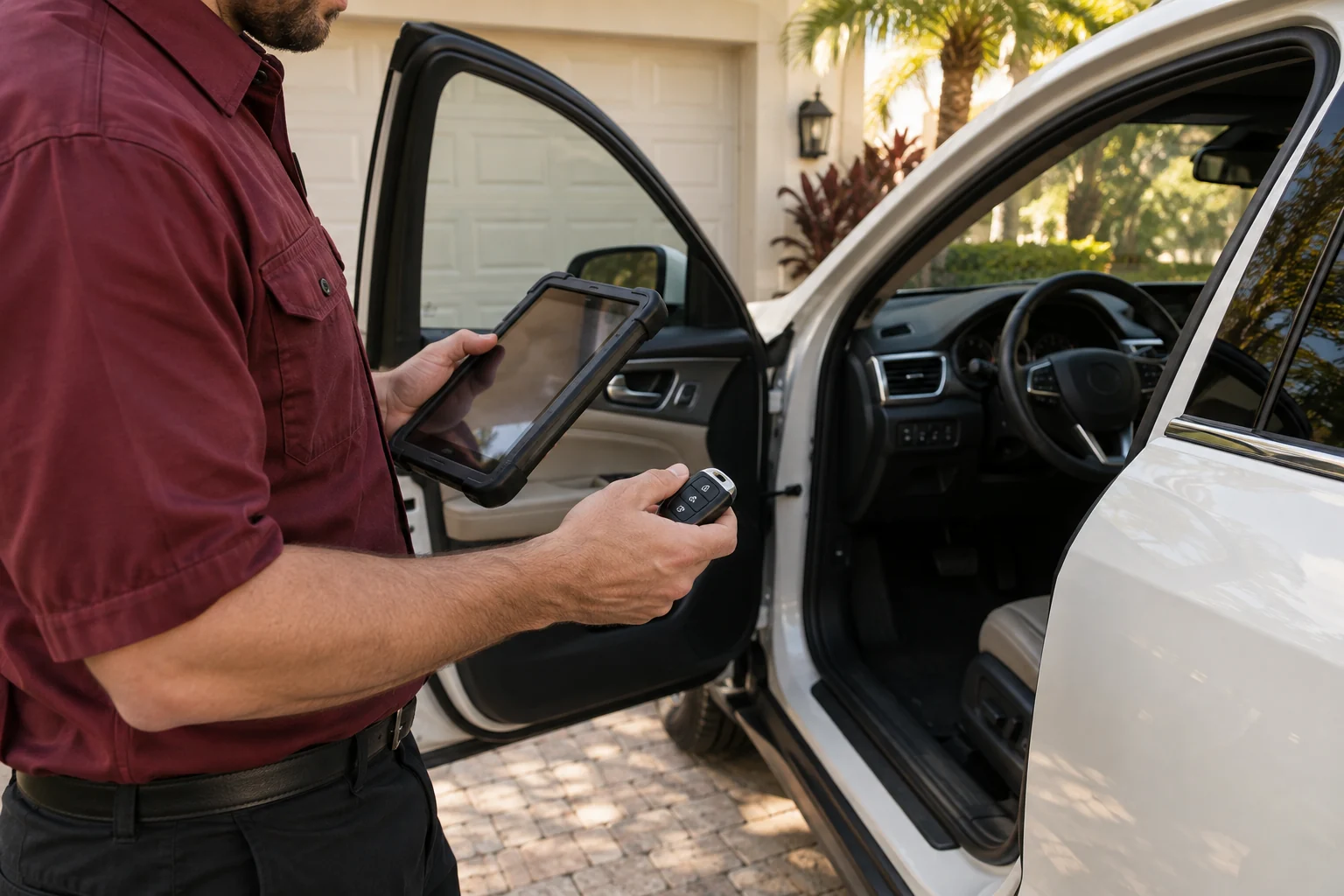
The sequence is plain. You call and describe the vehicle, the situation and where it is. The work and its price are explained before it begins, and you decide whether to continue. The technician confirms ownership, identifies the vehicle and does the work.
When the work is done, the result is tested with you. Every new key should open the doors, start the engine, operate any remote buttons and work the trunk. Try them more than once. Turn the engine off and on again. Check for dashboard warnings after the engine starts. If something is wrong, say so before the technician leaves.
Ask for all the keys to be handed to you, including the spare, and ask how many are now registered to the car. Keep paperwork in a safe place. If you want to compare options, our article on locksmith or dealership lists useful questions.
Before you leave the conversation, write down what you were told: the total, what it covers, the number of keys and what happens if one does not work. A person who gives you a clear answer now will not mind that you recorded it. If the answer is vague, ask again or decide to call someone else, since a plan you do not understand is a plan you cannot hold anyone to.
Locked out, and what to do next
A locked car with keys inside is a lockout, and it is the most common automotive call. Check whether another door or the trunk is open, whether a family member has a key, and whether a spare is nearby. Do not force a door or window, because that can damage seals, wiring and glass.
If a child or animal is inside, call emergency services at once, particularly in hot weather. Do not wait. Once the emergency has passed, a locksmith can help with the door and with a spare so that it does not repeat. If nobody is at risk, give the locksmith your location and the make, model and year.
Entering a car correctly takes training. Door panels hide wires, airbags and window mechanisms, and a careless approach can cost more than the lockout. For a full explanation, read our article on car lockout solutions, then return to the page on lockout service in Tamarac if the problem is at a house door.
Parking lots carry their own concerns. Wherever you are stuck, choose a place with other people and good light, and keep your phone charged. Avoid accepting help from strangers who approach unasked and offer to open the car. Wait for the person you called, ask for identification, and confirm the plan and price before any tool touches the door. Your patience here is your strongest protection against a second problem.
Common questions
Should I make a spare key right after buying a used car?
Yes, if the car came with only one key. Copying a working key is far simpler than replacing one when none remain. Ask whether old keys can be removed from the car's memory, so that keys held by previous owners no longer start the engine.
Why will my fob not start the car?
The battery may be weak, the pairing may be lost, or the fob may be damaged. Try a new battery of the correct type first. Many cars also have a spot where a weak fob can be held to start the engine, which the owner manual shows.
Can a locksmith help with a motorcycle key?
Often, yes, depending on the model. Some motorcycle keys are simple and others carry chips that must be programmed. Provide the make, model and year, and explain where the bike is and whether it can be moved.
What proof will I need to get a key made?
Expect to show identification and proof that the vehicle is yours, such as a registration or title. The locksmith will also need the make, model, year and possibly the vehicle identification number. Requirements vary, so ask when you call.
Is it safe to keep using a stiff ignition?
It is better to have it examined. A stiff or loose ignition is wearing, and forcing it can break a key inside. A locksmith can inspect the cylinder and advise whether service or replacement is needed before you are stranded.
What should I do if I locked a pet in the car?
Call emergency services immediately, especially in warm weather, and do not wait for a locksmith. Once the emergency is handled, a locksmith can help with the lock and with making a spare key so it does not happen again.
Talk through the job before work begins
Say what went wrong and what you need to work when we leave. Scope and price are settled with you ahead of the work.
Call (954) 888-8804