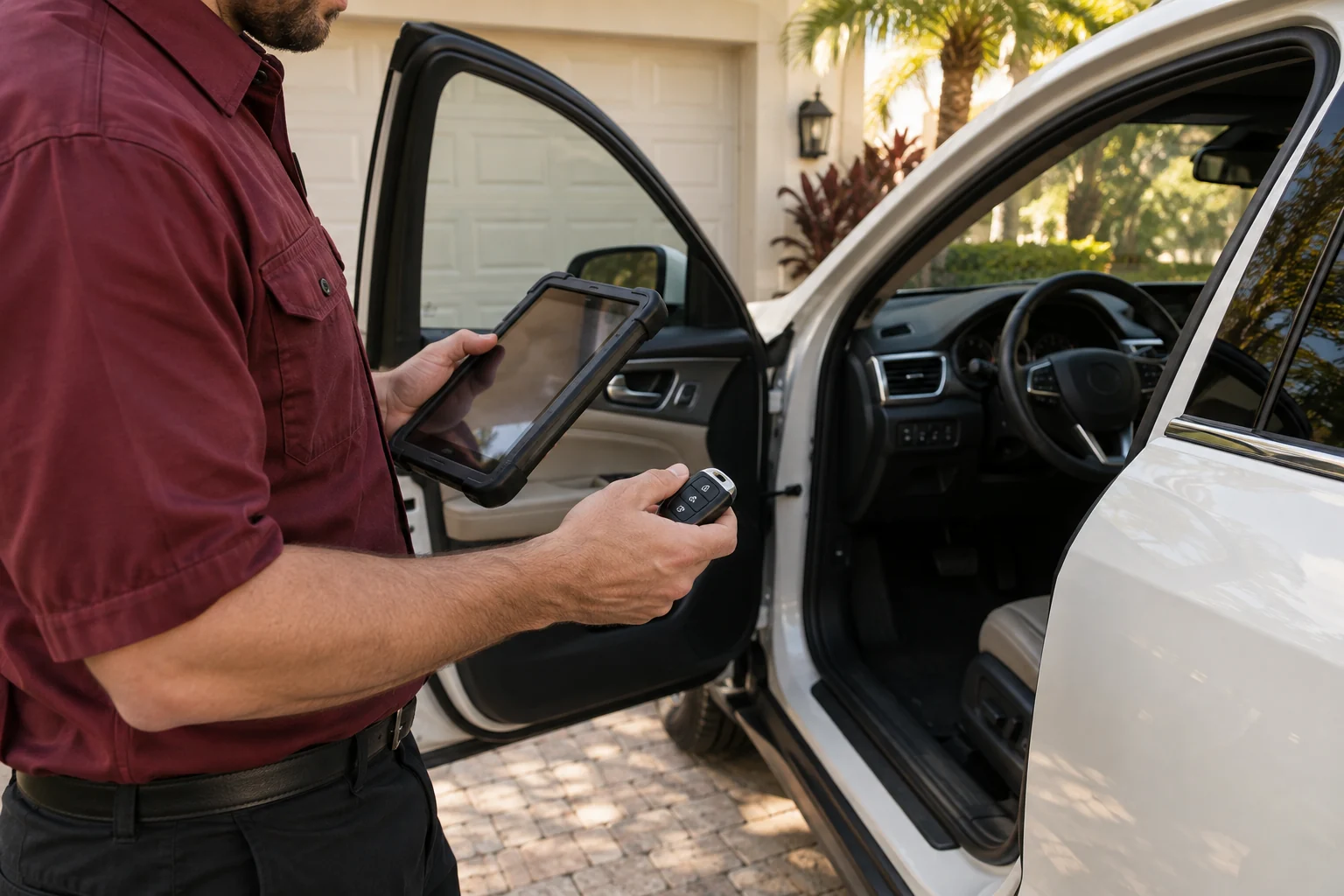
Automotive Locksmith in Margate
Car keys are small computers wrapped in metal. This page is general guidance for Margate drivers on lost keys, fobs, lockouts and ignition trouble, and on the details worth having ready before you call.
Call (954) 888-8804Why a modern car key is more than a piece of metal
Decades ago, a car key was a cut piece of brass that matched the lock. Today most vehicles use a key with a small chip inside that talks to the car. When the chip and the car agree, the engine is allowed to run. When they do not, the engine may turn over and then stop, or refuse to turn over at all.
That is why a hardware store copy of a modern key often opens the door but will not start the car. The metal part matches, yet the electronic handshake is missing. A locksmith who works on vehicles can cut the blade and also program the chip so the car recognizes the new key.
Knowing this changes how you approach a lost or broken key. You are not only replacing a shape, you are introducing a new electronic identity to your vehicle. Understanding that helps you ask better questions and recognize when an answer sounds incomplete.
It also explains why prices and timelines vary so much between vehicles. A basic older key is a simple job, while a late model smart key may involve specialized equipment, a security procedure, and careful testing afterward. Neither is better or worse, they are simply different kinds of work. When you hear a price, ask what exactly is included: the blade, the chip, the programming, the buttons, and the testing. A clear answer is a good sign, and a vague one is worth questioning before you agree to anything.
The kinds of keys you may be holding
A basic mechanical key has no electronics and is mostly found on older vehicles. A transponder key carries a chip in the plastic head. A remote head key combines the blade, the chip and lock and unlock buttons in one piece. A smart key, also called a proximity or push to start key, lets you unlock and start the car without inserting anything.
Some keys have blades cut on the edges, while others have a groove milled into the face of the blade. The second type, often called laser cut or sidewinder, is thicker and harder to copy on simple machines. Our article on laser cut versus standard car keys explains the difference.
Look at your key and note which type you have. If you are not sure, a clear photo of both sides and the make, model and year of the vehicle usually gives a locksmith what is needed to identify the right blank.
Check the key for any numbers or letters stamped on it, and look at the inside of the key head for a brand mark. Those clues can narrow things down. Also pay attention to the buttons: how many there are, what symbols they carry, and whether one opens a trunk or a sliding door. Two keys that look alike from across the room can use different chips and different frequencies, which is why matching the details matters more than matching the shape.
- Basic keys have no chip and are simple to copy.
- Transponder keys need programming to start the engine.
- Remote head keys add lock and unlock buttons.
- Smart keys let the car sense the key nearby.
- Laser cut blades need specialized cutting equipment.
When you have lost every key
Losing the only key to a car is a stressful moment, but it is a solvable one. When no working key exists, a new key must be created from scratch, which involves cutting a blade and introducing a fresh key to the vehicle. The process depends on the make, model and year, and some vehicles are more demanding than others.
Have the vehicle identification number, usually visible through the windshield at the driver side or on your registration and insurance papers, ready for the call. You will also be asked to show that the car is yours, with a title, registration or similar document, and a photo identification that matches.
If the car is at home, say so. If it is parked elsewhere, explain where and how it can be reached. Our car key replacement page lays out the process, and what to do when a push to start key is lost covers smart keys.
Once the new key exists, ask what happens to the old, missing one. On many vehicles the car can be told to ignore keys it has known before, which means a lost key can be made useless to whoever finds it. This is worth asking about, especially if the key was lost with a bag or a wallet. Making the missing key stop working is an important step that people often forget when they are relieved to be driving again.
One working key and the case for a spare
If you still have one working key, you are in a far better position. Making a copy from an existing key is generally simpler than starting from nothing, and the vehicle can learn the new key while the old one is available. The difference in effort is real.
Many drivers only act after the last key is lost, when the job is harder and the day is more disrupted. A spare tucked away at home, or given to a trusted family member, is a modest step that spares you a bad afternoon later.
Not every spare is worth making, and you should weigh the cost against your habits. If you drive a vehicle that is hard to open or start without a key, or if multiple people share it, a spare is worth thinking about. We weigh this in is a spare car key worth it.
Where you keep the spare matters as much as having one. A magnetic box under the bumper is a well known hiding place and can fall off in a puddle. A spare in a drawer at home, in a bag you carry, or with a relative you trust is more dependable. Tell whoever holds it what it is for, and test it once a year to confirm the buttons and the battery still work.
Locksmith or dealership
Dealerships are the traditional source for car keys, and they can handle many vehicles. A locksmith who specializes in automotive work is another route, and for many vehicles the result is the same: a working key that your car accepts. The practical differences are often in how the job is arranged and where it takes place.
With a vehicle that will not move, a service that comes to the car can matter. With a vehicle you can drive or tow, either path may be possible. Ask each option to explain the steps, the parts and the final price before you commit, and compare in plain terms.
We walk through the points in locksmith versus dealership and break down what affects the price in the car key replacement cost guide.
A fair comparison is more than a price on a screen. Ask whether the quote covers the cut, the programming and the buttons, what happens if the first key does not work, and whether the old key can be disabled. Ask who will do the work and where. A vague answer to simple questions is the signal to slow down, and you are always allowed to hang up and call someone else. Keep notes of who you spoke with and what they said, because a written trail makes it easier to compare answers and to remember the details when you are tired and the day has been long.
Fobs, remotes and batteries
Before assuming a key fob is broken, think about the battery. A weak battery makes buttons work only at close range, then not at all. The reach shortens first, the car starts to ignore a press, and eventually nothing happens. Replacing a small coin cell battery is often all that is needed.
If a fresh battery does not help, the problem may lie in the fob's circuit, a worn button, or a loss of programming. Water exposure is common in South Florida, from rain, pools and the beach, and it can damage the electronics inside.
Do not pry open a fob without looking up how it opens, as the case can crack and the circuit board can be harmed. Our guide to a key fob that is not working goes through the common causes in order.
One more tip: when the fob fails, find the hidden mechanical key that most fobs carry. A small release slides or clicks, and a metal blade comes out that opens the driver door. It will not always start the car, but it gets you in. Many smart key vehicles also have a spot, often in the console or on the steering column, where a dead fob can be held to let the car read it. Check your owner manual for the exact location in your model.
Ignition trouble that is not the key
Sometimes the key is fine and the ignition is the problem. Signs include a key that will not turn, a key that sticks or will not come out, a steering wheel that feels locked, or a dashboard that flickers when you wiggle the key. These point to a worn cylinder, a damaged tumbler or a steering lock that has caught.
Forcing the key is the worst response. A bent key, a snapped blade or a cracked plastic head makes the situation harder. If the steering wheel is locked, gentle pressure on the wheel while turning the key is a standard safe habit, but anything beyond that is better handled by someone trained.
Read about a key stuck in the ignition and ignition cylinder problems, and see our ignition repair page for how such work is approached.
Pay attention to patterns. A key that only fails on hot afternoons, an ignition that works after several tries, or a dashboard that dims when you turn the key point to wear that will not heal by itself. Writing down when it happens helps whoever looks at it. Avoid spraying random lubricants into the ignition, since some leave residue that makes the problem worse, and ask what is suitable before you try anything yourself.
Locked out of the car
A car lockout, with keys on the seat or in the ignition, is common in parking lots, driveways and at the beach. The right response is calm and careful. Check every door, including the trunk and rear doors, and think about whether anyone has a spare nearby.
Do not push tools into a door seam or break a window. Modern doors contain wiring, airbags and electronics that can be damaged by clumsy attempts. A trained person works around those parts without harming the vehicle.
If you are in a parking structure, a shopping center lot or a street, tell the locksmith exactly where, down to the level or the nearest entrance. Stay near the vehicle in a visible place, keep your phone charged, and do not wander off. In summer heat, step into the shade or an air conditioned building close by, and keep an eye on the car from there until help arrives.
If a child or a pet is inside, particularly on a warm day, contact emergency services first. Our guides to car lockout solutions covers other cases, and lockout guidance for Margate covers homes.
Remember that a trunk lockout is a different animal from a door lockout. Many trunks have an interior release, a pass through from the back seat, or a separate lock, and the solution depends on how yours is built. Describe exactly where the keys are and which doors still open, since a half open car sometimes offers an easy and harmless way back to the keys that does not involve any tools.
Heat, salt and a car parked outdoors
Vehicles in South Florida spend a lot of time in the sun and humidity. Heat can warp plastic key heads, loosen internal solder and shorten battery life in fobs. Moisture and salt air creep into door locks and ignitions, leaving them stiff or gritty.
A little care goes a long way. Keep keys out of direct sunlight on the dashboard, avoid leaving a fob in a wet swimsuit pocket, and wipe off salt residue when you can. Keep the key ring light, since a heavy bunch of keys hanging from the ignition stresses the cylinder over time.
If a lock begins to feel stiff, deal with it early. A cylinder that is rough today can fail completely during a rainstorm or at a bad moment, and the repair is easier before the key breaks inside.
Rain and car washes bring their own habits. Water that gets into a door lock can sit for days, and a fob left on a wet seat can short out. After a storm or a beach day, dry the key and wipe the lock face. If your car sits for long periods, perhaps because you travel or are a seasonal resident, start it and test every key now and then so a dead battery or a stiff lock does not surprise you.
Other vehicles and what to have ready
Cars are not the only vehicles with keys. Motorcycles, scooters and trailers use their own locks and chips, with their own challenges. If you ride, read motorcycle key replacement before you call.
Whatever you drive, collect a few details before the call. The make, model and year, the vehicle identification number, the type of key you have, how many keys exist, and your location. Have ownership papers and photo identification at hand.
The work and the price are explained before it begins, and the finished work is tested with you. Try every function of the new key, including the doors, the trunk, the remote buttons and starting the engine. This page is general guidance for Margate and does not describe specific past work.
After the visit, keep the paperwork and the spare keys in separate places. Take a photo of the key, front and back, and store it on your phone along with the vehicle details. If you ever lose a key again, that photo and the details save time on the call and make the whole conversation easier for both sides, because there is no need to guess what you were holding.
Common questions
Can a locksmith make a new car key if I have lost all of them?
In many cases yes, though it depends on the vehicle. A new key must be cut and introduced to the car so the engine will run. Have the vehicle identification number and proof of ownership ready, and explain exactly where the car is located when you call.
Why does my copied key open the door but not start the car?
The blade matches, but the chip inside the key head has not been programmed to the car. Modern vehicles check for a recognized chip before allowing the engine to run. The copy needs to be programmed, not only cut, before it can start the vehicle.
Is a key fob replacement the same as a key replacement?
Not exactly. A fob may only control the doors and trunk, while a key may also start the engine. Many keys combine both functions. Describe what your current key does so the right replacement is discussed and tested at the end of the visit.
What should I do if my key will not turn in the ignition?
Do not force it. Check that the car is in park or neutral, try gentle pressure on the steering wheel while turning, and stop if it does not move. A worn key or a damaged cylinder may be the cause, and a trained person should look at it.
Do I need to prove the car is mine?
Usually yes. A responsible locksmith asks for ownership paperwork, such as a title or registration, and photo identification that matches. This protects you from someone else gaining access to your vehicle. If your paperwork is missing, explain the situation and discuss other proof.
Can the work be done where my car is parked?
Often the work can be arranged at the vehicle, which is helpful if the car cannot be driven. Tell the person on the phone exactly where you are, how to reach the vehicle, and whether it is on private or public property so they can plan the visit.
Talk through the job before work begins
Tell us what happened, which doors or keys are involved and who needs to get in. The price and the plan are agreed with you before any work starts.
Call (954) 888-8804